Want a more convenient way to read this comic? Want to monetarily support this comic and more things like it? Want to read some brand new, previously unpublished Francis Bass scribbles? Great! You can buy a downloadable, PDF version of L.Y.C.C. at Gumroad or Itch.io. In addition to all of L.Y.C.C., this book includes “Last Summer,” a shorter series of comics made over the summer following my graduation, as well as older proof-of-concept comics and a quick step-by-step description of my process for creating L.Y.C.C.
Transcript
TEXT MESSAGE: To: Francis Bass
Shelfreading story is about segrrgation and integration im a genius the FIVKIN BOY IS GOOD
Want a more convenient way to read this comic? Want to monetarily support this comic and more things like it? Want to read some brand new, previously unpublished Francis Bass scribbles? Great! You can buy a downloadable, PDF version of L.Y.C.C. at Gumroad or Itch.io. In addition to all of L.Y.C.C., this book includes “Last Summer,” a shorter series of comics made over the summer following my graduation, as well as older proof-of-concept comics and a quick step-by-step description of my process for creating L.Y.C.C.
Want a more convenient way to read this comic? Want to monetarily support this comic and more things like it? Want to read some brand new, previously unpublished Francis Bass scribbles? Great! You can buy a downloadable, PDF version of L.Y.C.C. at Gumroad or Itch.io. In addition to all of L.Y.C.C., this book includes “Last Summer,” a shorter series of comics made over the summer following my graduation, as well as older proof-of-concept comics and a quick step-by-step description of my process for creating L.Y.C.C.
Transcript
FRANCIS: Alright, off to the library for work.
TEXT: 30 minutes of walking later …
FRANCIS: Hello patrons!
The sweat boy is here to drip drop on all your medical texts!
Okay, so this one is actually from my Junior year, while I was studying abroad in Spain, but I’m posting it because it uses a quote from Great Expectations, which book I’m posting a review of on Friday. So it’s all justified, I figure.
Want a more convenient way to read this comic? Want to monetarily support this comic and more things like it? Want to read some brand new, previously unpublished Francis Bass scribbles? Great! You can buy a downloadable, PDF version of L.Y.C.C. at Gumroad or Itch.io. In addition to all of L.Y.C.C., this book includes “Last Summer,” a shorter series of comics made over the summer following my graduation, as well as older proof-of-concept comics and a quick step-by-step description of my process for creating L.Y.C.C.
Transcript
TEXT: “There was a gay fiction among us that we were constantly enjoying ourselves, and a skeleton truth that we never did.”
—Charles Dickens, Great Expectations
Want a more convenient way to read this comic? Want to monetarily support this comic and more things like it? Want to read some brand new, previously unpublished Francis Bass scribbles? Great! You can buy a downloadable, PDF version of L.Y.C.C. at Gumroad or Itch.io. In addition to all of L.Y.C.C., this book includes “Last Summer,” a shorter series of comics made over the summer following my graduation, as well as older proof-of-concept comics and a quick step-by-step description of my process for creating L.Y.C.C.
Transcript
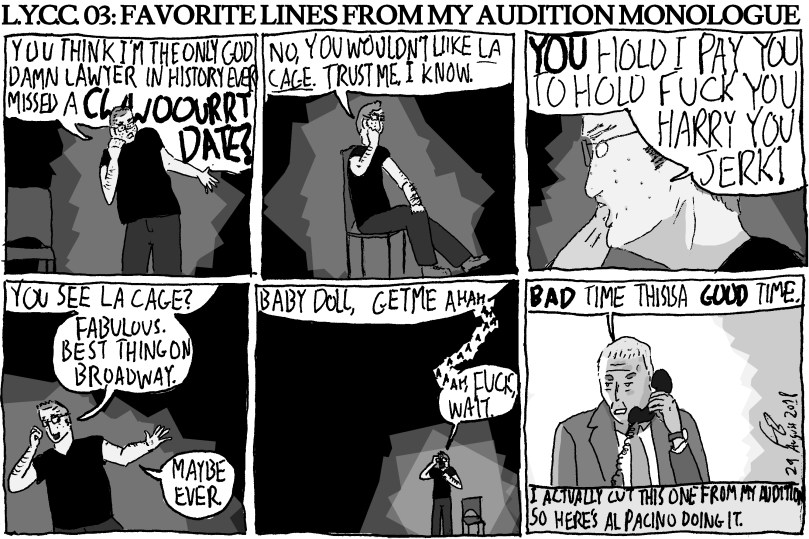
FRANCIS: You think I’m the only goddamn lawyer in history ever missed a court date?
FRANCIS: No you wouldn’t like La Cage. Trust me, I know.
FRANCIS: You hold I pay you to hold fuck you Harry you jerk.
FRANCIS: You see La Cage? Fabulous. Best thing on Broadway.
FRANCIS: Baby doll. Get me ahhahahahah, fuck, wait!
AL PACINO: Bad time this is a good time.
TEXT: I actually cut this one from my audition, so here’s Al Pacino doing it.
Want a more convenient way to read this comic? Want to monetarily support this comic and more things like it? Want to read some brand new, previously unpublished Francis Bass scribbles? Great! You can buy a downloadable, PDF version of L.Y.C.C. at Gumroad or Itch.io. In addition to all of L.Y.C.C., this book includes “Last Summer,” a shorter series of comics made over the summer following my graduation, as well as older proof-of-concept comics and a quick step-by-step description of my process for creating L.Y.C.C.
Transcript
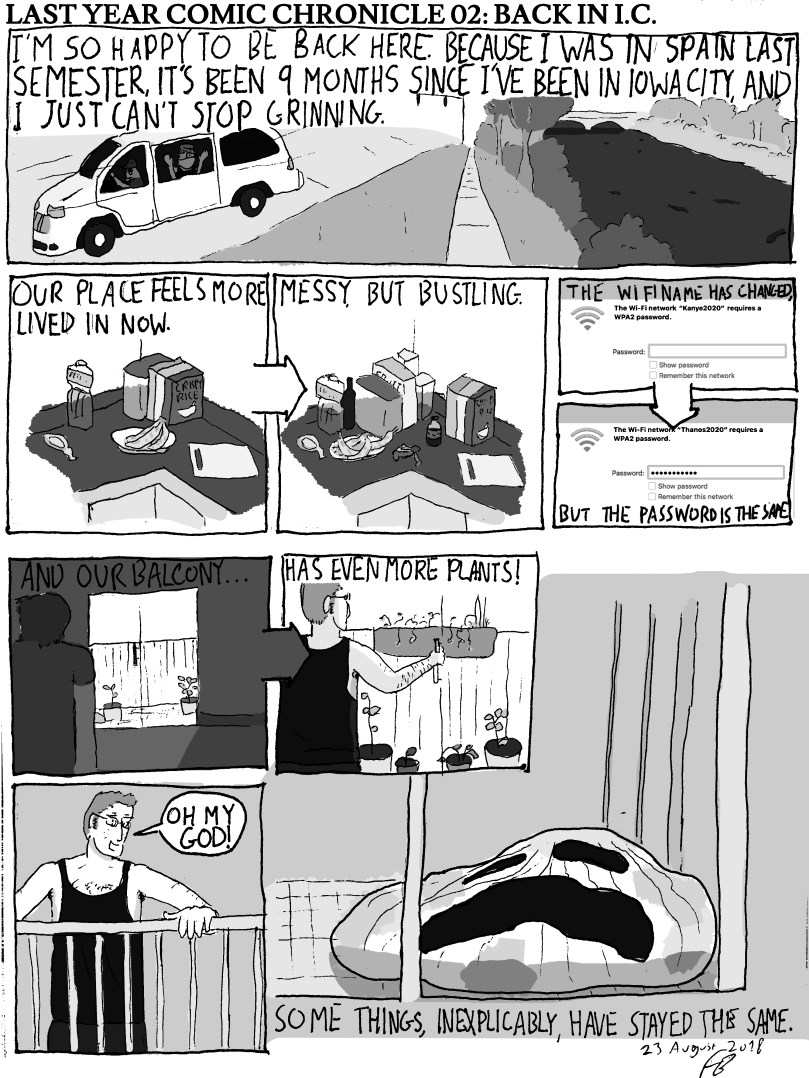
TEXT: I’m so happy to be back here. Because I was in Spain last Semester, it’s been 9 months since I’ve been in Iowa City, and I just can’t stop grinning.
Our place feels more lived in. Messy, but bustling.
The wifi name has changed, but the password is the same.
And our balcony… has even more plants!
FRANCIS: Oh my god!
TEXT: Some things, inexplicably, have stayed the same.
Want a more convenient way to read this comic? Want to monetarily support this comic and more things like it? Want to read some brand new, previously unpublished Francis Bass scribbles? Great! You can buy a downloadable, PDF version of L.Y.C.C. at Gumroad or Itch.io. In addition to all of L.Y.C.C., this book includes “Last Summer,” a shorter series of comics made over the summer following my graduation, as well as older proof-of-concept comics and a quick step-by-step description of my process for creating L.Y.C.C.
Transcript
FRANCIS: This is my last year of college, and I regret that I haven’t done much journalling during my college years (aside from my semester abroad.) So in the interest of documenting this era of my life, improving my drawing and comicking skills, and generating some scrumptious c o n t e n t, I’m going to put out a weekly autobio comic all throughout my senior year!
The comic will run from this week to May 17. It will post at least once each week, sometimes twice, depending on if I’m posting something else that week.
Most comics will be better than this one. Whatever. I’m still getting my bearings here.
Splendor and Misery by Clipping — So I’m late to the party on this, but better late than never, right? Splendor and Misery is a sci-fi concept album by experimental hip-hop group Clipping—already, what’s not to love? The album follows the lone survivor of a slave uprising aboard a spaceship, who commandeers the vessel and attempts to escape his pursuers.
What I love about this album is the way it blends ideas and styles. For a start, it’s fascinating to see how Clipping renders common sci-fi motifs musically, making them fresh and fascinating again. It’s not just an album that utilizes sci-fi jargon and aesthetics (though it does that as well), it’s an album that is clearly born from an understanding of the genre and its tradition. A great example of this is the track “All Black Everything,” which communicates the oppressive nothingness of space through it’s skeletal production and Daveed Diggs’s continuous, monotone refrain of “All black everything.” The album also blends different musical genres, mixing in negro-spiritual-inspired songs, blending past and future to create a gritty world that’s nevertheless full of emotion, and deeply human.
Sci-fi aside, the production on the album, by William Hutson and Jonathan Snipes, and Daveed Diggs’s rapping are just fantastic. The beats manage to suggest the environment, with beeps and clicks and staticky whines, while also effectively establishing different moods for each song. Diggs’s lyrics are great, punchy and complex, and his flow is phenomenal. Splendor and Misery really shows the range that this group has, from songs like “Air ‘Em Out,” a braggadocious gangster-rap-in-space type track, to “True Believer,” a song with a driving industrial beat, a spiritual-inspired chorus, and some wildly imagistic verses detailing a creation myth that offers some clues as to how these people have ended up enslaved.
The album is short, and has a lot to offer with each replay.
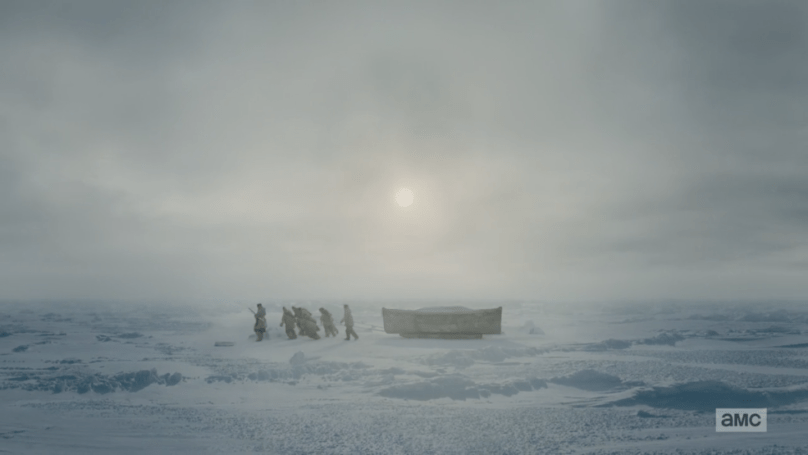
The Terror— This AMC series just wrapped up a few weeks ago and my god did it stick the landing. I love a good, one-season series, and The Terror does not disappoint (it may come back for a second season, though with a completely different story, American Horror Story-style.) The show, David Kajganich’s debut as a show-runner, is based off the Dan Simmons book of the same name, which tells a fictionalized account of the lost Arctic Expedition of Captain John Franklin. What little is known about the expedition’s fate after becoming trapped in the Arctic ice in 1846 is faithfully reproduced, and indeed everything that happens in the show could’ve plausibly happened in real life—except, that is, the strange, enormous bear (is it a bear?) which seems to dog the sailors wherever they go.
Este es el último puesto de esta serie de puestos sobre mis viajes, y trata de mi viaje a Portugal durante la Feria de Sevilla. Tal vez publicaré más secciones del diario en el futuro, o secciones de la parte en inglés (habrá una parte en inglés, mis amigos angloparlantes). Pero por ahora, este es el último. ¡Espero que les guste!
16 de abril, 13:39
Estoy en Seara Nova Cafetería en Faro con una galão, que es un café de espresso hecho con mucha leche. Es la semana de Feria en Sevilla, y no quería quedar allí toda la semana. Pensaba en viajar por el norte de España, a Galicia y el País Vasco, pero al fin decidí ir a Portugal, específicamente a Faro y Lisboa, porque quiero experimentar un viaje por un país en que no hablo la lengua predominante. Tengo un conocimiento ligero del portugués, y puedo leerlo más o menos pero hablar o incluso escucharlo es otra cosa. Cuando recibí mi café en este restaurante, le dije al barman “gracias” en vez de “obrigado,” y así debes entender mi nivel de competencia con este idioma.
Pero esto es lo que quería, un país aun más extranjero que España o Cataluña. Además, Portugal es cerca y barato.
17 de abril, 08:57
“Proximo” é o café em que escrivou. É uma cafeteria-snack bar (venga, eso es todo que puedo de Portugués) al lado de la estación de autobuses de Faro.
Ayer disfruté más las cosas que no había planificado que las que sí. Aunque me interesó la catedral de Faro con su retablo de multiples niveles, como un pastel de bodas dorado, y aunque me impresionaba el capillo de huesos de la Igreja do Carmo, me encantaba más el Jardim da Alameda João de Deus. Todos los jardines que he visto en España, o los parques, han tenido en común un carácter arreglado, con ángulos rectos y arbustos cuadrados. Aunque puedan ser bonitos, carecen de algo. Este jardín farense era diferente. Primero, tenía una variedad más amplia de especies, y los árboles exóticos se etiquetaban con su nombre científico. Segundo, el plano era más natural y orgánico, con curvas y descensos. No obstante, el aspecto más encantador del jardín era los pájaros. Había muchas palomas de tipos distintos, un grande pato blanco y muchos pavos reales.
La otra cosa que disfruté mucho, que por cierto no había planificado, era una caminata por las marismas. Después de visitar el jardín, todavía me quedaba molesto por no poder visitar la isla. De verdad, había querido ir por barco a la Ilha da Culatra, pero los barcos (esto es, los de transporte público) solo se operan en el verano, y solo me di cuenta de ese hecho hace dos días. Por eso la molestia, y por el hecho de que en Faro, un pueblo costal, tenías que pagar para visitar una playa, o incluso la Ria Formosa. Mierda, digo. Entonces, me decidí buscar la naturaleza por las afueras de la ciudad.
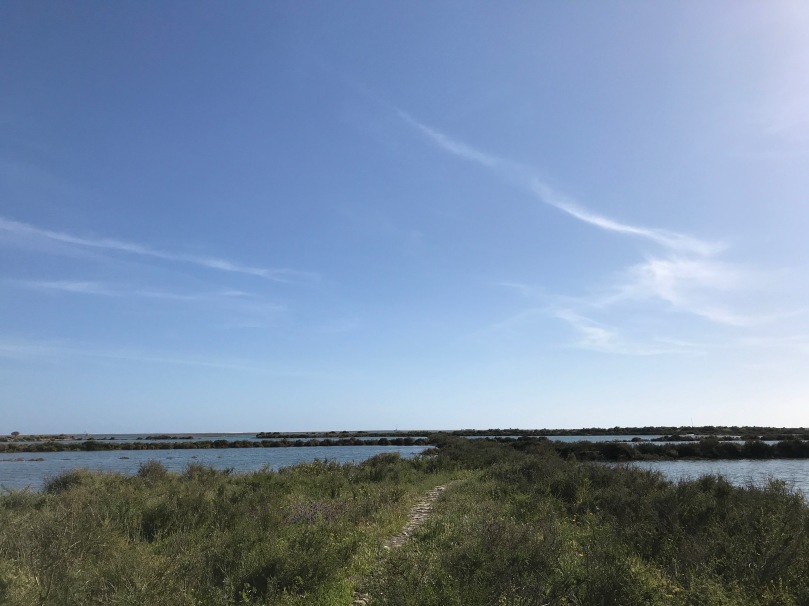
No lejos del jardín, llegué a una carretera de tierra que corría hasta una zona industrial. Aunque todo que rodeaba la área era propiedad privada, la calle no era así, y parecía que llegaría a las marismas. La seguí, crucé la ferroviaria y entré una zona de favelas y edificios industriales. Adelante de yo una docena metros o más, un hombre dio vuelta y caminó a una área de marismas, con largos pedazos de tierra estrechos que formaban un cuadrícula alargado en la laguna. En ese momento me di cuenta de que había caminos en esos líneas de arena y juncos.
Vista del centro de aquél cuadrícula, hacía el mar.
En este puesto, tercero en una serie de puestos basados en las entradas de mi diario de viaje, escribo del fin de mi viaje de Semana Santa en Extremadura.
1 de abril, 16:27
Ahora estoy de pie cerca de la Iglesia de Santa Marina esperando los pasos de La Resurrección, por los cuales se terminan las fiestas de Semana Santa en Sevilla.
Me ha pasado muchas veces ahora, pero siempre es un choque de grandeza y gracia acercar de una procesión, oír primero los tambores y luego los clarines, escuchar como el volumen va creciendo mientras pasas más cerca y de repente dar una vuelta y ver el enorme, demasiado grande para cualquier calle, paso que flota sobre la gente como un elefante de oro y flores.
Pues, eso experimenté dos veces en Villafranca de los Barros. La primera era cuando anduve desde la estación de autobuses hasta mi albergue; la cofradía de Nuestro Señor Jesús Cautivo y Nuestra Señora de las Angustias era a la mitad de su recorrido.
Nuestra Señora de las Angustias.
La segunda vez era cuando, después de no poder registrarme porque nadie estaba en el hostal, regresé a la calle para ver la procesión y en cuanto bajé allí estaban los nazarenos, y a la otra extremidad de la calle estaba el cristo. Es que mi hostal era justo al lado de la plaza en que se situaba la iglesia de la procesión, la Parroquia del Valle. A la plaza y las calles rodeaban niños y otros residentes, sobre todo alrededor de la iglesia. Era muy impresionante esa procesión con pasos humildes de madera y pintura. No hay que tener oro y hilo de plata y 4.000 nazarenos para ser impactante y grande una procesión, creo. La entrada en Villafranca de los Barros era un do mis favoritas de la Semana Santa, en parte por no haber habido tanta gente que no se podía mover. Todo el mundo tenía buena vista de la acción, y parecía una fiesta local, una fiesta de familiares y vecinos, en vez de la atracción turística que yo iba a ver en Sevilla.
Después de verla, subí al hostal, logré registrarme, y me dormí.
21:27
Escribo esta última entrada en mi ordenador, en mi habitación. Se ha terminado la Semana Santa ahora, y mañana las clases empiezan de vuelta. Tengo que hablar ya de Mérida.
Mérida también es como un museo grande al aire libre, pero de sitios romanos en vez de los restos medievales de Toledo. Además, Mérida, igual a Villafranca de los Barros, es mucho menos turístico que cualquier otra ciudad que visité durante mi viaje. Solo oí inglés allí una vez. Los turistas que vienen allí son españoles, o portugueses, pero no hay muchos de Alemania o Inglaterra. Eso disfruté mucho: una ciudad que no tenía que vestirse para ingleses o franceses, una España para españoles. Claro, hay lugares dentro de las ciudades grandes de España en que se encuentran pocos turistas, pero Mérida me parecía cien por ciento una ciudad ibérica. Eso no quiere decir que Madrid es menos español por ser turístico; claro, España gana mucho del turismo, entonces una ciudad turística es bastante español. Pero me alegría experimentar una parte de España distinto de la mayoría de los sitios a que había viajado.
Este segundo puesto de mi diario de viaje se ocupa de mi estancia en Madrid, y las excursiones que hice durante esos días a El Escorial y Toledo.
25 de marzo, 14:25
Estoy ya en Madrid sentado en una banca en el Paseo del Prado. El tiempo es buenísimo. No puedo registrarme en el hostal hasta las 15:00, entonces mientras espero contaré los sucesos del día hasta este momento.
Me dormía más o menos (o menos) en el autobús. No era cómodo, y cuando me bajé en el intercambiador de Avenida de América tenía que dormirme una hora más en una banca. Luego, empecé el paseo largo a la Puerta del Sol, en que tendría una cita para recibir un abono joven para el transporte público de Madrid. Por algún milagro, al comenzar caminar me di cuenta de que mis calcetines se habían secado. Aunque pesó mucho mi mochila, sin lluvia y sin calcetines mojados la caminata no fue horrible. Cuando llegué a la plaza de Sol, comí un sandwich y un yogur, y en poco tiempo fui a la oficina del intercambiador de Sol para comprar el abono. El proceso era muy sencillo, y después de quizás diez minutos se ha terminado.
Tener esa tarjeta en la mano me daba una sensación maravillosa de libertad. Como esa sensación romántica de tener una coche cuando eres adolescente, aunque nunca he tenido (ni querido) mi propio coche. En un instante, toda la región de Madrid —y una área fuera de esa zona que incluía Toledo y Guadalajara— era dentro de mi alcance. Cien por ciento alegre.
Puerta del Sol con falangistas.
26 de marzo, 11:28
Nunca he querido que este diario, ni este porción del diario, se convierta en lista. Hoy hice esto. Era divertido. Hacía mucho sol.Blah blah blah. Entonces, no diré todo lo que pasó ayer. No tengo nada para decir de ello. Basta decir que me disfruté, y ya. ¿Y Puigdemont se ha detenido? ¿Pienso? Será una Semana Santa intensa en Barcelona.
Pero basta de eso. Estoy en Toledo tomando café en Ñaca Ñaca, lo cual no me parece precisamente lo más auténtico de todas las cafeterías, pero no importa. Solo quería el café, y incluso los sitios turísticos o no auténticos no pueden arruinar un café con leche. (Pues, esto es, en España).
Ahora, durante toda mi estancia en España y todo este viaje de Semana Santa, he utilizado Google Maps. Lo que hago es descargar un mapa de cualquier ciudad cuando tengo conexión de wifi, y luego navegar por ella sin wifi, pero sí con la GPS (que funciona siempre) y el mapa descargado. Pues, esta mañana olvidé descargar un mapa de Toledo antes de venir aquí, cuando tenía wifi en el hostal. Así, tendré que navegar por el mapa físico de la ciudad y la ciudad en sí. Como he dicho hace unas semanas, muchas ciudades de España son mapas de sus mismas, con físicos puntos de referencia claros, esto es, edificios monumentales que orientan a la gente. Entonces, solo ahora veremos como me las arreglo en un día sin wifi.
He terminado el café. ¡Nos vamos!
27 de marzo, 16:31
Estoy en la tren de vuelta de El Escorial. No te preocupes, escribiré de Toledo (y ¡qué cantidad, las cosas que tengo para escribir de Toledo!), pero ahora quiero escribir un poquito de El Escorial.
Lo que me ha interesado más de este palacio es que representa todas las aficiones de la familia real, o, mejor dicho, los reyes españoles de los siglos XVI y XVII. Muchos monumentos muestran lo que la realeza, o la iglesia, quería imponer o evocar a la gente (“una iglesia tan grande que los que la vieren nos tomen por locos” es presuntamente cómo los que construían la catedral de Sevilla describían su proyecto). Pero El Escorial se construían para la familia real en sí. La Sala de las Batallas, una aula larga con murallas pintadas de conflictos militares entre España y otras potencias, es como un sistema de entretenimiento del siglo XVI. La Sala de Paseo es lo mismo, llena de mapas y pinturas del paisaje, me parece como el equivalente antiguo del documental de Netflix. Hay imágenes religiosos, claro, pero también se puede ver que la familia real disfrutaba los escenarios de acción y retratos de la naturaleza. No hemos cambiado, de verdad.Read More »
This post remains available for posterity’s sake, but a much revised and much expanded version of this translation is available completely for free! The revised version includes translated footnotes, a translated appendix, an expanded introduction, and a map of disputed territory and important locations. You can download a copy in the following formats: Docx — Epub — Mobi — PDF. Or, if you want to throw some money my way, you can set your price for it on Smashwords. And it’s in the public domain!
Bartolomé Mitre, as depicted on Argentina’s 2-peso note.
(1) As we have seen from Ferraz’s letter, on 5 September it was not yet thought that the emperor would take part in the siege of Uruguaiana. Tamandaré decided to go and kiss the hand of H.M. in the city of Alegrete (on 2 September), introducing him to General Flores and perhaps General Mitre. With the issue of commander-in-chief Mitre being in one of our provinces, the emperor of Brazil determined to take part in the military operations, especially since he found himself in that province, and not far off. Six days after Ferraz’s letter sent from Passo do Rosário, the emperor reached the encampment at Uruguaiana (11 September).
The question of the allied armies’ commander-in-chief was resolved by the 3rd article of the treaty of Alliance, through which, at the same time that it gave said command to General Mitre, the treaty established reciprocity in the event that military operations took place mainly in Brazilian or Uruguayan territory. However, Ferraz sent the following confidential notice to the governor of Rio Grande on 5 July: “General Osório will always act as chief commander of the army fighting the Paraguayans on the shores of the Plata and the Uruguay. The commander of arms, or anything else, of the forces of that province, in his rank as chief of reserve forces” (it’s best to repeat this to avoid confusion) “will lend to said chief general however much he can lend and however much the general can request, and if need be both forces will operate jointly within the province, or outside of it, if it is invaded; but in this case General Mitre, in accordance with the treaty of the Triple Alliance, will assume command of all the allied forces; and if as consequence of that province’s invasion the allied armies enter your jurisdiction, again General Mitre will exercise command of them.” This notice, taking into account the italicized words, should be interpreted in the following way, according to Ferraz: General Mitre could only exercise command by virtue of the aforementioned 3rd article, outside of our territory; but, the imperial government would waive its right to command in the event that Mitre was carrying out within our borders, having crossed them in pursuit of the enemy, the execution of a strategic plan. It’s clear that the government expected reciprocity in the event that this happened in Argentine territory, according to that article.
Brazil’s generous conduct is quite self-evident. Per the treaty of Alliance, the head of the Brazilian army, Osório, should have found himself under Mitre’s orders, except in the case of war in our territory or in Uruguay. If Mitre had a plan to beat the Paraguayan army, like, for example, the plan that brought to an end the fighting at Yatay, then passing the direction of operations from one general to another, as operations took place on this side and that of the Uruguay, would equate to sacrificing the principal interest of defeating the enemy to the secondary interest of satisfying a formality.Read More »
¡Me alegro decir que este es el primer puesto en español de este blog, pero el último no! Este semestre he estudiado en el extranjero en España y voy escribiendo un diario de viaje, lo cual formará parte de un proyecto escolar/memoria de que hablaré más en el porvenir. Por ahora, les presento cuatro puestos procedentes de ese diario. Su contenido tratará de dos viajes que hice este semestre, el primero durante Semana Santa y el segundo durante la Feria de Sevilla (15-21 abril). Escribía mucho durante esas vacaciones, demasiado para incluir en la versión final del proyecto; no obstante, estas entradas me parecen perfecto para este blog, y este blog, en que puedo incluir fotos, me parece un formato perfecto para estas entradas. Entonces, ustedes pueden considerar estas escrituras las escenas inéditas de mi memoria, o si quieran, las pueden leer como si fueran su propia obra. Me da igual, pero en todo caso espero que los disfruten.
Este primer puesto trata de mi estancia en Barcelona.
22 de marzo, 22:09
Estoy en el tren Renfe, en ruta al barrio Eixample de Barcelona, en que se ubica mi hostal. Estoy escribiendo estas palabras a mano, con un lápiz y un cuadernito. Todos mis entradas, desde ahora hasta el final del Jueves Santo, escribiré en este cuaderno, porque no he traído mi ordenador portátil. Pese demasiado, y estoy viajando ligero.
El plan del viaje es así:
Vuelo a Barcelona el jueves por la tarde. (Ya hecho. Vale).
El viernes irme a Montserrat.
El sábado andar por Barcelona, y a las 23:30 salir en autobús para Madrid.
Dormir en el autobús. (Con este truco espero ahorrar dinero por no pagar por una noche en un hostal).
(Ahora mismo el Renfe va entre Prat de Llobregat y Bellvitge.)
El domingo hacer cosas en Madrid. Tomar chocolate con churros en San Gines. Etcétera.
El lunes pasar el día en Toledo.
El martes, en El Escorial.
El miércoles hacer más cosas en Madrid y después salir para Villafranca de los Barros.
El jueves, irme a Mérida (solo duermo una noche en Villafranca para pasar el próximo día en Mérida, porque no hay hostales en esa ciudad, y el alojamiento más cerca está en Villafranca).
(Ahora mismo hemos partido de Bellvitge, y vamos para Barcelona Sants, en cual bajaré).
Y regresar a Sevilla el jueves por la noche.
22 de marzo, 10:41
Estoy en la tren del línea R5, con destino del Monistrol de Montserrat. Desde el Monistrol, iré por la cremallera al propio Montserrat. Pero bueno, ya debo hablar del vuelo la noche pasada.
Volé por la aerolínea Ryanair, lo que es conocido entre los estudiantes por tener los vuelos más baratos en Europa. La empresa cumple este hecho por restringir las maletas que se pueden traer, y por cargar dinero para las cosas que suelen ser gratuitas en la mayoría de los vuelos. Esto está en plena vista desde el momento en que se compran los billetes. Pero el otro truco solo va mostrándose poco a poco, y se revela por completo solo al partir el avión. Ese otro truco es la propaganda. Los ayudantes son, más o menos, adbots.
This post remains available for posterity’s sake, but a much revised and much expanded version of this translation is available completely for free! The revised version includes translated footnotes, a translated appendix, an expanded introduction, and a map of disputed territory and important locations. You can download a copy in the following formats: Docx — Epub — Mobi — PDF. Or, if you want to throw some money my way, you can set your price for it on Smashwords. And it’s in the public domain!
The Emperor’s presence in Rio Grande do Sul during the invasion, and concurrent with the allied troops’ arrival, was an act of great consequences—not only for the strengthening of Monarchist sentiments, especially in Rio Grande, but also for the strengthening of the alliance. The letters from Ferraz to Nabuco, written during the voyage, are noteworthy documents. Nabuco was Ferraz’s closest friend in the ministry, perhaps the only one to whom Ferraz could freely vent, without fear of political mistrust or memories of old disagreements. He shows himself extremely protective of his authority, clothing himself with the regalia that his position as ministerial delegate requires. What things he would’ve done, and how he would’ve had to reign everyone in, had the Emperor not been there!
Reaching Santa Catarina (1) on 13 July, Ferraz writes to Nabuco, “The minister has disappeared. The Emperor intrudes in even the most minor details, and everything revolves around him. He has at his disposal even the employees of my office, he gives orders through De Lamare (2), and through any other means. He is stubborn, but then he changes his mind. It is impossible for me to bear. There is no money here for the troops. Let us hope that Dias de Carvalho (3) does something, or takes some measure. I beg that you tell our colleague Silveira Lobo to order the authorities and subordinates in Rio Grande to obey my orders, and only my orders, or those of the governor of the province …”
On 16 July the Emperor unexpectedly arrives in Rio Grande; on the 18th Ferraz writes from that city: “Today, or better said, within two hours (eight thirty), we march to Porto-Alegre. Everything is going well. Enthusiasm has surpassed what was expected. The Emperor is satisfied and is doing well for the moment. The enemy’s plan is to stir up the Blancos … We have to be prepared for everything and we don’t even have cannons … Rest assured that these people think highly of me and are satisfied.”
On 21 July he complains from Porto-Alegre (4) about the state of the palace, and about the manner in which they were received, and on the 22nd he says:
Ângelo Moniz da Silva Ferraz, as depicted in Galeria dos Brasileiros Ilústres by Sébastien Auguste Sisson.
“They have put me in a jam. They wanted rich tack (5) of silver for the Emperor and the prince; they want for Cabral, Meirelles, and De Lamare also rich tack of three hundred to four hundred thousand réis (6) each, and all this at the Ministry of War’s expense. The demands are constant. They want horses for everyone, and even revolvers for the servants. The Emperor is fine, but he listens to these people despite the fact that he recognizes their (illegible). Caxias has comported himself discreetly and well. It’s been going around that he will be named chief general. Porto-Alegre’s appointment was done at the Emperor’s instruction, after hearing that Caxias and I were pleased with him, because this way everyone is content. Danger has silenced the partisan spirit to the point of seeming dead. ‘Good riddance,’ people tell me, ‘to arms and munitions. There is no money, our colleague who’s giving timely orders as fast as possible.’ The active troops are unpaid and unequipped.”Read More »
This post remains available for posterity’s sake, but a much revised and much expanded version of this translation is available completely for free! The revised version includes translated footnotes, a translated appendix, an expanded introduction, and a map of disputed territory and important locations. You can download a copy in the following formats: Docx — Epub — Mobi — PDF. Or, if you want to throw some money my way, you can set your price for it on Smashwords. And it’s in the public domain!
Meanwhile and almost simultaneously, in Rio de Janeiro, news of the naval battle at Riachuelo (1) and the invasion of Rio Grande do Sul was received. Moved by patriotic impulses, the Emperor resolved to go immediately to the front, not without some resistance from the ministry. This happy resolution, which played out so favorably, seemed to be supported by only one minister, Silveira Lobo, to whom, for this, the Emperor would show himself forever grateful (i).
Nabuco thought that the Emperor in the South would only raise the spirits of Rio Grande province, while in the capital he would inspire the entire country to war. To the emperor, as we will soon see, Nabuco did not betray his feelings. It was necessary to yield before the strict expression of the emperor’s will. With his departure, the issue of adjourning the Chambers remained won, because absent the sovereign, the ministry’s situation before the Chambers was difficult, and it even could have become a case of governmental paralysis, arising at the same time as the invasion of Brazilian territory.
Olinda writes to Nabuco on 4 July: “I receive now a letter from the Emperor, who tells me that to announce the journey to the Chambers and read them the adjournment decree, it is necessary that we be in São Cristóvão at nine in the morning, with the goal of taking precise measures. As such, Y.E., draft the speech to discuss it in today’s conference.”
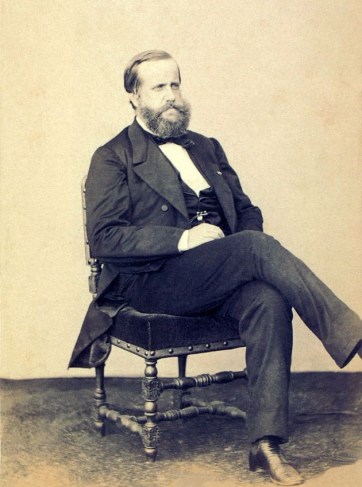
Emperor Dom Pedro II, 1865. Photo by Joaquim José Insley Pacheco.
Nabuco drew up the following draft: “I come to announce in the Senate that H.I.M. has resolved to depart immediately for Rio Grande do Sul, with the object of, with his presence, his prestige, and his example, invigorating the defense of that heroic province in case of foreign invasion. The Emperor feels—and he feels with enthusiasm—that such is his duty as perpetual defender of Brazil, and so firm is H.I.M.’s resolution that the ministry has ended up, by yielding to it, assuming the resulting responsibility. How to resist that desire of H.I.M. when every Brazilian vies for the glory of defending and saving their country, insulted and invaded by foreigners? How to leave him alone, when he should be surrounded by everyone? There is nothing to do but admire and show gratitude to this new proof of the Emperor’s refined patriotism; there is nothing to do but ask God Almighty to protect him and return him healthy and safe, and to add to the Emperor’s titles, with which he reigns over Brazilians, that of glory.”
The following letter accompanied the speech: “I am sending the draft of the speech. It doesn’t seem fit to me to announce the closure, but unwittingly we plant this issue in the Chambers, arousing grave difficulties for us. Tomorrow the decree, which we can present him when advisable, will be signed. Who knows if it will be necessary to do so tomorrow? Y.E. knows that the deliberative assemblies want to make themselves necessary, and be present in grave situations, but experience proves that in such situations they are a nuisance. The adjournment should not be debated. Besides, as the speech is only one, Y.E. should deliver it first in the Senate and then in the Chamber—I find it inelegant that Y.E. and I should say and repeat the same words. See you tonight.”
The joint legislative bodies remained closed from 8 July until 4 March of the following year. A law of the same date sets out how best to handle public business, powers of the ministry, and reciprocal succession of the ministers in absence of the head of State, and on 10 July the Emperor embarks for Rio Grande. With him goes Ferraz, Minister of War, and his accompaniment features the Duke Augusto de Sajonia, son-in-law of H.M., and the Marquis of Caxias, his aide-de-camp.
Footnotes
i. It is known that, to the objections made by the Council, the emperor responded: “If I am stopped from going as emperor, no one can stop me from abdicating and marching as a voluntario da patria.” Baron of Rio Branco, notes to Schneider, I, 218.
Translator’s Notes
1. A major naval battle near the city of Corrientes, on the Paraná river. Brazil won a decisive victory, and effectively secured the Río de la Plata river system up to Humaitá, cutting off the Paraguayan forces that were still in Rio Grande do Sul from any supplies or reinforcements.
This post remains available for posterity’s sake, but a much revised and much expanded version of this translation is available completely for free! The revised version includes translated footnotes, a translated appendix, an expanded introduction, and a map of disputed territory and important locations. You can download a copy in the following formats: Docx — Epub — Mobi — PDF. Or, if you want to throw some money my way, you can set your price for it on Smashwords. And it’s in the public domain!
Lithograph of the Palácio do Conde dos Arcos, published in Robert Walsh’s Notices of Brazil in 1828 and 1829.
Furtado, resentful of Saraiva, reluctantly supports the ministry and gets his friends to contain themselves. “I will give the government,” he says in the Senate, of which he was then a member, in July, “the means of sustaining the foreign war in which the empire finds itself endeavored, and my support, until events come to disavow the words of your excellencies … While events are forthcoming, I will keep a look out to see if the political swallows migrate (1). I have nowhere to which to migrate.”
The rift, the separation between Liberals and Conservatives that they’d sealed in 1862, was evident. The Liberals were getting along better with the pure Conservatives (2), with which they united against the Olinda government, than they did with their allies of yesterday. The more this breakdown of the party affected Nabuco, the further he found himself from wanting to contribute to it; nor did it suit him to aid the opposition in eliminating the Conservative element from the party, of which element he himself was a part.
Considering both halves separately, he still preferred that which represented the doctrine of Paraná, Conciliation, which represented the earliest Liberal tradition; recognizing, however, the insufficiency of that element as a third party, he preferred the government of the Conservatives, who formed an essential party. With the fusion of Liberals and moderates to form the other party not being possible, the Conservative party should have governed, the Conservative party which, since Itaboraí surrendered power to Paraná in 1853, had not returned to power except with the reconstructed Abaeté ministry in 1859, and with the Caxias-Paranhos ministry, also reconstructed, and which even in these two cases of purification had lacked Conservative leaders.
The truth is that the Nabuco’s spirit was objective and practical enough to let itself be dominated, especially during grand crises, by traditions without tangibility, by divisions without distinction, by sides with names that had only personal scope, and by relationships that were purely negative. He considered administration to be a practical thing, that required skill, preparation, the height of vision, and a sense of responsibility; for him there was not but one mode of administration, as in the navigation of waters there is not but one course to follow. Ferraz being at the head of the war chest seemed well to Nabuco, as Ferraz was an energetic, expeditious man, with his own resources and audacious initiatives; Nabuco did not have to enter into inquiries about if in 1860 he had fought with all his might in favor of the Conservative party; he accepted Ferraz’s word of honor of not being already joined with that group, without putting forth clear motives or intentions, nor entering into the examination of the past.
The Chamber’s adjournment freed the government from political minutiae; the recess would be long and would provide time for work. Nabuco would make an effort, would work tirelessly all through this period (almost a year) and then when the Chamber reconvened, if political passions showed themselves to be unyielding, rather than ingratiating himself with one of the sides, he would abandon power. Instead of volunteering to destroy the edifice he had raised, he would leave the work of demolishing it to the architects of ruins, precisely because he was sure that the common enemy would not delay in making a sudden invasion into the house divided, interrupting the work of the internal collapse.Read More »
This post remains available for posterity’s sake, but a much revised and much expanded version of this translation is available completely for free! The revised version includes translated footnotes, a translated appendix, an expanded introduction, and a map of disputed territory and important locations. You can download a copy in the following formats: Docx — Epub — Mobi — PDF. Or, if you want to throw some money my way, you can set your price for it on Smashwords. And it’s in the public domain!
The speech Nabuco gave in the Chamber on 26 May 1865 was, for that divided assembly, like a shining ray of patriotic eloquence. In the middle of the partisan disagreements, which only tended to worsen and become more irreconcilable, no one expected that appeal to harmony, that invitation to a political armistice in the name of the invaded country. In that moment, his speech had everyone’s assent. Nabuco’s presence beside Olinda was in itself only an agenda of political truces, since one could not forget the sacrifice that he made—his little fondness for power, and his neutrality in personal rivalries. A year later historians will come to do justice to Nabuco’s intentions to save the government and avoid internal struggle. From the first day, his attitude was such that, upon the ministry’s fall, he would continue to be the organizer preferred by the political spirits of the majority and the minority. The session had been very busy. “I have seen you shine today in the Chamber of Deputies,” the humorist Abaeté writes to him, “and I would have envied you if the feeling of friendship did not prevail over that of envy. There is nothing like being minister of the King!”
The speech was short, as fit an appeal to national sentiment, but, precisely because of this, it was vibrant. After having explained the reasons he had for not wanting to take on the task of forming a cabinet, he declares the reasons that moved him to accept his role as justice:
José Tomás Nabuco as depicted in Galeria dos Brasileiros Ilústres by Sébastien Auguste Sisson.
“My noble friend senhor Minister of the Navy has already explained the reason for my entry into the current ministry. It was a sacrifice that patriotism imposed on us all. You know the circumstances in which the country found itself: the crisis was becoming prolonged; public anxiety instantly increased; each day wasted harmed the great concern by which everyone was preoccupied, that is to say, the dream of returning our national honor and dignity. There does not exist any contradiction in my behavior, given the circumstances that suddenly arose, and besides, there is a great difference between organizing such a cabinet—being its brain—and forming a part of it. What’s more, this ministry’s agenda has been reduced to the war, not wanting to alter the political status quo. The noble deputy of Minas province (i), explaining the reasons that he has for not putting confidence in the current ministry, examined some of its members, attending only to the Liberal element, but upon doing so forgot the principle that serves as the basis of the current government. In effect, so that the noble deputy may deny the ministry his trust for such a reason, he should begin by proving that the Progressive Party, under whose government this Chamber was elected, is dissolved.”
Finally, he invoked with the solemnity of his convictions, words, and gestures, the irresistible motivation of the country’s defense, winning over the Chamber and making it forget its divisions:
“It is evident, senhores, that the same thinking that stopped me from accepting the charge to form a ministry, has brought me to enter into this one; that is, the desire to not alter the status quo during a war. Nothing is less timely than exciting political passions in these moments in which we need the concurrence of everyone to save the country, which has been invaded and bloodied by foreigners. This is not a good opportunity to divide the Chamber, making it powerless to do good and making the life of any ministry impossible.
“I believe, senhores, that with the government limited to this agenda of making war without altering the status quo of our political system, it can’t help but deserve the trust and support of this Chamber and of the whole country.
“I could say more, senhores, but I conclude by making these vows: God would not wish that the country, swayed by political passions, come to be powerless against the foreigners that have insulted our flag; God would not wish that history deplore the fluke of a young nation full of resources and life, but disgraced by its own failings … Let us take on the responsibility of the war and leave the settling of scores for after the victory.”Read More »









 Francis Bass