
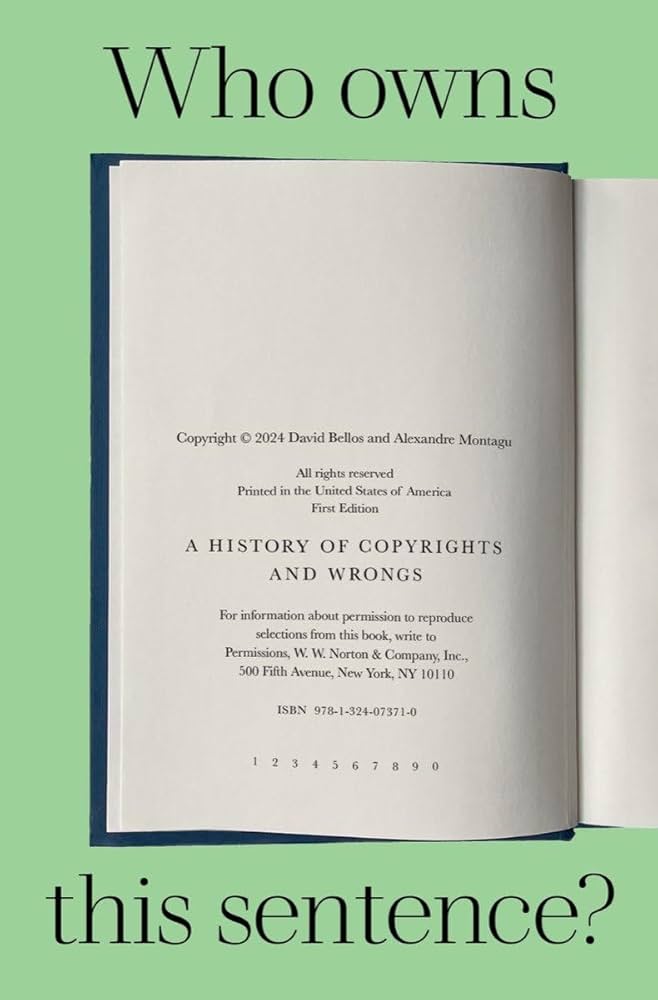
Happy Public Domain Day!!!!! This year, in addition to ceding one of my works to the public domain (read more about that here), I’m reviewing this excellent 2024 book by David Bellos and Alexandre Montagu. Years ago I read Bellos’s book on translation and interpretation, Is That a Fish in Your Ear?, and really loved it (you can read my review of that book here.) So when I saw that he’d co-authored a book about the history of copyright, I was all over it.
Unlike Is That a Fish in Your Ear?, where almost every chapter is like a stand-alone essay, Who Owns This Sentence? is a fairly chronological history of copyright. There are occasional diversions and cul-de-sacs, but you really want to read the book in order. Bellos and Montagu trace copyright’s origins to 15th-century Venice, when the city granted Arabic and Turkish tradesmen monopolies on various products to entice them to come set up shop. From this practice came patents, and from patents, copyright. Copyright has changed a lot over the centuries—from a patchwork of different laws in different countries to a nearly monolithic global regime, from protection of printed words to protection of printed anything, to protection of digital properties, sculptures, even architecture in some countries—and this book takes you through each of those transformations.
Fortunately, it’s not presented like an even-handed, both-sides-have-a-point, isn’t-this-so-darned-interesting?, [insert NPR show here]-style account. The authors are clearly dissatisfied with the current state of copyright law, and they make clear, committed claims about who benefits from it (corporations) and who is hurt by it (artists, the reading/viewing/listening public). They don’t ultimately present an argument for what copyright law should be—that’s not really within the scope of the book—but they are unambiguous in their distaste for its present state, and their dismay at the various turns which brought it there.
The prose is highly accessible—I think Bellos can get credit for that—while still being fairly rigorous. There were a few times where the authors seem to overstate their case (usually when trying to bring a chapter to a declarative, dramatic close), and one outright error that I noticed*, but overall they’ve done admirably bringing something as stuffy as copyright law into popular non-fiction, without simplifying it into a low-resolution mess. It’d make a great introduction for someone who knows nothing about copyright law, and great further education for someone who knows a lot about it—like me! I have a reasonably deep knowledge of modern US copyright law, but this book helped me place the system I know so intimately into the bigger picture—both chronologically and geographically.
For instance, I had no idea how much better copyright law is in the US than it is in many other countries. The repugnant life of author + 50 term (see my first Public Domain Day post if you need to brush up on what I’m talking about here), which we in the US established in the 1970s, had been standard throughout Europe for decades before. It’s only in the late 20th century that the US began to set the pace for international copyright law. As Bellos and Montagu put it, “A laggard in copyright protection for two hundred years and a reluctant participant in cross-border regulation for almost as long, the U.S. woke up fifty years ago to the reality of soft power and the income it could generate – and has succeeded since then in imposing its newly perfected rent-creation scheme on the rest of the world.” (Chapter 31)
The US has also, mercifully, never recognized “moral rights”—a suite of perpetual, heritable rights which, among other things, can be used to deny publications which impugn the integrity of the original work, even if it’s in the public domain. What constitutes a violation of a work’s integrity? Well, that’s up to the current rights-holder, which would be an heir. Bellos and Montagu give the example of the 1954 movie musical Carmen Jones, adapted from George Bizet’s 1875 opera Carmen. The film was banned in France for decades at the request of Bizet’s heir Maxime Real del Sarte, on the grounds that this adaptation violated the integrity of the original (by casting black people in it.) Maxime Real del Sarte, by the way, was a fucking collaborationist. Just a reminder: estates suck, heirs suck, you cannot convince me that any blood or legal relation should ever have claim on the status of a work of art after its creator has died. God save us from widows and orphans.
Anyway, as I was saying, the US stays winning! cause we don’t recognize moral rights, nor do we grant copyright to “useful objects” like buildings or furniture—in other countries, architecture and fashion designs can be copyrighted, and thus you might get taken to court if you publish a photo with an I.M. Pei structure in the background.
Whether you’re a neophyte or a copyright dork like me, the great value of this book is how it showcases a broad range of alternatives—different forms that copyright has taken, different customs practiced, recognized, debated. The book never dives deep into any one particular law or time period, but it trades depth in any one area for a breadth and diversity of scope. Aside from the general criticism of modern copyright law, this is the book’s central thesis—copyright law is arbitrary, not inevitable. In fact, the final chapter, “What If … ?”, is a series of thought experiments, speculating on what would’ve happened if pivotal moments in copyright’s history had turned our differently. The laws we have now are not ideal forms arrived at by careful, diligent technocrats—they are the result of political choices, court cases, sometimes total happenstances. Copyright has taken many forms, and it can take new forms again! Some concepts I found really interesting throughout the book were the idea of the “paying public domain” (a proposed system of compulsory licensing), and the Soviet system where authors and artists had no ownership of what they created, but would be rewarded by the state (Bellos and Montagu draw an insightful parallel to the way many corporations now treat the inventions of their employees, which are owned by the company, but may earn the inventor a promotion.)
One area I found lacking was in the discussion of copyright law (or analogous laws/institutions/customs) outside of Europe and the Americas. Our current international copyright regime derives from the European laws and treaties of the 18th and 19th century, so it makes sense why the book, in telling the story of how we got here, really only dedicates a single chapter to Japan and China—but this is also a book about paths not taken, so it would’ve been nice to read more about non-European conceptions of intellectual property.
All in all, Who Owns This Sentence? is a marvelous book. Back in 2021, in my “Plea for Authors to Consider the Commons,” I stated that I don’t want authors to share my opinions on copyright, I just want them to have any opinion. I feel that this book is written in that same spirit. Bellos and Montagu want not just creators, but everyone, to have some opinions about copyright. Copyright regulates the news we read, the social media we use, the entertainment we consume, the traffic of information and art between languages. “In earlier times, changes to copyright were made amidst loud and eloquent public debates in which the great minds of the age took part. In England, where the whole story began in the seventeenth century, John Locke, Daniel Defoe, and Alexander Pope, and later on William Wordsworth, Charles Dickens and Thomas Macaulay, were all involved in the making of copyright. … But in the last fifty years, copyright has spread over the globe without noticeable intervention from philosophers or poets, and with almost no public debate.” (Chapter 1) This book gives you the knowledge to understand these issues, and the provocation to begin forming opinions about them. Now let’s have some loud and eloquent public debate!

*In Chapter 31, “The U.S. Copyright Act of 1976,” they state that the US copyright law of 1998 retroactively placed certain works which had come into the public domain back under copyright by extending their term to life of author + 70 years. In fact, the law only applied life of author + 70 to works created after 1978, while most works made before 1978 had a flat renewal term of 95 years (increased from the 75 years granted by the 1976 act.) Terms were retroactively extended, but nothing which had entered public domain went back under copyright. Bellos and Montagu were likely confused because this is exactly what the 1996 British counterpart to the US law did. Which, hey, until looking into this to make sure I wasn’t getting something wrong, I didn’t know the UK law had worked like that. Copyright law can be implacably simple at times, and utterly counterintuitive at others, so if this is the only mistake in the book, I think that’s acceptable.

