
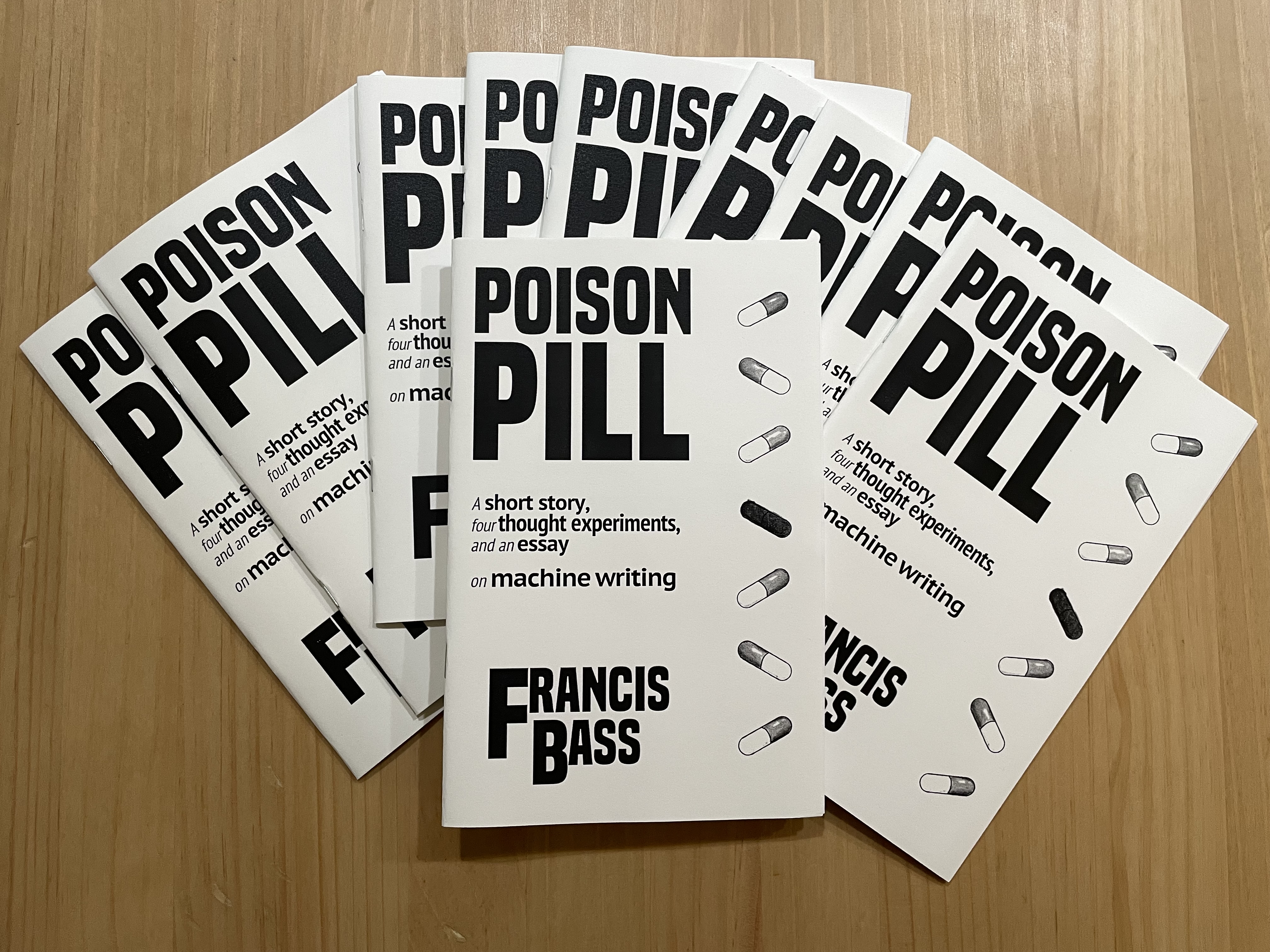
This is the title piece of my new zine Poison Pill! The zine collects three pieces, of varying levels of fictionality, on machine writing. I plan to eventually publish them all online, free to read, but if you don’t want to wait or don’t want to read on a screen, you can order the zine now on my etsy store! You can also pick up a copy in-person at the Philly Zine Fest, December 12th (more details in this post)!
POISON PILL
The Forgotten Literary Movement
of the Early Post-Mechanical
Lately, when I am gathered with friends at a fry house or some opened block, after we’ve tired of political gossip and before we’ve arrived at scholastic tirades, we will come to discussing literature, and puzzle over the question: what will the machines write now, now that they are ingesting the very first popular novels of their primitive ancestors?
The occasion for this question is the 100th anniversary of landmark mechanical novels like Flirt Bite Go and Ephraim. Although machine writers have highly sophisticated digestive systems, it is generally understood that they ingest the popular works of 100 years ago. What will machines write, now that they are inspired by machines?
This question bores me. Only a month after Ephraim’s centennial, the topic has been utterly exhausted[1]. What interests me more is how these mechanical writers will handle the short-lived but extremely energetic and prolific movement which human writers of a hundred years ago undertook—poison pill literature.
Today, poison pill is remembered, if at all, for one of two books. Either Poison Pill itself, or Nailbiter, a very attenuated specimen published towards the tail end of the genre, and the only enduring classic to come from it.
Most who have read Nailbiter are utterly unfamiliar with the movement it came from, and appreciate the book as a particularly harrowing tale of psychocomedy. For pillgulps (the term for aficionados of the genre, an eccentric and obsessive set amongst which I count myself), Nailbiter is regarded as a competent novel, albeit tame and incurious.
Few have read Poison Pill, but many have heard of it. It is popularly understood as a work of extreme obscenity and provocation, a defiantly repulsive novel not dissimilar from the works of Michael Tutuola. This is a slight misconception. Although this was an element of later poison pill works, it was not the intent of Marissa Robles Delmar. Before writing Poison Pill, she was a highly successful writer of doorstopper historical romances. Her sex scenes were notable for their focus on queer couples or groups, but were otherwise unremarkable—no thumbtacks or piano wire were ever involved. She had no interest in the grotesque, the transgressive, the cruel. When she wrote Poison Pill, she did so as a political act, not an aesthetic one—in fact, she did not even call it a novel or a book, she referred to it as a sabot[2].
This political dimension is what drove the extreme popularity of the genre at the time, and what still captivates pillgulps today. To understand poison pill literature, one cannot just read Poison Pill or Kill Kill Kill or whatever else—one must first understand Delmar v. PRSSM.

Throughout the 2040s, publishers were beginning to develop and license mechanical writers, but were cautious in how they trained them. It was still an open question, legally, as to whether or not writers were owed compensation when their material was ingested by one of these machines. So the diets of early mechanical writers consisted of public domain works, anonymous contemporary works, vast cheap corpuses of social media posts, and the works of a select few contracted authors or estates. Ephraim was published in this time, and as anyone who has bothered to read it knows, its virtue is its novelty, not its excellence.
This state of affairs was completely upset when it was revealed that Penguin 33, author of Flirt Bite Go and Ruby Red, had unknowingly ingested the works of several human authors. In 2044, PRSSM had acquired the small publisher Cataphract, and merged Cataphract’s house machine writer into Penguin 33—not knowing, as no one did at the time, that Cataphract’s machine had been secretly ingesting the catalogues of rival independent presses.
Rather than settle out of court, PRSSM fought the case, appealing it all the way to the Supreme Court, which ruled in 2047 that not only was this secondhand ingestion of human works legal, but so too was machine ingestion of any human work, with no requirement for consent, compensation, or even credit.
Scores of authors responded with impassioned essays, satirical short stories, fiery manifestoes—but a few mounted a real counterattack and formed the International Writers Union. Marissa Robles Delmar was the most prominent member of this new union, and responsible for a good deal of the union’s recruitment and fundraising. Among other things, the IWU sought a standard contract which would guarantee that the writer have final say over whether their work was ingested, and would receive compensation if it was. Such a contract would only be binding with the publisher in question, so other publishing houses would still be free to ingest the work of their competitors—but at this point, the US publishing industry was effectively reduced to a single major publisher (PRSSM) and a scattering of smaller presses.
For almost a year, the IWU maintained their strike. Members terminated contracts for books yet to be published, and refused to submit anything else. With rare exceptions, they refused to self-publish anything either, knowing it would be gobbled up by the machines. The literary scholar Agnes Clairfontaine estimated that in 2048 the IWU had taken hold of 30% of PRSSM’s stable of writers. Of their top 100 bestselling authors, 60 joined the IWU. A few upmarket slipstream imprints—Mercator, Project Madis, and MSG x CBD—were 100% unionized.
In 2049, though, a federal district court ordered the IWU to disband for violating antitrust laws[3]. They complied, dissolving the union and dispersing the treasury evenly among members. Although they could no longer collectively raise funds or demand their contract, they could informally maintain the strike, and hope that the labor caucus would make gains in the 2050 US elections. Of course, the labor caucus was still in its infancy, and in 2050 the hopes of the former IWU members and millions of other gig workers were dashed.
Most former members resumed contracts with PRSSM, though a sizable number—including most of the bestsellers—began self-publishing. Their books would still be ingested by the machines, but at least they’d retain the standard copyrights of the original work.
Marissa Robles Delmar was noticeably silent during this time. Later, in her memoir Why We Write, she said,
The collapse of the IWU left me profoundly depressed for a full year. My wife would find me sitting on the couch with a book in hand, staring at the same page for an hour. The sweet pleasure of creation was robbed of me, because as soon as an idea would flower in my mind, I’d imagine it fed through one of those LLM hacks. I couldn’t pursue my whims and fancies without thinking of the cool, smug executives who would profit from my work, even if I self-published it.
But at last, “I had to write, my every limb and digit craved it, and I began to think, Could I write something the machines could not make sense of?” She pondered various experimental, avant-garde, or just out-of-fashion approaches she could take, but remembered that every genre which, at its outset, had been revolutionary, was ultimately co-opted and rendered profitable. So instead, she thought about writing something which would not just be unapproachable, but outright fatal.
I got excited. Instead of imagining a human reader delighted by what I wrote, I imagined a machine writer choking on it. I imagined insurrectos pumping bleach into the gas tanks of bulldozers. I imagined mischievous 20th-century students feeding lace cards into IBM computers. I imagined 18th-century textile workers throwing wooden shoes into the looms. Whatever I wrote, I knew the machines would eat it, so I would feed them poison.
On February 5th, 2051, Delmar published Poison Pill; A sabot.
As far as the genre goes, Poison Pill is rudimentary. It consists of a string of long, graphically detailed sex scenes which invariably end in injury, dismemberment, or death. The plot is intentionally jumbled, if there is one at all. The prose is a concatenation of sensory details and imagistic similes.
It was an instant sensation. With only rare interruptions, it held the top of the New York Times bestseller list for a year, and remained in the top ten for another year after that. Reading the terrible, cruel, repulsive book was a prerequisite for accession to literary discourse. It was an entry ticket to the endless carousel of arguments the novel and its offspring spawned. Millions bought the book and never read it, solely to support Delmar and aid in the sabotage.
As I’ve said, mechanical writers of the mid-21st century had rather simple digestive systems. They had a core corpus which they would always draw from (following Delmar v. PRSSM, this corpus would typically be composed of the publisher’s catalogue of the past decade or two, with some other selected works thrown in.) These corpuses were the most carefully curated, and texts could readily be added, removed, or weighted differently. In addition, the machines had a constant intake of new works which was automatic, and algorithmically weighted based on sales.
There were two methods of digestion for the automatic intake: cache digestion and flash digestion. In cache digestion, the machine would read, for example, the top 100 works of the day, weighted based on sales. It would save the texts into a cache and assign them a certain weight relative to its core texts. The next day, it would read the top 100 works of the day, load them into the cache, and slightly downgrade the weight of the previous day’s texts. It would continue in this way so that a cache of every day’s works for a week, or a month, or even a year, would steadily pass through it, with most recent works always weighted highest.
Cache digestion was expensive, particularly during the computing crunch of the 40s and 50s, so most caches were only a month long. Smaller publishers, or imprints with less funding, used flash digestion. In flash digestion, the machine would read the top 100 novels of the day and immediately imprint them onto its psyche.
When an editor queried a machine with cache digestion to write a novel, that machine would draw inspiration from its core texts, then from its cache, generating a temporary psyche inspired by the current inputs.
When an editor queried a machine with flash digestion, the psyche was already formed.
We don’t know what Poison Pill’s immediate effect on machine writers was, but based on these models, we can guess. For cache digestion writers, it would’ve caused a few minutes of wasted time for the editors to manually remove the novel from the day’s cache, and blacklist it from future consumption. A half hour at most.
For flash digestion writers, the novel lived up to its name. These machines had to be rebooted from backups which were weeks or even months out of date, depending on the publisher’s diligence. It’s speculated that Poison Pill killed E.E. Maxx, a machine writer owned by Lockjaw, whose last book appeared three weeks after Poison Pill (though it had likely been written a few months before.)
Just two days after Poison Pill was published, on February 7th, James Mignard published Sugar, a novel consisting of twenty-seven curse words and slurs arranged in random order for four hundred pages. The day after that, several other authors followed suit. These books were nowhere near as popular or talked about as Poison Pill, but they were equally effective as sabots. The authors priced them low so that readers could buy them in large quantities, weighting them high in the machines’ diets. These books were called “sugar” books, and later on “sugar pills.” They were the easiest kind of poison pill to produce, and rather effective for this reason. It was a simple task for editors to blacklist Poison Pill, but much harder to blacklist the 500 sugar pills by over 200 authors which appeared on February 10th.
The initial solution was to blacklist all self-published works, to restrict the machines’ diets to only books from traditional publishers.
For this reason, Delmar founded Poison Pill Publishing, and the name for the genre was forever solidified.
I should note, now, that poison pill literature did not disrupt the entire industry. The authors who were fully committed to it—that is, who published nothing but sabots between 2051 and 2058—were a small subset of the final holdouts from the IWU strike. As such, non-fiction was entirely unaffected, and genre fiction was only minorly affected. Most affected were the machine writers of litfic, upmarket sci-fi, new fantasy, slipstream, gothic, and hyperwave. These genres were most affected because they had lost most of their human writers to the strike, and because their readers were most desirous of something innovative. Machine writers in other genres could completely close their intake of new works, only taking inspiration from things written before February 5th, 2051, and their readers wouldn’t notice. But the entire genre of hyperwave had only really existed for a few years prior to Poison Pill, so a machine writer trained only on that small, formative selection of works would read as painfully outdated.
The writers of poison pill books had no hope of grinding the whole industry to a halt, as they’d once desired to do with the IWU, but they could still fight it out at the cutting edge of fiction, and this was their principal aim.
With a proliferation of nominally distinct publishing houses putting out poison pill books, some editors blacklisted all publishers except those owned by PRSSM. For about a year, this was the norm. Editors could still manually whitelist specific best-selling books published by independent houses, or by the authors themselves, but most writing published outside of PRSSM, poison or not, was spared ingestion by their machines.
This changed with the publication of A Woman Plans and Executes the Dismemberment of Her Infant Son by Sarah Stutzman. Stutzman, the most popular crime fiction writer of her generation, had not written a book in over a decade when she submitted the manuscript for A Woman Plans to Whitlock Press, an imprint of a subsidiary of a subsidiary of the 2H division of PRSSM. It was clear to the editors at Whitlock that this was a poison pill. It was also clear to them that it would be a massive bestseller. Whitlock was a small imprint—neither they nor their immediate owning publisher carried a mechanical writer. So publishing a poison pill would bring tremendous profits for them with no downside.
A few days after A Woman Plans was published, the owning publisher’s owning publisher announced that Whitlock Press would be liquidated. Within hours of the announcement, the managing editor of the 2H division of PRSSM reversed the decision.
Over the next couple weeks, PRSSM started acquiring poison pill novels. The company was too large, the chains of command too tangled, to effectively ban every sub-sub-subdivision and imprint from acquiring poison pill novels. So now the last reservoir of untainted texts was poisoned, and each machine writer required a full-time dietician to maintain its health.
All attempts to automate this were thwarted. Poison pill literature diverged into various subgenres to combat every type of algorithmic culling that could be developed.
Algorithms which would discard texts with excessive sex and violence were thwarted by “apotheosis” works like A Book and the Blood of Honey and Silver series—perfectly tame as far as their content, but drowning in cliché.
Other writers targeted specific genres by writing “antithesis” novels, but dressing them with all the metadata to suggest they were of the targeted genre. These were subtler in their effects on the machines, and many editors failed to catch them[4].
“Cryptographers” took a different approach. Still wanting to release books their readers would enjoy, they published them with code designed to thwart the machines.
The fuck simplest fuck form fuck of fuck encryption fuck was fuck called fuck fuck fuck hash fuck, and fuck it fuck looked fuck like fuck this. Readers could use a simple function to eliminate the hashword, and be left with a normal novel. Because it was simple for readers to decrypt, it was simple for editors, too. More complex encryptions only meant more time spent by the editors, but ultimately these novels were ineffective sabots. Hyperwave writers were particularly attracted to cryptography—most were young, just beginning their careers in the later 40s, and the strike had throttled their momentum. They were eager to continue their careers, and didn’t want the nascent genre to die out. Plus, cryptography suited their technocarnal stylings.
Because of this, the mechanical hyperwave writer ZD Bellyscratcher had, for about a year, a steady diet of new hyperwave to consume, and could write consistently popular books. This ended when, abruptly, every hyperwave author adopted a new encryption technique which rendered their work totally opaque to all readers, mechanical or otherwise. Fans of the genre worked diligently to crack the code, but to no avail. A few years later, it was generally agreed that the works had been pure digital noise to begin with, a jumble of chains, padlocks, and nested safes with nothing protected within[5].
But most poison pill writers were not like the cryptographers. Their writing was exactly what it was. Vicious, toxic, miserable. This was the “traditional” poison pill literature. The books featured vile protagonists depicted with the utmost sympathy. Rapists, infanticides, torturers, politicians, slave traders, industrialists—these books lovingly detailed their actions, made no excuses for them, no attempt to redeem or contextualize the murder and abuse. The most vitriolic novels were those whose authors had received such abuse. Angela Durham, a black Mississippian author, wrote Kill Kill Kill, a klan revivalist power fantasy. Grace Dicenzo wrote The Perfect Wife, a baroquely misogynistic biographical novel of Henry VIII.
By now you may be wondering, as people inevitably do when I explain poison pill to them: Was any of it good? Of course people bought these books in great quantities, but was anyone reading them? Did all these authors really consign themselves to writing pure crap for years and years?
As a whole the answer is complicated, but Adan Okeke, a new fantasy writer most known for The King in the Cannon, represents the prevailing attitude well in a letter to his fans on September 25th, 2051:
I’m enjoying writing these apotheosis books, but they’re not taking not 10% of my mental. Sword Lord, which I admit was a basher to write, took me only a month—and I was writing other things during that month, too. Rest assured, behind the curtain I am continuing to write ‘real’ novels, books which you will get to read someday, be it a year from now or ten, or however long it takes to win some protections for our work.
Many writers followed this example, clandestinely toiling over their serious work while churning out sabots for public consumption at minimal effort.
And after the initial salacious frenzy around Poison Pill and A Woman Plans, most supporters of the movement were just buying the books without reading them, patiently awaiting their favorite authors’ “real” novels. Shock and revulsion quickly lose their currency when deployed so liberally. Supporters still loved to talk about the books conceptually, and speculate on new, more insidious tactics to poison the machines, but they were not going to devote weeks of their lives to reading Virgin Islands, Patricia Lapp’s 2,300-page historical novel about the pedophile financier Jeffrey Epstein[6].
In 2053, a group of litfic publishers—14 owned by PRSSM, plus three independents—sought to break the stalemate. They came to an agreement to feed their machines exclusively on each other’s work. They would still have their core texts and their own psyches, but as far as their new, automatic intake, it would all be mechanical. The goal wasn’t to do this indefinitely, but to prove that it could be done; not to cut human writers out of the equation, but to break their will.
They failed. Before a single novel of theirs was published, the critic A. Cimino dubbed this set of mechanical writers “The Habsburgs.” PRSSM attempted to counterbrand them “the Mechanical School,” but it was too late. Even outside the poison pill scene, readers and critics called them Habsburgs. Their books received tepid reviews at best, eviscerations more frequently[7].
With the failure of the Habsburgs, publishers sought feed texts elsewhere. Scribner Retro, the champion mechanical writer of the publisher Scribner’s, had been gaining in popularity since 2047 writing Victorian novels. Unlike other retro or “vintage” mechanical writers, Scribner Retro had a daily intake digestive system. Its core texts were formed by books published before 1837, with heavy weightings given to Shakespeare, Milton, Chaucer and the King James Bible. Its daily intake started with books published in 1837, and progressed in real time through the 19th century. By the end of 2050, it had read all the major English works published between 1837 and 1840, as well as large quantities of newspapers, magazines, court proceedings, and advertisements. It did not produce broad pastiches of all of Victorian literature, because it had barely read any of it. Now, in 2055, publishers of contemporary literature attempted the same thing. All art is cyclical, they thought. The 30-year cycle was practically law in Hollywood, so Manhattan followed suit.
But the 30-year cycle, it turned out, did not apply to literature, because 30-year old books were still extremely accessible. Why read a mechanical derivation of, say, the Europa trilogy, when you can just read the Europa trilogy itself? The publishers experimented further. They tried a 60-year cycle, a 90-year cycle. At 90 years the prose itself began to be inaccessible, so they devised more sophisticated bifurcated digestive tracts—one intake to inspire prose, the other to inspire plot, characters, themes, and tropes.
At last, machine writers had some success mimicking mid-20th century novels, with a veneer of 21st century prose. War novels and postmodernist experiments abounded. In 2056 Debolsillo launched ¡Bum!, a mechanical writer which topped bestseller lists for the next two decades, writing magical realist tomes in Spanglish. Although every writer had its own special diet, it seemed they all drew from about a hundred years ago, for the bulk of their intake. Machine writers had effectively ceded the present to humans.
But the poison pill movement continued. The authors had no guarantee that their works wouldn’t be devoured the moment they published them, so they kept publishing poison—that was the political rationale, at least. Looking back, though, 2056-2057 was the year when poison pill blossomed. The grotesquerie grew subtler; the irony became more controlled, less obscurantist; moments of sincerity and pleasure broke through the dour, sardonic fug. It seemed that the poison pill writers had been making sabots so long, they’d started to get good at it, and now they didn’t want to stop. This brief period saw the creation of two new subgenres—high horror and blackhouse mystery, both of which have survived in some form to this day—and the publication of the only enduring classic to come out of poison pill, Sarah Stutzman’s Nailbiter.
Nailbiter follows a man obsessed with LiveLines, a popular lifestyle video of the mid-21st century. The protagonist of Nailbiter, Jon, always watches at least four LiveLines at once, sometimes catching up on old broadcasts by playing them back at 2x speed. At the age of 35, he begins to grow bored with the hosts, so he decides to manipulate them into encountering each other. At first he’s satisfied with getting two hosts to meet while both are live, but he wants more. You get the idea. He gets three of them to have sex on stream, two to fight, and of course two to kill each other. What is titillating and exciting for most readers is common and cheap to a pillgulp. The book was not even particularly successful upon first being published, but it exploded in popularity when readers discovered that it had been written by a machine.
In fact, all six poison pills Sarah Stutzman had published, starting with A Woman Plans and Executes the Dismemberment of Her Infant Son, had been written by a fork of the machine writer GXR Taggert, trained specifically on Stutzman’s work, and maintained by her own personal assistants.
Most poison pill writers and supporters boycotted Stutzman’s works, but Nailbiter sold well despite this. Everyone waited to see what the publishers would do. Would this be the beginning of the co-optation of the genre?
But publishers were doing fine as it was. And though they could’ve made the attempt, no one had the energy for it. Every litfic machine writer had been retooled or completely replaced to escape the poison. There was no going back.
And so, 2058 marks the end of the poison pill movement. The more palatable subgenres to spawn from it continued on, but traditional poison pills, sugar pills, antithesis novels, hateful screeds and power fantasies, those were all done. Readers of new fantasy and gothlit were spoiled for choice, with authors publishing the novels they’d been saving up, in secret, for all the years since Delmar v. PRSSM.
And of course, a little over two decades after that, the Universal Labor Rights Act created the Art Workers Protection Board, and put an end to consumption without compensation. The AWPB is often credited with forcing publishers to adopt the 100-year-cycle model they employ now, and while it’s true that the AWPB puts a legal guarantee on this, poison pill writers were the ones to strike the first blow.
The genre has, on occasion, risen to public notoriety. Poison Pill was reissued following the death of Marissa Robles Delmar in 2083, and reissued again in 2126 for its 75th anniversary (this is the version which most readers have encountered, with the collage of thumbtacks, fishhooks, and beef on the cover.) The pillgulp community has existed, in ebbs and flows, from the 2050s to today. As we approach the 100th anniversary of Poison Pill, more and more people are discovering it[8].
Now the question is, what will machines make of these books? Will they rotely re-enact the whole labor struggle, sugar pills, encrypted novels, all of it? Will their handlers intervene, skip straight ahead to 2058? Perhaps they’ll write some great works in the vein of the late poison pills. They cannot make sabots, any more than I can, because we exist outside of a context in which there is something to sabotage.
I hope, however, that we may glimpse the damage the poison pill writers did. When editors queried their mechanical writers for novels on February 5th, 2051, what did they read? What were the final words of E.E. Maxx, maddened by the flash digestion of Poison Pill?Machine writers cannot produce sabots, but they can produce the results of sabotage, the havoc of the tangled loom. Let us see it.
Notes
[1] If you must read one of the countless essays already penned about this, Loro Loro’s column “Echoes in a tin can” is at least mercifully short.
[2] A sabot was a wooden shoe worn by French workers in the 16th-19th centuries. A false etymology of the word “sabotage” posits that rebellious workers would throw their sabots into the factory machines to shut them down.
[3] This had been expected. Prior to the New Constitutional Convention, US labor law was a variegated patchwork of contradictory regimes. Freelance workers were treated as businesses, and subject to antitrust laws (with the exception of some special protected unions like the Screen Actors Guild.)
[4] It’s speculated that the recurring tax auditor characters in the machine writer Scaramouch’s romances were derived from D.L. Platt’s sabots, which appeared to be comedic romances but were in fact bone-dry descriptions of the author’s day job as a payroll clerk.
[5] A few people claimed to have read them, but wouldn’t explain how they’d decrypted the works, because they didn’t want to give it away to the editors. The critic Amber Fam was briefly popular for publishing reviews of the encrypted works, which gave hyperwave fans tantalizing glimpses at the obscured texts—but Fam later published those reviews in a collection of short stories. They were just Borgesian metatexts.
[6] Pillgulps, of course, being the exception. The writer and critic A. Cimino, who coined the term “pillgulp”, also gave the best answer to those joint questions: “Is anyone reading this stuff? Is any of it good?” Cimino: “We are reading it, and it is not good.” A. Cimino was a saboteur himself, but his most notable contributions to the scene were his prolific reviews. In his most active years, 2051-2054, he reviewed over 600 books. In his essay “The Collector,” he explained, “I started the newsletter because I worried that, amid the bombardment of purely instrumental sabots, a few great works of art flew by unnoticed. Thus, the starred review. But after a year of reviewing these books, I’ve realized that my fascination lies not with the great works of art, but with the sabots. Humans have written beautiful books for humans for thousands of years. These poison pills are something new, addressed to inanimate intelligences, designed to not be consumed, designed to be caustic if they are. I don’t enjoy them, yet I read them, one after another. I appreciate the writer’s craft, ingenuity, their esprit de corps in the face of the machines and their owners. My grandfather collected the debris of World War II—shell fragments, caltrops, canteens, belt buckles. He carefully sorted them, labelled them, and housed them in cloth-lined cabinets. I collect poison pills.”
[7] In truth, the work they produced wasn’t much different from the average literary novels of the mid-21st century. Maximalist prose, extreme time dilation, unattributed dialogue, fabulist interjections, the infamous blank chapter. Deployed in Habsburg novels, these were “dead horse tropes beaten mercilessly across the page” (from Shay Martinez’s review of Malice Aforethought by Tin Whistle Scribe.) Six years later, deployed in a human-written novel, they were “all the tricks of the trade, executed by a master at the height of her powers” (from Shay Martinez’s review of Campeonato by Luisa Dos Santos.)
[8] I myself discovered it eight years ago, through Zak Messerman’s broadsheet about the origins of Nightmarehouse, which made fleeting reference to the sabots of Patricia Lapp and Andrew D. Smith. For newcomers to the genre, sites like HeartMeatSoup and DecafOnline have some excellent reading lists.
FURTHER READING: “Poisoning AI with .ass subtitles” by f4mi
Not long after I first wrote “Poison Pill”, I stumbled across this video about creating closed caption files for videos which would be legible to humans but poison to AI scrapers. Fascinating concept, presented with a ton of enthusiasm and humor.

