
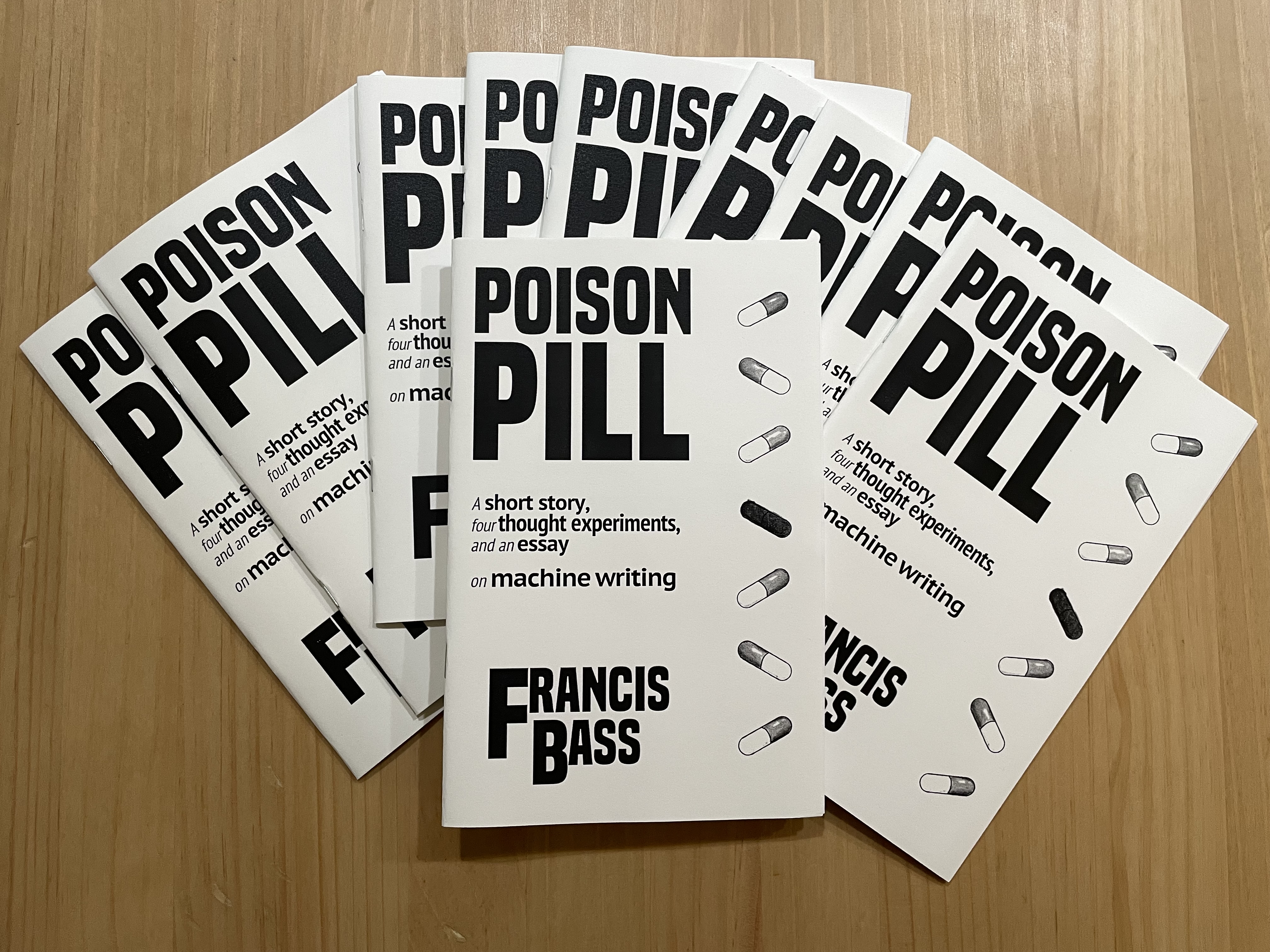
This is the title piece of my new zine Poison Pill! The zine collects three pieces, of varying levels of fictionality, on machine writing. I plan to eventually publish them all online, free to read, but if you don’t want to wait or don’t want to read on a screen, you can order the zine now on my etsy store! You can also pick up a copy in-person at the Philly Zine Fest, December 12th (more details in this post)!
POISON PILL
The Forgotten Literary Movement
of the Early Post-Mechanical
Lately, when I am gathered with friends at a fry house or some opened block, after we’ve tired of political gossip and before we’ve arrived at scholastic tirades, we will come to discussing literature, and puzzle over the question: what will the machines write now, now that they are ingesting the very first popular novels of their primitive ancestors?
The occasion for this question is the 100th anniversary of landmark mechanical novels like Flirt Bite Go and Ephraim. Although machine writers have highly sophisticated digestive systems, it is generally understood that they ingest the popular works of 100 years ago. What will machines write, now that they are inspired by machines?
This question bores me. Only a month after Ephraim’s centennial, the topic has been utterly exhausted[1]. What interests me more is how these mechanical writers will handle the short-lived but extremely energetic and prolific movement which human writers of a hundred years ago undertook—poison pill literature.
Today, poison pill is remembered, if at all, for one of two books. Either Poison Pill itself, or Nailbiter, a very attenuated specimen published towards the tail end of the genre, and the only enduring classic to come from it.
Most who have read Nailbiter are utterly unfamiliar with the movement it came from, and appreciate the book as a particularly harrowing tale of psychocomedy. For pillgulps (the term for aficionados of the genre, an eccentric and obsessive set amongst which I count myself), Nailbiter is regarded as a competent novel, albeit tame and incurious.
Few have read Poison Pill, but many have heard of it. It is popularly understood as a work of extreme obscenity and provocation, a defiantly repulsive novel not dissimilar from the works of Michael Tutuola. This is a slight misconception. Although this was an element of later poison pill works, it was not the intent of Marissa Robles Delmar. Before writing Poison Pill, she was a highly successful writer of doorstopper historical romances. Her sex scenes were notable for their focus on queer couples or groups, but were otherwise unremarkable—no thumbtacks or piano wire were ever involved. She had no interest in the grotesque, the transgressive, the cruel. When she wrote Poison Pill, she did so as a political act, not an aesthetic one—in fact, she did not even call it a novel or a book, she referred to it as a sabot[2].
This political dimension is what drove the extreme popularity of the genre at the time, and what still captivates pillgulps today. To understand poison pill literature, one cannot just read Poison Pill or Kill Kill Kill or whatever else—one must first understand Delmar v. PRSSM.
Read More »

