Free Fiction: Poison Pill

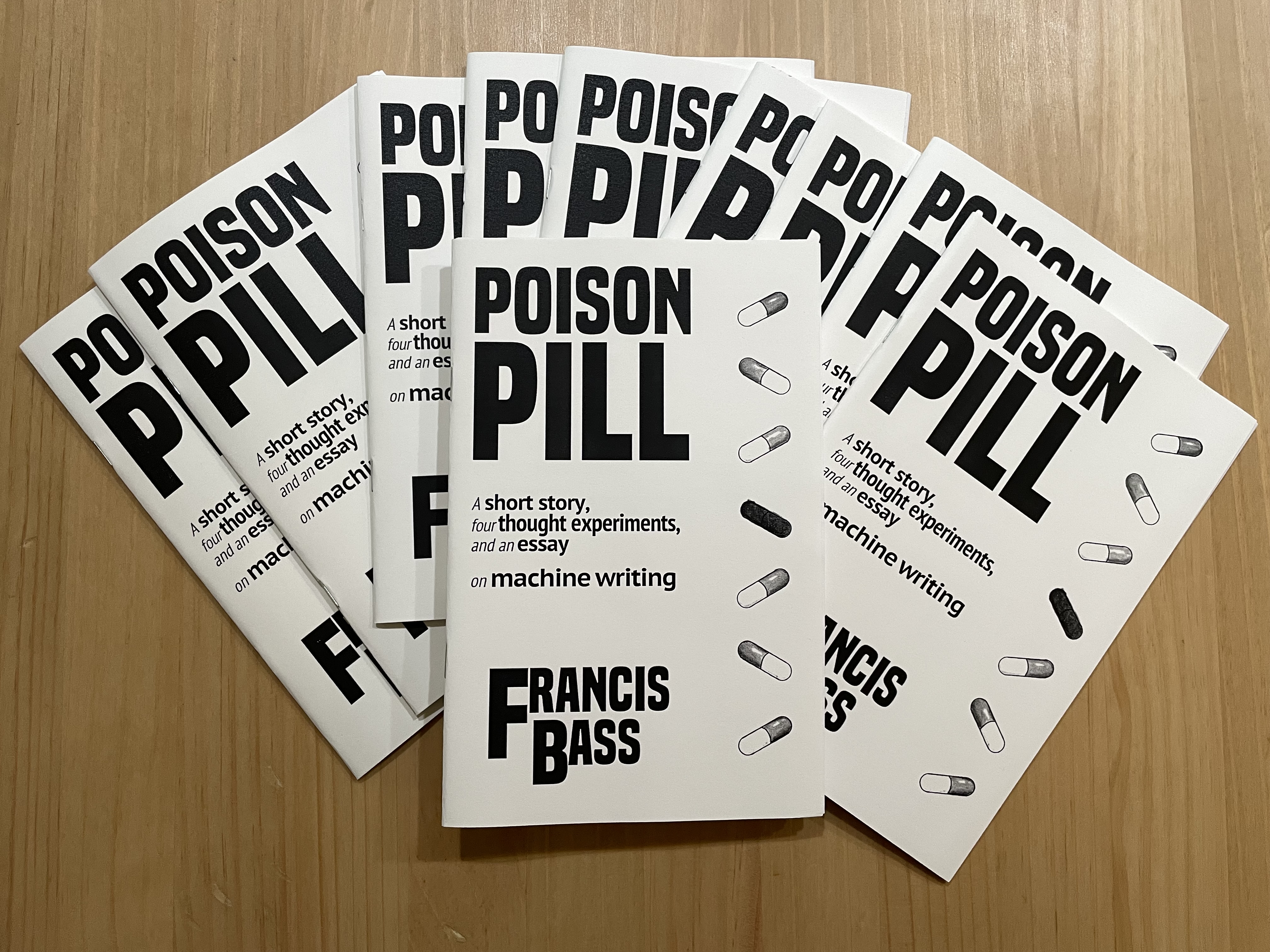
This is the title piece of my new zine Poison Pill! The zine collects three pieces, of varying levels of fictionality, on machine writing. I plan to eventually publish them all online, free to read, but if you don’t want to wait or don’t want to read on a screen, you can order the zine now on my etsy store! You can also pick up a copy in-person at the Philly Zine Fest, December 12th (more details in this post)!


POISON PILL

The Forgotten Literary Movement
of the Early Post-Mechanical

Lately, when I am gathered with friends at a fry house or some opened block, after we’ve tired of political gossip and before we’ve arrived at scholastic tirades, we will come to discussing literature, and puzzle over the question: what will the machines write now, now that they are ingesting the very first popular novels of their primitive ancestors?

The occasion for this question is the 100th anniversary of landmark mechanical novels like Flirt Bite Go and Ephraim. Although machine writers have highly sophisticated digestive systems, it is generally understood that they ingest the popular works of 100 years ago. What will machines write, now that they are inspired by machines?

This question bores me. Only a month after Ephraim’s centennial, the topic has been utterly exhausted[1]. What interests me more is how these mechanical writers will handle the short-lived but extremely energetic and prolific movement which human writers of a hundred years ago undertook—poison pill literature.

Today, poison pill is remembered, if at all, for one of two books. Either Poison Pill itself, or Nailbiter, a very attenuated specimen published towards the tail end of the genre, and the only enduring classic to come from it. 

Most who have read Nailbiter are utterly unfamiliar with the movement it came from, and appreciate the book as a particularly harrowing tale of psychocomedy. For pillgulps (the term for aficionados of the genre, an eccentric and obsessive set amongst which I count myself), Nailbiter is regarded as a competent novel, albeit tame and incurious.

Few have read Poison Pill, but many have heard of it. It is popularly understood as a work of extreme obscenity and provocation, a defiantly repulsive novel not dissimilar from the works of Michael Tutuola. This is a slight misconception. Although this was an element of later poison pill works, it was not the intent of Marissa Robles Delmar. Before writing Poison Pill, she was a highly successful writer of doorstopper historical romances. Her sex scenes were notable for their focus on queer couples or groups, but were otherwise unremarkable—no thumbtacks or piano wire were ever involved. She had no interest in the grotesque, the transgressive, the cruel. When she wrote Poison Pill, she did so as a political act, not an aesthetic one—in fact, she did not even call it a novel or a book, she referred to it as a sabot[2].

This political dimension is what drove the extreme popularity of the genre at the time, and what still captivates pillgulps today. To understand poison pill literature, one cannot just read Poison Pill or Kill Kill Kill or whatever else—one must first understand Delmar v. PRSSM.

Read More »

New Publication: Play Time, and Smashwords Sale

EDIT: A PREVIOUS VERSION OF THE PICTURE FOR THIS POST SAID MY ALL MY EBOOKS WOULD BE 75% OFF. PICTURE HAS BEEN UPDATED TO THE CORRECT DISCOUNT, 25% OFF.

If you’ve been reading my Play Time posts, you can now get all of them—plus the next four which won’t all be online until a month from now—in one convenient place, on Smashwords or Amazon. And if you haven’t been reading them, here’s what they’re all about:

playtime-c-2-alt4-NOTEfavoriteThis past spring semester I needed to fulfill my university honors requirements, so I “contracted” a creative writing class focused on time, by designing an additional curriculum of nine plays that I would read and respond to—all of them dealing with time in some way. Thus, Play Time—nine essays analyzing specific plays, pulling apart the ways the playwrights are using the medium of theatre to manipulate or comment on or distort or theorize about time. The idea wasn’t so much to definitively state What X Play is About, but more to point out what I find interesting in each play, and figure out how the artist—or how theatre as a medium—achieved it.

And if you get Play Time on Smashwords, you’ll get it for 25% off! For the month of July I’m participating in the Smashwords Northern Summer/Southern Winter sale, so all my ebooks there are 25% off, and Beach Realty of Sandcastle Isle and “Calamcity” are 50% off. Because those two pieces are about beaches, and Florida, and summer, and it’s summer in Florida right now. So, you can have some cheap beach reading, or some escapist reading if you’re in the southern hemisphere and you need to remember what sunshine is like.


New Publication: The Only Series that Matters

TOSTM-c-3Well, it’s newish. It’s a collection of all the posts I’ve been making about A Series of Unfortunate Events. If you haven’t been reading them, it’s a series of essays in which I examine each book in A Series of Unfortunate Events upon rereading them a decade after I first fell in love with them as a kid. The essays highlight literary techniques, thematic explorations, and the ideas communicated in these books that have resonated with me from when I first read the series to today.

If you have been reading them, consider purchasing the collection to support posts like these, and the blog in general. The collection holds all the posts that have appeared on this site so far, plus the last four posts that will appear on the site over the course of the next month, polished up and consolidated for the book. It also contains “Chapter Fourteen,” an essay that won’t be published on this blog, discussing my relationship with the series through different parts of my life, and The Appalling Appendix—an index of selected notes, quotes, and observations from the file I kept while rereading the series.

Currently it’s available on Amazon, and UPDATE: it is now available on Smashwords!

Chapbook – [Unintelligible] and other works

bottom-borders-smallest

As promised, here’s a PDF of the chapbook, containing two essays and a writing exercise. To be clear, it’s not a published chapbook, it’s a small compilation I made as the final project of a writing class.

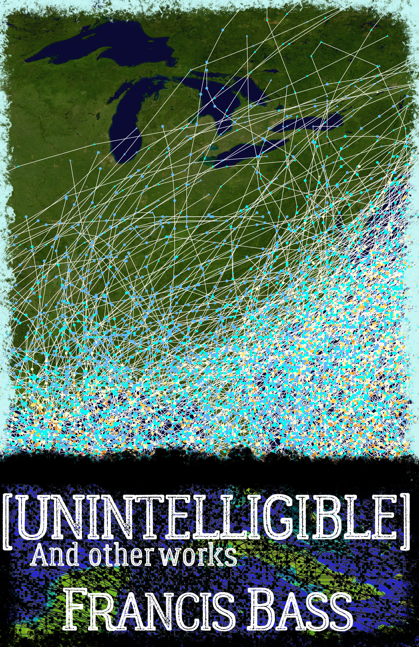
The works contained within are “A Faulty Baseline,” “It Was Unbroken,” and of course “[Unintelligible].” And in case you’re wondering, the image on the cover is a portion of a map showing  the paths of every Atlantic hurricane from every hurricane season since 1851.

The Starbucks Coffee House

In my writing class we had an assignment to write an essay about some place in Iowa City with cultural or historic significance. This is the essay I wrote:

The Starbucks Coffee House

During my first visit to Iowa City, after a day full of walking tours and departmental presentations, my mom and I stumbled across a café at the edge of downtown. At the corner of Clinton and Burlington, where close-knit brick edifices give way to expansive parking lots and construction projects, sat the Starbucks coffee house. Since this is a rather obscure café, I’ll explain that it isn’t owned by a person named Starbuck, but rather the name refers to a character in Moby Dick. We entered the handsome little square building, and were embraced by an aura of inspiration and nurture. Of handcraftedness and innovation. Of intimacy and charm. It was the spirit of the Starbucks coffee house. I ordered a cappuccino and my mom ordered a chai tea latte, and I new I’d found a home away from home.

Half a year later, I return to the café regularly, knowing that there I can find tradition, hospitality, and a good cup of joe. The whole building is permeated with these qualities, from the dark woodgrain countertops (and tabletops and paneling and flooring and bathroom doors), to the news stand with chalked-on prices, to the burlap sacks displaying POP! Gourmet Popcorn—almost as if the Lite Salt popcorn bags had come fresh from the harvest just minutes ago. Sepia-tone photographs on the walls display Iowa’s rich agrarian heritage in various images, such as fields, a man putting wheat into a machine, and other fields.Read More »