The War of Paraguay: Foreword

twop-c-10This post remains available for posterity’s sake, but a much revised and much expanded version of this translation is available completely for free! The revised version includes translated footnotes, a translated appendix, an expanded introduction, and a map of disputed territory and important locations. You can download a copy in the following formats: DocxEpubMobiPDF. Or, if you want to throw some money my way, you can set your price for it on Smashwords. And it’s in the public domain!

EDIT: A previous version of this post described the Paraguayan War as the deadliest war in Latin American history. That is not the case, as the Mexican revolution almost certainly claimed more lives. The Paraguayan War is, however, the deadliest inter-state war in Latin American history—in the history, in fact, of the entire western hemisphere.

39E.jpg
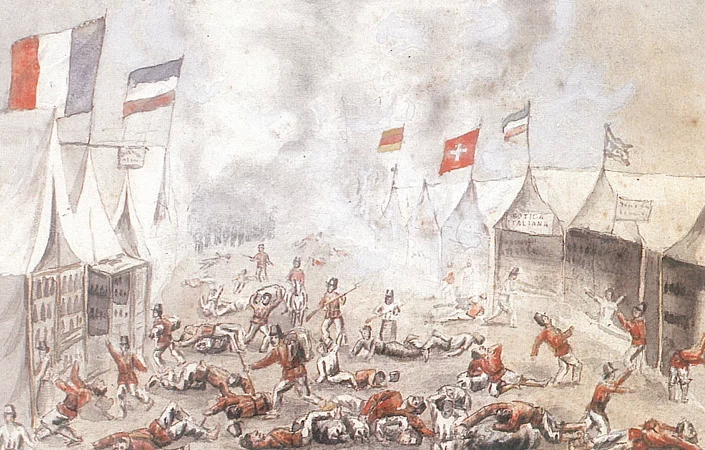
Watercolor by José Ignacio Garmendia, depicting Paraguayan soldiers ambushed while pillaging the allied camp’s commissary in the Second Battle of Tuyutí

I’m very excited to write that tomorrow, I will post the first chapter of The War of Paraguay. Before I do, I want to establish what exactly this thing is, what you should know before reading it, why I think its cool, and what my ultimate plans with it are. But before any of that,

Francis, what’s up with the title?

The title is a near literal translation of the Spanish, La guerra del Paraguay. It should be translated as The Paraguayan War, because that’s the English name for the war—and that’s how I translate it whenever it appears in the text. But for the title, I’m using The War of Paraguay because there is already a book titled The Paraguayan War, and there could well be more books with that title. I don’t think its that important since the title isn’t even the original author’s invention, as I’ll explain right now:

What is this book?

This book is an excerpt from Joaquim Nabuco’s Um estadista do Imperio (A Statesman of the Empire), which is a massive work chronicling the political scene in the Empire of Brazil, from 1813 to 1878 (pretty much the whole life of the Empire), with a special focus on Nabuco’s father, the eponymous estadista, José Nabuco. This excerpt is not a contiguous section of the book—it is pieced together from a few different “books” within Um estadista, which together describe the political, diplomatic, and military events surrounding the Paraguayan War. Each of these books contains multiple chapters, and nothing has been cut from them in the excerpting process, aside from a few footnotes. So each chapter, each book of chapters, is whole, although some of the books have gaps in between them, where Nabuco’s original work had more chapters on matters unrelated to the war.Read More »

Recommendation Dump September 2017

Oh, Hello On Broadway — Oh, Hello is a comedy act created by Nick Kroll and John Mulaney—two comedians who are terrific on their own, and dynamite together. Kroll plays the child-like Gil Faizon, and Mulaney plays the near-psychotic George St. Geegland—two seventy-something New Yorkers who are tantalizingly delusional, pretentious, and mean-spirited. The two have a terrific dynamic that doesn’t smack of the usual straight-man funny-man schtick, since they’re both ludicrous caricatures of elderly Upper West Side residents. Mulaney and Kroll have been refining these characters for over a decade, on Kroll Show, on podcasts, at live shows, and countless other places. Don’t take my word for it—you can watch them on youtube here here here and here, and actually a bunch more places if you like, but those are just a primer.

So, the show itself. The show is part stand-up routine, part parody, and part variety show. The conceit is that Gil and George are performing one of the many plays that George has written, though there is constant fourth-wall breaking throughout, including a long opening segment in which the two introduce themselves, and send-up various Broadway tropes. The play within the play is essentially autobiographical for George and Gil, although the characters in it are much more successful versions of themselves. In the middle of the show is a segment where, embedded as a prank show within the play-within-the-play, the two interview some celebrity—during the run of the show, it was a different person each night, but for the Netflix special it’s Steve Martin. It’s a nice little breather in the middle of the non-stop barrage of jokes and gaffes, where Kroll and Mulaney get to exercise their (practiced) improv chops, and the audience gets to see a different person making jokes on stage.Read More »

Food Waste: Part 2 – Consumption and Solutions

Here’s the second, concluding part of my notes on food waste.

During Consumption

When thinking about food waste, it’s easy to just peg it to the value of the food. This past year was the first time I really had to buy my own groceries. Multiple times, I messed up and didn’t store food properly, or bought too much of it and didn’t eat it fast enough before it got moldy. So when I was throwing away half a bag of green-splotched bagels, my thought was, crap, that’s like two bucks just gone. However when I realize that the faucet has been running all day, I think, crap, that’s a waste of water and energy for water treatment, because I’ve internalized that as the framework to understand water usage. Food waste isn’t a problem because of the dollar value, it’s a bunch of energy expended for no reason at all. So, to throw another analogy at you, it’s not like buying a sword in a video game, and then losing that sword when you die, and having to buy it again. It’s like buying a sword in a video game, and then losing it when you die, and then having all of the assets and coding for that sword deleted from the game, so that the developer has to redesign it and release a patch so you can buy the sword again. I don’t participate in the production of food, so it didn’t hit home to me all the labor that I was throwing in the trash with those bagels—I only knew the value of it as a consumer.

It shouldn’t be surprising that in developed countries, about 30-40% of food waste occurs at the consumption level, which is everything from household meals to restaurants. In restaurants, there are the same problems as at supermarkets re: over-stocking and expiration dates. In households, most cases of food waste can be broken down into a few categories, as outlined in a study of 14 lower-middle income Brazillian families: “(1) excessive purchasing, (2) over-preparation, (3) caring for a pet, (4) avoidance of leftovers and (5) inappropriate food conservation. Several subcategories were also found, including impulse buying, lack of planning and preference for large packages.” So let’s break these down.

“Excessive purchasing” is exactly what it sounds like—buying more food than is need, and more food than can be consumed before it goes bad. Ironically, this over-purchasing is often the result of buying in bulk in an effort to save money, or taking advantage of sales or BOGO bargains even when the family already has enough of the product at home. So the savings may be negated by the amount of food wasted. Excessive purchasing is also linked to unplanned shopping excursions—going to the store without a list, as “Only two of the 14 families studied prepare shopping lists.” In a 2012 study on national shopping trends in the US, the Hartman Group found that 69% of women make a list before shopping at a grocery store, and only 52% of men do the same.Read More »

Food Waste: Part 1 – Production and Retail

And now, the synthesis of some notes I took on food waste while doing research for a story I’m writing.

Intro.

The United States Environmental Protection Agency defines food waste as “uneaten food and food preparation wastes from residences and commercial establishments such as grocery stores, restaurants, and produce stands, institutional cafeterias and kitchens, and industrial sources like employee lunchrooms.” Food waste can occur all throughout the life cycle of a food product, from before the harvest all the way to the dining room table. With the waste that happens at all these different stages taken into account, the percentage of wastage in the US is a pretty big chunk of overall food production. A 2009 study published in PLOS ONE estimates that 40% of food produced in America is wasted, and a 2014 report from the USDA Economic Research Service pegs the number at 31%. In terms of calories, that’s either 1,400 calories per person per day, or 1,249 calories per person per day, respectively.

Obviously, this is a problem. Food production is the dynamo that powers all of human civilization. If that dynamo is inefficient and losing 1.3 billion tons of fuel per year, that’s a problem. If that dynamo is inefficient and losing 1.3 billion blah blah blah, and all of those 1.3 billion tons of fuel took additional fuel and water usage to produce, that’s a really big problem.

To put it another way, the situation isn’t as simple as walking to the store, and taking a wrong turn, and wasting an hour of time being lost before you make it to the store. The situation is driving a gas guzzler/steam engine beast of a vehicle, and taking a wrong turn, and wasting an hour of time and of gas and water and whatever else powers this thing you’re driving before making it to the store. Sustainable farming practices are kind of another kettle of fish, but it’s important to note here that a wasted potato is not just a wasted potato. It’s also a waste of all the resources that went into making that potato, which, depending on what point of the process the potato is wasted at, could be pretty hefty. The UN Food and Agriculture Organization estimated that, for the year of 2011, the carbon footprint of global food loss—the amount of energy put into food that ended up wasted—was 4.4 GtCO2, “or about 8% of total anthropogenic GHG emissions [EC, JRC/PBL, 2012 Emission Database for Global Atmospheric Research, version 4.2]. This means that the contribution of food wastage emissions to global warming is almost equivalent (87%) to global road transport emissions [IPCC, 2014 Fifth Assessment Report. Chapter 8: Transportation].”

How do we arrive at such an enormous amount of wastage? That’s what most of this two-part series of posts will address.Read More »

Happy Birthday to the Blog!

Four years ago, I wrote the first post of this blog. And then a few weeks later I stopped writing blog posts. Almost two years ago, I restarted this blog, and it’s been going strong (more or less) ever since. So I want to take this anniversary to discuss the past and future of this blog.

The Past

This blog started out (or re-started out) with a very explicit purpose: I wanted to have a place for new readers to land if they’d read me somewhere else, and a place to announce new publications to old readers. A “platform.” And just as importantly, I wanted to get in the habit of writing posts. I wanted to get good at regularly producing content, so that by the time that I actually started pulling in lots of readers, I wouldn’t “be fumbling around with weird disorganized posts like this one, or slacking off and going through long hiatuses.”

Mission accomplished! For the past seven months, I have been publishing one post a week, with the only exception being the week of January 30 – February 5. And, with over a hundred posts published on this site, I’d say I have a platform. It’s a multicolored, wildly erratic platform, with topics ranging from political analysis to theatre to uhhhhh this?, but a platform nonetheless.

So, now that I have achieved this, and this is the new status quo, what is the future of the blog?

The Future

First, something that’s already happened: the blog’s URL is now just “francisbass.com”! Yay! “francisbass.wordpress.com” still redirects to here, but if you have it bookmarked maybe change it anyway, just in case? Anyway, that’s fun.

Second, and more importantly, I definitely want to continue posting every week—specifically every Friday, because that’s the day of the week I’ve been posting on for the past four months. I like blogs / youtube channels / webcomics that update regularly, and I like the way doing this forces me to steadily add to this growing body of work that is the blog as a whole. However, I might have to have occasional hiatuses. I’ve had posts queued up all this summer, but now I’m quickly approaching the end of that queue. I have ideas for other stuff to write for the blog, which I’ll get to in a moment, but it’s pretty involved, meaning that it may take awhile to produce—and I’m heading into a heck of a year, in which I’ll be kept very busy with college, especially Spring of 2018. So rather than slowly squeeze out posts at irregular intervals, if I can’t update weekly I’ll just go on a planned hiatus, which I’ll make sure to announce on this site in some way—probably with a planned date of return as well. Because I appreciate regularity. Be the change you want to see in content creators, right?

Now, here’s the thing about posting weekly, regardless of whether I’m busy or not: the reason I’ve been able to do it for the past six months is that I’ve been putting out two very long series of posts—the Rereading ASOUE series, and the Play Time series. Writing these longer series is a lot easier than writing several stand alone posts, because writing a series, it’s easy to develop a specific format and style that can be used in every post, instead of having to figure that stuff out fresh, as I do with each one-off post. So that’s essentially how I plan to run the blog from here on out, writing multi-part series of posts. Still, I don’t want the blog to be totally overtaken by one topic for months at a time, or to eschew one-off topics that can’t be stretched into whole series, so I’ll try and throw a couple stand-alone posts into the middle of the series as well (as I’ve been trying to do, with some success, these past seven months.)

As for the actual content of those series, I have a few different things I’m mucking about with, which I’m still not certain have enough substance or are interesting enough to make into a series—but one thing I know for sure will be going up on this blog is La Guerra del Paraguay! It’s a Spanish translation of an excerpt of a work written in Portuguese, Um Estadista do Império, and I am currently translating the Spanish excerpt (which is book-length in its own right) into English. The excerpt covers the Paraguayan War, mostly through the lens of the Brazilian parliamentarians and diplomats. I plan to post my translation chapter-by-chapter on this blog, and publish a version of it with translations of appendix material and footnotes as well—though I’ve been working on it all summer, and only just now got to the point where I can start writing the english translation, so who knows when that’ll be. Hopefully starting this fall.

So, that’s the state of the blog, 2017. If there’s any type of post you’d like to see more of, or some preference for frequency of posts you have, or if you think this type of post where I’m just writing about the blog itself is boring, leave me a comment. I feel like it’d be nice to have one of these types of self-reflective posts every year, or maybe every two years like the Olypmics, but who knows. Here’s to finding out!

Game Review: Burrito Bison; Launcha Libre

Originally this was going to be part of a recommendation dump post, but as I wrote about this game, I realized I just have a lot to say about it. Enough to be a post in itself. So, here we go:

Burrito Bison: Launcha Libre is a launcher game from Juicy Beast. You play as a luchador who’s fighting various candy-people (primarily gummy bears) and trying to get a recipe book? I think? It’s been awhile since I’ve watched that opening cutscene, but it hasn’t been any time at all since I last played this game. I’ve been playing it, off and on, for about three months. It’s been my go-to game when I want to listen to music or a podcast or just totally zone-out.

The perfect, addictive core of this game is one that Juicy Beast had been doing a great job with since the first Burrito Bison game (Launcha Libre is the third in a series, and the first two are considerably smaller in scale, but still a lot of fun)—the balance between player input and the flow of the game. If the game relied too much on player input, or relied on more complex player input, it wouldn’t really be a launcher game, and it would be impossible to zone out to it. If the game eschewed player input too much, it would be a lot like most bad launcher games, with too much relying on variance and some lucky bounces to get you far. Some launcher games you can look away from and really not change the experience. Some launcher games it feels like you’re better off not using any of your power-ups or controls, and just hoping to land on a bomb or a bouncy mushroom or whatever it is that will keep you in the air. Burrito Bison is right at the crest of this wave, riding it perfectly, just between falling forward into boredom or falling backward into over-taxation of the brain.

pricklypear-BB
Burrito Bison riding a popped Prickly Pair

Read More »

Recommendation Dump, April 2017

It’s been a while since I did one of these, huh? Well, I’ve got some stuff to recommend, so I’m doing another one—here we go!

Democrats — Democrats is a documentary detailing the creation a new Zimbabwean constitution from 2009-2013, and especially the negotiations between the chief negotiators for the incumbent and the opposition party—Paul Mangwana and Douglas Mwonzora respectively. The film is phenomenal.

The documentary is presented with little editorializing, no retrospective interviews, and only occasional clips from news broadcasts to provide summary. The meat of it is incredibly candid interactions between party members and footage of the actual negotiation process. When I say incredibly candid, I mean that at one point Mangwana and another party official are openly talking about the fact that ZANU-PF—their party, the party of President Mugabe—has been bussing in party supporters to local meetings that they shouldn’t be a part of. The two are laughing, the official saying, “We can’t control that,” and Mangwana saying, “No, that’s ZANU-PF at work.”Read More »

Thoughts on A Series of Unfortunate Events, Season One

I’ve watched Netflix’s Lemony Snicket’s A Series of Unfortunate Events in its entirety now, and there’s a lot to talk about. This post will be part review, part analysis, and part comparison between the books and the show. The first third of the post contains no spoilers, but the next two thirds do, for the books and the show, and I’ve put a disclaimer in at that point.

For reference, and so I don’t have to explain it later, this is the basic plot: Three children, Violet, Klaus, and Sunny Baudelaire are orphaned when their parents die in a fire which destroys their home. The parents leave behind an enormous fortune, which cannot be accessed until the eldest Baudelaire comes of age. The children are moved from guardian to guardian, always pursued by the villainous Count Olaf, who schemes to steal their inheritance, and is ruthless in his pursuit of this goal. Violet Klaus and Sunny survive by their inventive thinking, extensive knowledge, and ability bite things (respectively.)

So, here we go:

If You Haven’t Read the Books …

If you’ve never read the books, I highly recommend the show. I don’t know if it’s better or worse to have read the books, but I’m confident that it stands by itself as a terrific work of art. There is nothing like it on TV, and for good reason.

asoueolaf
Photo courtesy of Joe Lederer/Netflix

Imagine if a showrunner spent seven years writing hundreds of pages of stories and characters and settings, and wrote all of them in the voice of the show’s narrator. Imagine they worked with a designer who drew hundreds of pieces of concept art detailing the looks of characters, props, and sets. Imagine if the showrunner also composed and performed thirteen songs to go along with different parts of the show (though not to be actually used in the show.) And imagine they had a decade after that time in which they continued thinking about the show, and expanded on the background of the narrator by writing a few hundred more pages about his childhood in this same world.

That, of course, would be absurd, but because of the way this all developed, it’s essentially what happened. And while this could be said of many shows and movies adapted from books, the difference here is that the original creator usually isn’t the one writing the screenplays. Daniel Handler, author of the book series, is also the screenwriter for every episode of the Netflix series (and although he’s not the showrunner, he is an EP.) The result is an uncompromising vision of a world and the characters who inhabit it. The music, set design, and writing are all of a cohesive style—one which is confidently gothic, bizarre, and witty. The show is highly engaging, full of wonderful(ly wry) commentary from the narrator, beautiful(ly ugly) sets, and charming(ly villainous) performances. At times I had doubts about the direction the show was going, the portrayal of a character, or the handling of a particular scene, but never, throughout watching the entire show, did I feel I could look away. I expect that kids will devour it.

If you have read the books, you will also probably love it, unless you love the books for some particular reason which the show has altered. In that case, I’d advise you to pretend that the series has nothing to do with the books, and enjoy it for what it is.Read More »

Recommendation Dump, September 2016

Jurymore –  Another podcast from the great Justin Robert Young, though unlike my previous recommendation of Politics Politics Politics (which I’m recommending again right now because it is continually terrific and it’s now going up three times a week) this one is not a one man podcast. It’s also not ongoing—it ended awhile ago, at about 30 episodes long. It ended because Justin got married—that’s the premise of the podcast. Justin Robert Young and his then fiancée Ashley Paramore recorded a regular podcast for the better part of a year leading up to their wedding, and document the process of planning the ceremony.

Terrific. The two have great rapport, and most episodes focus on an interesting topic—often something to do with the wedding planning, sometimes just something to do with relationships. Their honesty and ability to speak (and sometimes argue) freely while streaming the podcast live is refreshing, and some of the greatest moments of the podcast are when they get into fights. Because the two really are a terrific couple, and their fights aren’t abusive nonsense, they’re genuine arguments. And the whole show has an energetic, comedic tone, because it’s JuRY after all.

Also, they had the wedding ceremony at DragonCon, so once you’ve finished the podcast you can watch it, like a finale.Read More »

Political Analysis: Median Voter Theorem and Voting Systems

In this final, though not very conclusive, post on political analysis, we’re talking voting, voting systems, and ice cream.

The Median voter theorem helps explain the importance of the swing voter. For the MVT there are four elements:

  1. A set of n voters where n is odd (apparently an even number can work too, but we didn’t really talk about it, and, as in Minecraft, odd numbers just work better.)
  2. Unidimensional policy space (i.e. right vs. left, socialist vs. capitalist, more funding vs. less funding)
  3. Voters have quadratic or “single-peaked” preferences that can be represented by the equation U[x] = [x1 – x’]2. So they have one ideal point (x’) and whichever option falls closer to their ideal point is what they’ll vote for.
  4. The group makes decisions by majority rule (and we’ll talk about alternatives to this in a  bit.)

The theorem states that, if every voter in the group has an ideal point, the voter with the median ideal point is an indicator of how the group will vote.

To apply this, here’s an example:

The International Space Committee is voting between two bills to send colonists to Mars. There are seven seats on the committee. Three of them are hardliners who think colonization is a waster of resources, and their ideal point is 0 colonists. On the other end of the spectrum is a sci-fi fan who wants to send a hundred colonists. Then in the middle we have someone who wants to send three colonists, someone who wants to send five, and someone who wants to send twelve. Read More »

Political Analysis: Coalitions

In this penultimate post taken from my Intro to Political Analysis class notes, we’re talking about coalitions—and how to predict which coalitions will form. 

The fundamental building block of politics is the mass political party. The first mass political party was formed in the US. After the “corrupt bargain” of the election of 1824, Jackson’s supporters formed a mass political party, fully recognized as the Democrats by 1840.

But we won’t be really talking about the US, because we don’t have coalitions, because of our party system. Party systems (as with any systems, according to systemic theory) can be categorized as the one, the few, and the many.

The one would be places like China and Cuba, with only one party.

The US’s two-party system would be considered “the few.”

And the many is what you see in parliamentary countries (like most of Europe.) This is the kind of system we’ll focus on.Read More »

Political Analysis: The Decentralized Solution

Last week I wrote about the prisoner’s dilemma, and a centralized, Hobbesian solution to that—essentially, to get people to cooperate you have to bring in an outside authority, like a monarch. This is the decentralized solution.

The decentralized solution to the prisoner’s dilemma has three elements:

  1. The game is repeated an unknown number of times
  2. The strategy is reciprocity—if A cooperates, B does too. If A defects, B does too.
  3. The shadow of the future is sufficiently long.

That “unknown” bit is important. If people know the game’s gonna end, and they know when, there’s no reason to develop trust with the other person. “Unknown” can mean infinite iterations, or just a percentage chance each time that the game will be replayed.

So if you’re going to play forever (or potentially forever), two basics strategies are always defecting (“All-D”), or always cooperating (“All-C.”) These strategies are useful for reference points, but they aren’t actually practical, because they aren’t reciprocal strategy—they’re not based on what the other person is doing. And in a normal-form game, what the other person does, combined with what you do, determines your payoff.

One reciprocal strategy is “Tit-for-Tat”—whatever the player did last turn, do that this turn.

We’re going to focus on the “Grim Trigger” strategy. God, that sounds badass. With Grim Trigger, you start out by always cooperating, but if the other player ever defects, you switch to All-D.Read More »

Political Analysis: The Prisoner’s Dilemma

Now for a classic of political analysis—the prisoner’s dilemma.

“Rational individuals select actions to achieve their most preferred outcomes. If two rational individuals can do better by acting collectively, then they will do so, because they are rational.”

Annnnh! Wrong! That is the rock pile method, and it’s false, and we can see this with the prisoner’s dilemma.

A lot of people teach the Prisoner’s Dilemma, and a lot of them get it wrong. “If you’ve heard of it or had a class that covered it, get a lobotomy to eliminate that part of the brain,” says Professor Dion.

I’ll get to some misconceptions in a moment, but first, here’s the story of the prisoner’s dilemma: two accomplices in a crime are taken in for questioning. The police have enough to convict the two on a small charge, but they want to get them on this bigger crime. The two criminals are separated, and each is offered a deal—rat on the other guy (“defect”) and you’ll get to walk free, and the other guy will get a really harsh sentence. They’re also told that this deal is being presented to both of them. What ends up happening? They both defect, of course. If they expect the other person to say nothing (to “cooperate”), it’s best to defect, because then they’ll walk free. And if they expect the other person to rat on them, it’s also best to defect, because while they’ll still get a harsh sentence, it won’t be as harsh, because it’s split between them.

So, here’s the Canonical prisoner’s dilemma, shown as a normal-form game.

PD-canonicalRead More »

Political Analysis: Condorcet Jury Theorem

Last post I introduced the concept of aggregation in political analysis, and how you can’t always make inferences about members of a group based on the character of the group as a whole—or visa versa. This post will go further into that, and also why democracy works.

In college, it’s easy to forget how much smarter you are than everyone, because you’re surrounded by people as smart or smarter than you—but really, a lot of people are highly ignorant. [NOTE FROM THE NOTE-TAKER: This is how Professor Dion introduced the topic, not me just throwing in my own color. But it is kind of true.]

For example, only 74% of Americans believe that the Earth orbits around the sun. As for politics, in 2010 only 54% knew the controlling party of the House of Representatives.

So, is democracy doomed? The idea with democracy is that an individual is the best judge of their own interests, and will elect a good representative for themself. But if people are ignorant, will they really?Read More »

Political Analysis: Aggregation and the Ecological Fallacy

Well, with little planned in the way of textual posts (although I have plenty planned for other types of posts), now is as good a time as any to start posting the second half of my political analysis notes. I already posted the notes from the first half of the semester, which you can find grouped together here. Those posts are all about power. These coming posts will be from the second half of the semester, and will focus on aggregation. So, let’s begin.

The Latin word “grex” means “flock,” and “ad” (which becomes “agg” in aggregation) means “to,” so “aggregation” is assembling a flock. It’s clear how power pertains to politics—but how does aggregation relate to it?

Well, let’s start with another question: Why war?

Maybe it’s a spiritual problem, as the Dalai Lama would assert—a problem of misunderstanding and hatred.

Other people believe it is a diversionary tactic—leaders need support of the selectorate (the critical sectors of the voting society.) So when there are domestic problems, the leader will create a foreign policy crisis to distract the electorate and unify them against the common enemy.

Then there’s the strategic theory. The strategic theory says you need two states for a war, so it can be modeled as a game. And as we’ve seen, if people don’t trust each other, they’ll end up with suboptimal results—war. Another strategic theory is that war comes about when there is incomplete information—both sides are unsure if they can win an armed conflict, so they have to duke it out to find out, rather than relying on the validity of each other’s threats.

Finally, there’s systemic theory. Systemic theories don’t look at individual states or dyads (pairings), they look at the system. There are three types of systems—the one, the few, and the many.

The one, or unipolar, is a system with a single strong state, like the Aztec Empire in Mesoamerica, or the US since 1989. Also Childhood’s End.

The few, or bipolar, is a system with two powerful states, like Athens vs. Sparta, or the Cold War.

The many, or multipolar, is a system with more than two powerful states, usually a lot more than two. Examples are the concert of Europe, the Warring States Period of China, or A Song of Ice and Fire.

And if you want to determine if a war will happen, or why a war will happen, you have to determine what kind of system is present.

Hobbes said unipolar systems are best, because everyone will be subject to one power which will ensure that there’s no infighting. We’ll talk more about this later.

Neorealism disagrees with this, arguing that bipolar systems are better, because the two powers will be in competition, and both will work harder to ensure that what they control is peaceful.

And Wilsonian idealism champions multipolar systems, and a peaceful league of nations.

So, why all these theories? Which one is right?

That’s tough, because they’re all explaining war at different levels. The spiritual explanation looks at individuals, where diversionary theory looks at a single nation, strategic theory focuses on dyads, and systemic theory looks at the whole big mess.

So how do you link these levels together? How do you aggregate them? This, to some extent, is our question.

The Ecological Fallacy

The most basic form of aggregation is just to put everything together. Put together a bunch of individuals, you get a nation. Put together a couple nations, you get a dyad. Put together a bunch of dyads, you have a system. That’s what Professor Dion calls the “rock pile” method. If you put together a bunch of rocks, you get a rock pile. So if you have put together a bunch of dumb people, you’ll get a dumb group. If a majority of republicans are elected into congress, you’ll get a congress that votes republican.

But this isn’t actually the case. When you put a bunch of individuals together, things get weird.

To explore this, we’ll look at another question, similar to “why war?”: Who voted for the Nazis?

The problem is, they used secret ballots, and this information isn’t readily available. We could look at precincts and see how they voted, and what their demographics were. From that we can find a rough correlation between certain groups and voting patterns. This is perfect, right—or as close to it?

Not necessarily, because it’s an ecological fallacy. That name is a bit misleading, so I’ll explain. It comes from sociologists applying biological sciences to individuals—moving from individuals to whole groups, just like biologists moved from species to ecological systems to better understand the individuals. So sociologists applied this ecological approach, using the same sort of precinct analysis above, but this method was proven ineffective and inaccurate.

To summarize, the ecological fallacy involves using information from one level of analysis to make inferences about another level of analysis.

An example:

A Berkley graduate admission study in the 70s found that 46% of men were admitted, while only 36% of women were admitted. An ecologically fallacious argument would be that the school is biased against women. But by looking at each department, they found that some departments actually heavily favored women, while others just slightly favored men. So what happened?

Men applied to departments with high acceptance rates for everyone, while women applied more often to departments with lower acceptance rates. So it wasn’t that UC Berkley was discriminating against women—it was a problem of analysis on one level versus another.

Next post will look at a more accurate use of aggregation—the Condorcet Jury Theorem.

Do Hot Teachers Teach Better?

As the final project of my Intro to Political Analysis class, we had to write a short paper proposing a solution to some puzzle, and then determining if our solution was correct. This is what I did:

Do Hot Teachers Teach Better?

Introduction.

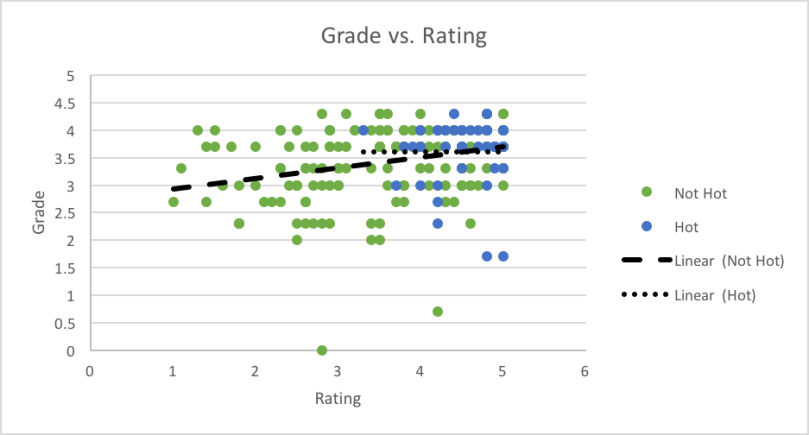
Ratemyprofessors.com is a site where students can post ratings of professors they have had, evaluating them on “helpfulness,” “clarity,” and “easiness.” “Helpfulness” describes how available and approachable the professor is. “Clarity” describes how well the professor teaches the material. A teacher’s overall rating is the average of their clarity and helpfulness scores from everyone who has rated them. “Easiness” is not factored in, though students can still use this measure to rate “how easy or difficult a class is”. Students can also post the grade they received in the class, and they can note whether their teacher is “hot” or not. Hotness is not measured numerically, but teachers who are hot are marked by a red chili pepper on their page. If there are more students who say a teacher is hot than students who say a teacher is not hot, the chili pepper will appear, though the number itself is not displayed.

The puzzle here is that teachers who are “hot” seem to receive a higher overall rating—a 2006 paper from Medaille College found that teachers labeled “hot,” on average, scored 0.8 points higher on their overall rating, suggesting either that hot teachers are more helpful, and teach their material more clearly, or that students are biased toward giving hot professors better ratings, regardless of their quality as a teacher.Read More »

Recommendation Dump, May 2016

Here are things I like.

Skeleton Gardens – Just a simple Ludum Dare game, but one with a really unique look and feel. You play as some sort of reaper, planting trees which grow skeletons warriors, as well as seeds to plant more trees. To ensure that the trees grow to maturity, you have to protect them from waves of knights attacking you. All of the trees appear to be randomly generated, as do the walls you can build and the special, massively destructive attack, all of them forming gnarly fractal patterns. Another fun thing about the game is that it always ends overwhelmingly—either you become overwhelmingly powerful, with hundreds of trees begetting hundreds more (and you get bored and close the game or let yourself die), or you’re crushed under an enormous onslaught of knights. I guess there’s something cathartic in that. There’s no cheap or meaningless death. The music is real fun too.

Politics Politics Politics – Of all the podcasts I listen to, this is the only one that’s pretty much a one-man show. Justin Robert Young, the host of Politicsx3, occasionally has on guests, but for the most part it’s just him—and he does a fantastic job. The content of the show is evident in the title. Politics, man. Specifically the 2016 US presidential elections. But it’s not a podcast about ideology, or policy, or anything like that. In Justin’s own words, from Episode 0 of the podcast,

“I was the only motherfucker in South Plantation High School who rolled in with the Kenneth Star report … this story perfectly encapsulates why I’m doing this show, why I love politics … I was not reading it because I thought Bill Clinton should be exonerated. I was not reading it because I thought Bill Clinton should be thrown out of the White House. I was reading it because they printed a bunch of shit about a dude getting his dick sucked, in the newspaper! … It is only politics … that has that carte blanche.”

And that’s what makes the show fantastic. Justin is incredibly energetic, and his love of the political game is always on full display. He’s also quite knowledgable about politics, and does a great job of analyzing the strategies of each candidate. The most recent episode came out yesterday, covering the recent dropouts from the election, and the campaign to come. With the primaries (pretty much) over, now’s a great time to start listening. The show is fantastic, and I’m sure it’s only going to get better as we move into the general election.

“How a fluke video game called the Eternal War became a cultural phenomenon—and changed its creator” – I’d heard about The Eternal War awhile ago in a Kotaku article, and I went and looked it up again recently. That’s how I came across this article, which does a really good job describing the whole story of the game. If you’re a normal person and you don’t know what I mean when I say The Eternal War, it’s a Civilization II game that someone played on and off for ten years—well past the time when the game is supposed to end.

Normally, the Civilization games simulate the rise of civilizations, from 4000 BC to the current time—and one of the civilizations will reach a victory condition, and win by the year 2020. But the player can continue playing after this, and one player, James Moore, did—for ten years. In his game, the world became locked in an endless, bloody stalemate between three superpowers, thus giving it it’s name, The Eternal War. That should be enough to intrigue you to read the article, which has plenty more interesting details, about the life of James Moore, and about the community that grew around the game when he posted about it on Reddit. It’s a really cool story about the convergence of history, culture, and technology. Check it out.

Lonely and Horny – If you’ve never watched Jake and Amir, or listened to If I Were You, you should probably go do those things. If you have, it should come as no surprise that Lonely and Horny, the first creative work (that’s been released) from Jake Hurwitz and Amir Blumenfeld since their webseries, Jake and Amir, ended a year or so ago, is hilarious.

The show, consisting of ten eight-to-ten-minute episodes, follows Ruby Jade, played by Amir Blumenfeld, who is enrolled in a hooking up class taught by Josh Rice, played by Jake Hurwitz. The episodes focus on this class and Ruby’s various attempts (and failures) to “close” with a girl. The show doesn’t have much of a story arc, though each episode does add more to the whole. The series feels like a thesis on being lonely and horny and pathetically desperate, and each episode fleshes out more of that, and more of Ruby Jade’s life and personality.

Amir’s performance is captivating. He walks a line between a crazy, exaggerated caricature and a real person with recognizable ticks and behaviors. That’s what makes the character, and the show, so funny. Underneath the over-the-top pick-up lines and sexism is a current of real insecurity—which makes the absurdity of the scenes even funnier. And of course, the scenes between Jake and Amir are dynamite.

The show is now available in its entirety on Vimeo, for $15—and you can watch the first episode free here.

Those were things I like, and hopefully you’ll like them too.

Political Analysis: Expectations

Now we come to the final topic from my notes on political analysis—at least from the first half of the class. I’ll probably do another series of posts at the end of this semester, but for now, this is the final word on power.

“How many divisions does the Pope have?”

Thus spake Joseph Stalin in response to Churchill’s concerns about the Vatican’s views.

So far in this discussion of power, we’ve focused on hard power—threats, bargains, consequences—the kind of stuff that Stalin could respect. But what about the Pope? Does he not have power just because his only divisions are brightly dressed swiss pikemen?

It turns out (sorry Stalin) that there is such a thing as soft power, and to talk about soft power we have to talk about expectations, and to talk about expectations, we’re going to talk about John Maynard Keynes and beauty contests.Read More »