The Absolute at Large – Chapters 18-19

Chapter 18 – Night Time in the Editing Room
As religions and governments all over the world embrace the Absolute, Bishop Linda berates the editor of a Catholic Journal for continuing their invective against Him.

Chapter 19 – The Canonisation Process
The Catholic Church goes through the long, unprecedented procedure of welcoming the Absolute into the church as its God.

Also available on Podomatic and iTunes.
Find the text of the ebook here.

This recording is under a Creative Commons attribution, noncommercial, share-alike license.
Music was composed by Uzeyir Hajibeyov and performed by the United States Navy Band.
The book was written by Karel Čapek, translated by David Wyllie, and performed by Francis Bass.

Political Analysis: Coalitions

In this penultimate post taken from my Intro to Political Analysis class notes, we’re talking about coalitions—and how to predict which coalitions will form. 

The fundamental building block of politics is the mass political party. The first mass political party was formed in the US. After the “corrupt bargain” of the election of 1824, Jackson’s supporters formed a mass political party, fully recognized as the Democrats by 1840.

But we won’t be really talking about the US, because we don’t have coalitions, because of our party system. Party systems (as with any systems, according to systemic theory) can be categorized as the one, the few, and the many.

The one would be places like China and Cuba, with only one party.

The US’s two-party system would be considered “the few.”

And the many is what you see in parliamentary countries (like most of Europe.) This is the kind of system we’ll focus on.Read More »

The Absolute at Large – Chapters 16-17

Chapter 16 – In the Mountains
Mr. Bondy and Marek meet in Marek’s house in the mountains, where the Absolute’s influence has yet to reach.

Chapter 17 – The Hammer and the Star
The brothers of the Hammer and Star lodge of the Free French Masons meet to discuss their response to the recent activities of the Absolute.

Also available on Podomatic and iTunes.
Find the text of the ebook here.

This recording is under a Creative Commons attribution, noncommercial, share-alike license.
Music was composed by Uzeyir Hajibeyov and performed by the United States Navy Band.
The book was written by Karel Čapek, translated by David Wyllie, and performed by Francis Bass.

The Absolute at Large – Chapters 13-15

Chapter 13 – The Chronicler Apologises
The chronicler apologizes for his inability to describe every story and character caught up in the worldwide influence of the Absolute.

Chapter 14 – Land of Plenty
The chronicler describes the obscene abundance created by the Absolute.

Chapter 15 – Upheaval
The chronicler explains the disastrous affects of the Absolute’s overproduction, and how humanity was saved from total starvation.

Also available on Podomatic and iTunes.
Find the text of the ebook here.

This recording is under a Creative Commons attribution, noncommercial, share-alike license.
Music was composed by John Philip Sousa and performed by the United States Marine Band.
The book was written by Karel Čapek, translated by David Wyllie, and performed by Francis Bass.

Political Analysis: The Decentralized Solution

Last week I wrote about the prisoner’s dilemma, and a centralized, Hobbesian solution to that—essentially, to get people to cooperate you have to bring in an outside authority, like a monarch. This is the decentralized solution.

The decentralized solution to the prisoner’s dilemma has three elements:

  1. The game is repeated an unknown number of times
  2. The strategy is reciprocity—if A cooperates, B does too. If A defects, B does too.
  3. The shadow of the future is sufficiently long.

That “unknown” bit is important. If people know the game’s gonna end, and they know when, there’s no reason to develop trust with the other person. “Unknown” can mean infinite iterations, or just a percentage chance each time that the game will be replayed.

So if you’re going to play forever (or potentially forever), two basics strategies are always defecting (“All-D”), or always cooperating (“All-C.”) These strategies are useful for reference points, but they aren’t actually practical, because they aren’t reciprocal strategy—they’re not based on what the other person is doing. And in a normal-form game, what the other person does, combined with what you do, determines your payoff.

One reciprocal strategy is “Tit-for-Tat”—whatever the player did last turn, do that this turn.

We’re going to focus on the “Grim Trigger” strategy. God, that sounds badass. With Grim Trigger, you start out by always cooperating, but if the other player ever defects, you switch to All-D.Read More »

New Publication: Beach Realty of Sandcastle Isle

Beach Realty of Sandcastle Isle is now available for purchasecover-5 on Amazon!

UPDATE: Also on Smashwords!

The fifteen-minute play follows two characters—Raymond Mare and Sandra Holt—as they vie for control of Sandcastle Isle. Ray is the CEO and inheritor of Mare Realty, an old, moneyed company which has a near total monopoly on the Floridian beach island. Sandra Holt works for the newer, less successful Beach Realty of Sandcastle Isle. Sandra, pretending she’s only a tourist, befriends and manipulates Ray, and the power dynamic between the two companies begins to shift. With each passing scene, the stage is constricted as the water rises, and the beach steadily erodes.

If you read my post “That’d Make a Great Play,” this is the play I was talking about. I was driven to right it because I found the spectacle of staging an eroding beach so interesting (it was also an assignment for my playwriting class, but whatever—I would’ve written it anyway.)

Included also in this publication is an afterword describing how I came upon this idea, why I went the path that I did with it, and why the name is so damn long.

What better summer reading than a play about Florida sinking?

The Absolute at Large – Chapter 12

Only one chapter today, because the next three chapters work well as a block, and I didn’t want to split them up. So, three chapters next Sunday, and just one chapter today—though it’s a very fun chapter.

Chapter 12 – The Private Tutor
The learned Doctor Balhouš sets out to write an academic paper regarding recent episodes of religious fervor and fanaticism, and does so all day long, and through the night.

Also available on Podomatic and iTunes.
Find the text of the ebook here.

This recording is under a Creative Commons attribution, noncommercial, share-alike license.
Music was composed by John Philip Sousa and performed by the United States Marine Band.
The book was written by Karel Čapek, translated by David Wyllie, and performed by Francis Bass.

The Absolute at Large – Chapters 10-11

Chapter 10 – The Blessed Elen
Mr. Bondy ponders the state of the world as he walks the streets, and has a chance encounter with his once love, Elen.

Chapter 11 – The First Conflict
A carousel fitted with a carburator becomes a divine sanctuary, and its owner a spiritual leader, but there is friction when the carousel starts touring near the holy dredger.

Also available on Podomatic and iTunes.
Find the text of the ebook here.

This recording is under a Creative Commons attribution, noncommercial, share-alike license.
Music was composed by John Philip Sousa and performed by the United States Marine Band.
The book was written by Karel Čapek, translated by David Wyllie, and performed by Francis Bass.

Political Analysis: The Prisoner’s Dilemma

Now for a classic of political analysis—the prisoner’s dilemma.

“Rational individuals select actions to achieve their most preferred outcomes. If two rational individuals can do better by acting collectively, then they will do so, because they are rational.”

Annnnh! Wrong! That is the rock pile method, and it’s false, and we can see this with the prisoner’s dilemma.

A lot of people teach the Prisoner’s Dilemma, and a lot of them get it wrong. “If you’ve heard of it or had a class that covered it, get a lobotomy to eliminate that part of the brain,” says Professor Dion.

I’ll get to some misconceptions in a moment, but first, here’s the story of the prisoner’s dilemma: two accomplices in a crime are taken in for questioning. The police have enough to convict the two on a small charge, but they want to get them on this bigger crime. The two criminals are separated, and each is offered a deal—rat on the other guy (“defect”) and you’ll get to walk free, and the other guy will get a really harsh sentence. They’re also told that this deal is being presented to both of them. What ends up happening? They both defect, of course. If they expect the other person to say nothing (to “cooperate”), it’s best to defect, because then they’ll walk free. And if they expect the other person to rat on them, it’s also best to defect, because while they’ll still get a harsh sentence, it won’t be as harsh, because it’s split between them.

So, here’s the Canonical prisoner’s dilemma, shown as a normal-form game.

PD-canonicalRead More »

The Absolute at Large – Chapters 8-9

Chapter 8 – On the Dredger
A religious service is held on a boat fitted out with a carburator, and a large group gathers to hear the good word about the god of the dredger.

Chapter 9 – A Celebration
A journalist attends the grand opening of the Central Electricity Carburator, which will power all of Prague, and the Mayor gives a lengthy speech.

Also available on Podomatic and iTunes.
Find the text of the ebook here.

This recording is under a Creative Commons attribution, noncommercial, share-alike license.
Music was composed by John Philip Sousa and performed by the United States Marine Band.
The book was written by Karel Čapek, translated by David Wyllie, and performed by Francis Bass.

The Absolute at Large – Chapters 6-7

Chapter 6 – MEAS
As MEAS begins production of carburators, some concerns are raised at the company directors meeting, and GH Bondy tries to maintain order.

Chapter 7 – Go On!
Mr. Bondy and his general manager discuss the explosive growth and popularity of the carburators.

Also available on Podomatic and iTunes.
Find the text of the ebook here.

This recording is under a Creative Commons attribution, noncommercial, share-alike license.
Music was composed by John Philip Sousa and performed by the United States Marine Band.
The book was written by Karel Čapek, translated by David Wyllie, and performed by Francis Bass.

Political Analysis: Condorcet Jury Theorem

Last post I introduced the concept of aggregation in political analysis, and how you can’t always make inferences about members of a group based on the character of the group as a whole—or visa versa. This post will go further into that, and also why democracy works.

In college, it’s easy to forget how much smarter you are than everyone, because you’re surrounded by people as smart or smarter than you—but really, a lot of people are highly ignorant. [NOTE FROM THE NOTE-TAKER: This is how Professor Dion introduced the topic, not me just throwing in my own color. But it is kind of true.]

For example, only 74% of Americans believe that the Earth orbits around the sun. As for politics, in 2010 only 54% knew the controlling party of the House of Representatives.

So, is democracy doomed? The idea with democracy is that an individual is the best judge of their own interests, and will elect a good representative for themself. But if people are ignorant, will they really?Read More »

The Absolute at Large – Chapters 4-5

Chapter 4 – God in the Basement
Marek warns Mr. Bondy of the dangers of letting God into the world.

Chapter 5 – The Consecrating Bishop
Mr. Bondy and Marek meet with a bishop to discuss the holy site which the carburator has become.

Also available on Podomatic and iTunes.
Find the text of the ebook here.

This recording is under a Creative Commons attribution, noncommercial, share-alike license.
Music (the Montenegro national anthem) was performed by the United States Navy Band.
The book was written by Karel Čapek, translated by David Wyllie, and performed by Francis Bass.

The Absolute at Large; A recommendation and promotion

taal-pod-5

This book is awesome.

It is one of a few works by Karel Čapek that is in the public domain and has a translation (which you can read here) that is under a creative commons license. Karel Čapek was a Czech science fiction writer from the early 20th century. Today he’s most well known as the originator of the word “robot”—which he introduced in his 1920 play R.U.RThe Absolute at Large was his first novel, after he’d written some plays and short stories. It’s a novel that begins in a very familiar, classic sort of way—a businessman sees an advertisement for an invention, realizes the inventor is an old friend, and goes to pay him a visit. It turns out that this invention (called a “carburator”) is a furnace that consumes matter entirely. It destroys it on an atomic level, releasing massive amounts of energy, and leaving nothing behind—at least, nothing physical. This is where the story turns away from typical hard sci-fi, and goes ahead toward something fantastic.

The inventor, Rudolph Marek, says that he has been reading about pantheism—the idea that god is in everything. This theory explains why when people go near the carburator, they feel a sense of awe—of holiness—all around them. By destroying matter completely, the carburator not only releases energy, it releases God—or, the Absolute.

The book continues to follow Marek and G.H. Bondy, the businessman, as Bondy purchases the invention and gets his company to start mass-producing them. As carburators are installed throughout the world, more and more instances of miracles occur, and the people near the carburators grow more and more spiritually fanatic. Groups of worshippers and cult leaders spring up all around these carburators, and eventually the Earth throws itself into a world war much more fractured, vicious, and global than the first one.

The fact that the Absolute manifests itself in every aspect of society means that Čapek’s satire has free reign. The absurd fanaticism inspired by the Absolute is a way to look at actual fanaticisms with a critical eye—communism, capitalism, and nationalism being chief among them. The book is short, but it is epically satirical.

This book is awesome, and I am recording an audiobook of it. I’ll release episodes every Sunday and Tuesday, on youtube and on podomatic.

UPDATE: And on iTunes here.

I’ve already posted the first three chapters, and you can listen to those in the video below.

And while you’re waiting for more episodes, here’s a playlist of the music I plan on using, to get you in the mood. This is going to be fun.

Political Analysis: Aggregation and the Ecological Fallacy

Well, with little planned in the way of textual posts (although I have plenty planned for other types of posts), now is as good a time as any to start posting the second half of my political analysis notes. I already posted the notes from the first half of the semester, which you can find grouped together here. Those posts are all about power. These coming posts will be from the second half of the semester, and will focus on aggregation. So, let’s begin.

The Latin word “grex” means “flock,” and “ad” (which becomes “agg” in aggregation) means “to,” so “aggregation” is assembling a flock. It’s clear how power pertains to politics—but how does aggregation relate to it?

Well, let’s start with another question: Why war?

Maybe it’s a spiritual problem, as the Dalai Lama would assert—a problem of misunderstanding and hatred.

Other people believe it is a diversionary tactic—leaders need support of the selectorate (the critical sectors of the voting society.) So when there are domestic problems, the leader will create a foreign policy crisis to distract the electorate and unify them against the common enemy.

Then there’s the strategic theory. The strategic theory says you need two states for a war, so it can be modeled as a game. And as we’ve seen, if people don’t trust each other, they’ll end up with suboptimal results—war. Another strategic theory is that war comes about when there is incomplete information—both sides are unsure if they can win an armed conflict, so they have to duke it out to find out, rather than relying on the validity of each other’s threats.

Finally, there’s systemic theory. Systemic theories don’t look at individual states or dyads (pairings), they look at the system. There are three types of systems—the one, the few, and the many.

The one, or unipolar, is a system with a single strong state, like the Aztec Empire in Mesoamerica, or the US since 1989. Also Childhood’s End.

The few, or bipolar, is a system with two powerful states, like Athens vs. Sparta, or the Cold War.

The many, or multipolar, is a system with more than two powerful states, usually a lot more than two. Examples are the concert of Europe, the Warring States Period of China, or A Song of Ice and Fire.

And if you want to determine if a war will happen, or why a war will happen, you have to determine what kind of system is present.

Hobbes said unipolar systems are best, because everyone will be subject to one power which will ensure that there’s no infighting. We’ll talk more about this later.

Neorealism disagrees with this, arguing that bipolar systems are better, because the two powers will be in competition, and both will work harder to ensure that what they control is peaceful.

And Wilsonian idealism champions multipolar systems, and a peaceful league of nations.

So, why all these theories? Which one is right?

That’s tough, because they’re all explaining war at different levels. The spiritual explanation looks at individuals, where diversionary theory looks at a single nation, strategic theory focuses on dyads, and systemic theory looks at the whole big mess.

So how do you link these levels together? How do you aggregate them? This, to some extent, is our question.

The Ecological Fallacy

The most basic form of aggregation is just to put everything together. Put together a bunch of individuals, you get a nation. Put together a couple nations, you get a dyad. Put together a bunch of dyads, you have a system. That’s what Professor Dion calls the “rock pile” method. If you put together a bunch of rocks, you get a rock pile. So if you have put together a bunch of dumb people, you’ll get a dumb group. If a majority of republicans are elected into congress, you’ll get a congress that votes republican.

But this isn’t actually the case. When you put a bunch of individuals together, things get weird.

To explore this, we’ll look at another question, similar to “why war?”: Who voted for the Nazis?

The problem is, they used secret ballots, and this information isn’t readily available. We could look at precincts and see how they voted, and what their demographics were. From that we can find a rough correlation between certain groups and voting patterns. This is perfect, right—or as close to it?

Not necessarily, because it’s an ecological fallacy. That name is a bit misleading, so I’ll explain. It comes from sociologists applying biological sciences to individuals—moving from individuals to whole groups, just like biologists moved from species to ecological systems to better understand the individuals. So sociologists applied this ecological approach, using the same sort of precinct analysis above, but this method was proven ineffective and inaccurate.

To summarize, the ecological fallacy involves using information from one level of analysis to make inferences about another level of analysis.

An example:

A Berkley graduate admission study in the 70s found that 46% of men were admitted, while only 36% of women were admitted. An ecologically fallacious argument would be that the school is biased against women. But by looking at each department, they found that some departments actually heavily favored women, while others just slightly favored men. So what happened?

Men applied to departments with high acceptance rates for everyone, while women applied more often to departments with lower acceptance rates. So it wasn’t that UC Berkley was discriminating against women—it was a problem of analysis on one level versus another.

Next post will look at a more accurate use of aggregation—the Condorcet Jury Theorem.

New Publication: “Grumbles” in Kzine

MyKzine15cover short story “Grumbles” is now available in the May 2016 issue of Kzine! This is my first publication by a paying magazine, so I’m very excited about it.

Kzine is a genre magazine, which publishes crime, horror, fantasy, and sci-fi stories. “Grumbles” falls into the sci-fi category. It’s about a foul-mouthed robot companion arguing with his owner about what childhood memorabilia the owner should pack for his move out to the asteroid belt. So if you’re interested in AI, futurism, or explorations of memory (thematically and science-fictionally), “Grumbles” should be an enjoyable read for you.

You can buy it here if you’re in the US, and here if you’re in the UK, and if you’re somewhere else you probably know better than me how to get ahold of foreign publications. It will also be available for free tomorrow, the 29th, for the day.

Do Hot Teachers Teach Better?

As the final project of my Intro to Political Analysis class, we had to write a short paper proposing a solution to some puzzle, and then determining if our solution was correct. This is what I did:

Do Hot Teachers Teach Better?

Introduction.

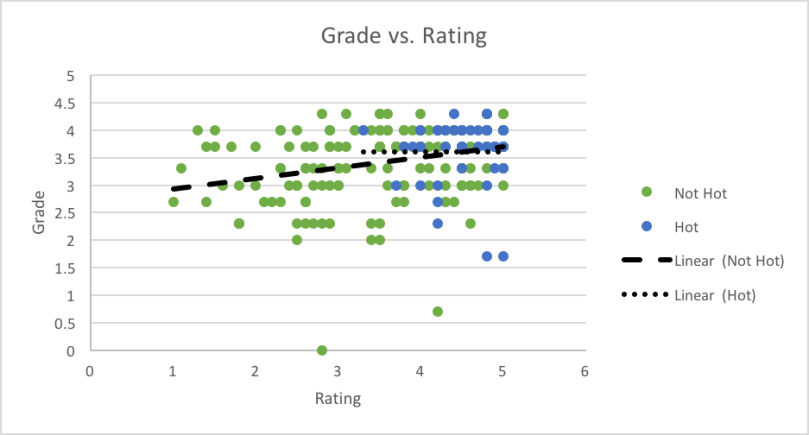
Ratemyprofessors.com is a site where students can post ratings of professors they have had, evaluating them on “helpfulness,” “clarity,” and “easiness.” “Helpfulness” describes how available and approachable the professor is. “Clarity” describes how well the professor teaches the material. A teacher’s overall rating is the average of their clarity and helpfulness scores from everyone who has rated them. “Easiness” is not factored in, though students can still use this measure to rate “how easy or difficult a class is”. Students can also post the grade they received in the class, and they can note whether their teacher is “hot” or not. Hotness is not measured numerically, but teachers who are hot are marked by a red chili pepper on their page. If there are more students who say a teacher is hot than students who say a teacher is not hot, the chili pepper will appear, though the number itself is not displayed.

The puzzle here is that teachers who are “hot” seem to receive a higher overall rating—a 2006 paper from Medaille College found that teachers labeled “hot,” on average, scored 0.8 points higher on their overall rating, suggesting either that hot teachers are more helpful, and teach their material more clearly, or that students are biased toward giving hot professors better ratings, regardless of their quality as a teacher.Read More »

How a World Makes a Story

Whenever I’m writing a secondary world, I always draw a map. Even when I don’t need to—even when the characters aren’t going to be traveling all over that beautiful map I drew. I imagine for some writers they aren’t important. It’s enough to know the distance between certain locations, and the names of the different countries, and that’s it. But I feel like I can’t start without knowing the shape of the world. I often don’t begin to do any world-building before drawing the map.

Part of it is this idea that I don’t know what I’ll need until I get there—I don’t know if I’ll need to know the topography of a certain part of the world until I’m in the middle of the first draft, and a character needs to have an anecdote about it. If I come across that situation, I’d rather be able to pull from an independent document rather than make something up on the spot (though I certainly have done that.)

Last week I talked about my personal process for drawing maps. This week, I’m writing about how all the information that I put into my maps helps me with world-building, characters, and plotting. While everything I’m going to talk about can be accomplished through written world-building, I find that maps do a lot of the same stuff much better and more efficiently than written descriptions. So, here are the four aspects of world-building and plotting for which I rely greatly on maps.Read More »

How I Make a World

I write a lot of secondary worlds, so I draw a lot of maps. Some are fairly simple, some are more detailed. The more detailed ones are for worlds that I’ll have to write in for awhile—novel- or novella-length pieces. In this post, I’ll go through my process for making one of these most detailed maps, because the process for less detailed maps is essentially the same, but with only the specific aspects I need.

This post isn’t meant to be a how-to—it’s just my own system that I’ve developed and modified as I’ve been drawing maps for invented worlds since I was ten. There are a thousand ways to go about map making (one of those thousand being to not make a map at all), and this is just one of them. I’m sharing it because I think it’s interesting, and I haven’t read much from other writers about this part of the creative process. Hopefully it is at least entertaining, and at most it provides some useful tools for fellow writers to improve their world-building.

So, let’s begin.Read More »

Recommendation Dump, May 2016

Here are things I like.

Skeleton Gardens – Just a simple Ludum Dare game, but one with a really unique look and feel. You play as some sort of reaper, planting trees which grow skeletons warriors, as well as seeds to plant more trees. To ensure that the trees grow to maturity, you have to protect them from waves of knights attacking you. All of the trees appear to be randomly generated, as do the walls you can build and the special, massively destructive attack, all of them forming gnarly fractal patterns. Another fun thing about the game is that it always ends overwhelmingly—either you become overwhelmingly powerful, with hundreds of trees begetting hundreds more (and you get bored and close the game or let yourself die), or you’re crushed under an enormous onslaught of knights. I guess there’s something cathartic in that. There’s no cheap or meaningless death. The music is real fun too.

Politics Politics Politics – Of all the podcasts I listen to, this is the only one that’s pretty much a one-man show. Justin Robert Young, the host of Politicsx3, occasionally has on guests, but for the most part it’s just him—and he does a fantastic job. The content of the show is evident in the title. Politics, man. Specifically the 2016 US presidential elections. But it’s not a podcast about ideology, or policy, or anything like that. In Justin’s own words, from Episode 0 of the podcast,

“I was the only motherfucker in South Plantation High School who rolled in with the Kenneth Star report … this story perfectly encapsulates why I’m doing this show, why I love politics … I was not reading it because I thought Bill Clinton should be exonerated. I was not reading it because I thought Bill Clinton should be thrown out of the White House. I was reading it because they printed a bunch of shit about a dude getting his dick sucked, in the newspaper! … It is only politics … that has that carte blanche.”

And that’s what makes the show fantastic. Justin is incredibly energetic, and his love of the political game is always on full display. He’s also quite knowledgable about politics, and does a great job of analyzing the strategies of each candidate. The most recent episode came out yesterday, covering the recent dropouts from the election, and the campaign to come. With the primaries (pretty much) over, now’s a great time to start listening. The show is fantastic, and I’m sure it’s only going to get better as we move into the general election.

“How a fluke video game called the Eternal War became a cultural phenomenon—and changed its creator” – I’d heard about The Eternal War awhile ago in a Kotaku article, and I went and looked it up again recently. That’s how I came across this article, which does a really good job describing the whole story of the game. If you’re a normal person and you don’t know what I mean when I say The Eternal War, it’s a Civilization II game that someone played on and off for ten years—well past the time when the game is supposed to end.

Normally, the Civilization games simulate the rise of civilizations, from 4000 BC to the current time—and one of the civilizations will reach a victory condition, and win by the year 2020. But the player can continue playing after this, and one player, James Moore, did—for ten years. In his game, the world became locked in an endless, bloody stalemate between three superpowers, thus giving it it’s name, The Eternal War. That should be enough to intrigue you to read the article, which has plenty more interesting details, about the life of James Moore, and about the community that grew around the game when he posted about it on Reddit. It’s a really cool story about the convergence of history, culture, and technology. Check it out.

Lonely and Horny – If you’ve never watched Jake and Amir, or listened to If I Were You, you should probably go do those things. If you have, it should come as no surprise that Lonely and Horny, the first creative work (that’s been released) from Jake Hurwitz and Amir Blumenfeld since their webseries, Jake and Amir, ended a year or so ago, is hilarious.

The show, consisting of ten eight-to-ten-minute episodes, follows Ruby Jade, played by Amir Blumenfeld, who is enrolled in a hooking up class taught by Josh Rice, played by Jake Hurwitz. The episodes focus on this class and Ruby’s various attempts (and failures) to “close” with a girl. The show doesn’t have much of a story arc, though each episode does add more to the whole. The series feels like a thesis on being lonely and horny and pathetically desperate, and each episode fleshes out more of that, and more of Ruby Jade’s life and personality.

Amir’s performance is captivating. He walks a line between a crazy, exaggerated caricature and a real person with recognizable ticks and behaviors. That’s what makes the character, and the show, so funny. Underneath the over-the-top pick-up lines and sexism is a current of real insecurity—which makes the absurdity of the scenes even funnier. And of course, the scenes between Jake and Amir are dynamite.

The show is now available in its entirety on Vimeo, for $15—and you can watch the first episode free here.

Those were things I like, and hopefully you’ll like them too.