
Got a bit of a grab bag this time around. One long review of The Agony and the Ecstasy, a shorter review of A Fine Balance, and a shortest review of The Hard Tomorrow. Also, after all that, some news about two writing projects I’m putting out this month, and an opportunity to place an ad in my zine! Pick your poison.
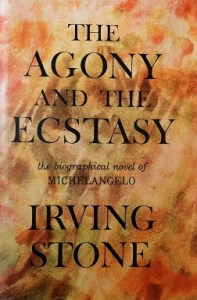
The Agony and the Ecstasy by Irving Stone is a biographical novel about Michelangelo. It starts when he is 13, about to be apprenticed to Domenico Ghirlandaio, and continues throughout his entire life, right up to his death at age 88. The plot is pretty much exhaustive—no part of Michelangelo’s life is omitted, though some is summarized, especially towards the end.
Initially, I concluded that “The Agony and the Ecstasy is a hack job, and it is glorious.” By “hack job” I meant that there’s really no artistry to it. Irving Stone is not making artistic decisions about how to represent things, he is not emphasizing certain moments over others. Every bit of information, every major event, is dutifully transposed into a kind of dramatized biography. This changes slightly towards the end, which I’ll explain more below, but I think my initial impression still applies to 90% of the book. No one should read this who does not want to read a 600-page biography of Michelangelo.
That’s not to say Stone is unskilled, not at all. The drama is compelling, the dialogue and narration are effective. He is rendering well, but he is only rendering. There’s no attitude, no flair, no vision. He is like David, an artist in the studio of Ghirlandaio who Stone describes thus: “David had been well trained in enlarging to scale the individual sections and transferring them to the cartoon itself, which was the dimension of the church panel. This was not creative work, but it took skill.”
The single biggest artistic choice Stone made, and it is a bold one, is writing this book at all. Michelangelo lived a long life, so treating his life with the intense level of researched detail that Stone employs does require commitment, belief, a supreme confidence in the worthiness of the material. This is a hack job in that it lacks any creativity, but it is an uncommon hack job, one which took a tremendous amount of care and effort to complete.
And presenting this long, full life in such exhaustive detail, certain themes emerge. The book is not built around them, but they’re there for the reader to observe, recurring as they do again and again.
One is the idea of making a “body of work.” Michelangelo’s master Bertoldo exhorts him to do this when he is young, and Michelangelo returns to the thought throughout the book, often with dismay that he is not doing so.
That’s another major theme: not being able to work. Michelangelo is constantly held back from working on his true passion, sculpture. He is frustrated by miserly patrons, by commissions for paintings, by political unrest, by lack of materials. He always thinks he will finish a project much faster than he can, and many of his commissions he must abandon partway through—a struggle which should resonate with any practicing artist. I was reminded of this passage from Tillie Olsen’s Silences: “Twenty years went by on writing Ship of Fools, while Katherine Anne Porter, who needed only two, was ‘trying to get to that table, to that typewriter, away from my jobs of teaching and trooping this country and of keeping house.'” Michelangelo is forever struggling to get back to his studio, to his marbles, away from Papal politics and frescos and architecture.
Now the second biggest artistic choice Stone makes is the summarizing which occurs toward the end. On page 540, Michelangelo celebrates his 50th birthday. That is 540 pages devoted to 37 years of the man’s life. The remaining 110 pages cover the remaining 38 years of his life, ending at his death. And they are an eventful, productive time for Michelangelo. He still produces great statues, but Stone does not devote dozens of pages to each. Only the really colossal works like The Last Judgment and St. Peter’s Basilica get serious page space in the book. The rest is fleeting.
It’s an extremely effective portrayal of the cruel acceleration of time, the way the years go by faster and faster in Michelangelo’s old age. Michelangelo meditates on this frequently, and at times these meditations combine with his other great concern about creating a body of work.
“Now time and space became identical. He could not swear how many days, weeks, months passed as 1537 gave way to 1538, but before him on the altar wall he could tell precisely how many figures he had floating upward through the lower cloud levels to the rocky crags on either side of the Madonna and Son.” (607)
“The present and future had shape for him only in terms of work to be done. How many more works of art could he live? The conversion of St. Paul would take so many years, the Crucifixion of St. Peter so many more. Better to count the projects ahead than the days; then he would not tick off the years one by one as though they were coins he was counting into the hands of a wary merchant. Simpler to think of time as creativity: the two Pauline frescoes, then a Descent from the Cross he wanted to carve for his own pleasure from the last of his magnificent Carrara blocks …”(617)
It’s an effect which could only be achieved with Stone’s brutish maximalism, with the exhaustive nature of the first 500 pages of the book. Which is not to say I think that it’s the main point of this book, or reason enough to read the book, no. Read this book if you are interested in Michelangelo, if you are interested in Renaissance-era Italy, if you want a nice big buffet of historical drama that can last you a while—and, if you care, there are also occasional insights on art, life, and a life’s work along the way.
Also this is a prime candidate for adaptation into a miniseries. Stone’s estate should phone HBO.

A Fine Balance by Rohinton Mistry is a book I came across by searching for contemporary Dickensian books. Specifically Dickensian in these ways: centering on a large, kind of gross, diverse and stratified city; having a big cast of characters; having disparate characters collide with one another in unexpected ways; being entertaining! Having a narrative pulse! A Fine Balance surpasses all these expectations. To be clear there are aspects of it that are not Dickensian, and Dickensian characteristics it lacks, because it is by Rohinton Mistry and not Charles Dickens. Suffice it to say, it’s got the special urban sauce I so desire, so I was all about it. I listened to the audiobook narrated by John Lee, he is as good here as he is with China Miéville’s books (read: quite good.)
The main characters are these: a pair of tailors from a village seeking work in the big city (never named, but presumably Mumbai); a widow desperate to hold onto her independence from her brother, even after her husband has died; a boy from a different village, son of a store owner, coming to the city for school. They all come together in the widow’s home, as she has to take on the student as a boarder, and she employs the tailors to fulfill orders for a big clothing company. All this during The Emergency, a time when civil liberties and democratic procedure were suspended in the name of maintaining order (and keeping Prime Minister Indira Gandhi in power.)
Scenes, dialogues, conflicts, vicissitudes, bad luck, good luck, coincidences, slow burns, fast flames, drama! The good shit! Craft each piece well, pile them together artfully, and you get a great novel.
My only gripe is with the last hundred pages or so, where it shows its artifice a little. No new characters appear, and all the old characters are terminated or tied off in some way. Rather than a great tree branching out further and further, the novel’s structure is like a capillary network, splitting into finer and finer stands, but ultimately merging again into a single vein.
Not a bad structure to have necessarily, but it feels wrong for this book, whose central conceit is life as quilt—particolored, asymmetric, unpredictable. So much of the vitality of the novel is in the large cast of secondary characters, so seeing their subplots neatly resolved gives a distasteful, synthetic impression.
That said, the endings for the four main characters are solid. Brutal cyclicality, strange survival. And no redemption! Although characters throughout the novel philosophize on why life is worth living in spite of its senseless cruelty, with variations on “you gotta take the good with the bad” and “it’s all part of your life story, telling your story redeems all misfortunes,” the events of the novel do not vindicate these ideas. Feel how you will at the end, figure out a meaning for yourself. The book has no interest in patting your back with some pathetic sunrise, look-to-the-future newborn, transcendent artwork, or any other cheap trick to add a gilding of nuance to the brute tragedy of being alive.
Speaking of bullshit redemption, I just read The Hard Tomorrow by Eleanor Davis which is good, but feels like it ends right at what should be the midpoint. Right when there’s all this good stuff cooking, it throws out, in this order: an implausible happenstance manslaughter, some minor domestic violence, a time skip, and a newborn baby. And then it’s just over! None of these events are interrogated or developed, and the themes introduced earlier in the book are left half-baked. Totally irresponsible. Abdication of artistic duty. All of the cachet of addressing serious political issues, zero effort. Okay not zero effort, the artwork is fantastic throughout. What I mean is, Davis doesn’t risk anything here. She doesn’t really say anything. Who cares?
This makes it sound like I really disliked the book—I didn’t, I liked it alright, but I had higher expectations than just alright given the subject matter and the author. I expect more from you Davis, see me after class!
Upcoming Writing Projects, and a Call for Ads
Sometime around the end of September—let’s say September 29th, though it may be sooner—I will be releasing two new writing projects!

First is Stories About Kids Stealing Things, a collection of seven short stories. They’re not all about kids stealing things, but a lot of them are. Some of the stories have been previously published, like “Fuck You Pay Me” and “Red, Her Hand.” Others, like “Ride of the Blind Sighthound” and “The Harrowing of Castle Maddox” are never before published. Editors HATE these! Read the stories Neil Clarke doesn’t want you to see! Check out the writing that Sheila Williams detests! I kid, I kid, mostly.
The collection will be released as an ebook, which you will have to pay money to get. Here is a very rough version of the cover! Wow! The final version will have color, and a better purse.

If you want to read one of the stories for free … well I guess you could just read “Fuck You Pay Me” or “Inside Joke” online, but at the end of September you will also be able to read “Fires Burn Forever in this World” as a zine! It’s a short story about a city where the antiquated practice of leaving firefighting to private insurance companies, and letting uninsured buildings burn, has persisted right up to the modern era. And also fires burn for a very, very long time. Take a look at this little firemark I drew up to use for the interior! The zine will be free, let me know if you would like one by email at FrancisRBass [at] gmail [dot] com, or whatever backchannels you have. I’ll put out another post when this stuff is actually published of course, you can also let me know then.
Finally, I have one blank page in the zine which I would like to fill with some ads! You can take out an ad for the low price of FREE. Bear in mind the zine will be printed black and white, and the full page is 5.5 x 8.5 inches. Sending me a little promo graphic as a png or jpg works, or if there’s no graphic element, you can just send me text and let me format it how I see fit. Contact me at the above email.
Ok bye for now, ttys!
 Francis Bass