Tabling at Philly Zine Fest, and other updates

Mark your calendars, Philadelphians! November 1st, 11am-5pm, in Temple University’s Mitten Hall, I will be tabling at Philly Zine Fest! This will be my first time attending a zine fest as a vendor, and I’m very excited. Some things I’ll be selling:

  • All my previously published zines, to wit:
    • “Cartographer”
    • “Fires Burn Forever in this World”
    • “Is Magic School Still Worth It?”
    • “The War on Hormones”
    • Lonely Friends
  • A brand new zine about making a map!
  • Brand new goblin stickers from some of my goblin week drawings!
  • And a couple free things:
    • “Masters of the Wine Printers Guild” zine
    • “Just Dig” 1-sheet

If you are in the Philadelphia area please come by and say hi!

If you’re not able to make it, most of my zines are available on my Etsy, and sometime in November I’ll have the stickers and the new mapmaking zine up there, too.

Some other updates

The main thing I’m working on these days is a comic, One-on-One. I’ve drawn and inked about 20 pages (still need to “color” them in), and I expect the rest of the comic will be another 20 pages. Here’s a few sneak peaks. I hope to be finished with it by the end of the year, and have physical and digital editions up for sale.

On the reading front, I’ve finished Battle Hymn of China by Agnes Smedley and can at last move on to the actual sci-fi books on the list, starting with The Dispossessed by Ursula K. Le Guin. I’m over a hundred pages into it now and really enjoying it.

Battle Hymn of China was good, and I’d definitely recommend it to anyone who read and enjoyed Daughter of Earth. It’s not as novelistic as that book, much more episodic. Reading all the chapters together, they don’t combine or build on each other too much, but there are a lot of really fascinating episodes.

That said, I’m going to put my utopia/dystopia reading list on pause in October so that I can engage in my annual tradition of reading horror books for the spooky season. This year I plan to read:

  • Never Whistle at Night, edited by Shane Hawk and Theodore C. Van Alst Jr.
  • No Gods, No Monsters by Cadwell Turnbull
  • A Scout is Brave by Will Ludwigsen
  • And perhaps, if I have time, Strange Pictures by Uketsu, trans. Jim Rion

Look forward to a post about that 🎃. You can see my previous Spooktober posts here.

A New Way to Get Some Old Zines

Wow, it has been a while! Much has happened, but nothing worth posting about by itself, until now: I have an Etsy store!  Going forward, this is where I will be selling zines digitally. Up on the store now are copies of “Fires Burn Forever in this World” ($8.50), “The War on Hormones” ($6), and a second printing of “Is Magic School Still Worth It” ($6). I’d like to put out a second printing of “Cartographer” for sale there too, at some point.

If you live in Philly and want to buy something I have listed, I can give it to you in person for $1 cheaper! I’m also going to try to put more zines in shops around Philly, and table at some zinefests—more info on that TK. Right now there may or may not be some copies of “Magic School” at Iffy Books that you can pick up for free :).

That’s the big announcement, now for some other bits and bobs:

I have finished the novel I’ve been writing for the past year! I still need to edit it, but for the moment I’m taking a break from it and working on comics and short stories. Here’s a lil drawing I made a while ago, of one of the characters from the book. 🙂

And yes you read that right, comics! I’ve decided it’s something I want to take a little more seriously, something I want to do more consistently. To that end, I’m working on filling out a collection of comics that I’ll release as a zine later this year, titled Lonely Friends. I’ve posted some of these comics on the website before, and there’s some I’ve never shared at all.

So look forward to me putting out that zine, posting a few more of the comics in it, and putting together a webpage that makes it easy to find all the comics I’ve posted so far. For now, here is a weird one I made during Comix Club at the Free Library of Philadelphia. I left the speech bubbles blank cause I didn’t really know what the characters were saying, I just wanted to put them in these poses. Maybe I’ll leave it like this for the zine, so people can fill it in themselves. What do you think they’re saying?

And finally, here’s a video of me biking along the Schuylkill River Trail on a foggy night in January.

Public Domain Day 2024: The Silencing and Rediscovery of “Life in the Iron Mills”

Happy Public Domain Day! Today, works from 1928 enter the public domain in the US and many other countries! Most infamously, this is the year that Steamboat Willie, the ur-Mickey Mouse, enters the public domain. The Duke Center for the Study of the Public Domain has a great write-up on what’s entering PD this year, as well as a detailed post about the Mickey Mouse situation.

As I do every year, I’m celebrating by ceding one of my own works to the public domain: “Just Dig”! This is one of the first stories I self-published, back in 2017. It’s a very short story about asteroid prospectors and luck. Has kind of a western vibe to it. It’s good! I’ll eventually upload it in more formats and update the ebook version on Smashwords, but for now you can read it in this single-sheet, printable version. To read my other posts about the Public Domain, or my other works in the public domain, go here.

I’d also like to take this opportunity to highlight a piece of writing which has been in the public domain for over a century, and which I love—”Life in the Iron Mills” by Rebecca Harding Davis.

“Belmont Iron Works Advertisement,” from “Directory of the City of Wheeling & Ohio County,” 1851. Digitized by the Ohio County Public Library.

This is a short story first published in The Atlantic in 1861, describing a few fateful nights in the life of Hugh Wolfe, a worker in an iron mill. The story was sensational and much acclaimed when it was published, and ahead of its time as far as exposés of the American underclass—this was decades before Jacob Riis and Upton Sinclair. However, the story and Harding Davis fell into obscurity for a while, before being re-introduced to the world in 1972 by writer and literary scholar Tillie Olsen. Olsen, an editor at Feminist Press at the time, published a new edition of the story, along with a lengthy biographical essay about Rebecca Harding Davis, drawing parallels between the thwarted creative efforts of the character Hugh and those of the writer. Olsen then expanded on this idea in Silences, a book about authors whose output was stifled or cut short by their socioeconomic circumstances (e.g. being a woman, being poor.)

I mention all this because 1. reading Silences is how I discovered “Life in the Iron Mills,” 2. I think Silences is required reading for anyone serious about being a writer, and 3. this cultural transmission is a triumph of the public domain. “Life in the Iron Mills” probably entered public domain in 1917, if not earlier. If it had been subject to our current laws, it wouldn’t have entered public domain until 1980, 70 years after Harding Davis’s death. Tillie Olsen would have had to track down the author’s estate and pay for the copyright. If she couldn’t find the estate, or couldn’t reach an agreement with it, she would’ve had to wait eight years for it to enter public domain. Basically my point is that our fucked copyright law is another form of silencing.

If you want to read “Life in the Iron Mills” now you can read it on Project Gutenberg, or you can get the 2020 edition of it from Feminist Press, which includes Olsen’s biographical essay, a few other short stories by Davis, and a new foreword by Kim Kelly. I would not recommend the 2020 edition though. Kelly’s foreword adds nothing, and the story itself contains several typos—right away there’s a typo in the epigraph, and later on an entire paragraph is missing! I would recommend just reading the story, then reading Silences, which does include a version of Olsen’s biographical essay on Harding Davis.

You can also read it in this little zine edition I made! And here’s a print-imposed version, you can just print this 2-sided, short-edge binding, and it’ll come out perfect.

I put this zine together over a year ago, just as a proof of concept for making little booklets like this, and I think I did a pretty good job. Nota bene: I included Olsen’s introductory note, so this zine is not public domain! This zine is illegal! But I think Olsen’s note is so good, one of the best introductions to a literary work I’ve ever read—probably because it’s so brief. So I will take her lead and not waste any more of your time.

Happy Public Domain Day!

New Edition of “The War on Hormones”, Year in Review, and More!

I’ve got a bunch of little announcements to make so I’m throwing them all together in this post, roughly in descending order of importance.

Free Zines!

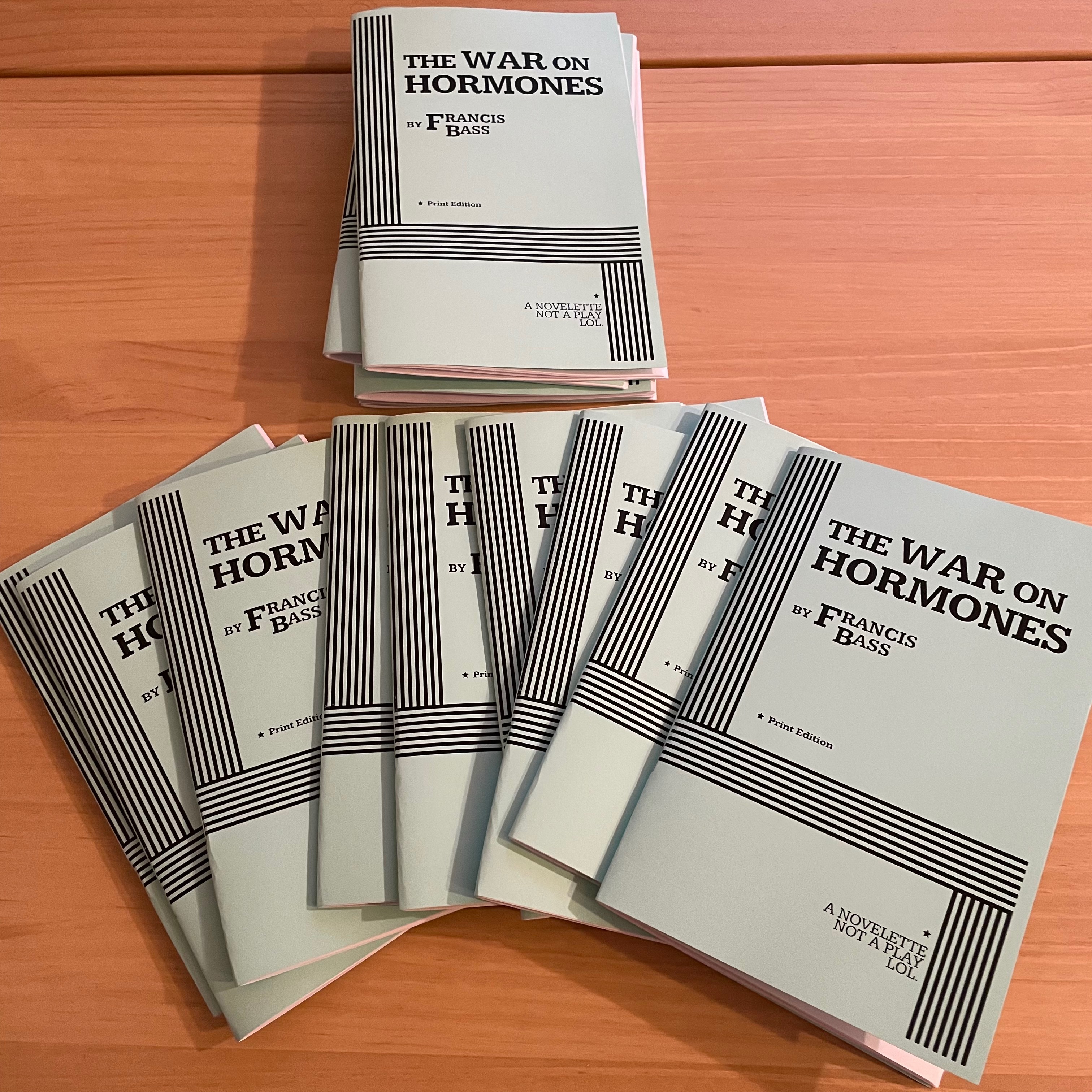
As promised, here is the 4th and final zine of 2023! This one is a re-issue of a novelette I previously published as an ebook, “The War on Hormones.” It’s about pharmaceutically asexual teenagers at a performing arts high school, and I wrote it when I myself was in 12th grade. Despite or because of this, I think it holds up! I had fun rereading it, anyway, and only made a few minor edits for clarity. I also cut the afterword to keep it a more conveniently printable length.

This new zine edition is free! Just email me at Francis.R.Bass [at] gmail [dot] com and I’ll send you a copy. You can also still buy the old ebook version on Smashwords if you want to throw me some money.

Also, if you would like any of the zines I’ve previously released, now is your last chance to get them for free, with free shipping!

To wit, that is:

  • “Cartographer,” a grotesque fantasy about a person lost in the colossal corpse of their god, and the mapmaker they always end up returning to. (LOW STOCK)
  • “Masters of the Wine Printers Guild,” an economic fantasy about a conspiracy of apprentices who decide to defy the masters and print their own wine;
  • “Is Magic School Still Worth It?”, a fantasy short story about trying to put a price tag on our nobler aspirations (i.e., magic.);
  • And “Fires Burn Forever in This World,” a short story about a city where the antiquated practice of leaving firefighting to private insurance companies has persisted right up to the modern era..

If you missed out on one of these before, or if you really liked one and want another copy to share with a friend, let me know! Going forward I will be charging for my zines like the mercenary wretch I am. So get them while you can, orders close Jan 1st.

Year in Review

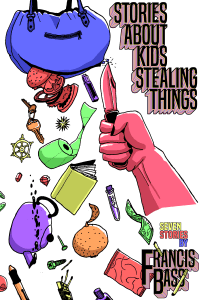
It’s been a pretty quiet year on the magazine front, but a big year for self-publishing stuff. There are all those zines of course, and also a new collection of short stories which I released as an ebook, Stories About Kids Stealing Things. The book collects seven stories about people with very little ability to control their own lives, and no ability to control the world at large. They are going to try anyway.

It’s also probably the coolest cover I’ve ever made.

I wrote a very long and very negative review of The Parable of the Sower. I mean, I wrote plenty of other reviews this year, but I think this one came out really well, and even if you don’t care about the book, the review gets at some of the things I find lacking in dystopian fiction. If you only read one of my posts from this year, read that one.

No new publications in magazines this year, but I did have one reprint—my story “The Mechanical Turk Has a Panic Attack” appeared on Escape Pod! This is a story I really love, and it was great to have my work appear in such a prominent institution of contemporary short sci-fi.

Not much other than that! I am still writing this fucking novel, the one I mentioned I’d started back in April. It is about 2x the length I expected it to be. I will hopefully have the first draft finished in January, and then can spend the next year writing short stories. I like writing novels, and I honestly think this one is going to come out amazing, but I think I am just too artistically promiscuous to write long projects like this one all the time. Like I cannot imagine committing myself to another novel right after I finish this one. So I’m looking forward to being a narrative slut next year.

Public Domain Day

Public Domain Day approaches! Each year on January 1st, Public Domain Day, I celebrate by releasing one of my works to the public domain. Last year, some friends and fellow artists joined me in this, ceding some of their works as well. If you would like to do the same this year, let me know so I can link to the work you’re ceding in my post! The work can be a song, a photo, a short story—anything you’ve made and would like to release forever to the commons.

For more info on Public Domain Day, you can check out my page on it, or the post from last year.

Happy holidays, see you January 1st!

What I’ve Been Reading, September 2023

Got a bit of a grab bag this time around. One long review of The Agony and the Ecstasy, a shorter review of A Fine Balance, and a shortest review of The Hard Tomorrow. Also, after all that, some news about two writing projects I’m putting out this month, and an opportunity to place an ad in my zine! Pick your poison.

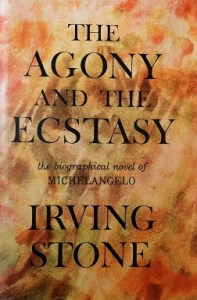
The Agony and the Ecstasy by Irving Stone is a biographical novel about Michelangelo. It starts when he is 13, about to be apprenticed to Domenico Ghirlandaio, and continues throughout his entire life, right up to his death at age 88. The plot is pretty much exhaustive—no part of Michelangelo’s life is omitted, though some is summarized, especially towards the end.

Initially, I concluded that “The Agony and the Ecstasy is a hack job, and it is glorious.” By “hack job” I meant that there’s really no artistry to it. Irving Stone is not making artistic decisions about how to represent things, he is not emphasizing certain moments over others. Every bit of information, every major event, is dutifully transposed into a kind of dramatized biography. This changes slightly towards the end, which I’ll explain more below, but I think my initial impression still applies to 90% of the book. No one should read this who does not want to read a 600-page biography of Michelangelo.

That’s not to say Stone is unskilled, not at all. The drama is compelling, the dialogue and narration are effective. He is rendering well, but he is only rendering. There’s no attitude, no flair, no vision. He is like David, an artist in the studio of Ghirlandaio who Stone describes thus: “David had been well trained in enlarging to scale the individual sections and transferring them to the cartoon itself, which was the dimension of the church panel. This was not creative work, but it took skill.”

The single biggest artistic choice Stone made, and it is a bold one, is writing this book at all. Michelangelo lived a long life, so treating his life with the intense level of researched detail that Stone employs does require commitment, belief, a supreme confidence in the worthiness of the material. This is a hack job in that it lacks any creativity, but it is an uncommon hack job, one which took a tremendous amount of care and effort to complete.

Read More »

Public Domain Day 2023: Now With 400% More Artists!

Happy Public Domain Day! This is my sixth year of celebrating Public Domain Day by releasing one of my works to the public domain, and this year I’ve reached out to get some other people involved. So not only are works from 1927 entering the public domain (you can read more about that here), and not only is something by me entering public domain, but also works from Trevor Neil White and I. Riva are now free for anyone to read, share, copy, and modify!

The short story “Feeding Day” by Trevor Neil White is a series of intersecting vignettes set in a world where the two-party system also happens to have a digestive system.

“Barrow Sentinel” by I. Riva is a short story in the style of an oral folk tale—a warning to would-be adventurers and “heroes.”

EDIT: Two more artists have joined in! “Way Down in the Country Mud” by Rybin is a short science fantasy story about a young man trying to survive and find some meaning in a rapidly collapsing society.

And Miranda White is ceding “The Weeping Statue”, a short, weird Game Boy fable about identity, friendship, and birbs. Playable in browser, Game Boy emulator, or on a Game Boy flash cartridge. Also in the public domain, available as a separate download: original .mod chiptunes, sprite sheets, and pixel art backgrounds from the game, plus a few bonus pieces that didn’t make it in.

Lastly, my novelette “Masters of the Wine Printers Guild” is an economic fantasy about a conspiracy of apprentices who decide to defy the masters and print their own wine. To simplify things, I made a specific page for it which has downloads in a bunch of file formats, including a pre-formatted, easily printable zine! I have jokingly described this as a story about printing a zine with a bunch of your friends (except the zine is magic wine), so it only seemed fitting. You can check it all out here.

Going forward, I would love to keep having other artists join me in celebrating Public Domain Day in this way. It is abundantly clear that lawmakers are not going to make the radical changes to copyright law that we need, so I believe it falls to creators to give back to the commons proactively. Shout out to everyone who joined me this year, and if anyone would like to join me next year, or is doing something similar, please let me know! You can also find my previous posts about the public domain, and my works therein, here.

Now, for some unrelated end-of-year things.

Read More »

Making the “Cartographer” Zine, and the Possibilities of Print

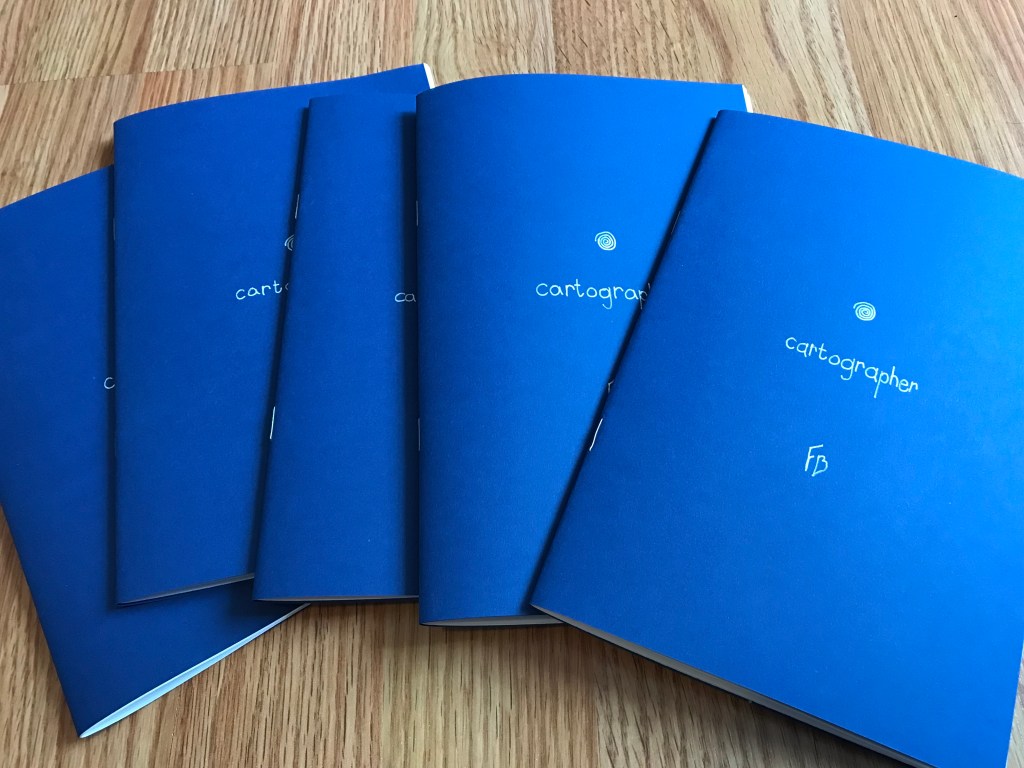
A photo of the booklets. the covers are blue cardstock with white lettering. they each bear a spiral, the word "cartographer", and my initials—"FB".
In all their glory.

This post was originally just an unlisted page on my website, exclusively accessible through a QR code in the back of the print edition of “Cartographer.” But I think the ideas here may be of general interest, whether you’ve read “Cartographer” or not, so with some modifications I’m posting it to the blog!

Contents

The Possibilities of Print

So my first major premise is that reading on a screen sucks. It sucks because a lot of people already spend most of their day staring at a screen. It sucks because you are staring into a light source. It sucks because that light source is always refreshing, shooting 60 images at you every second. It sucks because there is other stuff on that screen that can distract you—even if you are good at focusing, notifications can still pop up depending on the device. (I do see the irony that you are reading on a screen right now—but I think these annoyances are more tolerable for short texts.)

E-readers are the exception. Although it’s still a screen, most e-readers use e-ink displays, not LCDs. The display reflects light, like paper, rather than shining it at you, and it has a much lower refresh rate—the text just sits there, stable, until you “turn” the page.

Turning pages in itself is another benefit of e-readers. There is some satisfaction gained with each page turn that is totally absent with scrolling. As I understand it, this is part of why kids’ books are printed with large text and broad margins—to provide a sense of accomplishment even when reading relatively little, relatively slowly. Each page turn is a little mile marker surpassed. Even as an adult, I find my brain switching modes depending on how much white space there is on a page. Big, chunky paragraphs: serious reading ahead. Dialogue and two-sentence paragraphs: yes lets go fast fast fast!

With all that said, there are two problems with e-readers, from a writer/publisher perspective. First, not everyone has one. I read a ton, and have done so for a while, and I only just got my first e-reader a few months ago. They can be pricy, at least compared to the free pair of eyeballs in your head.

The second major issue is that ebooks are a pain in the ass to design, and you basically can’t guarantee they will look nice across multiple devices. Ebook files are like html files, in that they are meant to display the same content across multiple different devices and apps. The content stays the same, but the style and layout might shift. E.g. Chapter 4 of a .epub may start on page 100 on a computer, page 200 on a phone, and page 150 on an e-reader. That’s pretty minor, but there are bigger issues when it comes to style. “Keep with next” doesn’t seem to work, ever. Drop Caps look dramatically different across different devices, with the one commonality that they all look equally jank (check out this article about it and scroll down to the example screenshots.) Why do websites look good and consistent across devices, and ebooks don’t? My guess is that it’s because the corporations selling the e-readers do not want cross-compatibility. Amazon even has its own file format. There is no effort at coordination, no effort to make an ebook look good if it wasn’t purchased through the given e-reader’s marketplace. I guess people think books are just text, and who cares about the container.

Well, I care about the container! Sitting on a park bench and unfurling a risograph-printed brochure to read about architecture, I can tell you from experience, it rules. The same text on a computer screen in my stupid bedroom, or on a phone screen at my stupid job—that would not rule. The text can still be very good. It can be transcendent, and someone reading it can recognize and appreciate it as such. But the actual reading experience will be worse. (For instance, I read most of Rebecca Solnit’s Men Explain Things to Me on the Bluefire Reader mobile app [barf] during rehearsals. Great book, awful way to read it.)

Read More »