No One Thinks of Salt

No one thinks of salt.

Of course, people who live in cities close enough to either pole of the Earth do—they see it on sidewalks and roads and doormats for some period of time every year. They couldn’t not think of it, like they couldn’t not think of shoes. But they don’t really think of it in the way I mean. By “think of,” I mean “think up.” And while this could be applied more broadly, I’m mostly focusing on writers when I say “no one.”

More accurately I should say “no one would think of salt,” but that’s not as snappy. Besides, the idea came to me as “no one thinks of salt!” with an implied “if they have no exposure to it.”

So now that everyone’s confused, I’ll try to start making sense. I’ve lived in Tallahassee, Florida almost my whole life. The city, and the entire county it’s in, has just one snow truck, which practically never gets used. In my whole life living there, it only snowed once—and then it was more sleet than snow. So I definitely didn’t think of salt.

I knew that people salted roads in cities where it snowed, but what I didn’t consider is that sidewalks would be salted too. Now that I live in Iowa City, and I’m experiencing my first northern winter, I’ve realized that this is the case. I’ve also realized that salt gets stuck in the treads of your boots, and ends up all over the floor if you don’t kick them off thoroughly. Had I written a story before I lived here, about a city experiencing a typical, snowy winter, I never would have thought to add the detail of a character having salt caked around their boots. But that kind of inventive, extrapolated detail is what makes good writing, especially in science-fiction and fantasy.

Granted, world-building isn’t everything, and a well-told story with the typical fantasy props (castles, dragons, swords, etc.) can still be fun. But there’s no reason a writer can’t tell a good story and develop a well-realized world. Reading science fiction from the fifties, it always nags at me when nuclear power shows up. Many sci-fi writers used it as some catch-all that could power everything from household appliances to helicopters, rather than fully considering other potential energy sources. As a result, the worlds feel simplistic and flat.

Kim Stanley Robinson on the other hand is an excellent world-builder (though not from the fifties.) In his Mars trilogy, he has the typical tented colonies you might find in any martian story, but he also considers the possibility of cities built into mesas, or under the ice caps, or within lava tubes. His rendition of a colonized Mars feels explorable and deep.

Now back to the salt that no one thinks of. Let’s suppose an Earth that is covered by an enormous ocean, with every human being confined to an equatorial island where it never snows. On this tropical island, fantasy writers might spin tales of an incredible world where ice falls in little droplets from the sky. Science fiction writers might speculate about colonizing the polar ice caps. Would these writers consider the problem of snow obstructing paths, and the need to remove it? Probably. But what would their solutions for this problem be? They’d probably be pretty straightforward, and be more impractical than they’d appear on paper. These writers might imagine snow plows, or heated roads, or awnings that could extend to cover pathways when the snow fell. Maybe these writers would lazily speculate that snow could be channeled through gutters just like rain. Salt, although highly practical, would not be the common representation of a solution in these snow stories. But if some writer were inventive and thoughtful enough to envision salt as a solution, their story would be so much richer than the same-old same-old plows and heated roads.

This is what makes some speculative fiction feel not so speculative. What’s fantastic about another retread of Tolkien’s orcs elves and dwarves? What’s innovative about a domed colony on Mars?

It’s the writers that take the time and consideration to extrapolate, and solve problems from the viewpoint of a character in that world rather than an outsider, that create three-dimensional setting. Beyond speculative fiction, it’s the writers that research, or actually visit the setting of their story and fully observe its complexities, that portray a landscape which feels genuine.

It’s the writers who think of salt that craft worlds a reader can live in even after they’ve stopped reading.

Upcoming Publication: “Grumbles”

I’m thrilled to announce that my short story, Kzine15cover“Grumbles,” will appear in the May 2016 issue of Kzine, which will be published sometime around the end of May.

Kzine is a kindle only magazine featuring stories of crime, horror, fantasy, and science fiction. My story falls into the latter category, and once again deals with robots. More than being about sentience or robot souls though, “Grumbles” is about preserving memories, and choosing which memories to hold onto. More literally, it’s about a foul-mouthed robot companion arguing with his owner about what childhood memorabilia the owner should pack for his move out to the asteroid belt.

So … get hype? I think that’s the industry parlance.

Chapbook – [Unintelligible] and other works

bottom-borders-smallest

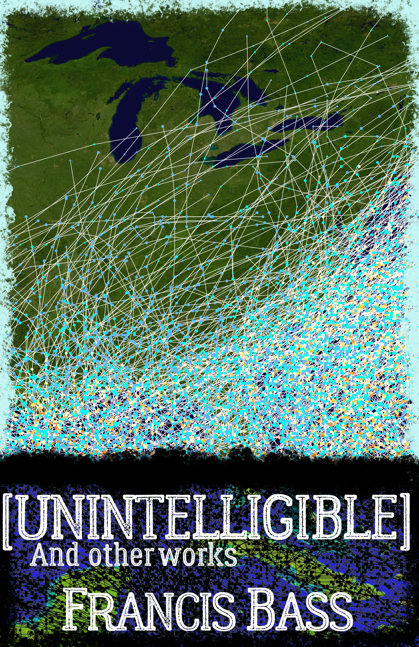
As promised, here’s a PDF of the chapbook, containing two essays and a writing exercise. To be clear, it’s not a published chapbook, it’s a small compilation I made as the final project of a writing class.

The works contained within are “A Faulty Baseline,” “It Was Unbroken,” and of course “[Unintelligible].” And in case you’re wondering, the image on the cover is a portion of a map showing  the paths of every Atlantic hurricane from every hurricane season since 1851.

Riding NaNoWriMo Out

Back Again
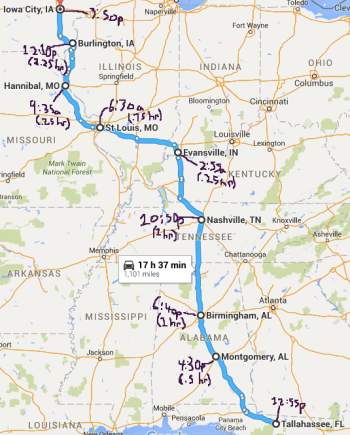
My route as generated by Google Maps, with major stops, arrival times, and layovers

I posted about the bus ride to Tallahassee, now here’s the bus ride back to Iowa City—as well as the final day of NaNoWriMo. This bus ride was only 28 hours, starting at 1:00 pm est on Saturday, and ending at 4:00 pm cst on Sunday. I did a lot more writing this time around, so this post is more focused on NaNoWriMo, and there are no pictures. It was mostly the same cities anyway, nothing new to see.


I started out at around thirty-three thousand words written—seventeen thousand to go.

1:19 pm est

We’re heading out of Tallahassee now. This bus isn’t too crowded, but there is someone next to me. Hopefully they’ll get off in Montgomery. And hopefully more people won’t get on. These are the hopes.

I’m going to write a bunch of Stuffed now.

 2:24 pm cst

We just stopped in Dothan, and I just wrote a shitload of Stuffed. I wasn’t sure whether or not I would, or if I even wanted to. Completing NaNoWriMo isn’t so much something I need to do to prove that I can, because I already know I can. The question really is, do I want to get this book done faster? So I decided that I don’t want to take months and months to finish books (even the shortest novel I’ve ever written took three months to write the first draft of—longer, including false starts and outlining.) I’m not going to do that when I’m a professional writer, so I’m not going to do it now. If I want to finish book one of Stuffed within two months (I do), finishing NaNoWriMo is a great way to reach that goal.

But really, I wrote so much because it was a lot of fun. The above thinking is only what got me to start writing.Read More »

A Mid-Month NaNoWriMo Update

So far, I’ve been having a nice, lazy, NaNoWriMo. That was my exact plan, and why I decided to write a book about my stuffed animals instead of some horribly complicated time travel thing.

Well, it turns out that when you have a lazy NaNoWriMo, you fall behind! About 10,000 words behind. Who would’ve thought? I kind of did. It’s not so much that I’ve been lazy as it is that I’m prioritizing school work, and not writing much of Stuffed. And I expected that would be the case. The wonderful thing about NaNoWriMo being in November (for Americans, anyway) is that there’s a nice big Thanksgiving break near the end of it. There’s also Veteran’s Day, but UI didn’t give us the day off for it.

The point being, I planned for this. I knew that I would have a long Thanksgiving Break to get a lot of writing done, not to mention two long bus rides to and from Tallahassee. “Long” meaning about thirty hours. I’ll probably spend my time reading, writing, sleeping, drinking coffee, listening to podcasts, and doing various combinations of all those things at once. I may make a post about it, because it seems like it’ll be a fantastic adventure. The most time I’ve ever spent on the road was on the car trip up to Iowa City, and when I did that we stopped for a night in the middle. There’ll be stops on the bus ride, but none of them ten-hours long.

So, that’s where I’m at mid-month. I plan to get up to 20,000 words before my bus ride, but who knows. I have a 10-page paper due this week, so I may not write another word of Stuffed until I’m on the Greyhound. Whatever happens, I’m not worried. Comebacks are more fun anyway.

Did the Author Really Mean That?

Today in my Dickens class, though in a roundabout way, the question was asked.

Did Dickens intentionally use all of the rhetorical devices that we analyze throughout his writing? (The actual question was how long it took Dickens to write his books, assuming that the more time he spent the more likely it was that his subtext was intentional.) This is a question I’ve heard in classes throughout my education—Did the author really mean that? Is it really possible that the author consciously layered in so much meta-textual meaning, or are we looking too hard? The paradox that jumps out at me most is the fact that a person can spend more time analyzing a sentence than the time it took to write the sentence—how do we reckon that?Read More »

Why Do I Keep Writing Science Fiction?

This is a question that nags at me a lot. Why do I almost exclusively write fantasy and science fiction? I normally try to challenge myself, writing in a format or style or length I’ve never written in before—and yet, I continually steer clear of realistic fiction. It seems childish.

One theory is that I’ve hardly lived at all, so I have hardly anything real to write about, and to fill that cavity I have to shove in gods and phasers. That might be part of it.

It’s not as though I’m actively avoiding it. Whenever I come up with ideas for stories, it happens that the ones that excite me are the fantasy ones. I can’t help what excites me, can I?

And then I realized that speculative fiction is just like all fiction, except the world is made up too. Simple, obvious even—I know. It’s the implications of this that got me really thinking.

As far as content goes, there are three elements of a story. Plot, setting, and character. Of course that’s totally simplified BS, but for the purposes of what I’m getting at here, this is how it is. In realistic fiction (or “fiction” as bookstores group it) the plot and characters are invented, but the setting is the same. In science fiction and fantasy books, world, character, and plot are all invented. And this is why I write science fiction and fantasy. I like to make up the world as well as the characters and plot. Why then is this type of fiction labeled differently in bookstores, if it’s just one degree more of made-upness? Totally superficial reasons, which I don’t know enough about to discuss here.

But let’s look at the actual differences. Having a book set in the real world does make for a different book—it’s not completely superficial. It changes the frame of reference, the immediacy, the way a reader processes a book. But the problem is, this is the case for more than just setting.

Why doesn’t a series like Foundation by Isaac Asimov belong to it’s own genre? The characters and world are made up, but the story is roughly modeled on the fall of the Roman empire, which makes for a different reading experience than if it was totally made up.

And what about a book like  Last Night in Twisted River by John Irving, in which his own life and total fiction are mixed together in every element of the story? The way that reality and fiction interact in that story, and in the real world, definitely effected my comprehension and enjoyment of the book.

And what about my own writing? Although it feels like I’m always writing fantasy, when I look at my work this way, I’m really all over the place. In three of my latest stories, one had an invented setting/partially autobiographical character/invented plot, another a partially real-world setting/invented characters/invented plot, and another an invented setting/invented characters/invented plot.

But as far as I can tell, the division in bookstores is this: invented setting/x character/x plot is one genre, real setting/x character/x plot is another genre, and real setting/real character/real plot is a totally different section of the building. There are other books that are divided out based on specific types of plots (like mysteries) or types of settings (like westerns), which is even more obviously superficial than the division between fiction and fantasy. And even with all this division, there may be more variation between two Fantasy books than between a Sci-Fi novel and a Mystery (which, to niche in this whole other can of worms, kind of reminds me of this.)

Like I said, I don’t know the history of these superficial divisions very well. I’m not trying to explain them, or understand them. I’m just rejecting their ideas that I’d unintentionally internalized, and presenting a more dynamic (though still very simple) way of looking at differences in stories. I’m just telling you why I don’t care that I keep writing science fiction.

So About Next Month

We’re coming up on a fun month for writers—November, National Novel Writing Month. I’ll be participating, writing fifty thousand words of StuffedStuffed is a book concept I’ve toyed with but never seriously considered writing. It’s about stuffed animals. My stuffed animals, an ensemble of characters that I’ve held in my head ever since I first played with them. That’s why I never seriously considered writing it. I was afraid it would just be too self-serving, I’d spend too much time wallowing in nostalgia, and that the concept would be completely inaccessible to people who weren’t me. The whole idea also seems wildly unsalable, because the premise sounds like it’s meant for a chapter book, but I’m going to write it like any adult fantasy book.

My not taking it seriously is why I’m actually going through with it though. I have so much writing in the needs-to-be-edited pipeline right now (four books plus, actually), I need something that’ll just be easy. Something that won’t take much outlining. Something I won’t stress about editing. Something where I already know all the characters, and where whimsical discovery writing will fit the mood.

While I no longer fear the book will be too self-serving, I still worry about it being unsalable. But that just means I’ll release it in some alternate way. Maybe indie. Maybe totally free. Maybe a combination. I don’t know, but I’m certain writing it will be a blast.

So I’ll probably make a few NaNo posts throughout November. As a means of procrastinating from writing Stuffed, probably.

Everybody Submits (Except Whiners)

I recently overheard a conversation between two writers (but were they really?) about how much submitting sucked, how much bias there was toward known authors, how brutal rejection was. I wanted to run to the opposite corner of the room and hide from the abundant stupidity of that conversation. I might’ve interjected, but they were too far away from me. So let me break this down.

I don’t know how much bias there really is toward known authors. I have very little experience on the other end of submissions, and I’ve heard editors claim they don’t even know who a submission is from when they get it, and therefore have no bias. And yet, I can’t imagine Asimov’s publishing a novella by someone completely unheard of, without the writing being positively godly. I don’t know if things are any better or worse in the literary community—my knowledge is confined to speculative fiction markets. No matter what though, unknown people do get published, especially in magazines. Names sell issues, of course, but magazines are different from books. They’re subscription based, and they have multiple authors per issue. So it’s not like a book where a reader is deciding whether or not to buy a copy, they’re probably already subscribed. And for the people who aren’t subscribed, they can pick up an issue with a cover story by Aliette de Bodard that also has a short story by Unknown McNeverpublished.

Is it harder for unknowns? Who gives a shit. I’d be more stressed by being a known, and wondering if the market was accepting subpar stories just because I had a recognizable name.

Whatever. Not that important. Second part now.

“Rejection, it’s brutal.” Those were the exact words. I don’t understand this. I love submitting. And, while I’d rather be accepted than rejected, I enjoy getting rejected too. It means I can submit again.

I think what I like about submitting, and receiving rejections, is that it gives me a feeling of legitimacy. I don’t have much in common with professional writers—not in payment, not in success, not in quality of writing—but something I do have in common with them is that we all submit stories, and we all get rejections. At least, those professional writers who write short fiction do. And that connection to professionals is a cool feeling. With each query letter I write, with each story I put into standard manuscript format, with each new list of markets to submit to that I make, I feel like I’m doing professional work. And I also get a little spike of serotonin thinking, Maybe this’ll be the magazine that accepts this story. Maybe this’ll be my first published piece of short fiction.

And it’s the same with getting a rejection. It gives me a sense of camaraderie, like I’m tapping into this universal vein of disappointment and perseverance and writerliness. I’m not insane, some rejections are painful—like form rejections from a market that normally gives feedback, or rejection after a story has been held for further consideration—but mostly they’re just a small, manageable sting. What was worse was getting no rejections. For a while I was working on a 150K-word novel, and had no short fiction to submit, and I missed submitting so much.

So what’s wrong with these chuckleheads complaining about submissions and rejections? I imagine that they don’t realize that professional writers have achieved success because of long hard work. These clowns probably believe that writers are just like them. That professional writers are people with luck, or people with good connections, or people with god-given talents, or anything other than just plain, old, skilled workers. And because they believe that professional writers are so like them, they ironically don’t feel any connection when they submit, and instead suppose their actual writing to be the connection between them and professional writers. This is valid in some ways, but every writer’s process is different, so I’ve always felt that this writing is more of a personal thing. I suppose it’s less personal if you ape the process of a famous writer, which is what many writing books suggest, and can be a trap for aspiring writers. So by supposing themselves and professionals to be equal, these goofballs debase the writers, and devalue that tenuous but very special connection made in submitting.

The worse for them. I love submitting, and I’ll do it relentlessly just like every writer worth a damn has ever done. And they whinge about submitting, and they’ll do it infrequently—and the poor slush readers will have a few less submissions to read. The better for the workers.

1058 Miles from Home; An Epic Journey from Queso

I am roughly a thousand miles from my hometown now, but it doesn’t really feel like that far. I want to figure out why that is—after all, this is an important aspect of books. A large part of what makes an epic “epic” is a large scope. Scope can be rendered in a large cast of characters, or a long stretch of time, or in huge distances, or in all three. But how does an author make two landmarks feel far apart, without just telling the reader that they are?

The answer that jumps out to me is to show the journey. Show the blown out tires and midnight resting stops along the way. The problem is that I had this experience traveling from Tallahassee to Iowa City. My mom and I drove there over the course of two days. We went through the southern end of the Appalachians and a violent thunderstorm at the same time. We stopped in Clarksville Tennessee and spent the night at a hotel there. We carried on through Kentucky into Illinois, and puffy trees disappeared where expansive fields took their place. We passed by the St. Louis arch crossing from Illinois into Missouri, and finally came to our destination in Iowa City, Iowa.

And yet, I can’t conceptualize the distance between Iowa City and Tallahassee the way I can the distance between my house and Moe’s. It’s possible that this is because I’ve walked from my house to Moe’s. Maybe it’s just that I think of cars as slow teleportation—step into a box, wait, step out of the box and you’re where you want to be. Or maybe it has to do with inevitability. The car ride to Iowa City was as much a part of going to college as writing my application had been. The trip was an item in itself, not an expression of distance. When I walked to Moe’s, it wasn’t some inevitable thing.

For a start, I didn’t even have to go there. Not that anyone’s forcing me to go to UI, but it’s something that I’ve been set on for so long, it’s a fact of life. Not so with Moe’s. I made the decision on the bus ride home from school. It was free queso day, and I was going to take advantage of it. I had several moments of doubt when it was not certain that I would go—mainly, when I looked up on google maps the path that I’d have to take. It was long—fifty minutes. And it was hot out. But I went anyway. Every step was intentional. And now I’m beginning to understand what the difference is—the distance became tangible because it was a force that I had to conquer in order to get my free queso. I had to walk down long, unshaded roads with big hills. I had to consult my map when I cut through windy neighborhoods. Worst of all, I had to go through Frenchtown—the “bad” part of town, directly north of the Moe’s—and avoid all of the irrational racist fears that might be inspired there.

So it’s not enough to just show the distance, the distance must be tangible. It must be brought to bear against the adventurer, it must be clear that this distance stands between the quester and the queso. And there was only one moment where I had any struggle on the road, when I was driving through that thunderstorm and could hardly seen ten yards ahead of me. The rest of it was slow teleportation. All I had to do was sit for long enough, and I’d end up in Iowa.

Interesting.

Maybe I should hitchhike home for Thanksgiving, really feel the distance that way.

Or I could save the risk of (insert nightmare hitch-hiking scenario) and just pretend that Iowa City and Tallahassee are linked by a slow teleportation box called the Greyhound.

Blog Re-Beginning

So I’m going to pick up this blog thing again.

It’s for me, not for you. Apparently it’s good for a writer to build a platform, so that when you publish new stuff people can buy it, or if readers look you up they can see what your past publications are. And since I actually have something published now, and may have more some time in the sometime, I’m going to give this another shot.

Yes, it’s all about money. And on the topic of money, !!!THE TRIAL OF ADBOT 579!!! is a ¡¡PLAY¡¡ by me about advertising robots and humanity and you can buy it HERE HERE HERE.

In the past I did this blog (three whole posts worth) just because I felt like screaming into the void. I think I gave up on it because I ran out of things to say. Whatever happened, I’ll try to update regularly now. Maybe weekly. Maybe less often.

Although the point of this blog is to attract attention so that people will buy my stuff, the posts will rarely be advertisements.

Speaking of advertisements, I actually wrote a —-> ONE ACT PLAY <—- about an adbot called PLEA$E GIVE ME MONIE$ which you can purchase HHEERREE.

I’m not sure what the posts will be. I don’t even know what this one is. I feel obligated to start this blog with an introduction, even though this isn’t a book. Plus it’s not introducing anything, because I don’t know what this blog is going to be about.

So instead of trying to introduce a never-ending book I haven’t written yet, I’ll elaborate more on why I’m doing this blog. It’s only sort of about money. That is to say, I don’t expect this to do anything for my nearly nonexistent revenue until I have more major publications, ones with bios that point back to this website. I’d like to get into the habit of writing blog posts regularly though, so that when it actually matters I won’t be fumbling around with weird disorganized posts like this one, or slacking off and going through long hiatuses. I’ll have already been keeping up with this for awhile, and will have no problem continuing to post.

Now that I mention it, posting is kind of like…oh screw it.

The Ins and Outs of Routines

Back in the day, I was up at seven o’ clock every Saturday and Sunday.  I’d head to the kitchen and fix a cup of coffee, sit down at my Macintosh PowerPC, and I’d write until ten or eleven.  Then I’d make breakfast, and print out a chapter if I’d finished one.  I did that from sixth to eighth grade.  It was just the most intuitive way to do things—I had school during the week, so I wrote on the weekends.

Freshman year, I tweaked the routine a bit.  During the week I utilized class time in some of my duller periods to write story notes, while maintaining the weekend writing.

In sophomore year, things finally changed.  With classes I couldn’t just coast through, I had less time to outline stories.  Homework fluctuated from weekend to weekend and left no guarantee of a solid chunk of time to spend writing.  And when homework was on the weekdays, staying up late to finish it didn’t leave me inclined to get up at seven on a Saturday.  I managed NaNoWriMo, but I’ll get to that.  The rest of the year I bobbled in and out of my routine.  By the time it was summer, the system had been broken and I couldn’t get back into it.  I did try, but attempting to maintain the archaic holdover from middle school just meant I didn’t write on the weekdays, and wrote only a couple paragraphs on the weekends before getting distracted.

Trying to force that routine was bad.  But here’s where routines can be good.  When I did NaNoWriMo, I started a routine especially for it, and set out some rules.  Quoting directly from my journal, here they are:

“Every weekday, I will write one thousand words, starting today.  Every weekend or non-school day, I will write four thousand words.  During school I will outline the plots and characters of the episodes.  And school will always take backseat when the choice is between it and writing. ”

That last part was very helpful, and is part of why the NaNoWriMo system worked and my old routine didn’t.  But let me clear two things up.  First off, don’t worry about the math.  I was a bit behind at that point, so it does add up.  Secondly, I’m not advocating ditching school as a routine.  This was just for a month, so it was fine.

Now here’s my point.  Having a system in place, repeating a task day in and day out really helped me.  Each successive time I completed what I needed to do for the day, I could look back and have more and more productive days supporting me.  The routine was self-sustaining—or self-helping at least.  Obviously there were some bumps in the road, but NaNoWriMo’s  more fun like that anyway.

So what’s my opinion of routines?  I think they can be very beneficial.  But they can go obsolete, and if they do I have to step back and reaffirm that writing has nothing to do with circumstance.  I’ve written in houses, planes, buses, on a desk, a ping-pong table, my knees, with water, coffee, orange juice—and how productive I am is always up to me.

To put it as simply as I can, routines are only good when they give you a reason to write, not an excuse not to.