I think you can turn any idea into a play, and any idea into a piece of prose. However, there are some ideas that just suit one form or the other better, and since I enjoy writing both, I never try to make an idea that’s best for a short story into a play, or visa versa. I can’t really say what makes an idea excellent material for prose, because there’s so much flexibility in style and scope with prose fiction—however, plays are much more limited. So it really is special when I have an idea for a story, or find inspiration in some piece of news, and think, Man, that’d make a great play. So, when I’m considering how to develop an idea, these are the biggest characteristics that make me think it’d be a good candidate for a work of theatre.
Restricted Setting
This is probably the most obvious one. Because theaters have limited budgets, and limited stage space, most plays take place in one or a few locations. Of course there are exceptions, like every Shakespeare play, but most plays feature just one or two settings. This is something that sets prose and plays apart. There is a clear limitation on the story which is communicated to the audience. The characters can’t get around one another—they can’t solve their problems somewhere else. Everything is going to have to go down on stage, and that creates tension. Even if a prose story is all set in one place, there’s no feeling of suspense over the knowledge that it’s going to be finished in that space—because it isn’t necessarily going to be finished in that space. There are no inherent limits to the form, so the characters can go anywhere they want to, and it takes more work for the author to establish restrictions. With plays, the restrictions are instantly clear.Read More »

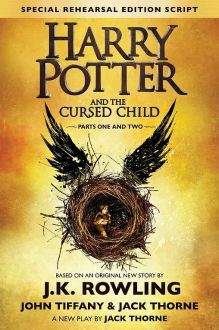 I just finished Harry Potter and the Cursed Child, and I feel like it was one of the most multi-layered reading experiences I’ve ever had with a contemporary work. By multi-layered I mean that I was thinking about, and analyzing meta-textual elements while reading it—which is a common enough experience, when I’m reading old literature for my english classes, but pretty rare with recently published books and plays. So, rather than just reviewing the play as I might review Mr. Burns or Water by the Spoonful, I’m going to review the play in all it’s aspects—the things I noticed as a reader, as a writer, as a theatre person(ish), as a fan of the original books, and as someone interested in the publishing industry. I’ll mention plot elements throughout this post, so if you don’t want the play spoiled, halt now.
 Francis Bass