Spooktober 2025 (and new zine!)

Alright before I get to the main event, I first have an announcement: I have a new zine out! “Map of the Lost City of Uatdan Wuchke” is an interactive fantasy story in which you, the reader, must draw the map. The zine includes a fold-out drawing surface for readers to use while they read. You can order it online on etsy, and I’ve also just added some bike goblin stickers to my etsy shop, if you’re interested in those.

Now, on to the spooky stuff! Every October I like to read a few horror books, and then review them all together in one post. You can see my previous spooktober posts here. This year I read:

Never Whistle at Night: An Indigenous Dark Fiction Anthology, edited by Shane Hawk and Theodore C. Van Alst Jr — I always expect multi-author short story collections to be a mixed bag, with some decent stories, some great ones, and some duds. But this book’s got no duds! The worst stories were just decent, and the best had me wanting to read more by their authors. The pieces encompass a great breadth of styles and genres, from blood-and-guts horror to lyrical ghost stories to gritty crime. It was also really fascinating to see so many takes on storytelling, with several of the pieces containing stories within stories. Here were some of my favorites:

  • “Hunger” by Phoenix Boudreau—a beautifully lyrical wendigo story which, three quarters of the way through, switches perspectives to become a kind of monster-of-the-week episode. Both parts well executed.
  • “Scariest. Story. Ever.” by Richard Van Camp—Much like Tenacious D’s “Tribute”, this is not the scariest story ever, but a story about the scariest story ever. The narrator wants to win a scary story contest, so goes to a storyteller to ask him for the scariest story he’s ever heard. The storyteller agrees to pass the story on, but starts by explaining how he came to hear the scariest story ever … wonderfully absorbing, layered, and sticks the landing. This one’s my favorite of the whole collection.
  • “Collections” by Amber Blaeser-Wardzala—a Native American English major goes to her lit professor’s party so she can schmooze a letter of recommendation out of her, and finds that the professor’s house is decorated with human heads. Real heads. No one else seems concerned. Collections.

I highly recommend this book to anyone who’s into horror or dark fiction—with any luck, you may find a new favorite author in there.

Read More »
Spooktober 2024

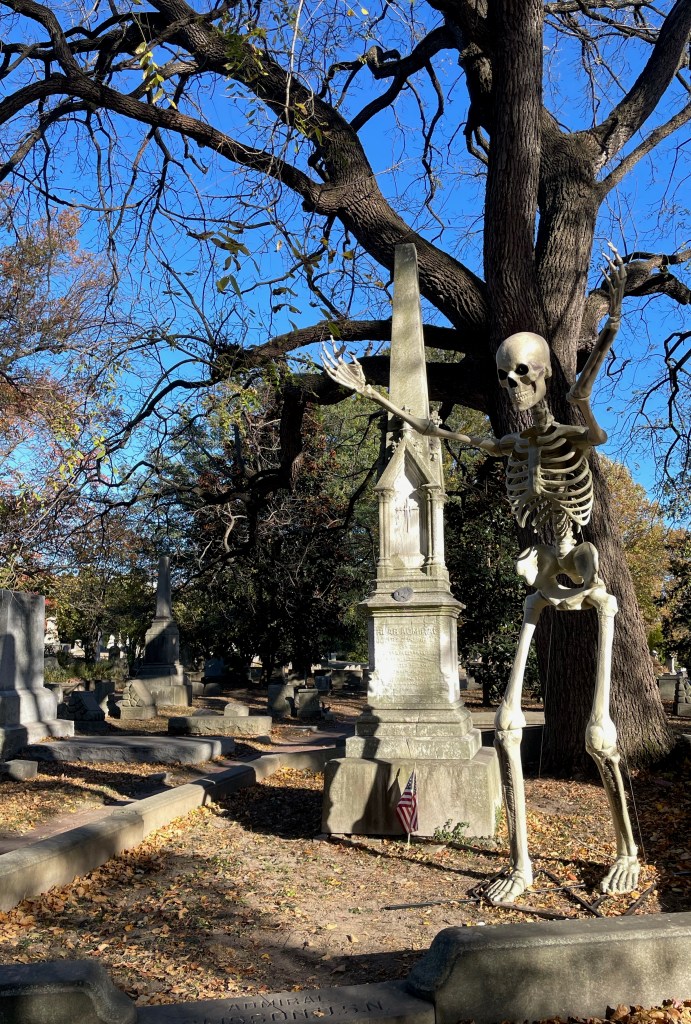
A larger than life size skeleton posed with arms raised in front of an obelisk grave in the Woodlands cemetery in Philadelphia

Every year around October I like to read horror books and you can see all my previous posts about that here and this is this year’s post.

This year I had a couple false starts with some really insipid contemporary horror novels, so I wasted time on those and didn’t finish them, and only ended up reading one prose horror novel—a novella, actually, Low Kill Shelter by Charity Porpentine Heartscape. I also read the graphic novel A Guest in the House by E.M. Carroll, and I watched a bunch of movies, and I went to some graveyards, so I’m just gonna throw all that into this post too. Enjoy! 🎃

What I’ve Been Reading

Low Kill Shelter by Charity Porpentine Heartscape – A virus has spread across the world which turns its victims rabid, and causes canine-like changes in their jaws. But it hasn’t spread so thoroughly that society has collapsed—in fact, the world is still running along as normal. You still have to work. And everyone has given up on discovering a cure, even the companies supposedly funded to do that. The officially sanctioned cure now is just to execute the infected person.

The novella follows a man who is keeping his infected friend chained up in a closet in his apartment, studying him and trying to find a cure on his own.

This is quintessential Porpentine—a dead-eyed vision of the world which brings the grotesque and the banal smashing together, transgressive in a way that doesn’t feel like just a stunt, transgression as a by-product of probing deep into pain, discomfort, and rabid desires. The book excels in attitude, style, and narrative voice, but the plotting felt a little stilted. At a certain point it just starts going from one archetypal monster movie scene to another, and loses the extreme tension, the claustrophobia, the push-and-pull dynamic of the beginning. Overall I enjoyed it, but it lost its edge about halfway through.

Read More »

What I’ve Been Reading, Spooktober 2023

The month of spooktober has passed, but autumn, the season of death, still surrounds us. So today I bring you reviews of the books I read this October. For the past several years this has been a tradition of mine, reading a bunch of spooky books around this time of year, though I’ve only made a post reviewing them all once. Hopefully from this year forward, that can be part of the tradition too.

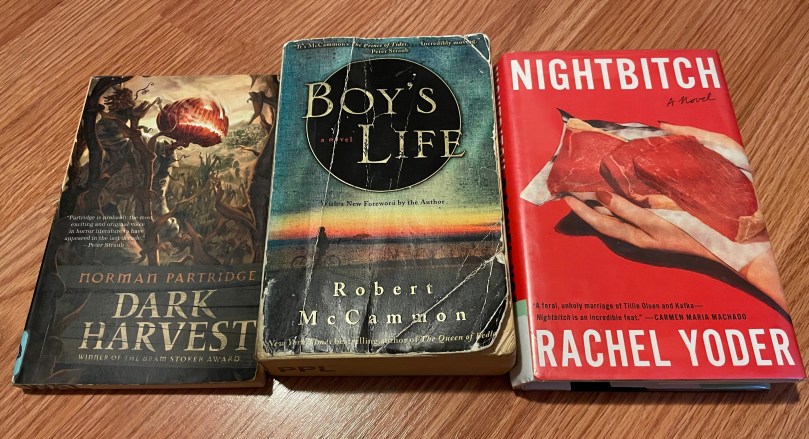
Boy’s Life by Robert McCammon Boy’s Life is narrated by Cory Mackenson, a middle-aged writer looking back on a pivotal year of his life growing up in the small town of Zephyr, Alabama. The book is divided into four main parts, each corresponding with a season, starting in spring and ending in winter. The year in question is the year Cory turns 12, and the year he and his father stumble upon a murder victim drowned in Saxon’s Lake, an old flooded quarry. That murder, and the mystery of the victim’s identity, let alone the killer’s, is the main throughline of the novel.

However, this book is over 600 pages, and it is not 600 pages of Encyclopedia Brown working one case. Instead, the book is composed of episodic chapters detailing various different adventures in Zephyr. Sometimes these chapters reveal a little more about the murder mystery, but usually they don’t. They often don’t even relate to one another, and they vary greatly in terms of tone and genre. One chapter is about a new kid in town who turns out to be a baseball prodigy; another is a monkey’s paw-esque story about the death of the family dog; another finds Cory abducted by a member of a moonshining clan. These chapters don’t really connect or build up to a larger narrative arc, aside from the arc of Cory growing up. Characters enter and exit like stage actors. They arrive, they play their part to a tee, and then they leave. Even Cory’s main group of friends really only shows up when they’re a central part of the chapter, but otherwise they have no involvement with the murder mystery or any other misadventures.

Because each chapter is so totally committed to its trope or theme or genre, McCammon never holds back. He gets to the good stuff right away, every time. The lake monster isn’t going to come back later, so the first chapter where it appears doesn’t waste time with just a little ripple in the water, or a half-glimpsed fin, no—the lake monster makes a full appearance and attacks Cory! Lots of the chapters feel like B-movies that have been fast-forwarded right to the climax. So instead of a tightly woven story where each thing leads to the next, you get a multigenre smorgasbord of all killer no filler one-off adventures. It’s a trade-off which I was happy to accept.

Read More »

Making the “Cartographer” Zine, and the Possibilities of Print

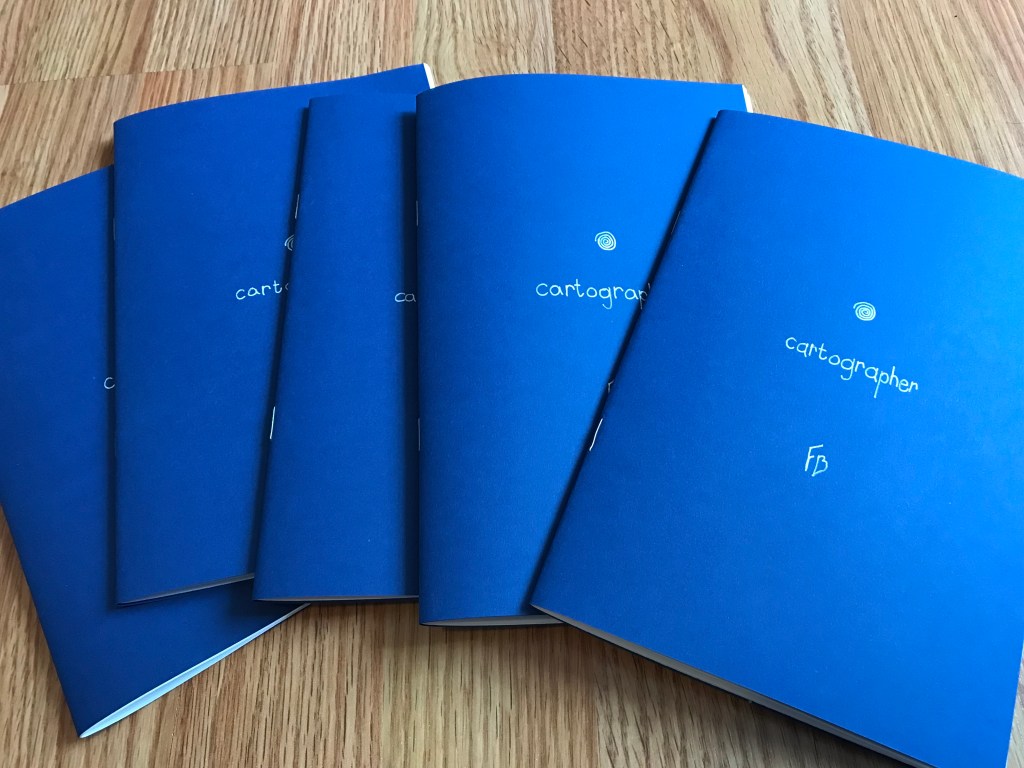
A photo of the booklets. the covers are blue cardstock with white lettering. they each bear a spiral, the word "cartographer", and my initials—"FB".
In all their glory.

This post was originally just an unlisted page on my website, exclusively accessible through a QR code in the back of the print edition of “Cartographer.” But I think the ideas here may be of general interest, whether you’ve read “Cartographer” or not, so with some modifications I’m posting it to the blog!

Contents

The Possibilities of Print

So my first major premise is that reading on a screen sucks. It sucks because a lot of people already spend most of their day staring at a screen. It sucks because you are staring into a light source. It sucks because that light source is always refreshing, shooting 60 images at you every second. It sucks because there is other stuff on that screen that can distract you—even if you are good at focusing, notifications can still pop up depending on the device. (I do see the irony that you are reading on a screen right now—but I think these annoyances are more tolerable for short texts.)

E-readers are the exception. Although it’s still a screen, most e-readers use e-ink displays, not LCDs. The display reflects light, like paper, rather than shining it at you, and it has a much lower refresh rate—the text just sits there, stable, until you “turn” the page.

Turning pages in itself is another benefit of e-readers. There is some satisfaction gained with each page turn that is totally absent with scrolling. As I understand it, this is part of why kids’ books are printed with large text and broad margins—to provide a sense of accomplishment even when reading relatively little, relatively slowly. Each page turn is a little mile marker surpassed. Even as an adult, I find my brain switching modes depending on how much white space there is on a page. Big, chunky paragraphs: serious reading ahead. Dialogue and two-sentence paragraphs: yes lets go fast fast fast!

With all that said, there are two problems with e-readers, from a writer/publisher perspective. First, not everyone has one. I read a ton, and have done so for a while, and I only just got my first e-reader a few months ago. They can be pricy, at least compared to the free pair of eyeballs in your head.

The second major issue is that ebooks are a pain in the ass to design, and you basically can’t guarantee they will look nice across multiple devices. Ebook files are like html files, in that they are meant to display the same content across multiple different devices and apps. The content stays the same, but the style and layout might shift. E.g. Chapter 4 of a .epub may start on page 100 on a computer, page 200 on a phone, and page 150 on an e-reader. That’s pretty minor, but there are bigger issues when it comes to style. “Keep with next” doesn’t seem to work, ever. Drop Caps look dramatically different across different devices, with the one commonality that they all look equally jank (check out this article about it and scroll down to the example screenshots.) Why do websites look good and consistent across devices, and ebooks don’t? My guess is that it’s because the corporations selling the e-readers do not want cross-compatibility. Amazon even has its own file format. There is no effort at coordination, no effort to make an ebook look good if it wasn’t purchased through the given e-reader’s marketplace. I guess people think books are just text, and who cares about the container.

Well, I care about the container! Sitting on a park bench and unfurling a risograph-printed brochure to read about architecture, I can tell you from experience, it rules. The same text on a computer screen in my stupid bedroom, or on a phone screen at my stupid job—that would not rule. The text can still be very good. It can be transcendent, and someone reading it can recognize and appreciate it as such. But the actual reading experience will be worse. (For instance, I read most of Rebecca Solnit’s Men Explain Things to Me on the Bluefire Reader mobile app [barf] during rehearsals. Great book, awful way to read it.)

Read More »

What I’ve Been Reading, Spooktober 2018

Okay, so I intended for this post to go up in October, but it took me awhile to finish House of Leaves, and honestly, whateverSpooktober can live on in our hearts year round. So yeah. Here’s a ton of spooky stuff that I’ve been reading.

Universal Harvester by John Darnielle Universal Harvester begins with Jeremy, a VHS rental store clerk in the small town of Nevada, Iowa, when customers begin returning tapes and complaining that something has been taped over part of them. When Jeremy inspects the tapes, he finds odd, lingering shots of a farmhouse spliced into the middle of the movies—and the inserted footage only becomes more and more disturbing.

But that’s just where the book begins. As it progresses, the narrative winds its way through various small Iowa towns, backward and forward in time, sometimes leaning more toward horror, sometimes more toward the mundane (which isn’t to say that the two aren’t connected.) Overall the book is very atmospheric, but it isn’t an atmosphere of constant dread. It’s a portrait of the midwest that is loving without being provincial, critical without falling back on the old clichés we all know about middle America and rural communities. That’s really what struck me about the book—its quiet, steady chronicling of the lives of characters dealing with loss, struggling to find home, caught between staying and leaving. It’s a book without climaxes, no do-or-die moments, just endless process, a book about living.

Read More »