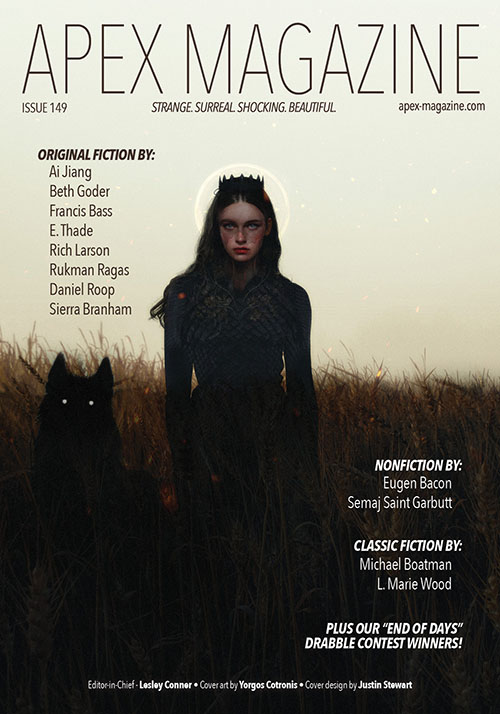
I’m thrilled to announce that I have a short story out in this month’s issue of Apex Magazine! The story, “I Remember a One-Sided Die,” is about an alien species with a strange way of perceiving time and memories, and is narrated by one of those aliens. This is my first story to appear in a magazine in a while, and the longest story I’ve ever had in a magazine, so I’m pretty excited to have it out there! I was also interviewed for this publication by Marissa Van Uden, so after you’ve read the story you can read that interview to see where the idea for this story came from, and how I developed it.
You can read the story and the interview right now if you buy the issue, or you can wait a month and both will be posted on Apex’s website, free to read. I’ll probably share that link in a future blog post as well, when it’s available.
Other news!
I don’t think I’ve actually mentioned it on this blog yet, but back in January I finally finished editing the book I’d been working on for most of the past two years! Currently I’m taking a break from it/waiting to hear back from readers, and later in this year I’ll start querying agents.
I’m also just taking a break from writing in general … although I am editing some short stories I wrote last year … but no new writing! Instead, I’ve been gearing up to making a short comic. I’ve never really intentionally set out to make a comic before, other than LYCC—and that was like a diary comic, so it didn’t require any overarching planning or character development. So this will be a bit of an adventure for me. Right now I’m mostly warming up to drawing again, trying to make it a habit, and I’ve been trying to draw a little 4-panel comic every day. I may clean some of those up and post them here at some point.
That’s the main news from me. Here’s a video of me biking up the SRT to Norristown yesterday.
Wow, it has been a while! Much has happened, but nothing worth posting about by itself, until now: I have an Etsy store! Going forward, this is where I will be selling zines digitally. Up on the store now are copies of “Fires Burn Forever in this World” ($8.50), “The War on Hormones” ($6), and a second printing of “Is Magic School Still Worth It” ($6). I’d like to put out a second printing of “Cartographer” for sale there too, at some point.
If you live in Philly and want to buy something I have listed, I can give it to you in person for $1 cheaper! I’m also going to try to put more zines in shops around Philly, and table at some zinefests—more info on that TK. Right now there may or may not be some copies of “Magic School” at Iffy Books that you can pick up for free :).
That’s the big announcement, now for some other bits and bobs:
I have finished the novel I’ve been writing for the past year! I still need to edit it, but for the moment I’m taking a break from it and working on comics and short stories. Here’s a lil drawing I made a while ago, of one of the characters from the book. 🙂
And yes you read that right, comics! I’ve decided it’s something I want to take a little more seriously, something I want to do more consistently. To that end, I’m working on filling out a collection of comics that I’ll release as a zine later this year, titled Lonely Friends. I’ve posted some of these comics on the website before, and there’s some I’ve never shared at all.
So look forward to me putting out that zine, posting a few more of the comics in it, and putting together a webpage that makes it easy to find all the comics I’ve posted so far. For now, here is a weird one I made during Comix Club at the Free Library of Philadelphia. I left the speech bubbles blank cause I didn’t really know what the characters were saying, I just wanted to put them in these poses. Maybe I’ll leave it like this for the zine, so people can fill it in themselves. What do you think they’re saying?
And finally, here’s a video of me biking along the Schuylkill River Trail on a foggy night in January.
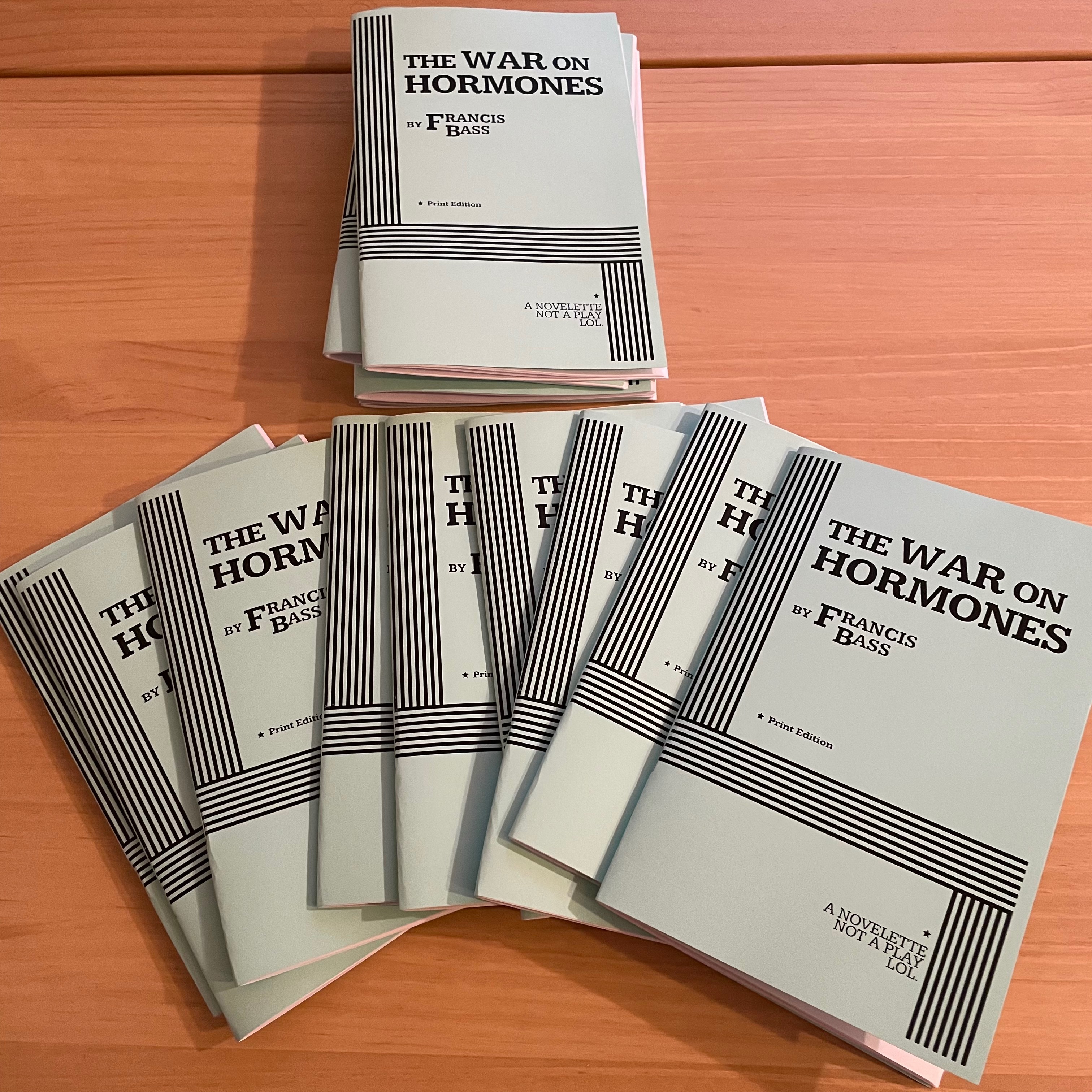
As promised, here is the 4th and final zine of 2023! This one is a re-issue of a novelette I previously published as an ebook, “The War on Hormones.” It’s about pharmaceutically asexual teenagers at a performing arts high school, and I wrote it when I myself was in 12th grade. Despite or because of this, I think it holds up! I had fun rereading it, anyway, and only made a few minor edits for clarity. I also cut the afterword to keep it a more conveniently printable length.
This new zine edition is free! Just email me at Francis.R.Bass [at] gmail [dot] com and I’ll send you a copy. You can also still buy the old ebook version on Smashwords if you want to throw me some money.
Also, if you would like any of the zines I’ve previously released, now is your last chance to get them for free, with free shipping!
To wit, that is:
“Cartographer,” a grotesque fantasy about a person lost in the colossal corpse of their god, and the mapmaker they always end up returning to. (LOW STOCK)
“Masters of the Wine Printers Guild,” an economic fantasy about a conspiracy of apprentices who decide to defy the masters and print their own wine;
“Is Magic School Still Worth It?”, a fantasy short story about trying to put a price tag on our nobler aspirations (i.e., magic.);
And “Fires Burn Forever in This World,” a short story about a city where the antiquated practice of leaving firefighting to private insurance companies has persisted right up to the modern era..
If you missed out on one of these before, or if you really liked one and want another copy to share with a friend, let me know! Going forward I will be charging for my zines like the mercenary wretch I am. So get them while you can, orders close Jan 1st.
Year in Review
It’s been a pretty quiet year on the magazine front, but a big year for self-publishing stuff. There are all those zines of course, and also a new collection of short stories which I released as an ebook, Stories About Kids Stealing Things. The book collects seven stories about people with very little ability to control their own lives, and no ability to control the world at large. They are going to try anyway.
It’s also probably the coolest cover I’ve ever made.
I wrote a very long and very negative review of The Parable of the Sower. I mean, I wrote plenty of other reviews this year, but I think this one came out really well, and even if you don’t care about the book, the review gets at some of the things I find lacking in dystopian fiction. If you only read one of my posts from this year, read that one.
No new publications in magazines this year, but I did have one reprint—my story “The Mechanical Turk Has a Panic Attack” appeared on Escape Pod! This is a story I really love, and it was great to have my work appear in such a prominent institution of contemporary short sci-fi.
Not much other than that! I am still writing this fucking novel, the one I mentioned I’d started back in April. It is about 2x the length I expected it to be. I will hopefully have the first draft finished in January, and then can spend the next year writing short stories. I like writing novels, and I honestly think this one is going to come out amazing, but I think I am just too artistically promiscuous to write long projects like this one all the time. Like I cannot imagine committing myself to another novel right after I finish this one. So I’m looking forward to being a narrative slut next year.
Public Domain Day
Public Domain Day approaches! Each year on January 1st, Public Domain Day, I celebrate by releasing one of my works to the public domain. Last year, some friends and fellow artists joined me in this, ceding some of their works as well. If you would like to do the same this year, let me know so I can link to the work you’re ceding in my post! The work can be a song, a photo, a short story—anything you’ve made and would like to release forever to the commons.
For more info on Public Domain Day, you can check out my page on it, or the post from last year.
Got a bit of a grab bag this time around. One long review of The Agony and the Ecstasy, a shorter review of A Fine Balance, and a shortest review of The Hard Tomorrow. Also, after all that, some news about two writing projects I’m putting out this month, and an opportunity to place an ad in my zine! Pick your poison.
The Agony and the Ecstasy by Irving Stone is a biographical novel about Michelangelo. It starts when he is 13, about to be apprenticed to Domenico Ghirlandaio, and continues throughout his entire life, right up to his death at age 88. The plot is pretty much exhaustive—no part of Michelangelo’s life is omitted, though some is summarized, especially towards the end.
Initially, I concluded that “The Agony and the Ecstasy is a hack job, and it is glorious.” By “hack job” I meant that there’s really no artistry to it. Irving Stone is not making artistic decisions about how to represent things, he is not emphasizing certain moments over others. Every bit of information, every major event, is dutifully transposed into a kind of dramatized biography. This changes slightly towards the end, which I’ll explain more below, but I think my initial impression still applies to 90% of the book. No one should read this who does not want to read a 600-page biography of Michelangelo.
That’s not to say Stone is unskilled, not at all. The drama is compelling, the dialogue and narration are effective. He is rendering well, but he is only rendering. There’s no attitude, no flair, no vision. He is like David, an artist in the studio of Ghirlandaio who Stone describes thus: “David had been well trained in enlarging to scale the individual sections and transferring them to the cartoon itself, which was the dimension of the church panel. This was not creative work, but it took skill.”
The single biggest artistic choice Stone made, and it is a bold one, is writing this book at all. Michelangelo lived a long life, so treating his life with the intense level of researched detail that Stone employs does require commitment, belief, a supreme confidence in the worthiness of the material. This is a hack job in that it lacks any creativity, but it is an uncommon hack job, one which took a tremendous amount of care and effort to complete.
EDIT: This post previously misattributed quotes to the Camden mayor, which were in fact made by the Director of the Camden County Board of Commissioners.
Negative review time! It’s time for a negative review!
I never write negative reviews—I mean fully negative, not just a mixed bag—because I rarely finish books that I really dislike. And then if I do, I don’t want to waste even more energy writing about it. But Parable of the Sower is beloved and lauded, and Octavia Butler is basically canonized by the current crop of SFF writers, so I think a full review is worth my while and yours. Maybe it will shed some light on common failings in dystopian lit, maybe it will make other people who disliked this book feel less insane, maybe it will just be fun!
There will definitely be some spoilers, if you can spoil something that is already rotten.
Introduction
Parable of the Sower is narrated by Lauren Olamina, a young girl living in Orange County, in the year 2024. The United States is collapsing into poverty and lawlessness, and is backsliding into oligarchy, all apparently driven by global warming. Things start bad and get a lot worse. Strike that: things start bad for Lauren’s last-gasp-of-the-middle-class enclave, and get a lot worse. For the poor, the misery is pretty abject from the very beginning.
The book has two major parts, about equal in length. In the first half, when things are only bad, Lauren is preparing for the worst, and trying to get her community to do so as well. This preparation mainly entails making bug out bags and reading books about foraging, first aid, etc. Also she wants to start a religion, “Earthseed,” which recognizes change as the only God, and as a fundamental force which people must accept and work through. She develops this religion, writing its holy verses, in secret.
In the second half, her community has been obliterated, and she travels north with a few survivors, hoping to find somewhere they can resettle. They join a mass migration north, and occasionally add new members to their group. Lauren starts to share Earthseed with them. They are attacked multiple times.
Also Lauren has a psychosomatic hyper-empathy condition triggered by the apparent physical sensations of others. It’s not plot-relevant or theme-relevant, and it’s barely character development-relevant, so I will not mention it again.
That is the basic story-shape of the book. There is a sequel, I haven’t read it.
What’s really strange is that this book is not good any way you turn it. With books I dislike, I can usually see the element that people enjoy in them. I cannot see it here. It fails, or is at most subpar, on all counts.
Let’s start with the loftiest of traditions which this book attempts to engage, which is societal critique. This is generally how this book is framed when people describe or recommend it—a cautionary tale of where we’re heading, or (jerk off motion) a prescient vision of where we are!! Oooo!! Octavia Butler warned us!!! (jerk off motion)
My story “The Mechanical Turk Has a Panic Attack” is newly available in audio form, at Escape Pod! Wow!! The story was first published a year ago at Uncharted Magazine, and now you can listen to it, narrated by Valerie Valdes, produced by Summer Brooks, and with some host commentary from Tina Connolly. It’s a story about a server in a high-end but not quite high-end-enough restaurant pretending to be an android. The title is the plot, essentially.
I’ve said it many times before, this is one of my favorite pieces from the past few years, and it does a lot of the stuff I really want to do with SFF writing. Check it out! And if you’ve read it already, it’s definitely worth a listen, as Valdes does a wonderful job on the narration.
Some other stuff
I still have copies of “Is Magic School Still Worth It?” available! They are still free! Go here to read more about that.
I recently read “Questioning the Bipedal Default” by friend and fellow SFF person M.E. White, published in the October 2018 issue of Worldbuilding Magazine. It’s an in-depth look at the evolution of bipedalism in humans, with speculations on whether or not it’s a prerequisite to intelligent alien life. Very worthwhile read for SFF writers, or anyone into evolutionary bio!
And to close things out, here’s some videos I took while biking around the Navy Yard, an old semi-disused industrial park at the far south end of Philadelphia. (Although the first clip is from another day, earlier this year, crossing Grays Ferry Bridge.) 🚴♂️🚴♂️🚴♂️
Plates from Ernest Wittenberg’s 1960 article “Échec!”, about the actual mechanical turk
A bit delayed in announcing this, but I’ve got a new story up on Uncharted Magazine! It’s about a server in a high-end but not quite high-end-enough restaurant pretending to be an android. I mean, the title is the plot, essentially. It’s really good! Seriously, this is probably my favorite thing I’ve written in the past couple years, and I’m so pleased to have it published. You can read it over on Uncharted Magazine.
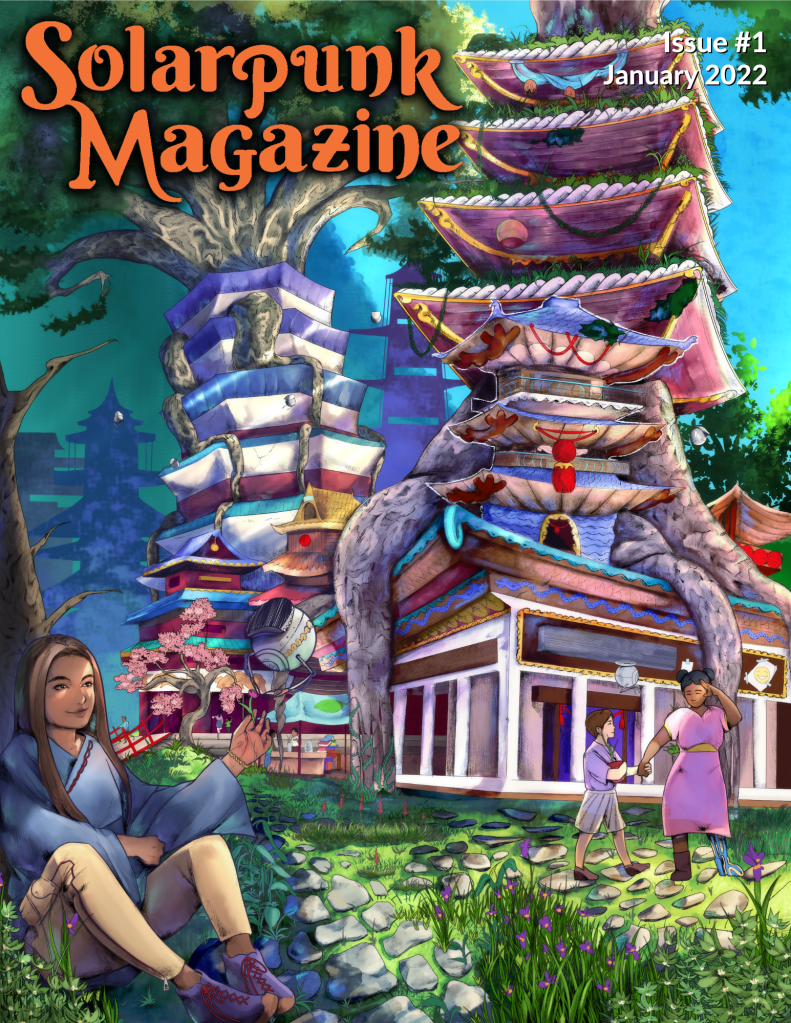
My story “The Hilarious Inside Joke of Our Overwhelming Melancholic Nostalgia” is in the inaugural issue of Solarpunk Magazine, just published today! Solarpunk Magazine is a new magazine publishing writing and artwork that grapples with climate change and “demand[s] utopia.” The first issue is extra-large, with 6 short stories, 3 poems, and 4 nonfiction articles. It even includes an interview with Kim Stanley Robinson! You can purchase it here. EDIT: You can also read or listen to my story online here!
My story is set in a future Florida radically changed by climate change, where “Crimes Against the Future” are punished by implanting memories of the world before, the world lost to rising sea levels and changing ecologies. Kyra, whose older brother has been punished in this way so many times that the implanted memories have become permanent, wants to commit a crime so she can know what the old world was like herself.
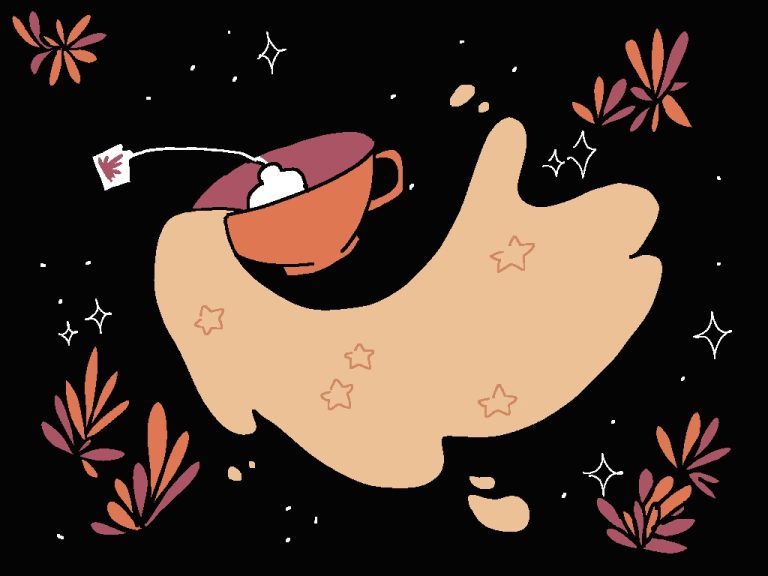
Illustration by Renee Leanne, courtesy of Electric Literature.
I have a new piece of flash fiction out from Electric Literature today, “Extrasolar Teas Box”! The headline they put on it is “No One Was Exploited in the Production of this Space Tea” which I think gives you a good idea of what the story is about. The wonderful illustrations accompanying it are by Leanne Renee. Check it out here!
A few other announcements: First, a month or so ago some writer friends put out an anthology of short stories, which I wrote the foreword to. Each story starts with the same line, “It was a dark and stormy night,” but they all diverge from there. You can get it for free on Smashwords!
Speaking of Smashwords, I am once again participating in their end-of-year sale, so all of my writing on Smashwords is 75% off or free from now until the end of the month!
And finally, there will be more new Francis writing very very soon, because I have a story in the inaugural issue of Solarpunk Magazine! So look forward to that next month, and if you want you can preorder the issue or subscribe to the magazine here.
The Gold Coast is the second book in the Three Californias Triptych, written by Kim Stanley Robinson. The triptych portrays three visions of a future Orange County: the first, The Wild Shore, post-apocalyptic; the second, The Gold Coast, dystopian; and the third, Pacific Edge, utopian. I’m simplifying, but that’s the basic idea. For the most part, characters don’t carry over from one book to the next—you could pick this book up by itself no problem. I’ll talk more about the effect of reading it together with the others later, but suffice it to say it makes an excellent stand-alone novel.
The two major plotlines of the book follow Jim McPherson and his father Dennis McPherson. Dennis is an engineer working for Laguna Space Research, a defense contractor. It’s 2027 but the Cold War never ended. The Bulletin of Atomic Scientists has set their clock “one second to midnight man, set there for twenty years.” Jim is a part-time English teacher at a junior college, making ends meet by doing some clerical work at a real estate office too. He’s enchanted by the history of Orange County, the orange groves long ago torn out to make room for condos and freeways, which have so devoured the landscape recently that he and his friends refer to the county as “autopia,” and it’s residential areas as “condomundo.” He’s dissatisfied with the state of the world and the state of his own life, but doesn’t know what to do about either. So the two major plot-lines are 1. Dennis McPherson’s efforts to land a contract for a new missile defense system, and the hell of bureaucracy and inter-departmental rivalries which get in his way; and 2. Jim McPherson’s growing involvement in efforts to sabotage defense contractors in Orange County. These two plotlines will of course have to converge at some point.
That said, this isn’t a book driven by plotlines, and the two I just described aren’t exactly the focus. Where other novels direct their energy forward in chains of causal events, Gold Coast directs its energy outwards. More than anything characters drive the novel, representing a broad section of the young people of Orange County. Steadily, steadily, the world reveals itself through their different viewpoints, through the maneuvers of their daily lives. Jim is a prototypical lost young man, but the pitfalls of this trope (e.g. telling a story ostensibly about social issues by centering a middle class straight cis white man, most protected from the consequences of those issues) are avoided by the fact that the book takes on so many different viewpoints. Each chapter follows a specific character, and Jim’s chapters are just one tributary of the novel’s expansive river basin. The book almost feels like a sitcom at times, especially since so many of the viewpoint characters are part of the same friend group. So Jim’s aimlessness isn’t valorized or held up as some universal experience, it’s just one life cast among the lives of drug dealers, ambulance drivers, surfers, revolutionaries, art teachers. The one glaring failure is the lack of women. Sure, they’re around, but only one of them is given her own chapters. Oddly enough, it’s Jim’s mother. So while Robinson is admirable for including chapters following her life, which is indeed an expansive and realized life entirely separate from her son or her husband, he’s worth criticizing for otherwise showing Orange County entirely through male inhabitants.
“Yellowknife” is now available at Amazon and Smashwords! (And because I’m participating in Smashwords’s Authors Give Back sale, for the next couple days you can get it free from Smashwords!) For anyone who’s read my story “The Wisdom Goddess Star,” this novelette is set in the same world, though with a different group of characters.
Inspector Naval is not that sort of inspector. He examines safety code violations, claims of mismanaged funds, workplace accidents. He is not a private eye, he is not a detective, he is not a genius of deductive reasoning. But Mars has scarcely any law enforcement, so when Margaret Hoehn turns up dead at an International Martian Program facility, Inspector Naval is the best the IMP can send.
Margaret Hoehn died at Yellowknife, an isolated research base mainly dedicated to studying the extraterrestrial bacteria found there. It was in the room containing this very bacteria that Hoehn was found dead from CO2 poisoning. In such a small facility, with constant surveillance footage ruling out most suspects, there’s a narrow pool of people who could’ve killed her—or maybe it was suicide, or just an accident. Regardless, Naval is still out of his depth, and he’ll have to adjust to the peculiar rhythms of life at the small, insular colony if he’s ever going to find out what really happened.
In addition to the novelette, this publication also includes an afterword by the author about how a mystery fiction class and research on Antarctica influenced the writing of the story.
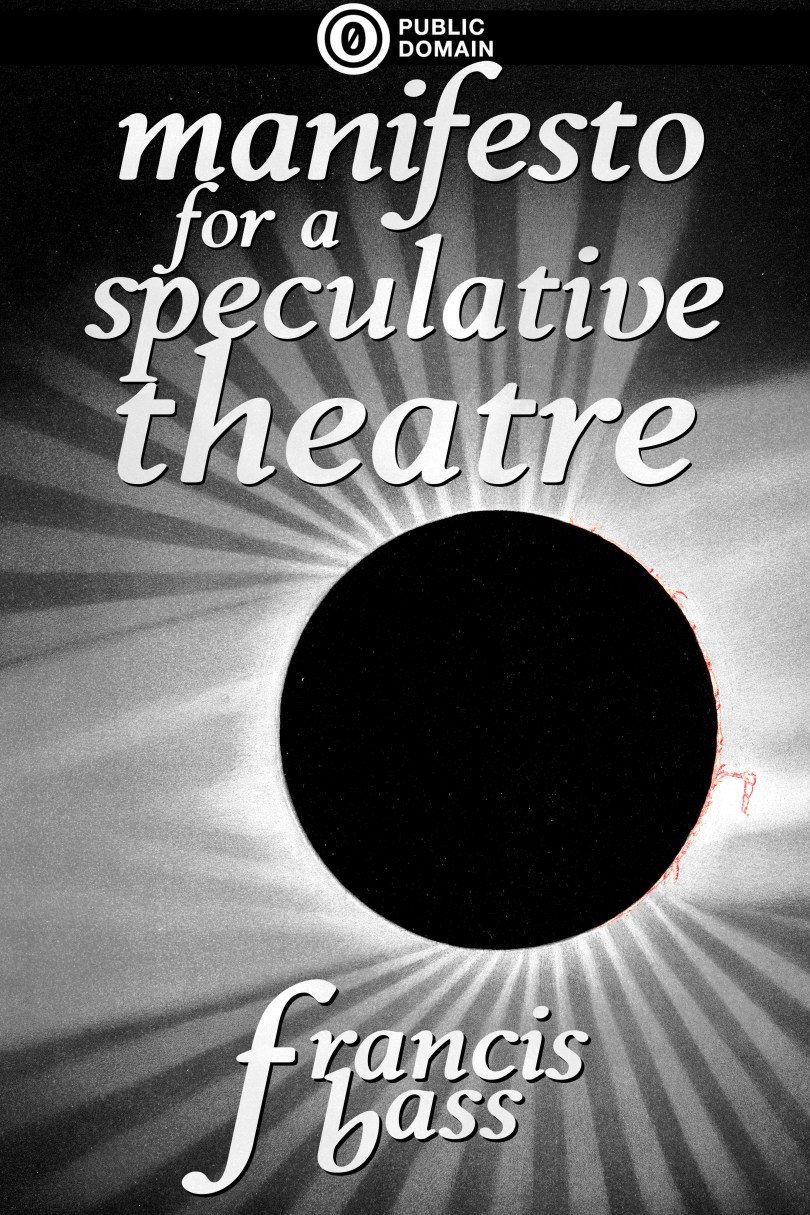
Get excited! These are the plays I write and the plays I love to read, this is why they’re great, this is why you should write them too! I wrote this a year ago, edited it a lot more recently, and I’m publishing it now! These are strange times but they won’t be the strangest, let’s go! Download the manifesto in these formats: PDF — Epub — Mobi — Docx. Or read it below:
preamble
audience
This manifesto addresses itself to two groups of people—playwrights, and writers of science fiction and fantasy.
People who can call themselves both are its intended result.
claim
Theatre enriches science fiction and fantasy. Science fiction and fantasy enrich theatre.
Very little speculative theatre exists; very much should.
speculative
For the purpose of this manifesto, I distinguish the type of work I am calling for, “speculative theatre,” from the already existing vein of theatrical works which merely incorporate science-fictional or fantastical elements (e.g. the angels in Angels in America, the ghost in Hamlet.) As well, I use “speculative” and “science fiction and fantasy” interchangeably for convenience.
The majority of plays which utilize SFF elements do so only as an outgrowth of character, theme, plot, adapted myth, etcetera.
In a “speculative” play, as I define it, character, theme, and plot spring from the SFF world (or the SFF element, though it often implicates the entire world.) In a “speculative” play, the world extends beyond characters, story, and even author.
Both types of play create a world or redefine our own, but speculative plays use the invented world as the foundation, and then speculate, while non-speculative plays use their SFF element to point back to characters, plot, theme, or the real world.Read More »
If a cataclysmic shattering world could write a novel, this would be it. The organizing principle of Dead Astronauts is not chronology, nor non-linear chronology (a book told out of order still postures itself against a fixed, correct order which the reader can construct in their mind.) The organizing principle is ecology, iteration, echoes. I had a dream recently where someone told me they “experience things cumulatively,” which I find to be an oddly apt description of this novel. You experience this book cumulatively. The book takes place in the world of Borne, but it may as well not, because aside from the familiar post-apocalyptic landscape and the similarly surreal lifeforms that populate it, the way the world behaves is just totally different, starting with the timeline-hopping Dead Astronauts.
The second chapter of the book, and also the longest, follows these titular characters, “the three.” If not for this section, the book wouldn’t have anything close to a main plot, just lots of small stories filling in the histories of different places, the backstories of different characters. So, what is the narrative? “The three,” Grayson, Chen, and Moss, are on a seemingly futile mission to reclaim the City from the Company, a mission they’ve repeatedly undertaken across multiple alternate timelines, facing different variations of the same archetypal characters each time, often (always?) ending in failure.
But … why? This chapter was probably my least favorite—the parts of it that I liked most were the parts delving into the astronauts’ pasts, while the actual narrative through-line, this mission, just wasn’t all that compelling. What are they reclaiming the city for? What would they do once its reclaimed? The thing Grayson Chen and Moss seem to care about most is each other, not the City. Grayson and Moss may have personal reasons to want to exact vengeance on the Company, but … enh, that’s more my own speculation than anything the text explores. And unlike in the Area X trilogy, the hollowness of the mission isn’t developed and spotlighted as a theme, it just feels like flat writing.
Once the title characters get out of the way, other chapters shine a lot brighter, like that of Charlie X, a scientist at the Company with a fast deteriorating memory, or the chapter for the Dark Bird, a deadly, tortured creation of the Company. These chapters are much less narrative-focused, more non-linear and experimental (granted, even the Dead Astronauts section is far more experimental than something like, say, Borne—it’s a testament to how wild this book is that that chapter seems conventional in contrast to everything else.) Probably my favorite chapter was “Can’t Forget,” a vigorous, hateful 60 pages narrated by the Blue Fox, describing an ancestral memory of humankind’s assault on foxes, through fur-trapping and climate change up to the Company’s experiments on and exploitation of the Blue Fox as a biological reconnaissance tool. I could write a post about that chapter in itself—the use of huge walls of repeated text, the effect of actually reading through it, the defiant and truly inhuman voice VanderMeer achieves. There are a few single sentences in the chapter that floored me, simple phrases that land with explosive impact because of how the text builds up to them.
Truly, VanderMeer’s prose is great throughout the whole book, it’s as inventive as the novel’s overall structure. He gives lots of focus to the materiality of words, their sound, their weight when repeated over and over, with less emphasis on strict semantic meaning. Characters stutter out series of rhyming words, text appears in blocks with big vacuums of white space in between. Just as this world is full of characters whose striking, mythological stature transcends a more realist, psychological approach, the language often strives for force, vitality, in order to transcend the mere conveyance of information.
If a cataclysmic shattering world could write a novel, this would be it. And because of its non-linear nature, because the narrative is more a decentralized history than a single plot, it beckons to be reread, reread in pieces, in sections, out of order or over and over again. If you like VanderMeer’s more experimental stuff, definitely check this out. There is little out there like it.
Death’s End is the conclusion to the Remembrance of Earth’s Past trilogy. Spoilers for the first two books, which I reviewed here. Death’s End more or less picks up where The Dark Forest left off, with Trisolaris in an uneasy cold war with the Earth, and Luo Ji sitting with his finger on the button. I say “more or less” because the book actually does take some time to go back to the “Crisis Era,” describing a failed espionage project, and introducing us to the book’s main character, Cheng Xin. This brief episode at the beginning, where we see a human brain sent out to the Trisolaran fleet, is the last bit of set-up Liu needs—after a book and a half of waiting for the fleet to arrive, we finally have a book where, start-to-finish, humanity is dealing with immediate existential threats, or suffering immediate damages. With the exception of these few chapters of anticipation at the beginning, the whole book is falling dominoes.
And the scope of the book is truly phenomenal, full of so many historical episodes across different eras of human existence. I say “historical” because that’s really the only way to describe it, even though it’s a history of the future. Cheng Xin is the main character, as she lives through many different epochs by undergoing “hibernation” for long periods of time, but human civilization is the protagonist. It is humanity that is at stake, humanity that must act, humanity broken and humanity triumphant. And so many of these episodes are captivating little stories in themselves—a war crimes trial of the survivors of the Doomsday Battle, the horror of mass-resettlement to Australia, and three intriguing and cryptically coded fairytales which form a strange, imagistic core to the book much in the way the game Three-Body did to the first novel. This serial nature is also similar to the first novel, but here, each episode has two previous books’ worth of material to build on, bringing all that unstoppable momentum crashing forward on and on. It makes for a solid read.
I also greatly enjoyed the book on a thematic level. It covers a lot of ground, and a lot of different sci-fi concepts, but above all it is a profoundly sorrowful book, a book about death—of people, of civilizations, of the universe. It is pre-apocalyptic, post-apocalyptic, and intra-apocalyptic all at once. It also manages to leverage some basic observations about the universe, along with some of Liu’s own postulations, to reach terrifying conclusions about the fate of all things, similar to the ominous overtones of the first book. The idea of the “Dark Forest” is already harrowing enough, but Death’s End promises even more terrifying ideas about the nature of space and cosmic intelligence, about the utter insignificance of our place in existence, and it delivers on those promises in spades.
If you enjoyed the first two books, definitely read this one. If you enjoyed the first one but not so much the second, I’d still highly recommend Death’s End. While it’s a lot longer, not nearly as compact as The Three-Body Problem, it still feels like a return to form, in the ways I’ve mentioned above. And if you haven’t read any of the trilogy, I highly recommend all of it. As a whole, it present a dark and captivating vision of galactic civilizations, and humanity’s future among the stars.
Some blog housekeeping: No more “What I’ve Been Reading” posts! Only individual reviews from now on! Basically, the “What I’ve Been Reading” posts made sense when I first started doing them because the reviews were quite short, and they were a quick way to throw in a bunch of reviews in the middle of some other series of blog posts. However, now I tend to write longer reviews, and if I feel like I can only write a paragraph about a book, I just don’t write anything. Also, for the foreseeable future book reviews and other kinds of reviews will be the only thing going up on this site, so I have no need to condense them and make way for other posts. Also, no more “Recommendation Dump” posts. Just gonna atomize everything.
I mean, probably. Maybe I’ll still bundle reviews together from time to time. Who knows. But that’s why this review is its own post, even though its not super long, and that’s how it’ll be from now on.
Acceptance is the final book in Jeff VanderMeer’s Southern Reach trilogy, the rest of which I reviewed a while ago, here and here. Spoiler warning for those books, I guess?
There are three major narrative threads in Acceptance, which the book alternates between by chapter—the lighthouse keeper, the Director, and Ghost Bird & Control. The Lighthouse Keeper’s story occurs before Area X has taken over the coast, though it soon becomes clear that Area X’s arrival is impending. The Director is the director from Annihilation, and her narrative takes place before the events of that book, showing the lead up to that expedition. Ghost Bird and Control (the book also alternates between them by chapter, though their stories form one continuous narrative) are entering Area X and trying to find the Biologist, their story picking up right where Authority ended.
All of these component parts are great. The Director chapters are reminiscent of Authority, getting into the oppressive, decadent world of the Southern Reach agency, a long slow burn with the “12th expedition” looming on the horizon. The Ghost Bird and Control chapters are more like Annihilation, though a bit faster, punchier—a return to Area X, with new revelations, new menacing phenomena, and a steady drive toward a mysterious objective. And the lighthouse keeper chapters feel completely new, with Saul Evans (the lighthouse keeper) being maybe the most normal character in the whole trilogy? I came to quite enjoy these chapters, settling into the small coastal town setting, getting to know Saul, and slowly seeing the gruesome shadow of apocalypse fall across everything.
However. The sum is less than the parts. Authority, the previous book in the series, was a very slow book, but I came to enjoy it, its immersive quality and careful consideration. The Director and Lighthouse Keeper chapters are, likewise, fairly slow, the characters don’t have big objectives, and they present worlds you really want to sit with. By contrast, the Ghost Bird and Control chapters are maybe the most action packed of the trilogy—if the books have been building up to anything it is these chapters, and you just want to keep reading, keep pushing deeper into Area X and closer to their goal. So the faster chapters break the immersive, slow-burn pacing of the slower chapters, and the slower chapters wreck the momentum of the faster ones.Read More »
My short story “Fuck You Pay Me” is now available in Reckoning 3! Reckoning is a non-profit journal that publishes poems, artwork, stories, and essays about climate change and environmental justice. My writing aside, you should absolutely check them out. They do fantastic work and support a broad range of artists, and I’m thrilled to be included in this year’s issue.
As for my story, “Fuck You Pay Me” is a story about two high school seniors who will be graduating soon, facing a world severely effected by climate change, and watching their opportunities dry up before their eyes. So, using an accountability AI to calculate the dollar amount that they are owed by the world, given the damage that climate change has done to them, they decide to balance the scales of climate justice and rob a wealthy family. Other stuff happens, and it takes place around Christmas, so it’s a perfect story for the holidays!
Currently you can buy an ebook of Reckoning 3 here. If you can’t spare the seven bucks right now, everything in Reckoning will be published online over the next six months, so you’ll be able to read my story free in April 2019—and if you want a physical copy, tthose will be available in June 2019.
Just as I did last year, here are two collections of all the plays I published in the past year, and all the short stories I published in the last year. I’m now less enamored of the idea of this being a “complete works” series, for various reasons which I explain in the forewords of these anthologies. Mainly, what does “complete” even mean? Regardless, these collections really do have all the pieces I self-published while I was 20, and all the afterwords I published with them. And I will continue this series, because I like having a cheap way for people to buy my stuff—the collections just might always not be annual, or they might not always be “complete.”
20; Two plays and a monologue contains Suggest the Empire, Chimaera Cries ON STREAM!!!!!, and Tallahassee Ca. 2045—including a brands new afterword for Chimaera Cries ON STREAM!!!!!! You can get it on Smashwords or Amazon.
20; A collection of short stories contains “A Clash at Grozny Airfield,” “The Wisdom-Goddess Star,” “Beneath Them,” and “ChannelCon ’30.” You can get it on Smashwords or Amazon.
I wrote this post before Ursula K. Le Guin passed, though it seems fitting now to open it with these words of hers, in response to the question, “What do you want to happen to your books after you die?”: “I want them to be available, I want cheap paper editions of them, I want them to be continuously downloaded in forty different languages, I want them to be read, I want them to be argued about, I want people to cry over them, I want unreadable dissertations written about them, I want people to get angry with them, I want people to love them.” Well, I’ve read a second-hand cheap paper edition of The Left Hand of Darkness, gotten angry with it, kind of loved it in a few moments, argued about it (in my head, with myself and with two different versions of Le Guin), and now, behold, an unreadable dissertation blog post. Hopefully, this is exactly as Le Guin would wish. Rest in peace.
Cover of the 1st edition, vastly superior to the latest edition’s cover, which is just a glacier, honestly it’s stunning how mediocre that new cover is. Courtesy of Ace Books
The Left Hand of Darkness is one of those books I’ve always felt silly for not having read—and likewise, Ursula K. Le Guin is one of those authors I’ve always etc. Not just because Left Hand is considered a classic, and Le Guin one of the greatest, most influential sci-fi/fantasy writers, but because it’s the kind of sci-fi and fantasy that really interests me. Sci-fi with a focus on society, on the world, on characters. Not to mention, the gender thing—I’ve always heard that Le Guin is a great feminist writer, someone who subverts and challenges our ideas about gender, and especially about women. And Left Hand is, of course, the gender book—or the book without gender. A world where the dominant sentient life-form has no biological sex—fantastic. I’m always interested in that kind of premise, I always like to see deconstructions and reconstructions of gender. Yet, I somehow never got around to reading it, I always had some other book or author I was more interested in. I finally decided to read the book when I got it in a white elephant gift exchange, and, for months, had the physical copy sitting about in my bedroom somewhere, staring at me.
So I read it. One less thing to feel silly about Francis, good job. After reading it, and kind of wondering what everyone else saw in it re: the discussion of gender, I read Le Guin’s essay on the book, “Is Gender Necessary?” Actually I read the “Redux” version, which was written over a decade later, with annotations from Le Guin clarifying and arguing with her past self. In some ways, the redux essay is a revisiting of a revisiting—Left Hand came out in 1969, “Is Gender Necessary” (henceforth to be referred to as IGN) in 1976, and the redux in 1988. Which would make this blog post a commentary on a commentary on a commentary on a book, at least in some part.
I’ve struggled with how to write this post. It seems unfair to review the book as if its some kind of argument—in fact, Le Guin herself mentions this in “Redux,” when she writes that “critics of the book insisted upon talking about its ‘gender problems’ as if it were an essay not a novel.” That line instantly made me think of “Cat Person,” the Kristen Roupenian short story that made the rounds last year, and which was bizarrely referred to as an “article” or “essay” by some. These stories did not ask to be scrutinized as perfectly hygienic arguments about gender and sexuality. The idea that Left Hand is an incredible classic which strikes right to the heart of gender politics is external to the book. So I’ll do my best to separate the two, to review the book as just a book, before specifically going into why I found it lacking in terms of gender commentary.Read More »
I’ve just published “Beneath Them,” a short story available on Smashwords and Amazon.
In this piece of flash fiction, without warning, thousands of alien spaceships have appeared above major urban areas around the globe, and some have descended to devastating effect. Although the aliens have expressed a lack of ill intentions, and a desire for “recreation,” no one really knows what they are doing on Earth. The only thing that is clear is their overwhelming power, and their overwhelming intelligence.
In the shadow of this invasion, life goes on as Atlanta resident Cheyenne, and her younger cousin Denise, deal with roaches in their apartment.
Also included in this publication is a brief afterword, in which I describe my own encounter with a cockroach which inspired this story.
Merry whatever and joyous thingummy everyone! All of my ebooks are on sale on Smashwords for the month of December! Most of them are 50% off, and the newer releases (19 and 19, “A Clash at Grozny Airfield,” and Suggest the Empire once it’s published later this month) are 25% off. And “Just Dig” is 34% off. Cause it wouldn’t let me do 50%, cause the price is already almost at the minimum.










 Francis Bass