New Publication: “I Remember a One-Sided Die” in Apex Magazine

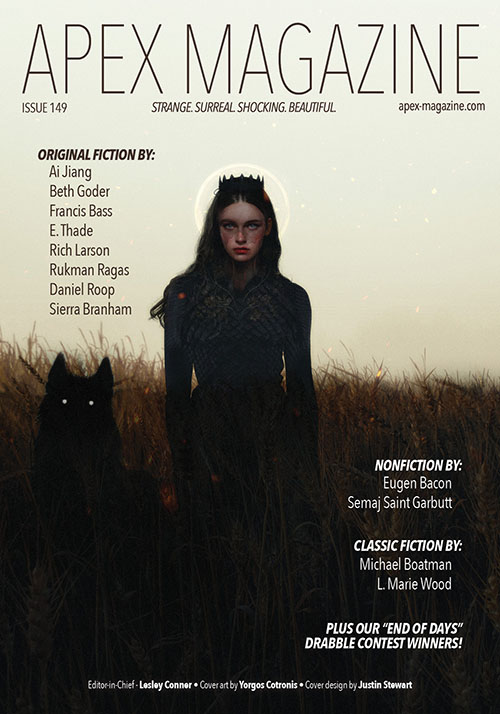
I’m thrilled to announce that I have a short story out in this month’s issue of Apex Magazine! The story, “I Remember a One-Sided Die,” is about an alien species with a strange way of perceiving time and memories, and is narrated by one of those aliens. This is my first story to appear in a magazine in a while, and the longest story I’ve ever had in a magazine, so I’m pretty excited to have it out there! I was also interviewed for this publication by Marissa Van Uden, so after you’ve read the story you can read that interview to see where the idea for this story came from, and how I developed it.

You can read the story and the interview right now if you buy the issue, or you can wait a month and both will be posted on Apex’s website, free to read. I’ll probably share that link in a future blog post as well, when it’s available.

Other news!

I don’t think I’ve actually mentioned it on this blog yet, but back in January I finally finished editing the book I’d been working on for most of the past two years! Currently I’m taking a break from it/waiting to hear back from readers, and later in this year I’ll start querying agents.

I’m also just taking a break from writing in general … although I am editing some short stories I wrote last year … but no new writing! Instead, I’ve been gearing up to making a short comic. I’ve never really intentionally set out to make a comic before, other than LYCC—and that was like a diary comic, so it didn’t require any overarching planning or character development. So this will be a bit of an adventure for me. Right now I’m mostly warming up to drawing again, trying to make it a habit, and I’ve been trying to draw a little 4-panel comic every day. I may clean some of those up and post them here at some point.

That’s the main news from me. Here’s a video of me biking up the SRT to Norristown yesterday.

Review: Parable of the Sower by Octavia E. Butler

EDIT: This post previously misattributed quotes to the Camden mayor, which were in fact made by the Director of the Camden County Board of Commissioners.

Negative review time! It’s time for a negative review!

I never write negative reviews—I mean fully negative, not just a mixed bag—because I rarely finish books that I really dislike. And then if I do, I don’t want to waste even more energy writing about it. But Parable of the Sower is beloved and lauded, and Octavia Butler is basically canonized by the current crop of SFF writers, so I think a full review is worth my while and yours. Maybe it will shed some light on common failings in dystopian lit, maybe it will make other people who disliked this book feel less insane, maybe it will just be fun!

There will definitely be some spoilers, if you can spoil something that is already rotten.

Introduction

Parable of the Sower is narrated by Lauren Olamina, a young girl living in Orange County, in the year 2024. The United States is collapsing into poverty and lawlessness, and is backsliding into oligarchy, all apparently driven by global warming. Things start bad and get a lot worse. Strike that: things start bad for Lauren’s last-gasp-of-the-middle-class enclave, and get a lot worse. For the poor, the misery is pretty abject from the very beginning.

The book has two major parts, about equal in length. In the first half, when things are only bad, Lauren is preparing for the worst, and trying to get her community to do so as well. This preparation mainly entails making bug out bags and reading books about foraging, first aid, etc. Also she wants to start a religion, “Earthseed,” which recognizes change as the only God, and as a fundamental force which people must accept and work through. She develops this religion, writing its holy verses, in secret.

In the second half, her community has been obliterated, and she travels north with a few survivors, hoping to find somewhere they can resettle. They join a mass migration north, and occasionally add new members to their group. Lauren starts to share Earthseed with them. They are attacked multiple times.

Also Lauren has a psychosomatic hyper-empathy condition triggered by the apparent physical sensations of others. It’s not plot-relevant or theme-relevant, and it’s barely character development-relevant, so I will not mention it again.

That is the basic story-shape of the book. There is a sequel, I haven’t read it.

What’s really strange is that this book is not good any way you turn it. With books I dislike, I can usually see the element that people enjoy in them. I cannot see it here. It fails, or is at most subpar, on all counts.

Let’s start with the loftiest of traditions which this book attempts to engage, which is societal critique. This is generally how this book is framed when people describe or recommend it—a cautionary tale of where we’re heading, or (jerk off motion) a prescient vision of where we are!! Oooo!! Octavia Butler warned us!!! (jerk off motion)

Read More »

Reprint: “The Mechanical Turk Has a Panic Attack”

My story “The Mechanical Turk Has a Panic Attack” is newly available in audio form, at Escape Pod! Wow!! The story was first published a year ago at Uncharted Magazine, and now you can listen to it, narrated by Valerie Valdes, produced by Summer Brooks, and with some host commentary from Tina Connolly. It’s a story about a server in a high-end but not quite high-end-enough restaurant pretending to be an android. The title is the plot, essentially.

I’ve said it many times before, this is one of my favorite pieces from the past few years, and it does a lot of the stuff I really want to do with SFF writing. Check it out! And if you’ve read it already, it’s definitely worth a listen, as Valdes does a wonderful job on the narration.

Some other stuff

I still have copies of “Is Magic School Still Worth It?” available! They are still free! Go here to read more about that.

I recently read “Questioning the Bipedal Default” by friend and fellow SFF person M.E. White, published in the October 2018 issue of Worldbuilding Magazine. It’s an in-depth look at the evolution of bipedalism in humans, with speculations on whether or not it’s a prerequisite to intelligent alien life. Very worthwhile read for SFF writers, or anyone into evolutionary bio!

And to close things out, here’s some videos I took while biking around the Navy Yard, an old semi-disused industrial park at the far south end of Philadelphia. (Although the first clip is from another day, earlier this year, crossing Grays Ferry Bridge.) 🚴‍♂️🚴‍♂️🚴‍♂️

New Publication: “The Mechanical Turk Has a Panic Attack” in Uncharted Magazine

Plates showing the mechanical turk, a machine made to look as though it is an automaton playing chess, while really a person is crouched inside it controlling everything.
Plates from Ernest Wittenberg’s 1960 article “Échec!”, about the actual mechanical turk

A bit delayed in announcing this, but I’ve got a new story up on Uncharted Magazine! It’s about a server in a high-end but not quite high-end-enough restaurant pretending to be an android. I mean, the title is the plot, essentially. It’s really good! Seriously, this is probably my favorite thing I’ve written in the past couple years, and I’m so pleased to have it published. You can read it over on Uncharted Magazine.

New(ish) Publication: Classic Cage

In honor of Public Domain Day, I’m ceding my play Classic Cage to the public domain! Classic Cage was produced by Theatre Cedar Rapids as part of the 2019 Underground New Play Festival, and later published in issue 3 of some scripts. And now it’s free for all to read, modify, and perform! Nota bene, this play could very easily, minimally, be adapted to be performed over zoom, since it already takes place entirely through video calls—that’s right, I wrote a zoom play before it was cool!

Here’s the synopsis:

Tara Cage is struggling to sell her next book. Publishers on Mars want another of her cheerful, optimistic Earth travelogues, the ones that made her so popular, but things have been getting bad on Earth. Climate change and economic upheaval have made Tara a lot more cynical, and sick of selling Mars a whitewashed version of her home planet. Her sister and literary agent, Michaela Cage, tries to grease the wheels with a potential publisher by getting a realtime FTL video connection between them on Mars and Tara on Earth. Unfortunately Tara’s internet connection has been screwy, making the video chat’s predictive AI patch over moments of lag with an AI version of Tara, compiled from calls made by Tara the last time she used it—which was twenty years ago. Between the upbeat, cheerful robo-Tara, and the true, jaded, bitter Tara, the publisher is getting mixed messages—though the AI seems to be making a better impression than Tara herself.

Classic Cage is a play about public personas, optimism and pessimism, and the reconciling of youthful dreams with present realities.

Running time is approximately 40 minutes. The cast is 3F, 2M.

You can download the play in the following formats: PDFEpubMobiDocx. If you really want to pay me for it, you can set your own price for it on Smashwords.

I’ve also written a post for Public Domain Day, about the Public Domain Review, which you can read here.

New Publication: Classic Cage in some scripts Issue 3

some scripts issue 3My one act play Classic Cage is available in issue 3 of some scripts, their climate change-themed issue! The issue is available to read free for the next month, until June 11th, here. Here’s the synopsis:

Tara Cage is struggling to sell her next book. Publishers on Mars want another of her cheerful, optimistic Earth travelogues, the ones that made her so popular, but things have been getting bad on Earth. Climate change and economic upheaval have made Tara a lot more cynical, and sick of selling Mars a whitewashed version of her home planet. Her sister and literary agent, Michaela Cage, tries to grease the wheels with a potential publisher by getting a realtime FTL video connection between them on Mars and Tara on Earth. Unfortunately Tara’s internet connection has been screwy, making the video chat’s predictive AI patch over moments of lag with an AI version of Tara, compiled from calls made by Tara the last time she used it—which was twenty years ago. Between the upbeat, cheerful robo-Tara, and the true, jaded, bitter Tara, the publisher is getting mixed messages—though the AI seems to be making a better impression than Tara herself.

manifesto for a speculative theatre

Get excited! These are the plays I write and the plays I love to read, this is why they’re great, this is why you should write them too! I wrote this a year ago, edited it a lot more recently, and I’m publishing it now! These are strange times but they won’t be the strangest, let’s go! Download the manifesto in these formats: PDFEpubMobi — Docx. Or read it below:

preamble

audience

This manifesto addresses itself to two groups of people—playwrights, and writers of science fiction and fantasy.

People who can call themselves both are its intended result.

claim

Theatre enriches science fiction and fantasy. Science fiction and fantasy enrich theatre.

Very little speculative theatre exists; very much should.

speculative

For the purpose of this manifesto, I distinguish the type of work I am calling for, “speculative theatre,” from the already existing vein of theatrical works which merely incorporate science-fictional or fantastical elements (e.g. the angels in Angels in America, the ghost in Hamlet.) As well, I use “speculative” and “science fiction and fantasy” interchangeably for convenience.

The majority of plays which utilize SFF elements do so only as an outgrowth of character, theme, plot, adapted myth, etcetera.

In a “speculative” play, as I define it, character, theme, and plot spring from the SFF world (or the SFF element, though it often implicates the entire world.) In a “speculative” play, the world extends beyond characters, story, and even author.

Both types of play create a world or redefine our own, but speculative plays use the invented world as the foundation, and then speculate, while non-speculative plays use their SFF element to point back to characters, plot, theme, or the real world.Read More »

New Publication: The Ones I Used to Know in some scripts

Screen Shot 2019-02-02 at 11.33.51 AMMy short play The Ones I Used to Know is now available in the inaugural issue of some scripts! I’m so happy to have been included in this project, a magazine founded on the idea that scripts have literary merit, and can be enjoyed and appreciated even in their purely textual form. I’ll refrain from going into my full rant on the importance of reading plays, but basically the core ethos of this magazine is right in line with how I feel about scripts and screenplays as textual objects, and I’m as excited to be published in it as I am to read all the other contributors’ works.

My play is a ten-minute piece about climate change and Christmas music, set in a small town in Iowa. I realize this sounds awfully similar to “Fuck You Pay Me” but 1. Yes, and 2. They are actually quite distinct, and 3. You should check it out anyway!!!

New Publication: ChannelCon ’30

Right on time for convention season, my new novelette “ChannelCon ’30” is now available on Amazon and Smashwords!

0016d89f1aa203ded0e47304488df88d16e3c368With hours and hours of old movies entering the public domain every year, in the near future curators emerge as a new kind of content creator, culling all this old material and selecting personal favorites to livestream on their channels. Lindsey Xong and Amber Smith are two such curators, Amber focusing on finding movies, and Lindsey focusing on commentary and abridgment. Together, the two form Amber Linz, an incredibly popular channel, poised to sign a major deal to to get exclusive access to old movies a year before they enter public domain. To announce this deal and to engage with the curator community, the two go to ChannelCon, the biggest, greatest curator convention in the world.

But almost instantly, it’s clear that ChannelCon is coming apart at the seams, beset by the growing division between purists (who stream content completely unedited) and cureditors (who stream abridged or even completely remixed movies.) As retaliations and acts of sabotage escalate, the two sides seek to claim either Amber or Lindsey as their own, driving a wedge between the duo and jeopardizing their deal. Finding out which side is perpetrating all the chaos is not only important for purists and cureditors—it could also be the only way to save the Amber Linz deal, and Amber Linz itself.

In addition to this novelette, this publication includes an afterword in which I discuss the real world inspiration for this story, and how little fandom and conventions have changed in the past 80 years.

New Publication: Tallahassee Ca. 2045

Remember this post about the Parkland shooting and representation of high schoolers? The play I was talking about back then is now available, on Smashwords and Amazon.

Tc2045-c-2In the year 2045, a group of politically conscious high school seniors decides to organize a youth rally—a protest to lower the minimum voting age. Just before the protest is scheduled to happen, a massive ice sheet breaks off of Antarctica, causing global flooding. The youth rally becomes a demand for radical change of climate policy, and the politics of the students are put under new pressure. Relationships between the original group of friends strain as the protest grows further and further out of control, and any hopes of changing the world look dimmer and dimmer.

Tallahassee Circa 2045 is an exploration of protest culture, shifting ideologies, and the intersection of youth and politics, set against the backdrop of global catastrophe and an ever-shifting national landscape.

Running time is approximately 120 minutes. The cast is 1M, 5F, 3NB.

In addition to the play, this publication includes an afterword (a large part of which already appeared on this blog in that MSD post) which constitutes an in-depth look at youth rights, representations of high schoolers, and the politically tumultuous period in which the play was written.

Happy summer everyone! #HotOutHere

New Publication: Beneath Them

beneaththem-c-3I’ve just published “Beneath Them,” a short story available on Smashwords and Amazon.

In this piece of flash fiction, without warning, thousands of alien spaceships have appeared above major urban areas around the globe, and some have descended to devastating effect. Although the aliens have expressed a lack of ill intentions, and a desire for “recreation,” no one really knows what they are doing on Earth. The only thing that is clear is their overwhelming power, and their overwhelming intelligence.

In the shadow of this invasion, life goes on as Atlanta resident Cheyenne, and her younger cousin Denise, deal with roaches in their apartment.

Also included in this publication is a brief afterword, in which I describe my own encounter with a cockroach which inspired this story.

New Publication: The Wisdom-Goddess Star

Happy Valentine’s Day everyone! My novelette, “The Wisdom-Goddess Star,” is now available on Smashwords and Amazon. It has nothing to do with love or romance, but neither does St. Valentine (possibly), so it works out. Here’s the synopsis:

twgs-c-2Alexander Irving. First generation Martian, born to Patricia Irving and Peter Leung. Studied journalism at the newly founded University of Mars, a petri dish for “human journalism,” a new style of journalism to compete with AI reporters. Moved to Phobos upon graduation and joined the staff of The Light, the premier news organization of Mars’s largest satellite. Reported primarily on the working class of Phobos—technicians, repair crew, service workers—and always felt he was missing something. The grit of real journalism, investigative journalism, the kind which humans still do in the mud and shadows of Earth.

2 Pallas. Third most massive asteroid in the solar system, the newest acquisition of the International Martian Program. Its colonization is the first major IMP project to make use of the Per Aspera Ad Astra program, recruiting a thousand new members from working class, low income, secondary education backgrounds. Due to its highly eccentric orbit, Pallas only nears Mars once every 2 years—making it the most isolated colony in the IMP.

Pallas gives Irving the opportunity he’s looking for, to probe deep into a colony from which AI cannot harvest data, as the colony still lacks a long-range communications relay. When Irving arrives, he shortly discovers that Pallas’s isolation may be the intentional work of the local governor, and he endeavors to discover what exactly the governor wants to keep hidden from the rest of the IMP.

In addition, the publication includes an afterword in which I discuss how a school superintendent election, a dysfunctional novella, and a few English classes influenced the creation of this story.

New Publication: A Clash at Grozny Airfield

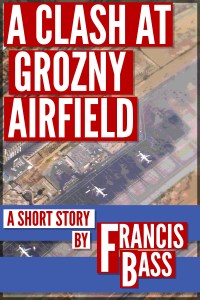
Remember almost exactly two years ago when I wrote a post about Chechnya, based on my research for a story? Well, that story is now available on Smashwords and Amazon!

cover-5In Grozny, the first ever all-robot military unit fights an integrated army of humans and robots. The clash is viewed by five American travelers in an airport café—a veteran, a journalist, two young sisters, and a barista—as the events unfold on TV. Each traveler has a different connection to the distant battle, and they all watch with more and more rapt attention as the integrated forces close in.

Also included is a brief afterword about how I came to choose the setting of the story and write that Chechnya post, and the meaning of the acronym ITF.

Free Fiction: The Forgotten Coast

This was originally a writing exercise for my Foundations of Creative Writing class. I revised it a few times for that class, and I’ve toyed around with posting it here. Now, with the publication of “Calamcity,” I can leverage it into a promotional tool for that novelette, so it’s like I’ve got to publish it now, right? So, here it is:

The Forgotten Coast

I finally went on one of those kitschy submarine tours around the sunken wreckage of Pensacola and PCB and the Forgotten Coast. Hurricane Erica wrecked the shop, so I’d been sitting around waiting for the insurance company to get back to me, to see whether I was finally down the drain after circling it so long—and I saw an an ad with a coupon code for the Forgotten Coast tour. A few years ago, Jesse had really wanted to go on it, just before her, Ed, and their kids moved inland, but I’d been sick. Not sick enough to not go, but I’d played it up like I was. I always knew that I could go to the coast whenever I wanted, so I never felt any urgent pressure to do so. It was all flooded already, a few years’ more sea-level rise wouldn’t change that. And the ruin-porn aspect of it chafed at me. I didn’t want to sit in a sub with a bunch of inlanders gazing in awe at my ravaged childhood like it was a disaster movie.

But I saw this ad with a coupon code, and I was doing nothing, and I had this strange feeling like maybe, with the shop in shambles, I would finally be moving inland like my family and friends had done years and years ago, and maybe this one stupid coupon was meant to be my last chance to see the coast—so I bought the discounted ticket. I took a bus down from Tallahassee to Milton, now a coastal town. It was mostly tourists getting onto the sub (I could tell by their clean, uncorrupted northern English and pale skin) and a handful of local kids with red-brown tans. At least, they looked like kids to me. Teens, early twenties, late twenties—kids.Read More »

New Publication: Just Dig

justdig-4I’ve just published “Just Dig,” a short story, available on Amazon and Smashwords. Here’s the synopsis:

Two brothers, asteroid prospectors, are awoken when an asteroid lands somewhere along the boundary between their little plot, and the enormous plot owned by their neighbors. They drive out to see on whose plot the rock has fallen, and who can claim it as theirs to sell. As they do, they argue about whether they can depend on luck to end a long dry spell, or if they’ll have to make their own luck to turn a profit.

Also included in the publication is a brief afterword, in which I explain the origins of the story, the edits it went through, and who won the 2014 FSU vs. Notre Dame football game.

What I’ve Been Reading, August 2016

Whew. It’s been awhile since I did one of these, but here goes.

Lagoon by Nnedi Okorafor – Lagoon is a book about Lagos, Nigeria, and what happens when aliens arrive there. It’s a sprawling portrait of the city, its people, its landmarks, and the ecosystem it was built around. It focuses most on three individuals—a marine biologist, a soldier, and a rap star, who all find themselves wandering out to the beach shortly after the aliens arrive, and being sucked into the lagoon.

The book has an enormous ensemble of characters, and still manages to have all of them distinct enough that you can keep track. It also does an excellent job of describing the city, which becomes even more important as the book goes on, and parts of the city literally come alive. The story twists and turns without a clear direction, but it’s a lot of fun following those twists, and the book is constantly introducing new and interesting characters and ideas. A testament to how well characterized everything in his story is—it’s been over three months since I listened to it, and I can still remember multiple characters and events that are only mentioned in a single chapter.

Also I listened to the audiobook of it, over the course of the long drive from Iowa City back to Tallahassee, and the narrators (a male and a female) are fantastic.

Seriously though, as I write this description, I keep remembering characters and details from the book, like the guys running 409 scams, and the rapper from Atlanta, and the fantastically entertaining and dislikable preacher. That’s because it’s awesome. Nnedi Okorafor is awesome. Check this book out.Read More »