Rereading A Series of Unfortunate Events: The Carnivorous Carnival

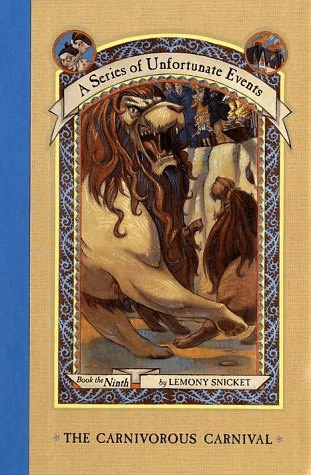
I loved A Series of Unfortunate Events when I read it as a kid, and now I’m rereading and re-loving all thirteen books. Today’s post is about The Carnivorous Carnival, the ninth book of the series. This post will contain spoilers for book 9 and some of the books preceding it, so if you don’t want plot information given away, then in the words of Lemony Snicket, “your time might be better filled with something more palatable, such as eating your vegetables, or feeding them to someone else.”

Carnivorous_Carnival
Cover courtesy of HarperCollins

In The Carnivorous Carnival, the Baudelaires arrive at a rundown carnival in the hinterlands, where Count Olaf is consulting the fortune-teller Madame Lulu to learn the location of the Baudelaires, and whether or not one of their parents survived the fire. Violet, Klaus, and Sunny disguise themselves as carnival freaks, and try to discover how Madame Lulu knows so much about the Baudelaires, and perhaps pre-empt Count Olaf’s next move. Count Olaf also helps Madame Lulu by trying to raise the popularity of the carnival, letting one of his henchmen direct the freak show and make sure the freaks are properly humiliating themselves, and installing a pit of lions.

The book is sparkling with amusing, vibrant characters, from the mysterious Madame Lulu to Kevin, whose big, freakish, shameful quality is that he is ambidextrous (“Is that why you traveled out here to the hinter-lands, so you could stare at somebody who can write his name with either his left hand or his right?”—hilarious. [66]) It’s strikes the perfect tone for a book about a carnival—colorful, eccentric, and with a strong undercurrent of sadness and danger. It also provides a great opportunity for me to talk about:

#FakeNews

In my post about The Vile Village I explained the differences between the books in the first half of the series, and the books in the second. Another difference, which I didn’t mention then, is the nature of the unfortunate events. In the first half, the unfortunate event at the end of every installment is Count Olaf getting away. This is continued into the second half, but also combined with the the Baudelaires repeatedly failing to uncover the mysteries of VFD, and more and more misinformation about them spreading with each book.Read More »

What I’ve Been Reading, March 2017

Plays and comics! I’ve been reading a bunch of plays and comics lately. I’m in a playwriting class, and I’m reading a bunch of plays for a project for another class, and the comics I’m reading because they’re light and I really can’t squeeze in too much extra reading given all the Lemony Snicket books I’m reading, not to mention short stories and essays and poems for another class—anyway, here are some of the plays and comics that have really been stand-out terrific, and worth writing about:

The Goat, or Who is Sylvia? by Edward Albee – This is a play about a man who is cheating on his wife with a goat.

Hahaha, lololol, such fun.

Really, the brilliance of this play is that it is both as ridiculous as that description and as real as the chair I’m seated in (I’m seated in a chair of the real variety, by the way.) And the super-brilliance of the play is the fact that it doesn’t just violently switch tracks between isn’t-this-absurd-you’re-in-love-with-a-goat and what-are-the-real-and-tragic-implications-of-doing-such-a-thing, it runs the two modes simultaneously. I was constantly bursting out laughing and constantly taking sharp inhales throughout reading this play. I reacted to it in the same way I react to horribly-absurd/absurdly-horrible real world events. I have to laugh at the absurdity, but I can’t get away from the horrible reality of it because it’s something that actually happened, in the world I live in.

Albee’s great accomplishment here is that he never lets the audience put distance between themselves and the work. The characters continually make choices, adopt lines of conversation, that ring so true that you can’t just think, well it’s just a silly play.

And the play was written by Edward Albee, so it’s crackling with his wit and dynamic character interactions.Read More »

Rereading A Series of Unfortunate Events: The Hostile Hospital

When I was a kid, I adored A Series of Unfortunate Events, and now I’m rereading through all thirteen books. Today I’m discussing book 8, The Hostile Hospital. This post will contain spoilers for book 8 and some of the books preceding it, so if you don’t want plot information given away, in the words of Lemony Snicket, “this [review] is something best left on the ground, where you undoubtedly found it.”

Hostile_hospital
Cover courtesy of HarperCollins

In this eighth installment of Unfortunate Events, the Baudelaire orphans find themselves at Heimlich Hospital, a half-constructed hospital in the middle of nowhere, which inexplicably contains a massive library of records. The Baudelaires manage to get jobs filing paperwork in the library of records, all the while hoping to find some information on the mysterious organization VFD, or the murky circumstances surrounding the destruction of their home and the death of their parents. The treacherous Count Olaf has also arrived at the hospital, though for what purpose the Baudelaires do not know.

Reading to the Rescue!

One of the greatest aspects of Unfortunate Events, which is especially great to find in children’s literature, is the dramatization of reading. Throughout the series, literature and language is used to thwart villains, crack secret codes, and gain an advantage against the Baudelaires’ antagonists. Certainly, plenty of fiction involves characters reading or studying things—Harry Potter and Buffy the Vampire Slayer immediately jump to mind—but in those cases, reading is just a means to deliver knowledge upon which to take some other action (magic, fighting, confronting another character.) In ASOUE, reading is presented in a much more dynamic way, and it often is the action itself. There’s no scene in Harry Potter where the reader feels tension wondering whether or not the characters will fail to read, but there are multiple such scenes in A Series of Unfortunate Events.

The reason I bring this up with this book is that The Hostile Hospital contains more Reading to the Rescue!TM than any other book—it is consistently the way the Baudelaires pursue their goals, and attempt to save themselves from the schemes of others. Not only does the book prominently feature reading and language, it also presents multiple facets of these activities, instead of just the typical studying that every book in the series contains.Read More »

Rereading A Series of Unfortunate Events: The Vile Village

A Series of Unfortunate Events is one of my favorite book series from when I was a kid, and I’m rereading through all thirteen books. Today I’m discussing the seventh book, The Vile Village. This post will contain spoilers for book seven and all the books preceding it, so if you do not want plot information given away then, in the words of Lemony Snicket, “you may prefer to do some other solemn and sacred thing, such as reading another [review] instead.”

vile_village
Cover courtesy of HarperCollins

The Vile Village is a turning point in A Series of Unfortunate Events. It falls in the exact middle of the thirteen-part series, and narratively speaking, it has one foot in the first half of the series and one foot in the second half. Just like all the previous books, the Baudelaire orphans are sent to live with a new guardian—in this case, an entire village standing in as a guardian, the Village of Fowl Devotees. VFD is governed by the Council of Elders, a group of old townspeople who have generated thousands of rules that must be strictly obeyed. And, the same as the last five books, Count Olaf shows up in disguise to steal the Baudelaires’ inheritance. The book ratchets up the stakes and the tension of all the previous books, in addition to having all the usual dark creativity, verbal gymnastics, and intriguing mysteries.

So, what separates this book from all the books of the first half?

Half and Half

Before I answer that question, I should first explain what I mean by “first half” and “second half.” This is a deeply ingrained framework in my head for understanding A Series of Unfortunate Events. The first half is books 1-6, and kind of book 7. The second half is books 8-13, and kind of book 7. The reason that book 7 doesn’t fall firmly into either category isn’t just because of the imperfect math—it’s because it shares characteristics with both halves. So hopefully I can take this opportunity both to highlight the transitional nature of The Vile Village and delineate the characteristics of the first and second half.Read More »

Rereading A Series of Unfortunate Events: The Ersatz Elevator

A Series of Unfortunate Events is one of my favorite book series from when I was a kid, and I’m rereading through all thirteen books. In today’s post I review the sixth, The Ersatz Elevator, and talk about mood, darkness, and architecture.

the_ersatz_elevator
Cover courtesy of HarperCollins

In the sixth installment of Unfortunate Events the Baudelaires return to the city to stay with their new guardians Jerome and Esmé Squalor. The Squalors are obscenely wealthy, and they live in a penthouse on the 66th floor of an apartment building. Esmé is a financial advisor obsessed with fashion, and she constantly discusses which items are “in” and which are “out,” while her husband Jerome is exceedingly kind, but also exceedingly non-confrontational. While the book follows similar plot beats to the previous five, it also alters the formula in a significant way. In this book, not only are the Baudelaires trying to outsmart Count Olaf, who is back to steal their inheritance, they’re also delving into the secret surrounding their parents, the fire that destroyed their home, and Count Olaf himself.

Moody

What this book does better than any other ASOUE book I’ve reread so far (and at this point I’ve reread through book nine) is mood. Of course, all the books have a very distinct style, and Snicket has a distinctly macabre, dry tone—but, at least the way I’m using it here, that’s different than mood. When I say mood, I mean the overall feeling that a book evokes in its reader. Some books evoke wonder, some evoke excitement, and some evoke dread. A Series of Unfortunate Events is the kind of series that has a mood of dread about it, and The Ersatz Elevator has it in spades. In no other book is this feeling that something is terribly wrong so all-encompassing, so pervasive throughout the whole novel. Of course, there are sources of dread in all the books, because the reader knows even before they begin that, whatever the circumstances, this is not going to be the happy home where Violet, Klaus, and Sunny will spend the rest of their childhoods. In The Reptile Room, the narrator mentions early on that Uncle Monty will die later in the book. In The Wide Window, the precarious location of Aunt Josephine’s house on the edge of a cliff instantly inspires anxiety.

The key with dread is to strike a balance between what the reader knows and what they don’t know. If the reader knows too much, then they can anticipate what horrible events are going to happen. If they know too little, then they won’t even realize that there’s any threat of danger. It’s the difference between knowing that your ex is going to come over to get their things at 1:00 pm (some dread), knowing your ex is going to come over some time during the day (maximum dread), and not knowing your ex is going to come over (no dread.) In most of the books, Handler errs on the side of letting the reader know more, displaying the awful machinations which will eventually be set into motion. This has its own benefits (it helps with world-building and character development and is just generally intriguing) but it does cut down on the feeling that something bad could arise from any corner at any time.Read More »

What I’ve Been Reading, February 2017

It’s been awhile since I did one of these, partly because I’ve been reading more short stories than novels, partly because I’ve been reading A Series of Unfortunate Events. So, other than those books, here’s what I’ve been reading:

The Reeducation of Cherry Truong by Aimee Phan – This novel is a family epic, which surveys the lives of two families of Vietnamese immigrants—the Truongs and the Vos. The families are linked by the marriage of Tuyet Vo and Sanh Truong, but there is plenty of bad blood between them, revealed throughout the book. Cherry Truong is the daughter of Tuyet and Sanh, and the main character of the story—though really, the book is an ensemble work.

Each chapter is told from a different perspective, giving a broad scope of the families, and their lives as immigrants—one family in Paris, the other in Orange County, California. Every character is intriguingly flawed, and watching them interact, and seeing how small conflicts beget bigger conflicts is fascinating. The scope of the book is satisfyingly large, and all the backstories of the characters memorable. The book doesn’t have much of a coherent through-line, and I felt Cherry’s arc was a little rushed, but I still enjoyed it overall.Read More »

Rereading A Series of Unfortunate Events: The Austere Academy

A Series of Unfortunate Events is one of my favorite book series from when I was a kid, and I’m rereading through all thirteen books. In today’s post I review the fifth, The Austere Academy.

Austere_academy.jpg
Cover courtesy of HarperCollins

The Austere Academy is a departure from the first four books. Instead of having a guardian, the Baudelaire orphans are sent to live in Prufrock Preparatory, a boarding school. The closest thing they have to a guardian is Vice Principal Nero, a cruel, pompous man who is a terrible violinist, and who enforces strict rules with harsh punishments in the school. While the book has almost all the trappings of the previous four (Count Olaf in disguise, scheme to steal the Baudelaire fortune, horrible circumstances) it also introduces two new characters that will continue to be important in the following books—Isadora and Duncan Quagmire. Isadora and Duncan are siblings, two of three triplets, whose third sibling and parents have died in a fire. They make a unique addition to the series, first in that they are kids, and second in that they actually befriend and help the Baudelaires.

Soup!

This book gives me a great opportunity to discuss something I’ve been wanting to write about throughout this series—psychological realism. I had trouble posturing what I wanted to say about it, but this book provides a great example of what I mean, and the kind of straightforward simplistic psychology that children’s lit usually engages in. First, what I mean by psychological realism:

Students are forbidden from entering the administrative building, with the punishment being having to eat their next meal without silverware. However, Violet, Klaus, and Sunny Baudelaire have to walk to the administrative building to tell Nero about their suspicions about Count Olaf.  On the way there, Klaus starts snickering.

“I just realized something,” Klaus said. “We’re going to the administrative building without an appointment. We’ll have to eat our meals without silverware.”

“There’s nothing funny about that!” Violet said. “What if they serve oatmeal for breakfast? We’ll have to scoop it up with our hands.”

“Oot,” Sunny said, which meant “Trust me, it’s not that difficult,” and at that the Baudelaire sisters joined their brother in laughter. …

“Or fried eggs!” Violet said. “What if they serve runny fried eggs?”

“Or pancakes, covered in syrup!” Klaus said.

“Soup!” Sunny shrieked, and they all broke out in laughter again. (85)

The reason this sequence is great is that, for most of the book, the emotions of the Baudelaires are static. They will react to some change in circumstances or piece of news, positive or negative, and then remain in that emotional track until another such event. So, the most straightforward way to plot this would be as follows: Orphans go to talk to Nero—Orphans are apprehensive—Orphans arrive and begin to talk to Nero—Orphans are determined/frustrated—Orphans are turned away—Orphans are disappointed. There’s nothing wrong with this, and the books move quick so there’s necessarily little time for twists in the tracks. Still, Daniel Handler finds places to put in these little moments where the orphans break from their emotional track, not because of some external development, but because of their own internal psyche. The above sequence gives the reader a window into the minds of Klaus, Violet, and Sunny, to show how they’re coping with these horrible situations by laughing at them.

Read More »

Thoughts on A Series of Unfortunate Events, Season One

I’ve watched Netflix’s Lemony Snicket’s A Series of Unfortunate Events in its entirety now, and there’s a lot to talk about. This post will be part review, part analysis, and part comparison between the books and the show. The first third of the post contains no spoilers, but the next two thirds do, for the books and the show, and I’ve put a disclaimer in at that point.

For reference, and so I don’t have to explain it later, this is the basic plot: Three children, Violet, Klaus, and Sunny Baudelaire are orphaned when their parents die in a fire which destroys their home. The parents leave behind an enormous fortune, which cannot be accessed until the eldest Baudelaire comes of age. The children are moved from guardian to guardian, always pursued by the villainous Count Olaf, who schemes to steal their inheritance, and is ruthless in his pursuit of this goal. Violet Klaus and Sunny survive by their inventive thinking, extensive knowledge, and ability bite things (respectively.)

So, here we go:

If You Haven’t Read the Books …

If you’ve never read the books, I highly recommend the show. I don’t know if it’s better or worse to have read the books, but I’m confident that it stands by itself as a terrific work of art. There is nothing like it on TV, and for good reason.

asoueolaf
Photo courtesy of Joe Lederer/Netflix

Imagine if a showrunner spent seven years writing hundreds of pages of stories and characters and settings, and wrote all of them in the voice of the show’s narrator. Imagine they worked with a designer who drew hundreds of pieces of concept art detailing the looks of characters, props, and sets. Imagine if the showrunner also composed and performed thirteen songs to go along with different parts of the show (though not to be actually used in the show.) And imagine they had a decade after that time in which they continued thinking about the show, and expanded on the background of the narrator by writing a few hundred more pages about his childhood in this same world.

That, of course, would be absurd, but because of the way this all developed, it’s essentially what happened. And while this could be said of many shows and movies adapted from books, the difference here is that the original creator usually isn’t the one writing the screenplays. Daniel Handler, author of the book series, is also the screenwriter for every episode of the Netflix series (and although he’s not the showrunner, he is an EP.) The result is an uncompromising vision of a world and the characters who inhabit it. The music, set design, and writing are all of a cohesive style—one which is confidently gothic, bizarre, and witty. The show is highly engaging, full of wonderful(ly wry) commentary from the narrator, beautiful(ly ugly) sets, and charming(ly villainous) performances. At times I had doubts about the direction the show was going, the portrayal of a character, or the handling of a particular scene, but never, throughout watching the entire show, did I feel I could look away. I expect that kids will devour it.

If you have read the books, you will also probably love it, unless you love the books for some particular reason which the show has altered. In that case, I’d advise you to pretend that the series has nothing to do with the books, and enjoy it for what it is.Read More »

Rereading A Series of Unfortunate Events: The Miserable Mill

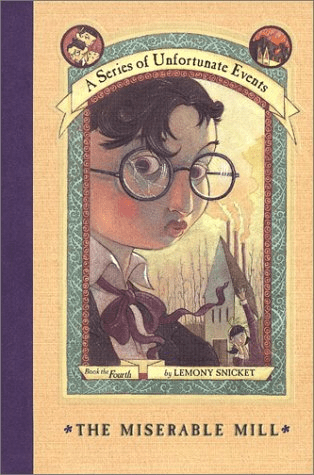
With the TV adaptation released as of this very Friday the thirteenth, I’m rereading one of my favorite book series from when I was a kid—A Series of Unfortunate Events. Today’s post brings us up to fourth book in the series, and the last book adapted in the Netflix show—The Miserable Mill. This post contains spoilers for the first four books of ASOUE, so as Lemony Snicket would say, “if you prefer [reviews] that [don’t give away plot information], please feel free to make another selection.”

the_miserable_mill_usa
Cover courtesy of HarperCollins

The fourth installment of Unfortunate Events tells of the Baudelaire orphans’ stay at the Lucky Smells Lumbermill. Instead of living in a house, the Baudelaires have to live in a bunkhouse for the mill’s employees. Their new guardian offers them a “good deal”—in exchange for his providing them food, housing, and protection from Count Olaf, they will work in his mill. The orphans really have no choice in whether or not to take the deal, and they are forced to work in terrible conditions. While they uphold their end of the deal, their guardian is unable to protect them from Count Olaf, who once again returns in disguise and attempts to steal the Baudelaires’ inheritance.

Some Gripes

The writing of the book is as superbly dark, imaginative, and humorous as the previous three, but there’s less interesting character work, and less intriguing plotting. The new characters introduced in the book are one-note, and the Baudelaires themselves are inactive throughout most of the book. For the majority of the story, things happen to the orphans, rather than them taking initiative and trying to outsmart Olaf, or uncover his plot, the way they usually do. This isn’t actually a problem, as I’ll explain later, but it does make the book a slower read than most of Snicket’s books.Read More »

Rereading A Series of Unfortunate Events: The Wide Window

With the TV adaptation’s release just two days from now, I’m rereading one of my favorite book series from when I was a kid—A Series of Unfortunate Events. Today’s post covers book three, The Wide Window.

the_wide_window_usa
Cover courtesy of HarperCollins

“Book the third” of A Series of Unfortunate Events finds the Baudelaire orphans arriving at the house of their new guardian, Aunt Josephine. Aunt Josephine’s house is perched on the edge of a cliff (all but the foyer of the house is held up solely by stilts) above Lake Lachrymose, a lake filled with man-eating leeches. As always, Count Olaf shows up in disguise and concocts a plan to steal the Baudelaires’ inheritance. The book is full of Handler’s dark, gothic creativity, and the plot twists and turns in unpredictable and riveting ways. As I write this, I’ve already reread through book six of Unfortunate Events, and The Wide Window is probably my favorite of the early books.

That Leaves You with a Rattle

In my previous posts I’ve talked about how each of the main characters is somewhat defined by their particular skills—Violet invents, Klaus reads, and Sunny bites—and about how the story can sometimes feel contrived because of the way the orphans end up being presented with situations that require their specific skills. The Wide Window manages to subvert this trend to great effect. When the Baudelaires come to their new home, their Aunt Josephine presents each of them with a present. Violet is given a doll, Klaus a train set, and Sunny a rattle. The fact that the items are so incongruous with the orphans’ skills and interests subverts the reader’s expectations, and this subversion really accentuates the awkwardness of the situation. It’s a smack of reality after the perfect (at least before Count Olaf showed up) life that they had with their previous guardian. But the subversion continues.Read More »

Rereading A Series of Unfortunate Events: The Reptile Room

With the TV adaptation just around the corner, I’m rereading one of my favorite book series from when I was a kid—A Series of Unfortunate Events. Today’s post regards book two, The Reptile Room, and it does contain spoilers for that book. As Lemony Snicket would say, if you don’t want plot information given away, “you are free to put this [review] back on the shelf and seek something lighter.”

And Speaking of Spoilers …

the_reptile_room_usa
Cover courtesy of HarperCollins

In this book, the Baudelaire orphans go to live with another distant relative, “Uncle” Monty, who studies snakes. Right as the orphans arrive, Uncle Monty is planning a scientific expedition to Peru, and he wants the orphans to come along. Eventually Count Olaf shows up disguised as Monty’s assistant, and schemes to steal their children’s inheritance once again—a scheme made easier by the death of Uncle Monty.

What’s interesting about this book is that it reveals the death of Uncle Monty as early as page 28—and not in some hint or euphemism, the narrator explicitly states, “It is Uncle Monty, unfortunately, who will be dead.” Mentioning this so far up front is important because it lets the readers know that, even though the main characters are having a good time in their new home, misfortune will strike again.

It also softens the blow of Uncle Monty’s death. The death of the caretaker is more disturbing than anything in the first book, because the children actually see his corpse (compare this to Harry Potter, wherein there’re no corpses until book four, more than halfway through the series.) It’s also more shocking to the reader than anything in The Bad Beginning, because unlike the parents who die in the first book, we actually get a chance to see Dr. Montgomery and get to know him before he dies. So knowing that it’s going to happen ahead of time takes some of the edge off the murder. It’s important to do that because this is only the second book of the series, and the first book where the guardian isn’t Count Olaf—the reader can’t have very clear expectations of how “unfortunate” these books will get, so the death of Uncle Monty establishes the tone, and severity of misfortune, for the entire series.Read More »

Rereading A Series of Unfortunate Events: The Bad Beginning

badbeginning
Cover courtesy of HarperCollins

I’ve been wanting to reread A Series of Unfortunate Events for a while, and with the Netflix series premiering in just a week and change, now seems like a good time. So, leading up to Friday the 13th, I’ll be posting reviews of the first four books—the ones covered in the TV series. I could stop there, but as soon as I started reading the first one I was hooked, and I could easier stop drinking coffee than stop reading these books at this point. So I’ll keep posting reviews after that, I don’t know how often, but at least weekly.

The Only Series That Matters

I’ll start by explaining, why this series? Between the ages of six and ten, I read a lot of YA and middle grade books, and a lot of book series—The Underland Chronicles, The Inheritance Cycle, Magic Treehouse, the Alex Rider books, the Alfred Kropp books, GoosebumpsAnimorphsCaptain UnderpantsThe Spiderwick Chronicles, and others. Some of these series I read all the way through, others I didn’t. But as far as I was concerned, A Series of Unfortunate Events and Harry Potter were the only series that mattered. There were no other books that I reread so often as the books in those series. They were the two pillars of children’s literature for me. Looking back on all the books I read as a kid, those are the only series I’m still interested in rereading—and, although Harry Potter was my favorite when I was a kid, Unfortunate Events is the series I now care about rereading most. The books introduced me to so many concepts, phrases, quotes, and words which have stuck with me to this day. Molotov cocktails, Friedrich Nietzsche, mob psychology, waxing and waning—but I’m getting ahead of myself. The point is, the series looms large in my childhood, and hopefully these posts will explain why, as well as illuminate other matters I find interesting along the way.Read More »

What I’ve Been Reading, November 2016

Lot’s of books about Vietnam, because I’m in a literature class called “Reimagining Vietnam.” So, here’s what I’ve been reading:

The Quiet American by Graham Greene – The Quiet American is a book narrated by Thomas Fowler, a jaded British journalist working in Vietnam during the violent overthrow of French colonialism. The American of the title is Alden Pyle, a representative with the American economic mission, who seems to have some greater role than he lets on.

The book’s plot is pretty interesting in it’s own right, mainly focusing on the growing relationship between Pyle and Fowler, and Pyle’s attempts to win the heart of Fowler’s Vietnamese mistress—but what I enjoyed most were all the questions it raised about being “engagé.” Fowler firmly believes in remaining neutral as a journalist, while Pyle is full of idealism, convinced that America can do good in bringing democracy to Vietnam—before the US even had a strong military presence there. The book was published shortly after the events described in it—before the “Vietnam War”—but the debates between Fowler and Pyle about the role of western powers in under developed nations have only become more and more relevant. What is the global role of a fading colonial power? What is the role of a rising superpower? At what point does inaction become action?

The book is a quick read, full of dry wit, vivid descriptions of the communist uprising, and terrific dialogue.

The Things They Carried by Tim O’Brien – Vietnam book number two. The book is a collection of short stories revolving around a platoon of American soldiers in the Vietnam War. Most of the stories are narrated by a fictitious version of the author. Some are short vignettes, some are longer, more traditional stories, and some are almost like personal essays, with choppy bits of story and pieces of argument or reflection mixed together.

The more traditional stories are all compelling. O’Brien does a masterful job of characterizing the soldiers and the landscape around them. The opening piece, “The Things They Carried,” is a long meditation on the physical and emotional burden of each of the soldiers, all their memories and personal totems. One of my favorites is “On the Rainy River”, which describes the narrator’s struggle deciding whether or not to dodge the draft. These types of stories, with their intimate depth of character and reflective tone, would be enough for me to highly recommend this book. What makes the collection really special, and something worth re-reading, is the inclusion of those more non-fictional pieces. Pieces like “Spin,” “How to Tell a True War Story,” and “Good Form” add another layer to the book, calling into question the truth of things, and the purpose of writing, and remembering, and telling war stories. And O’Brien did fight in Vietnam, so there’s another layer. The book is rich with experience and questions, an engaging read and one to remember, and keep thinking about, as well.

No Man’s Land by Duong Thu Huong – This book is great. It takes place in (surprise!) Vietnam shortly after the victory of the Communist forces, in a town called Mountain Hamlet. The action kicks off almost immediately when Mien, one of the three main characters, finds that her first husband has returned from the dead. She had married him just before he went off to war, and for over a decade he’s been presumed dead. In that time, Mien married an entrepreneur named Hoan, and had a child with him. But once her first husband, Bon, returns, she feels a social and moral obligation to become his wife again.

The strength of the book is the characters. The main characters are the members of the love triangle, Bon, Hoan, and Mien, but there are plenty of side characters that are just as interesting. Everyone has a backstory, with more depth and hardship hidden beneath the surface. Huong digs deep into all the characters, and all the settings, with descriptions that range from beautiful to horrifying. Everything is so well wrought, the characters and settings and backstories all leave deep emotional impressions on the reader. Of all the books I’ve read so far for my Vietnam class, this one is my favorite.

The Adventures of Huckleberry Finn by Mark Twain – As with many of Mark Twain’s books, this one is all over the place, in terms of tone and subject matter. Most of the time, it works, and the result is a book that is full of many different memorable characters and entertaining situations.

If you don’t know the plot already, Huckleberry Finn follows the Huck and Jim, a runaway slave, as they run away from their abusive father and their owner who plans to sell them down the river, respectively. They set off on a raft down the Mississippi, intending to take a turn around the south end of Illinois and head northeast, to the free states. The book is mostly composed of short episodes which occur as they travel down the river.

This is the strength of the book. These episodes are full of larger-than-life characters, like the Duke and the King—two conmen who board the raft as they’re being chased out of the town they just ran a grift on—or the Grangerfords and the Sphepherdsons—two families on opposite sides of a generations-old feud, whose cause know one can even remember anymore. Below the surface all the colorful characters and funny stories are issues of race, dominance, violence, mob mentality, religion, and, of course, slavery. The balance that Twain strikes between entertainment and substance is terrific and compelling, and it’s why the book is a classic. Unfortunately, the ending is (famously) underwhelming, and abandons the substance in favor of just entertainment, leaving all those issues unresolved and unacknowledged.

Regardless, the book is absolutely worth reading, and there’s a great audiobook of it, performed by John Greenman, on Librivox.

Harry Potter and the Holistic Review

Harry_Potter_and_the_Cursed_Child_Special_Rehearsal_Edition_Book_CoverI just finished Harry Potter and the Cursed Child, and I feel like it was one of the most multi-layered reading experiences I’ve ever had with a contemporary work. By multi-layered I mean that I was thinking about, and analyzing meta-textual elements while reading it—which is a common enough experience, when I’m reading old literature for my english classes, but pretty rare with recently published books and plays. So, rather than just reviewing the play as I might review Mr. Burns or Water by the Spoonful, I’m going to review the play in all it’s aspects—the things I noticed as a reader, as a writer, as a theatre person(ish), as a fan of the original books, and as someone interested in the publishing industry. I’ll mention plot elements throughout this post, so if you don’t want the play spoiled, halt now.

So, let’s begin.Read More »

What I’ve Been Reading, August 2016

Whew. It’s been awhile since I did one of these, but here goes.

Lagoon by Nnedi Okorafor – Lagoon is a book about Lagos, Nigeria, and what happens when aliens arrive there. It’s a sprawling portrait of the city, its people, its landmarks, and the ecosystem it was built around. It focuses most on three individuals—a marine biologist, a soldier, and a rap star, who all find themselves wandering out to the beach shortly after the aliens arrive, and being sucked into the lagoon.

The book has an enormous ensemble of characters, and still manages to have all of them distinct enough that you can keep track. It also does an excellent job of describing the city, which becomes even more important as the book goes on, and parts of the city literally come alive. The story twists and turns without a clear direction, but it’s a lot of fun following those twists, and the book is constantly introducing new and interesting characters and ideas. A testament to how well characterized everything in his story is—it’s been over three months since I listened to it, and I can still remember multiple characters and events that are only mentioned in a single chapter.

Also I listened to the audiobook of it, over the course of the long drive from Iowa City back to Tallahassee, and the narrators (a male and a female) are fantastic.

Seriously though, as I write this description, I keep remembering characters and details from the book, like the guys running 409 scams, and the rapper from Atlanta, and the fantastically entertaining and dislikable preacher. That’s because it’s awesome. Nnedi Okorafor is awesome. Check this book out.Read More »

The Absolute at Large; A recommendation and promotion

taal-pod-5

This book is awesome.

It is one of a few works by Karel Čapek that is in the public domain and has a translation (which you can read here) that is under a creative commons license. Karel Čapek was a Czech science fiction writer from the early 20th century. Today he’s most well known as the originator of the word “robot”—which he introduced in his 1920 play R.U.RThe Absolute at Large was his first novel, after he’d written some plays and short stories. It’s a novel that begins in a very familiar, classic sort of way—a businessman sees an advertisement for an invention, realizes the inventor is an old friend, and goes to pay him a visit. It turns out that this invention (called a “carburator”) is a furnace that consumes matter entirely. It destroys it on an atomic level, releasing massive amounts of energy, and leaving nothing behind—at least, nothing physical. This is where the story turns away from typical hard sci-fi, and goes ahead toward something fantastic.

The inventor, Rudolph Marek, says that he has been reading about pantheism—the idea that god is in everything. This theory explains why when people go near the carburator, they feel a sense of awe—of holiness—all around them. By destroying matter completely, the carburator not only releases energy, it releases God—or, the Absolute.

The book continues to follow Marek and G.H. Bondy, the businessman, as Bondy purchases the invention and gets his company to start mass-producing them. As carburators are installed throughout the world, more and more instances of miracles occur, and the people near the carburators grow more and more spiritually fanatic. Groups of worshippers and cult leaders spring up all around these carburators, and eventually the Earth throws itself into a world war much more fractured, vicious, and global than the first one.

The fact that the Absolute manifests itself in every aspect of society means that Čapek’s satire has free reign. The absurd fanaticism inspired by the Absolute is a way to look at actual fanaticisms with a critical eye—communism, capitalism, and nationalism being chief among them. The book is short, but it is epically satirical.

This book is awesome, and I am recording an audiobook of it. I’ll release episodes every Sunday and Tuesday, on youtube and on podomatic.

UPDATE: And on iTunes here.

I’ve already posted the first three chapters, and you can listen to those in the video below.

And while you’re waiting for more episodes, here’s a playlist of the music I plan on using, to get you in the mood. This is going to be fun.

What I’ve Been Reading, March 2016

Some theatre, some sci-fi, some sci-fi theatre. That’s what I’ve been reading.

100 Essays I Don’t Have Time to Write by Sarah Ruhl – The title pretty much explains the book. It’s a collection of one hundred partial essays, almost all of them about theatre. The immediate question that this raises is: why read a book that isn’t complete? And, if you’re looking to learn something, or be informed, or be totally and utterly convinced of something, this is not the book for you. But if you want to be stimulated and provoked, this book is terrific.

First of all, Sarah Ruhl has a fascinating mind. Almost every essay probes into some question or insight that I never would’ve come up with. And, because the essays don’t have to come to some grand point, and very often end with questions, I was left to further explore the topic on my own. The book reads very quickly, and I probably could’ve blown through it in one sitting if I didn’t keep stopping to think, and argue with myself about the ideas she raised in her essays. My only caveat is that I don’t know how interesting the book would be to someone who does not have some experience with theatre—as an audience member, as a performer, or even just as someone who reads plays. My advice for such a person would be: go experience some facet of theatre, and then read Sarah Ruhl’s 100 Essays. It’s fantastic.

If you’re still unconvinced, you can go to her website and read a randomly selected essay (or two, or five.)Read More »

My Understanding of Don Quixote

NOTE: I read the Tom Lathrop English translation of this book. The translation is very readable, and full of interesting footnotes to give context. Quotes in this post come from the Ormsby translation, because I don’t have my edition handy.

I’ll start this post by talking about a different  book—The Odyssey.

I was assigned to read this book in a class in middle school and one in high school, and never finished it either time. Every other reading assignment in high school I completed, but not The Odyssey. Part of it was that I was in eighth and ninth grade when it was assigned. Another part was that the book is terrible if read just as a book. The characters are flat, the story is convoluted and repeatedly drags itself out in cheap, illogical ways, and though the writing can be striking at times, it’s translated from a poem written in ancient Greek over two thousand years ago, so I imagine a lot of the poetry is lost. It’s only interesting as it relates to all of western literature following it, which a ninth grader, even one who’s a precocious writer, has no grasp of.

Don Quixote is not as inaccessible as The Odyssey, but it is still a flawed work. The most important thing it contains which The Odyssey doesn’t is relatable characters. Don Quixote and Sancho Panza are realistic, and even have distinct voices. While some of the other characters blur together, and all speak in the same formal style as don Quixote, Sancho Panza and don Quixote are enough to engage a reader on a basic level, with no need for historical context. In addition to this, Don Quixote has the advantage of humor, something that transcends the dry, formal writing style and meandering plot.

If I read this book as just a book, I would say that I enjoyed the episodic style except where the plot completely derailed into repetitive romance stories that had nothing to do with the main characters, and that the book was bloated, but contained an interesting through-line. I’d criticize the almost complete lack of visual descriptions. I would say I adored the main two characters but that there were many secondary characters who seemed redundant, and could’ve been merged into one character. I would say that the handling of Sancho’s character arc was smooth and natural, while don Quixote’s was a bit more jerky and sudden. I’d critique the ending as fitting though too abrupt. Overall I’d like the book, though I wouldn’t recommend it to anyone who wasn’t a big reader.

But I didn’t do that. I read the book knowing it is considered the first modern novel, knowing that everything I’ve read and written has been influenced by this book. I read it knowing that Cervantes wrote the book at the height of the Spanish Empire, and the height of its excess. I read it knowing that it was parody of chivalric romances, the popular genre of the day. I read it knowing it was blazing it’s own path through uncharted literary territory. With that in mind, I loved the book.

Read More »

What I’ve Been Reading, January 2016

Here I go again, with a Victorian novel, a sci-fi novella, and a dramatic play.

Our Mutual Friend by Charles Dickens – The last book I read for my Dickens class, and the last book that Dickens completed. The plot is hard to pin down. The “mutual friend” described in the title is definitely a big part of it, but he’s not the only part, or even the biggest part. There’s the typical Dickens ensemble of characters that ranges from villains to saints and paupers to aristocrats, but they’re not all connected by a common plot. They are connected through themes, the big ones being death and wealth. The mutual friend is the heir to a fortune, and he fakes his own death to live a humbler life—which really ties the two big themes directly together. More than that, it’s difficult to say. I imagine each reader gets a different impression of what the most noteworthy aspect of this book is, and there’s a lot to choose from.

If you like Dickens though, you’ll love this book. The writing is complex and entertaining, and the characters and their relationships are a constant source of fascination. It’s a recombination of many of Dickens’ tried and true motifs, characters, and plots, but a perfection of them that kept me engaged enough to read through the last two hundred pages in a day.

“The Citadel of Weeping Pearls” by Aliette de Bodard – This novella, which I read in the October/November issue of Asimov’s, is set in Bodard’s Xuya universe—a world where China discovered the Americas first, and Southeast Asian cultures goes on to be much more influential. In this novella, it is the space age, and the Dai Viet Empire is facing threats from the Nam Federation. To counter these threats they desperately need to find the Citadel of Weeping Pearls, a space station to which the rebellious princess and heiress fled thirty years ago, and which disappeared without a trace.

The novella is similar to Our Mutual Friend in the way all the characters are tied together by themes, if not plot. That’s not entirely true, because the characters converge much more tightly in “Citadel” than they do in Our Mutual Friend, but that convergence isn’t really crucial or meaningful, it’s just useful for keeping things focused in a short novel. The recurring struggle of these characters is retrieving something that’s lost. The empress wants to reunite with her daughter, who she last saw when she was trying to attack the citadel. An engineer attempts to build a portal into the citadel so she can see her mother again, who was onboard the citadel when it disappeared. The younger princess feels disconnected from her daughter, who was turned into a mindship to be used by the empire.

Though the story opens strong with a fantastically large and interesting world, the characters, and their relationships and struggles, are what ended up engaging me the most. For them, “The Citadel of Weeping Pearls” is worth reading. Currently it’s only available in the issue of Asimov’s in which it was published, but I’m guessing it will be published by itself some time down the line.

Oleanna by David Mamet – Oleanna is a short, two-person play by David Mamet. The characters are a college professor and a student of his. The first act is dominated by the professor spouting long philosophical lines about the failures of higher education, under the pretense of helping his student understand the class. The second act flips things around, as the audience discovers that the student has used sexual harassment claims to threaten the tenure of her teacher.

The play is fascinating. It changed my mind many times throughout reading it, but not because of ambiguity or a withholding of information—just because the characters and the questions raised are so challenging, and so well-explored. It even has a sound, decisive conclusion without crowning a victor, without establishing a right and a wrong. It’s a play that I’m definitely going to re-read, and watch the first chance I get. The only problem is that both the characters seem to be empty, sterile Mamet puppets, mere vehicles for the clashing ideas without much other content (the professor has a house, a wife, and kids, but that’s about all we get. I’m not even sure what the class was really about, or what degree the student wanted to get.) There were times when the lack of personality made me feel distant, and less engaged. I don’t know that the play would be improved with the inclusion of more character development though. Part of why it’s effective is how bare-bones it is. Plus, I didn’t see two flesh and blood actors performing it, so maybe it’s a problem exclusive to the written form of the play.

Regardless of that minor quibble, I highly recommend reading or watching Oleanna.

EDIT: Ennh, or not. At the time I read this I didn’t see it as an attack on political correctness and a denunciation of assault allegations, as one work in a long line of bullshit campus plays and novels. I mainly read it as an exploration of student-teacher power dynamics existing in a vacuum, and I dunno, if you can read it like that maybe you can enjoy it. But I think it pretty clearly was not written in a vacuum, and it’s just another fuckin campus play. As I said in the above review, I actually empathized with the student, which the text is like, not trying to get the audience to do? I’ve never reread or watched Oleanna, and I don’t intend to.

So, that’s what I’ve been reading. I also read Foundation’s Edge and Don Quixote. I thought Foundation’s Edge was alright, but I didn’t talk about it here because I wouldn’t recommend it. The only reason that I’m mentioning it at all is that I mentioned it last post, and I want to clarify that I’m not going to write about it in one of these. You know, in case you’ve just been on god damn tenterhooks since my last What I’ve Been Reading post. Don Quixote I’ll probably write about in a separate review, because there’s a lot to write about.

I have no idea what I’ll review next. Probably it’ll be words.

What I’ve Been Reading, November 2015 (Dickens Edition!)

Here it is, another post about what I’ve been reading. Mostly Charles Dickens, because I have a lit class on him, and one other book that I mentioned awhile ago.

Little Dorrit by Charles Dickens – This is the second book we read in my Charles Dickens class, and it’s another massive one. It follows the story of the Dorrits—William Dorrit, the father, has spent decades in a debtor’s prison. His youngest daughter (“Little Dorrit”) was born in prison, and his son is constantly in and out of debt and the prison as well. At the same time, the book follows a few families in the aristocracy, among them Arthur Clennam—a middle-aged man without any direction in life, who befriends Little Dorrit. By interweaving the two worlds, Dickens satirizes the aristocracy as well as the British bureaucracy, and notions of gentility and wealth. While I enjoyed the humor of this one as much as I do with any Dickens novel, I was a little bored by the lack of agency these characters had. More often things happen to them rather than any of them doing things, and most of their actions are reactions. It was still an excellent character study, though not a book where I was eager to get to the climax.

Great Expectations by Charles Dickens- This book, on the other hand, develops the main character’s motivations very well. It’s clear that Pip, the poor, orphan protagonist, is striving to be a gentleman—and while this is a rather arbitrary, subjective goal, that’s the point, and it doesn’t make Pip any less compelling. He is by no means a purely good protagonist, and watching his corruption and challenges is fascinating. Really, almost all the characters are like this, and I loved seeing good characters make bad decisions, and bad characters reveal good intentions.

As usual, the book does a wonderful job satirizing gentility, but specifically life in the big city, London. This quote I particularly loved:

“We spent as much money as we could, and got as little for it as people could make up their minds to give us. We were always more or less miserable, and most of our acquaintance were in the same condition. There was a gay fiction among us that we were constantly enjoying ourselves, and a skeleton truth that we never did.”

I’d highly recommend the book. If you don’t have time to sit down and read it, this librivox version of it by Peter John Keeble is excellently performed, and I listened to it for some chapters.

A Tale of Two Cities by Charles Dickens – While this book doesn’t provide such a clear protagonist to latch onto as Great Expectations, the cast of characters and the development of setting is really engaging. The book is a grim look at the French Revolution and the Reign of Terror, showing the madness and bloodlust of the revolutionaries, and thrusting a family into the midst of it—and, of course, paralleling this to mob aggression in London. The family we follow is that of Alexandre Manette, once wrongly imprisoned in the Bastille. Also his daughter Lucie, and her husband, the emigrated French marquis Charles Darnay. A hundred other characters are attached to them as well, each working toward their own motivations.

I was captivated by this book. The fuse is long, but once it’s burnt down, the story really explodes. It’s the way that relationships and characters change and mirror each other throughout the book that makes it so interesting, and so entertaining. Like I said, there isn’t as much of a main character, so I didn’t enjoy it quite as much as Great Expectations, but it’s still an excellent read—and a particularly action-packed one for Dickens.

The Accidental Terrorist by William Shunn – The only non-Dickens book this time around. I mentioned this book earlier, when it was up for pre-order. Now, a few months later, I’ve read it, and it’s available in hardcover and paperback here. And I still recommend it.

The book is about sci-fi writer William Shunn’s experiences in Alberta, Canada, serving his mission for the Mormon Church. What I love is the combination of highly entertaining characters and stories with detailed information about the Mormon Church—its history as well as the its practices at the time Shunn was a missionary. I value any book that can give an up-close look at something most people only vaguely know about, and this book delivers for missionary work. Who knew some missionaries used golf balls to produce a crisper, louder knocking sound when proselytizing? I do, now.

And the other elements, the ones I’d look for in any fictional book, are there too. Shunn describes a wide range of missionaries—brown-nosers, slackers, sinners—showing a full picture of the Mormon church that isn’t just silly magic underwear or straight-laced morality. And, once the story really gets going, it’s incredibly compelling. Less so because I already knew it, but still entertaining, full of twists and tension.

So, that’s what I’ve been reading. I’ll probably talk about Don Quixote next, and the last couple Dickens books we’re reading. See you then.