Review: Imagined Communities by Benedict Anderson

imaginedcommunities
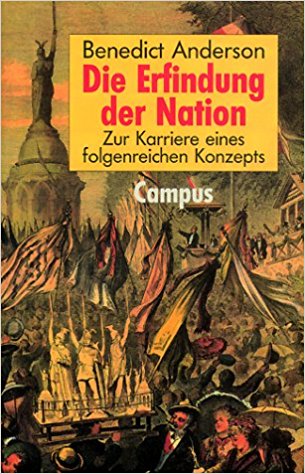
Cover of the first German edition, courtesy of Campus Fachbuch

I heard about this book around the time I was starting to form my own ideas about why people identify themselves as Americans, Porteños, Quebecois—and why other people don’t. Essentially, what does it take to convince people that they belong to a group? Why did US citizens identify more with their states than their nation, in the early 19th century? When does state building fail, and when does it succeed? Imagined Communities does not examine those specific questions, but it effectively answers them, and provides a whole bunch of tools for understanding nationalism, and, I ‘unno, separatist movements like the one that is happening right now. Might be worth picking up now for that reason.

The central conceit of Imagined Communities is that nationalism, even the concept of clearly delineated nations as the ultimate form of legitimacy, is recent, and that it was only possible with the rise of print capitalism. When reading newspapers based in Venezuela, inhabitants of the country could imagine other “Venezuelans” reading the same text as them, reading about the same political appointments, the same market changes, the same marriages of nobility. This “imagined community” is the nation. Of course, there are other imagined communities (Anderson describes religious community as the greatest precursor to national community), but because of the insularity of nations, and a host of other factors which he delineates in the book, this imagined community becomes one that people are willing to die for.Read More »

What I’ve Been Reading, December 2017

Another one! Already! Well, I’ve been reading a lot, and honestly the fact that this is being posted in December has more to do with when I got around to writing it all of it than when I read the books. Anyway, here’s what I’ve been reading, more or less around this time:

Tar Baby by Toni Morrison — Tar Baby is one of the most focused books by Morrison. The majority of it takes place in one house, on one island, with a core cast of just six. With long passages of just dialogue, the book often feels like a play. It’s also a break from Morrison’s typical MO in that it spends a lot of time focused on white characters. Those white characters are Valerian and Margaret Street, and the book starts out following them, a husband and wife, Valerian being the heir to his family’s massive candy business, Margaret a beauty queen twenty years her husband’s junior. Now retired, Valerian lives in what was once just his summer home, a manor on the caribbean Isle des Chevaliers, tended to by Sydney and Ondine. Christmas time is nearing, and Jadine Childs is visiting the manor—a successful young black fashion model, raised by Sydney and Ondine, and put through college by a generous sponsorship from Valerian. That’s five of the core cast I’ve just mentioned. The sixth shows up when Margaret finds him hiding in her closet—a black man named Son, a fugitive who jumped ship in the Caribbean and managed to swim to Isle des Chevaliers. Inexplicably, and to Margaret, Sydney, Ondine, and Jadine’s horror, Valerian decides to invite Son to stay with them, as a guest.

The majority of the book is the action that plays out between this major disruption in the house—the disruption of Son’s arrival—and the disruption which occurs around the Christmas dinner (right from the beginning its clear that Christmas dinner is not going to be the perfect gathering that Margaret is planning for.) Watching the reactions of these characters of all different social and racial backgrounds is fascinating, a thorough study in social hierarchy and perceived social status, and what people do when they feel their status is threatened or challenged—and the build up and eventual explosion of all the anxiety and pressure Son’s arrival has caused is masterful. It’s also great to see Morrison flex her considerable dialogue muscles here—dialogue is something she’s terrific with (is there anything she’s not terrific with?), but in this book it’s featured prominently, as the main means of propelling the story along.

A great book to read for Christmas! (jk jk jk i mean its great for anytime but lol this aint rudolph or whatever)Read More »

What I’ve Been Reading, November 2017

I’ve been reading all kinds of Toni Morrison and all kinds of mystery books, because those are the two English classes I’m in this semester. So you can expect more Morrison and more mystery in the next What I’ve Been Reading post—but that’s actually What I‘ll Be Reading. Let’s get into the ‘ve Been.

Devil in a Blue Dress by Walter Mosley — This was one of the books in my Mystery/Detective Fiction class, and one of my two favorites that we’ve read so far. My other favorite is Big Little Lies, which I’ll discuss below—the two are sort of tied. Devil in a Blue Dress is Mosley’s first Easy Rawlins mystery, and damn if it doesn’t make me want to read the rest of them. In this book, Easy isn’t yet a PI—he’s just a working-class African-American man who’s moved to Los Angeles in the Second Great Migration, after serving in World War II. A day after being fired from his job, a man approaches him offering money for him to find Daphne Monet, a white woman who often visits black jazz clubs. After some reluctance, Easy takes the job—and spends the remainder of the book trying to work his way out of the dangerous web he’s put himself in.

It doesn’t really have the precision and clarity of a detective story, mainly because at various points Easy doesn’t give a shit about solving any kind of mystery. It’s more like what would happen if an ordinary person wandered into the middle of a hard-boiled detective world, bumping into various rackets and intrigues, but not doggedly pursuing any hidden truth. Easy does end up solving some mysteries, and does so well enough that by the end he decides to become a professional PI, but the plot of the book is really about him trying to survive. To that end, it’s a great book. Well-paced, fun characters painted in many different shades of sinister, and a first-person narrator with lots of attitude.Read More »

What I’ve Been Reading, September 2017

March by John Lewis, Andrew Aydin, and Nate Powell – March is a trilogy of graphic novels co-written by Congressman John Lewis and Andrew Aydin, and illustrated by Nate Powell, detailing Lewis’s involvement in the African-American civil rights movement, up to the passing of the 1965 Voting Rights Act.

Powell’s art is gorgeous and expressive. It captures the weight of small interpersonal moments as well as enormous, historical turning points. To borrow a word from Martin Luther King, it dramatizes the movement in a way that is visceral and inspiring.

For the most part, the books do a good job of interweaving narrative and history—partly because John Lewis’s personal narrative is so wrapped up in the historical events of that time. The mixing of scene and summary is effective, not bogging the reader down in prose, nor abandoning the reader without any through-line to grasp onto. Book two may be the weak link of the trilogy, with long sections of historical events in which Lewis didn’t personally play any part. These passages feel a bit dry and distant, without the narrative thrust or intriguing insights that Lewis offers in the other sections. However, I only really noticed this in book two, because the fact is, John Lewis truly was involved in so many important events at the time.

And that’s what’s terrific about these books—they aren’t just a third-person, documentarian presentation of history—they’re the story of a man who was at the heart of the movement, and who ended up straddling the lines of multiple factions within it. What I found most fascinating was not just the external conflict against people like Alabama Governor George Wallace or Dallas County Sheriff Jim Clark, but the internal conflict of the civil rights movement. Lewis was one of the earliest members of the Student Nonviolent Coordinating Committee, and over the course of the books, we see it change, growing much larger, becoming more impatient, and we see Lewis pushed further and further out of it. There’s also the internal conflict of the Democratic and Republican parties, as they struggle to reconstruct their agendas around the civil rights movement, and make massive shifts toward becoming the parties we see today.Read More »

Recommendation Dump September 2017

Oh, Hello On Broadway — Oh, Hello is a comedy act created by Nick Kroll and John Mulaney—two comedians who are terrific on their own, and dynamite together. Kroll plays the child-like Gil Faizon, and Mulaney plays the near-psychotic George St. Geegland—two seventy-something New Yorkers who are tantalizingly delusional, pretentious, and mean-spirited. The two have a terrific dynamic that doesn’t smack of the usual straight-man funny-man schtick, since they’re both ludicrous caricatures of elderly Upper West Side residents. Mulaney and Kroll have been refining these characters for over a decade, on Kroll Show, on podcasts, at live shows, and countless other places. Don’t take my word for it—you can watch them on youtube here here here and here, and actually a bunch more places if you like, but those are just a primer.

So, the show itself. The show is part stand-up routine, part parody, and part variety show. The conceit is that Gil and George are performing one of the many plays that George has written, though there is constant fourth-wall breaking throughout, including a long opening segment in which the two introduce themselves, and send-up various Broadway tropes. The play within the play is essentially autobiographical for George and Gil, although the characters in it are much more successful versions of themselves. In the middle of the show is a segment where, embedded as a prank show within the play-within-the-play, the two interview some celebrity—during the run of the show, it was a different person each night, but for the Netflix special it’s Steve Martin. It’s a nice little breather in the middle of the non-stop barrage of jokes and gaffes, where Kroll and Mulaney get to exercise their (practiced) improv chops, and the audience gets to see a different person making jokes on stage.Read More »

Play Time: Rosencrantz and Guildenstern Are Dead by Tom Stoppard

Rosencrantz and Guildenstern Are Dead is a classic contemporary play by Tom Stoppard, which follows Rosencrantz and Guildenstern, two minor characters, courtiers in Hamlet, as they are called to the palace to find out what’s wrong with the Prince, and then sent to deliver a message to the king of England. As they are led from one task to another, they catch glimpses of the great Shakespearean tragedy unfolding around them, and wonder at what is going on.

The play explores time in two ways, both of which are fundamentally tied into the medium of theatre—theatrical fatalism, and the conflict between finite time and eternal time.

Now . . . And Now . . . And Now . . .

Life and theatre are eternal and finite.

Life is eternal (or appears so), because it is impossible for a person to really grasp the fact that they have an end, the way they can grasp that a day or a season has an end. As Rosencrantz puts it, “Whatever became of the moment when one first knew about death? There must have been one, a moment in childhood when it first occurred to you that you don’t go on for ever. … And yet I can’t remember it. It never occurred to me at all.” (71-72)

And life is finite because people are born and they die.

Theatre is eternal because every play can be performed an infinite number of times. Rosencrantz and Guildenstern is about two characters invented by a writer that died dozens of generations ago, and the play is still being performed (in fact, it’s currently being revived at the theatre at which it premiered exactly fifty years ago.) It’s also a very immediate medium, not something you can put down and stop like a book. The play is continuing, going from one line to the next, without end. And, especially in a play like Rosencrantz and Guildenstern Are Dead, which languishes in long scenes of dialogue and moments of silence, this can give the impression that the thing is boundless. “One is, after all, having [a future] all the time . . . now . . . and now . . . and now . . .” (70).

And theatre is finite because, some exceptions aside, most plays last just a few hours or less.

Rosencrantz and Guildenstern addresses this dissonant experience, the simultaneous feeling that we are immortal and knowledge that we are not, both through dialogue and through the form of the play. Of course, it being a play alone emphasizes the themes discussed by the characters, but there are some other formalistic aspects peculiar to Rosencrantz and Guildenstern that reinforce the concept. To start, there’s the title—Rosencrantz and Guildenstern Are Dead. It’s a quote from one of the last lines of Hamlet, and as a title it seems paradoxical. For the majority of Rosencrantz and Guildenstern Are Dead, Rosencrantz and Guildenstern are not dead. Those final lines are another formal quirk to the play, and to Hamlet as well, because they’re recursive. The ambassador from England tells Horatio that “Rosencrantz and Guildenstern are dead,” (Hamlet 5.2.371) and Horatio, surrounded by the corpses of the royal family, tells the ambassador that he will “speak to the yet unknowing world / how these things came about” (5.2.380-381). The end of the play could be the beginning, and the whole thing could circle around on itself endlessly as Horatio tells the story over and over again—but the title, which comes from that same scene, declares how finite these characters are.Read More »

Play Time: An Inspector Calls by J.B. Priestley

An Inspector Calls is the most famous of J.B. Priestley’s time plays, as well as one of his best-known works in general. The play contains elements of all the other plays, starting with the setting—similar to that of Time and the Conways—of the estate of an upper-class family, the Birlings, in 1912. Unlike Time and the Conways, this play takes place entirely over the course of one night. A police inspector shows up to ask some questions about Mr. Birling’s interactions with a young woman who has just committed suicide—a former employee of Mr. Birling. It soon becomes apparent that all of the Birlings, as well as Gerald Croft, the fiancé of Sheila Birling, had some negative impact on this girl that lead to her demise, which Inspector Goole will extract from them and bring to light. In this way, the play is similar to Dangerous Corner, in the way that every character shares some blame in this girl’s death, and Inspector Goole is piece-by-piece constructing a timeline of events that leads to her suicide. The big “trick” (to use one of Priestley’s words in describing these plays) in An Inspector Calls is that the girl, Eva Smith, has not yet died, until the very end of the play, when the Birlings receive a call from the police station, informing them that Eva Smith has been found dead, and the real police inspector has been sent to question them.

Time and the Conways

Aside from this little trick at the end, the time discontinuity is mostly felt by the audience. Put it this way—the whole play is like the third act of Time and the Conways, in which the audience knows exactly what has happened in the future of the characters, but the characters don’t. There’s even a moment in which Mr. Birling bloviates optimistically about the prosperous future they will all live in. It’s different from the moment where Madge does the same in Time and the Conways though, because Mr. Birling’s is a capitalist dream of the future, in which “the interests of Capital—are properly protected,” (6) and everyone will “have forgotten all these Capital versus Labour agitations and all these silly little war scares.” (7) Birling’s optimism reaches its pinnacle of absurdity (from the audience’s perspective) when he mentions the Titanic—the “unsinkable, absolutely unsinkable” ship which seems to embody the pompous optimism of the pre-war period, as well as the promise of industrialism. This ship was a modern marvel, one of whose features was its inability to fail, that almost instantly failed catastrophically.Read More »

Play Time: I Have Been Here Before by J.B. Priestley

I Have Been Here Before is the third of J.B. Prietsley’s time plays, written the same year as Time and the Conways. The play explores P.D. Ouspensky’s theory of eternal recurrence, that everyone lives their life over and over again, and déjà vu and precognitive dreams are the result of remembering past lives. Unlike Time and the Conways or Dangerous Corner, Priestley doesn’t develop this idea through any formalistic techniques. The acts occur in chronological order, and it all takes place in the same timeline. The fact that it’s a work of theatre is in itself a formalistic technique, which I’ll discuss in a moment, but otherwise Priestley’s pretty straightforward, and presents the theory in a science fictional style.

The story unfolds over the weekend before Whitsuntide, a week-long holiday celebrated after Pentecost in parts of England. Three interconnected groups meet in the Black Bull Inn: Sam and Sally, father and daughter and the managers of the inn. Mr. Farrant, a teacher at the boarding school which Sally’s son attends. And Mr. and Mrs. Ormund, Mr. Ormund being one of the governors and funders of Mr. Farrant’s boarding school. Ouspensky’s theory comes in with Dr. Görtler, an exiled German scientist who seems to know exactly what everyone is going to do before they do it. The major conflict of the play, which ends up affecting everyone because of how entangled their lives are, is an affair between Janet Ormund and Mr. Farrant. Dr. Görtler attempts to defuse the situation by explaining a dream he had, in which he met Janet at a later time in her life, and learned that she and Mr. Farrant had run off together, causing Mr. Ormund to commit suicide, and the boarding school to collapse. This play seems the most hopeful of the three time plays I’ve so far read, because Dr. Görtler explains that everyone actually is capable of making small changes in their lives—their existence is not circular, they “move along a spiral track … [They] must set out each time on the same road but along that road [they] have a choice of adventures.” (264) Görtler convinces Ormund to let his wife divorce him and start a life with Farrant, and to not kill himself, and so, Ormund escapes the memories of self-destruction in past lives which have always haunted him.Read More »

Game Review: Burrito Bison; Launcha Libre

Originally this was going to be part of a recommendation dump post, but as I wrote about this game, I realized I just have a lot to say about it. Enough to be a post in itself. So, here we go:

Burrito Bison: Launcha Libre is a launcher game from Juicy Beast. You play as a luchador who’s fighting various candy-people (primarily gummy bears) and trying to get a recipe book? I think? It’s been awhile since I’ve watched that opening cutscene, but it hasn’t been any time at all since I last played this game. I’ve been playing it, off and on, for about three months. It’s been my go-to game when I want to listen to music or a podcast or just totally zone-out.

The perfect, addictive core of this game is one that Juicy Beast had been doing a great job with since the first Burrito Bison game (Launcha Libre is the third in a series, and the first two are considerably smaller in scale, but still a lot of fun)—the balance between player input and the flow of the game. If the game relied too much on player input, or relied on more complex player input, it wouldn’t really be a launcher game, and it would be impossible to zone out to it. If the game eschewed player input too much, it would be a lot like most bad launcher games, with too much relying on variance and some lucky bounces to get you far. Some launcher games you can look away from and really not change the experience. Some launcher games it feels like you’re better off not using any of your power-ups or controls, and just hoping to land on a bomb or a bouncy mushroom or whatever it is that will keep you in the air. Burrito Bison is right at the crest of this wave, riding it perfectly, just between falling forward into boredom or falling backward into over-taxation of the brain.

pricklypear-BB
Burrito Bison riding a popped Prickly Pair

Read More »

Play Time: Time and the Conways by J.B. Priestley

Time and the Conways is the second of J.B. Priestley’s Time Plays—six plays (the first being Dangerous Corner) dealing with different theories of time, and how time is experienced. This play focuses on the Conways, a wealthy family living in a prosperous suburb of the fictitious manufacturing town Newlingham, and their declining fortunes between 1919 and 1937. The first act takes place during Kay Conway’s twenty-first birthday in 1919. Aside from Mrs. Conway, the Conways are all in their early twenties or younger, and have their whole lives ahead of them. The boys of the family have just returned from war. Mrs. Conway, the widowed mother of all of them, owns lots of valuable real estate in Newlingham. The future appears bright.

The second act jumps ahead twenty years to the present when the play was written—1937. Most of the Conways have scattered from Newlingham and fallen out of touch with one another, but they are reconvening (coincidentally on Kay’s fortieth birthday) to discuss Mrs. Conway’s finances, which have significantly deteriorated to the point of near bankruptcy. Everyone is disillusioned with their lives, where they ended up, and this point is driven home with Act III, which returns to that birthday party in 1919. We see the Conways interacting with the family friends that will end up being their spouses, and expressing their desires for the future—all of which, we know from the second act, will not come to pass.

Future

Priestley basically analyzed his play for me:

“KAY: But, Alan, we can’t be anything but what we are now.
“ALAN: No . . . it’s hard to explain . . . suddenly like this . . . there’s a book I’ll lend you—read it in the train. But the point is, now, at this moment, or any moment, we’re only a cross-section of our real selves. What we really are is the whole stretch of ourselves, all our time, and when we come to the end of this life, all those selves, all our time, will be us—the real you, the real me.” (177)

The book that Alan, the oldest of the Conways, is going to lend Kay is almost certainly J.W. Dunne’s An Experiment with Time. Priestley was continually interested in Dunne’s theory of time, exploring it in plays and essays throughout his career. An Experiment with Time posits exactly what Alan explains to Kay, with the additional claim that in dreams, our consciousness is able to experience the whole stretch of our existence, delivering precognitive visions of the future. Kay has this experience in Act III, apparently seeing some vision of Act II while Mrs. Conway is talking about how wonderful the future will be for the Conways. Of course, this is also the experience of the audience, throughout all of Act III. Having just come from the grim, shabby household of 1937, the jubilance of all the characters in 1919 rings false and discordant.Read More »

Play Time: Dangerous Corner by J.B. Priestley

Dangerous Corner is a 1932 play by British writer J.B. Priestley, about a dinner party attended by the directors of a publishing firm and their wives. Pretty soon the audience learns that one of the directors, Martin, recently committed suicide, and was suspected of embezzling money from the company. A few moments later, one of the guests, Olwen, makes an offhand remark about recognizing a cigarette box—a cigarette box that she shouldn’t have any memory of, because it was originally Martin’s, and it was mailed to him the day he died. Olwen’s remark is like a single loose thread in a sweater, and once Robert, one of the directors and the brother of Martin, pulls at it, the sweater begins to unravel, spooling out a series of interconnected secrets that every last character has been hiding, all wrapped up in the death of Martin and the embezzled money. In the final act of the play, Robert, in a drunken craze, retrieves a revolver, the lights go down on the stage, and we hear a shot and a woman’s scream. When the lights come up, we are back at the beginning of the play, with the female characters having just listened to the last scene of a murder mystery radio play. The play progresses as it originally did, only this time, when Olwen remarks on recognizing the cigarette box, it goes unnoticed, as one of the directors succeeds in tuning in to a channel on the radio—something he had failed to do in the first iteration of the timeline.

Priestley presents time in a very concrete, mechanical way, as a series of events with causes and effects, and with specific choices directly affecting the chain of events. This if clear, of course, in the final scene in which the audience sees the entire course of the play altered by one instance, but it’s also clear throughout all the revelations that form the meat of the show. The characters are constantly trying to figure out who is to blame for Martin’s death—who is the person at the root of all of it?—and with each secret revealed, the blame shifts, and the timeline that the characters are constructing reorganizes itself to place a different person as the catalyst for all the events. The conflict and tension of Dangerous Corner comes from these clashing timelines that each character holds, and the only way to resolve the tension is by filling in the gaps with more information from other characters. Of course, each contribution to this communal timeline only opens up more questions, and reveals new gaps that have to be filled. Ultimately, the timeline can never be perfect because at the heart of it is Martin—someone whose understanding of the chain of events has disappeared from the world with his death. Olwen herself describes the problem of clashing realities when she’s talking about the radio play:

“The point is, I think—there’s truth and truth. … the real truth—that is, every single little thing, with nothing missing at all, wouldn’t be dangerous. … But what most people mean by truth, what that man meant in the wireless play, is only half the real truth. It doesn’t tell you all that went on inside everybody.” (5)

Indeed, the biggest gap in the story, the hole that will never be filled, is “all that went on inside” Martin. It seems like everyone had a different relationship with him, and characters will often assert something along the lines of, “you didn’t know him as I did.” When Robert is convinced that Martin killed himself because Martin believed that Robert stole the money, and Martin was shaken by his older brother’s misconduct, Robert explains, “But neither of you knew him as I did.” (37) When Freda, Robert’s wife, learns that Martin attempted to assault Olwen, she moans that “he wasn’t like that really. If you’d known him as I’d known him—before.” (42) Although the characters are intending to invoke authority when they say this, as if they are experts on who Martin is, Priestley’s precise phrasing points to the reality of the situation. You didn’t know him as I did. Not a definitive “I knew him,” or “I knew him best,” but rather a distinguishing between the different ways that different characters understood Martin, understood his experiences, composited his history.Read More »

Play Time: Top Girls by Caryl Churchill

Caryl Churchill’s 1982 play Top Girls centers on Marlene, an agent at the London-based Top Girls employment agency, who has just been promoted to manager. The action of the play occurs in three main spaces: the Top Girls agency, where the audience sees the tensions Marlene and her female colleagues are facing in a male-dominated world; the home of Marlene’s sister Joyce and Marlene’s illegitimate child that Joyce has raised as her own, where the audience sees Marlene’s lower-class roots and her rejection and contempt for them; and, the opening scene taking up more than a third of the play, a celebratory luncheon attended by historical female figures—some fictional, some real, some a combination of both—advising Marlene on her success and relating their own stories of achievement and challenges in patriarchal societies.

While there is no dramatic this-leads-to-that connection between these different spaces, they are all in conversation with one another, and in productions of the play all of the actors for the historical figures are double cast as other characters throughout the rest of the play. This thematic dialogue between the different spaces is what ties the play together into a cohesive exploration of female empowerment, and the self-destructive nature of empowerment through capitalistic, patriarchal means. It’s also, in itself, a theatrical way to represent how past and present overlap, echo, and argue—both the past of Marlene’s personal life, and the past of the entirety of history.

Interruptions and Continuations

The first scene of the play does an excellent job of dramatizing the conversation of history, with five historical figures converging in the present moment. Rather than a normal, back-and-forth conversation, the characters talk around one another. Instead of one character telling a story about an illness they had, and another saying “I had something like that too—how long did it last for you?” the dialogue runs more like:

“ISABELLA: But even though my spine was agony I managed very well.
“MARLENE: Wonderful.
“NIJO: Once I was ill for four months lying alone at an inn. Nobody to offer a horse to Buddha. I had to live for myself, and I did live.
“ISABELLA: Of course you did. It was far worse returning to Tobermory. I always felt dull when I was stationary. / That’s why I would never stay anywhere.
“NIJO: Yes, that’s it exactly. New sights. The shrine by the sea. The goddess had vowed to save all living things. / She would even save the fishes. I was full of hope.
“JOAN: I had thought the Pope would know everything.” (24-25)

Read More »

Play Time: Strange Interlude by Eugene O’Neill

Strange Interlude covers a span of about twenty-five years in the lives of Nina Reeds and her three lovesick admirers—Charles Marsden, Edmund Darrell, and Sam Evans. At the beginning of the play, Nina is heartbroken over the death of the love of her life, Gordon Shaw, in World War I. Throughout the rest of the play, she is attempting to fill in the gaps left by Gordon with Marsden, Darrell, and Evans. There are plenty of twists across the nine acts of this five-hour play, but the most notable feature is the internal monologue device. Characters frequently stop to deliver their thoughts in a stream-of-consciousness style—not in a Shakespearean manner, where the actors seem to be taking the audience into their confidence, but more like the playwright has slowed down the action and opened up the mind of a character to show the audience their thought process.

This play deals with time in two ways—in micro and in macro. The micro is the internal monologues, which take individual, fleeting moments and expand them into sometimes multiple minutes of speech. The macro is the enormous scale of the play itself, which covers over two decades, comprises nine acts, and is typically presented with a dinner break in between acts five and six. The tension between these two levels of time is the tension, and dissonance, experienced by everyone—the brief, minute, immediate nature of the present set against the enormous backdrop of a person’s life.

Micro

O’Neill achieves this sense of immediacy in a few ways. First, the obvious, through the monologues. While there’s no indication of whether or not the rest of the scene freezes or slows down when a character’s internal monologue begins, it certainly seems to slow down. The monologues are full of ellipses and rambling sentences, questions and repeated ideas. The effect of this slow, languorous pace to the interior of the characters is that when the actual dialogue of the scene resumes, it feels rapid and instant, unrestrained.Read More »

Play Time: Not I, Footfalls, and Rockaby by Samuel Beckett

For this project, I wanted to read some short plays at some point, as short plays can get away with doing deviant formalistic things that longer plays can’t. I chose these three plays by Samuel Beckett because they are sometimes collected together, or performed together, and with good reason. While each play was written separately, all of them overlap in their treatments of time and memory.

Not I

Not I is a monologue performed by “Mouth.” When staged, the actor playing Mouth wears black make-up over her face, and the lighting is as isolated as possible to just the mouth. The effect is of a disembodied mouth, floating in darkness, rapidly reciting sentence fragments which tell a story of a woman—presumably the owner of the mouth—who has lived a solitary, bleak life, and who has scarcely spoken throughout all of it. The title comes from the repeated refrain of Mouth: “what? … who? … no! … she!”—denying that what she is describing happened to her.

The play explores the disjuncture between experience and retelling, with the speaker being an extreme case of someone whose speech has become drastically separated from her experience of the world. The whole play, Mouth is trying to make sense of the woman’s life, constantly asking questions, constantly doubling back, always unsure, and always careening forward to dig up some other scrap of memory. The way Mouth bolts through fragmented sentences puts in mind a person searching through a library for a book, and reading aloud titles and last names of authors as they go.

The speech is not just an attempt to retell what has happened in this woman’s life for the sake of the audience—it is an attempt to make sense of it for herself. Almost all her life she has been speechless, unable or unwilling to connect her experiences with linguistic structure, and so Not I is an attempt to do so. It is a demonstration of the difficulties of manifesting a life verbally, of making sense of events through retelling, and of the disconnect between the person who lived an experience and the person telling it (even if they are one and the same.)Read More »

Play Time: We Are Proud to Present a Presentation about the Herero of Namibia, Formerly Known as South West Africa, from the German Südwestafrika, between the Years 1884-1915 by Jackie Sibblies Drury

This past semester I needed to fulfill my honors requirements by completing 3 s.h. of honors credit. I wasn’t in any honors classes, so I did this by contracting a creative writing class focused on time, by designing an additional curriculum of nine plays that I would read and respond to—all of them dealing with time in some way. Thus, Play Time—nine essays analyzing specific plays, pulling apart the way the playwrights are using the medium of theatre to manipulate or comment on or distort or theorize about time. The idea isn’t so much to definitively state What X Play is About, but more to point out what I find interesting in the play, and figure out how the artist—or how theatre as a medium—achieved it. This first post is on We Are Proud to Present a Presentation about the Herero of Namibia, Formerly Known as South West Africa, from the German Südwestafrika, between the Years 1884-1915 by Jackie Sibblies Drury, and I promise I will only use the abbreviation of that title from here on out.

We Are Proud to Present is a play about six actors putting together a theatrical presentation detailing the history of Namibia as a German colony, and the genocide of the Herero people. The play is as much focused on the conquest, exploitation, and extermination of the peoples of Namibia as it is on how the actors are portraying it, how they are trying to relate to it, how theatre operates as a medium, and how to tell the history of a people who were almost completely wiped out. 

Processtation

The play (that is, the theatrical work written by Drury) portrays this presentation (that is, the theatrical work performed by the characters in the play) from start to finish in chronological order, though it switches back and forth between “The Presentation” and “The Process” (7). Each scene is labeled as one of the two. “The Presentation” is an actual performance of the presentation, and “The Process” is a rehearsal of it (presumably early on in the production.) So while the audience (that is, an actual real world audience) is seeing the presentation about the Herero of Namibia from start to finish, they are also seeing the actors themselves in two different moments in time. This structure accomplishes a few things.

First, it’s an efficient way to show both the creation of the show and the show itself. The play could’ve been divided into two acts, the first The Process and the second The Presentation, but by interweaving the two into one continuous action, Drury can avoid repetition, and just show the most important pieces of each strand.

Second, it makes it very clear how The Process is being expressed in The Presentation. For example, at one point during rehearsal, the actors are doing an exercise, and Actor 3 is acting as Actor 6’s grandma:

“(ACTOR 3 smacks ACTOR 4 with his prop on each “Tell.”)
“ACTOR 3 (as Grandma): Tell me that you didn’t eat that cornbread. …
“Tell me that you didn’t eat that corner piece of cornbread.
“I don’t need you to Tell me that you ate that corner piece of cornbread.
“I can Tell the corner piece is missing so Tell me that you ate it.
“Tell me.
“Tell me.” (58)

Later on, during the actual performance, the audience sees how the actors have repurposed this theatrical device for a completely different scene, with completely different implications:

“(ANOTHER WHITE MAN lands blows on BLACK MAN on each “Tell.”)
“ANOTHER WHITE MAN: Tell the man you broke the law …
“Tell the man you were gonna kill me.
“I don’t need you to Tell me that you were gonna kill me.
“I can Tell you wanted to kill me, so Tell the man.
“Tell him.
“Tell him.” (102)

There are echoes, recurrences, like this all throughout the play, and by presenting the rehearsal and the performance in such close proximity Drury examines how the most contentious, the most bizarre, or the most seemingly useless ideas generated during rehearsal are reshaped, retooled, and evolved to express something in the presentation.Read More »

Rereading A Series of Unfortunate Events: The End

When I was a kid, I loved A Series of Unfortunate Events, and now I’ve reread all thirteen books. This final post is about The End, book 13. This post will contain spoilers for The End and probably other books preceding it, so if you don’t want plot information given away, then to paraphrase Lemony Snicket, “I would drop this [review] at once, so THE END does not finish you.”

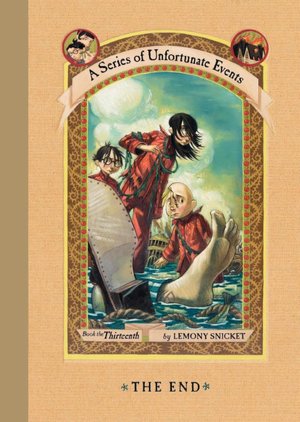
The_End
Cover courtesy of HarperCollins

Finally, we arrive at The End. Violet, Klaus, and Sunny Baudelaire are at sea with Count Olaf, and a massive storm shipwrecks them on an island. Pretty soon they encounter the inhabitants of the island, an easygoing colony of castaways, lead by the “facilitator” Ishmael. Count Olaf is forbidden from entering the colony, and while the colony is undoubtedly dull and unambitious, it seems the Baudelaires have finally found a place where they can be safe. Of course, it turns out the island is full of as many mysteries and confusing conflicts as the world the Baudelaires left behind, and the siblings come to realize that they can never really escape these issues.

The End is also the end. (Surprise.) It is Book the Last, and it knows it. Where The Penultimate Peril felt climactic in terms of surface-level story elements—bringing together characters from all throughout the series, putting the Baudelaires in the middle of a direct conflict between the two factions of VFD—The End feels climactic in terms of theme. The book is exploding with meaningful imagery, literary and biblical allusions, thematic discourse, and symbolic scenes. I’m only going to talk about some of them though, the ones that interest me, but there’s all sorts of overlap, so hopefully I’ll be able to cover all the main threads by doing this.

STTTTTTUUUUUUUUUUFFFFFFFFFFFFFFFFF!

“What’s the deal with all this super specific junk in the general store?”—that’s the note I made when this motif first cropped up in The Hostile Hospital. In the opening of that book, the Baudelaires are in a general store waiting for a telegram, and multiple times Handler lists out in hyper-specific detail the items surrounding them, none of which seem to fit with each other:

“They were surrounded by nylon rope, floor wax, soup bowls, window curtains, wooden rocking horses, top hats, fyber-optic cable, pink lipstick, dried apricots, magnifying glasses, black umbrellas, slender paintbrushes, French horns, and each other, but as the Baudelaire orphans sat and waited for a reply to their telegram, they only felt more and more alone.” (18-19)

Is this a comment on materialism? Something about greed maybe? I had a hunch about what it could be, but Handler didn’t distinctly make the connection, so I just continued to note the motif whenever it popped up. In The Grim Grotto, when the Baudelaires are in the grotto, they each list out all the worthless items they’ve found while searching for the Sugar Bowl. Again, it’s hard to tell if Handler is just having fun or actually doing something.Read More »

Rereading A Series of Unfortunate Events: The Penultimate Peril

A Series of Unfortunate Events was one of my favorite series when I was a kid, and I’m rereading through all thirteen books, and today I’m talking about the second-to-last one: The Penultimate PerilThis post will contain spoilers for book 12 and all the books preceding it, so if you do not want plot information given away then, to paraphrase Lemony Snicket, “allow me to recommend that you put this next-to-last [review] down first, and find something else to read next at last.”

ThePenultimatePeril
Cover courtesy of HarperCollins

The Penultimate Peril is the penultimate book in Unfortunate Events, and it finds the Baudelaires at the Hotel Denouement, a hotel organized by the Dewey decimal system (for example, there are teachers staying in room number 371, the number for schools and school activities in Dewey Decimal Classification.) The Hotel Denouement is the last safe place for VFD, and the secret organization will be meeting there in just two days. The Baudelaires, disguised as concierges, spy on the hotel guests, hoping to discover whether or not the safety of the hotel has been compromised, and whether or not they should give a signal to call off the meeting.

I Won’t Tell You When You’re Older

The Penultimate Peril is full of cameos from characters introduced and exited earlier in the series and one of the characters to return is Sir—known as Sir because his actual name is unpronounceable. Other than his callous attitude toward the workers in his lumber mill, Sir’s defining characteristic is the cloud of cigar smoke that is forever swirling around his head, completely obscuring his face. When I first discussed Sir, I wrote about how he’s a model for what’s to come later in the series—these mysteries that are never solved, secrets that only exist as secrets. Since I’ve finished rereading Unfortunate Events, I’ve been poking around looking at reviews of the series. I’ve seen complaints that not all of the big mysteries were resolved, which makes the last few books kind of disappointing. To those people I would say:

You are less discerning readers than an eight-year-old.

I can’t take away anyone’s reading experience—I don’t think anyone is wrong to say that they were disappointed. I would, however, defend Daniel Handler vigorously from anyone who thinks he dropped the ball. Handler does a lot to signal that these big secrets will never be clarified a hundred percent, and rereading Penultimate Peril, I remember that the sequence with Sir was when I, as an eight-year-old, realized that there were certain things that the thirteenth book still would not divulge. The scene is farcical in the way it conceals Sir’s face. Klaus is spying on Sir and his partner Charles, and he escorts the two to a sauna. Sir orders Klaus to hold his cigar while he goes into the sauna. Francis of 2005 was so excited about this—finally, we get to see Sir’s face! What if he’s actually another character under that smoke? What if he’s a relative of another character? But then, “Sir handed Klaus the cigar and strode into the sauna before the cloud of smoke around his head could clear.” (109) And it was at that moment that I realized that we would never find out what the Sugar Bowl is.Read More »

Rereading A Series of Unfortunate Events: The Grim Grotto

As a kid, A Series of Unfortunate Events was one of my favorite series, and I’ve been rereading all thirteen books. Today I’m discussing my favorite book of the series, book the eleventh, The Grim Grotto.

Grimgrotto.jpg
Cover courtesy of HarperCollins

In The Grim Grotto, the Baudelaire orphans join the crew of the Queequeg, a VFD submarine run by Captain Widdershins and his stepdaughter Fiona. The Baudelaires join the Queequeg in its mission to find the Sugar Bowl before Count Olaf does, eventually identifying its location as the Gorgonian Grotto, an underwater cave that contains a lethal, parasitic species of fungus.

Having at this point reread the whole series, I can say that this book is my favorite. The mood and atmosphere is deeply unsettling, there’s lots of great character revelations and development, and the plot is as good as they come—with the Baudelaires actually being proactive instead of reactive, for the first time in the whole series. So, in this post I’m just going to explain exactly why I love this book so much.

Staring Blindly

First off, the mood. I won’t reiterate everything I said about mood in my post on The Ersatz Elevator, but I will retread some of that ground, because The Grim Grotto is doing the same sort of thing. The mood in book 11 is similar to that in book 6, and both are achieved through similar means—they inspire dread by keeping the reader in the dark on the dangers surrounding the characters. In Ersatz Elevator there’s the darkness of the empty elevator shaft, and in Grim Grotto there’s the darkness of the ocean, and the narrow passage leading into the Gorgonian Grotto. While The Ersatz Elevator still outdoes this book in the omnipresent atmosphere of dread, Grim Grotto is a near second, with the oppressive feeling of a cold, dark, unknown world surrounding the Queequeg at all times. The most prominent example of this is what is referred to in a later book as “The Great Unknown”—a gargantuan serpentine shape, larger than the Queequeg and even Count Olaf’s own enormous submarine, which shows up on the Queequeg’s sonar as a question mark. Whatever it is, it’s something that terrifies volunteers and villains alike, and the best view the Baudelaires ever get of it is after nightfall, and “They could not even tell, just as I will not tell, if it was some horrifying mechanical device, such as a submarine, or some ghastly creature of the sea.” (311)Read More »

Rereading A Series of Unfortunate Events: The Slippery Slope

A Series of Unfortunate Events is one of my favorite book series from when I was a kid, and I’m rereading through all thirteen books. Today I’m writing about The Slippery Slope, the tenth book in the series, as well as meaninglessness and morality.

Slipperyslope
Photo courtesy of HarperCollins

The Slippery Slope is set in the Mortmain Mountains, a chilly range of odd, squarish mountains, home to snow gnats, bears, and the VFD headquarters. The Baudelaire orphans are separated, with Sunny being kidnapped by Count Olaf and taken to the summit of Mount Fraught, and Violet and Klaus left for dead along the road up the mountains. Sunny is forced to cook for and clean up after Count Olaf and his troupe, who are planning to destroy the headquarters of VFD. At the same time, Violet and Klaus are searching for the headquarters, and hoping to rescue their baby sister.

The Slippery Slope is the first book where the reader starts to get some broad ideas of what VFD is, and why so many villains and heroes alike seem involved in it. It also has some incredibly clumsy grappling with morality and what separates good people from bad people. But, to paraphrase a Fernald’s remarks in The Grim Grotto (which does a much better job of handling these themes), books aren’t either good or bad, “they’re like chef’s salads, with good things and bad things chopped and mixed together” (223). And Slippery Slope is actually mostly good, so while I will get to the fumbled themes, I’m going to highlight some other parts where it sticks the landing wonderfully. First off:

Xylophone

After being attacked by a swarm of snow gnats, Violet and Klaus take refuge in a cave, and find a group of Snow Scouts camping there. The Snow Scouts quickly welcome Violet and Klaus into their troop, and recite the Snow Scout Alphabet Pledge:

“Snow Scouts … are accommodating, basic, calm, darling, emblematic, frisky, grinning, human, innocent, jumping, kept, limited, meek, nap-loving, official, pretty, quarantined, recent, scheduled, tidy, understandable, victorious, wholesome, xylophone, young, and zippered — every morning, every afternoon, every night, and all day long!” (71)

The pledge recurs throughout the book, sometimes as the Snow Scouts recite it and other times just in reference to its absurdity—however the most pertinent commentary on it comes immediately after the scouts first recite it, when Snicket writes that, “Like many pledges, the Snow Scout Alphabet pledge had not made much sense” (71).Read More »

New Publication: The Only Series that Matters

TOSTM-c-3Well, it’s newish. It’s a collection of all the posts I’ve been making about A Series of Unfortunate Events. If you haven’t been reading them, it’s a series of essays in which I examine each book in A Series of Unfortunate Events upon rereading them a decade after I first fell in love with them as a kid. The essays highlight literary techniques, thematic explorations, and the ideas communicated in these books that have resonated with me from when I first read the series to today.

If you have been reading them, consider purchasing the collection to support posts like these, and the blog in general. The collection holds all the posts that have appeared on this site so far, plus the last four posts that will appear on the site over the course of the next month, polished up and consolidated for the book. It also contains “Chapter Fourteen,” an essay that won’t be published on this blog, discussing my relationship with the series through different parts of my life, and The Appalling Appendix—an index of selected notes, quotes, and observations from the file I kept while rereading the series.

Currently it’s available on Amazon, and UPDATE: it is now available on Smashwords!