New Public(Domain)ication: BLOOD DINER • FULL SERVICE • BUTCHERED LIVE

Composition with Red, Blue and Yellow by Piet Mondrian, 1930.

Happy Public Domain Day!!! Today, works published in 1930 enter the public domain in the US and many other countries. This year that includes The 42nd Parallel by John Dos Passos (the first book in his U.S.A. trilogy), Olaf Stapledon’s Last and First Men, and the 1930 Watty Piper version of The Little Engine that Could, with illustrations by Lois Lenski. You can read more about what’s entering the public domain over on Duke’s Center for the Study of the Public Domain blog.

As I do every year, I’m celebrating by releasing one of my own works to the public domain. This time it’s a little different—the work I’m ceding to the public domain is a script for an as-yet-unwritten graphic novel, titled BLOOD DINER • FULL SERVICE • BUTCHERED LIVE. It’s set in a future where medical technology allows for the rapid regeneration severed body parts, and the story follows a server on a trial shift at a restaurant which serves human meat.

So you can take this script and read it, print it, adapt it into your own comic, adapt it into a film or a play—whatever you want! I do intend to eventually make it into a graphic novel, and when I do I’ll probably publish that graphic novel as a copyrighted work—but even then, the script will remain in the public domain.

You can download BLOOD DINER as a PDF or Docx. If you end up doing anything with it please let me know! It may be a while before I get around to making my comic.

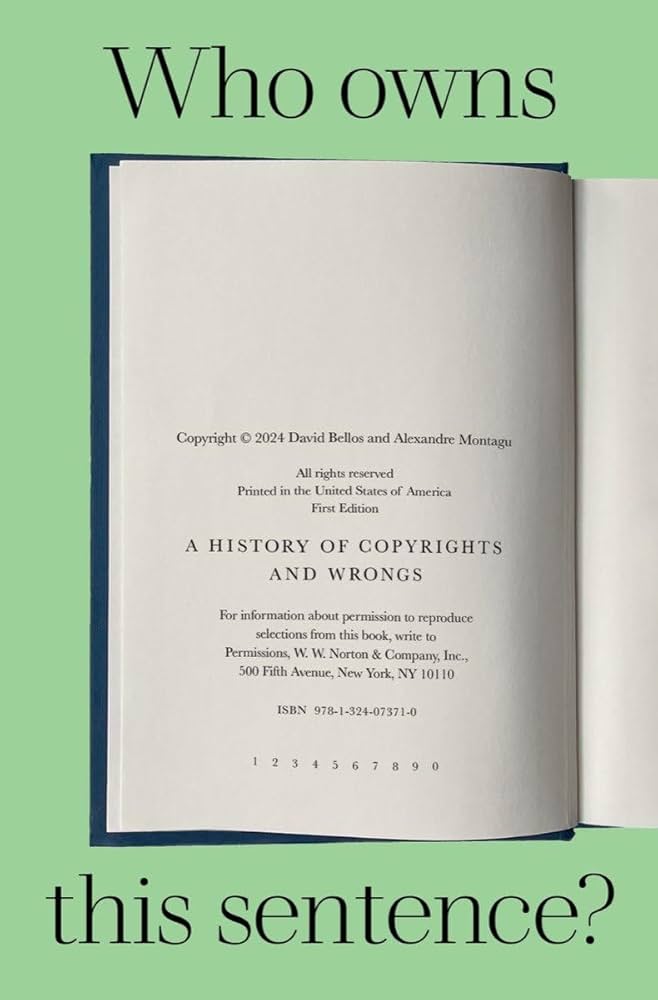
In further celebration of the public domain, I just reviewed Who Owns this Sentence? A history of copyrights and wrongs by David Bellos and Alexandre Montagu, and you can read that here. And if you want to see previous years’ posts about the public domain, and all the other works I’ve ceded to it, you can find that here.

Composition by Sophie Taeuber-Arp, 1930.

Public Domain Day 2026: Reviewing Who Owns this Sentence? by David Bellos and Alexandre Montagu

Happy Public Domain Day!!!!! This year, in addition to ceding one of my works to the public domain (read more about that here), I’m reviewing this excellent 2024 book by David Bellos and Alexandre Montagu. Years ago I read Bellos’s book on translation and interpretation, Is That a Fish in Your Ear?, and really loved it (you can read my review of that book here.) So when I saw that he’d co-authored a book about the history of copyright, I was all over it.

Unlike Is That a Fish in Your Ear?, where almost every chapter is like a stand-alone essay, Who Owns This Sentence? is a fairly chronological history of copyright. There are occasional diversions and cul-de-sacs, but you really want to read the book in order. Bellos and Montagu trace copyright’s origins to 15th-century Venice, when the city granted Arabic and Turkish tradesmen monopolies on various products to entice them to come set up shop. From this practice came patents, and from patents, copyright. Copyright has changed a lot over the centuries—from a patchwork of different laws in different countries to a nearly monolithic global regime, from protection of printed words to protection of printed anything, to protection of digital properties, sculptures, even architecture in some countries—and this book takes you through each of those transformations.

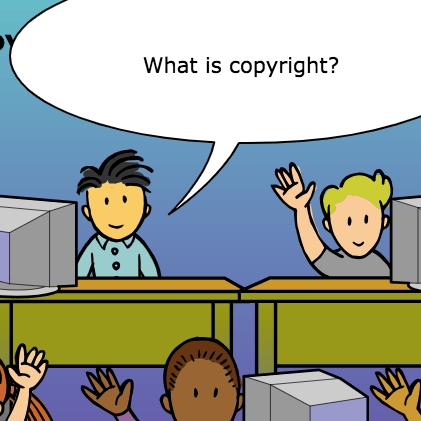
These images are screencapped from “Copyright with Cyberbee,” which gets a brief mention in Who Owns this Sentence.

Fortunately, it’s not presented like an even-handed, both-sides-have-a-point, isn’t-this-so-darned-interesting?, [insert NPR show here]-style account. The authors are clearly dissatisfied with the current state of copyright law, and they make clear, committed claims about who benefits from it (corporations) and who is hurt by it (artists, the reading/viewing/listening public). They don’t ultimately present an argument for what copyright law should be—that’s not really within the scope of the book—but they are unambiguous in their distaste for its present state, and their dismay at the various turns which brought it there.

Read More »

Spooktober 2025 (and new zine!)

Alright before I get to the main event, I first have an announcement: I have a new zine out! “Map of the Lost City of Uatdan Wuchke” is an interactive fantasy story in which you, the reader, must draw the map. The zine includes a fold-out drawing surface for readers to use while they read. You can order it online on etsy, and I’ve also just added some bike goblin stickers to my etsy shop, if you’re interested in those.

Now, on to the spooky stuff! Every October I like to read a few horror books, and then review them all together in one post. You can see my previous spooktober posts here. This year I read:

Never Whistle at Night: An Indigenous Dark Fiction Anthology, edited by Shane Hawk and Theodore C. Van Alst Jr — I always expect multi-author short story collections to be a mixed bag, with some decent stories, some great ones, and some duds. But this book’s got no duds! The worst stories were just decent, and the best had me wanting to read more by their authors. The pieces encompass a great breadth of styles and genres, from blood-and-guts horror to lyrical ghost stories to gritty crime. It was also really fascinating to see so many takes on storytelling, with several of the pieces containing stories within stories. Here were some of my favorites:

  • “Hunger” by Phoenix Boudreau—a beautifully lyrical wendigo story which, three quarters of the way through, switches perspectives to become a kind of monster-of-the-week episode. Both parts well executed.
  • “Scariest. Story. Ever.” by Richard Van Camp—Much like Tenacious D’s “Tribute”, this is not the scariest story ever, but a story about the scariest story ever. The narrator wants to win a scary story contest, so goes to a storyteller to ask him for the scariest story he’s ever heard. The storyteller agrees to pass the story on, but starts by explaining how he came to hear the scariest story ever … wonderfully absorbing, layered, and sticks the landing. This one’s my favorite of the whole collection.
  • “Collections” by Amber Blaeser-Wardzala—a Native American English major goes to her lit professor’s party so she can schmooze a letter of recommendation out of her, and finds that the professor’s house is decorated with human heads. Real heads. No one else seems concerned. Collections.

I highly recommend this book to anyone who’s into horror or dark fiction—with any luck, you may find a new favorite author in there.

Read More »

What I’ll Be Reading, and other updates

This post is mostly to introduce a reading list that I’m embarking on, but also to provide updates on a couple things.

First, DC 33 is no longer on strike. At the time I’m writing this, members are voting at the union hall on whether or not to ratify the tentative agreement that DC 33 and the city have reached. It will most likely be ratified. I’m very optimistic about the future of DC 33. “If workers end up divided and disorganised after the struggle, this is a defeat, even if something has been gained. If workers come out of the struggle more united and organised, this is a victory, even if some demands remain unmet.” (From We Want Everything by Nanni Balestrini, trans. Matt Holden)

Another update on something I previously announced here: my story “I Remember a One-Sided Die” is now available to read online, free! It was previously only available to subscribers or people who bought the issue, but now anyone can read it. You can also read the interview which Marissa Van Uden conducted with me about the story.

Now, to the main point of the post!

What I’ll Be Reading

I am setting out on a little reading list that I’ve put together. It’s a very specific niche, but a surprisingly populous one: science fiction books by women in which the main character travels between two or more realms governed by contrasting economic and political regimes. These are not books where the two realms are at war (not necessarily, at least), or where one regime must supplant the other. The protagonists are not leaders or warriors, they are travelers, diplomats, emissaries. Some of the books feature anarchism, some communism. I expect to have more thoughts on why this specific treatment of this specific subject has occurred more than once, and why it has always been women writing this*, as I work through the list.

*I didn’t exclude books by male writers from this list, I just didn’t have any! Of books that I’ve read, Kim Stanley Robinson’s Mars trilogy comes closest to qualifying, though those books take place almost entirely within the political realm of Mars, and one regime is supplanted by another there.

These are the books, in the order I plan to read them:

Daughter of Earth by Agnes Smedley (1929)
Battle Hymn of China by Agnes Smedley (1943)
The Dispossessed by Ursula K Le Guin (1974)
Floating Worlds by Cecelia Holland (1976)
China Mountain Zhang by Maureen McHugh (1992)
Vagabonds by Hao Jingfang, trans. Ken Liu (2016)

The first book is actually not science fiction, it’s an autobiographical novel about a working poor woman growing up, and growing into political consciousness, at the start of the 20th century. And although she moves around a lot, she is always in early 1900s America, a uniformly dystopian capitalist setting. So why is it on this list? Well, the author herself was much like one of the main characters of these novels—shortly after finishing Daughter of Earth, Agnes Smedley moved to China, where she spent the next decade reporting on the nascent Chinese Communist Party and the Chinese Civil War. Honestly, the book is on this list because I wanted to read the book, and I incorrectly thought it would cover some of her time in China.

And now it’s been so long since I first drafted this post, I’ve actually finished Daughter of Earth! I really enjoyed it, but it has quite an abrupt ending, so I’ve decided to just go ahead and read Battle Hymn of China, which as I understand it is a mix of autobiography and reportage covering most of Smedley’s time in China.

It would be cool if I posted a review for each of these books as I finished them, wouldn’t it? Yeah. Maybe I will. Probably not. But I will definitely periodically update the “Reading” section on my homepage as I move from one book to another.

If you have read any of these books, or want to suggest any additions that fit my narrow parameters, or if you want to read along (??), please write to me or comment below!

New Publication: “I Remember a One-Sided Die” in Apex Magazine

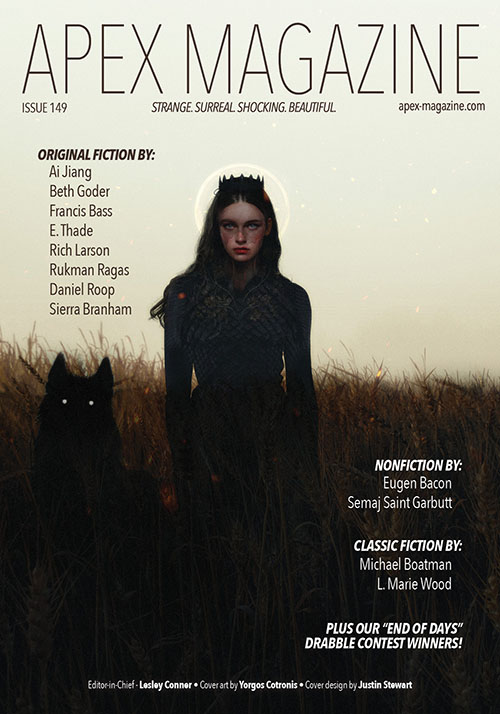
I’m thrilled to announce that I have a short story out in this month’s issue of Apex Magazine! The story, “I Remember a One-Sided Die,” is about an alien species with a strange way of perceiving time and memories, and is narrated by one of those aliens. This is my first story to appear in a magazine in a while, and the longest story I’ve ever had in a magazine, so I’m pretty excited to have it out there! I was also interviewed for this publication by Marissa Van Uden, so after you’ve read the story you can read that interview to see where the idea for this story came from, and how I developed it.

You can read the story and the interview right now if you buy the issue, or you can wait a month and both will be posted on Apex’s website, free to read. I’ll probably share that link in a future blog post as well, when it’s available.

Other news!

I don’t think I’ve actually mentioned it on this blog yet, but back in January I finally finished editing the book I’d been working on for most of the past two years! Currently I’m taking a break from it/waiting to hear back from readers, and later in this year I’ll start querying agents.

I’m also just taking a break from writing in general … although I am editing some short stories I wrote last year … but no new writing! Instead, I’ve been gearing up to making a short comic. I’ve never really intentionally set out to make a comic before, other than LYCC—and that was like a diary comic, so it didn’t require any overarching planning or character development. So this will be a bit of an adventure for me. Right now I’m mostly warming up to drawing again, trying to make it a habit, and I’ve been trying to draw a little 4-panel comic every day. I may clean some of those up and post them here at some point.

That’s the main news from me. Here’s a video of me biking up the SRT to Norristown yesterday.

Spooktober 2024

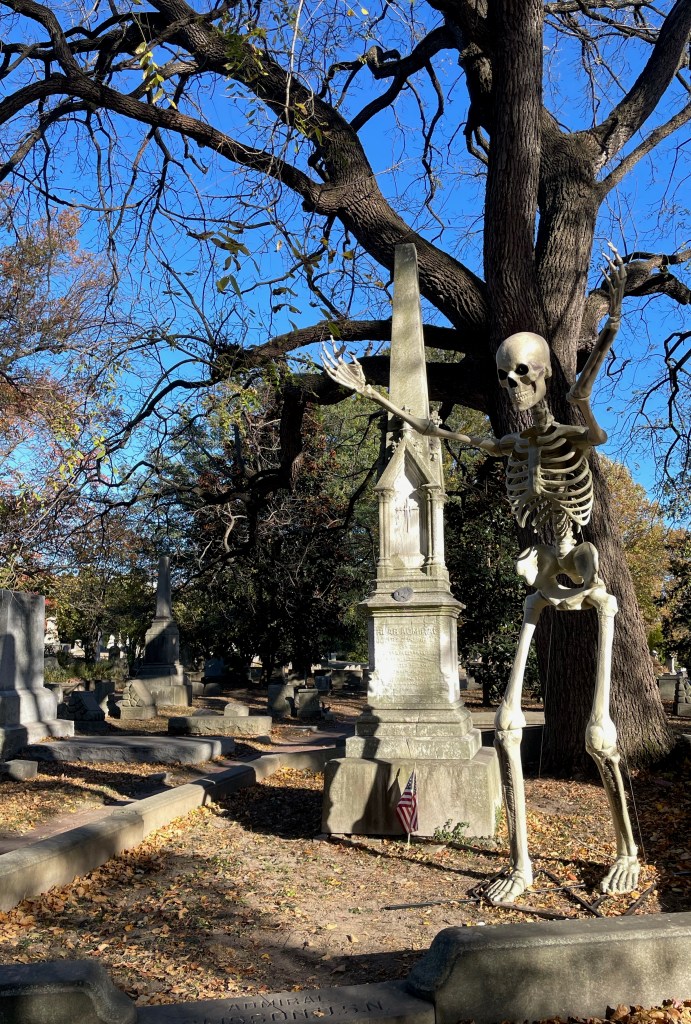
A larger than life size skeleton posed with arms raised in front of an obelisk grave in the Woodlands cemetery in Philadelphia

Every year around October I like to read horror books and you can see all my previous posts about that here and this is this year’s post.

This year I had a couple false starts with some really insipid contemporary horror novels, so I wasted time on those and didn’t finish them, and only ended up reading one prose horror novel—a novella, actually, Low Kill Shelter by Charity Porpentine Heartscape. I also read the graphic novel A Guest in the House by E.M. Carroll, and I watched a bunch of movies, and I went to some graveyards, so I’m just gonna throw all that into this post too. Enjoy! 🎃

What I’ve Been Reading

Low Kill Shelter by Charity Porpentine Heartscape – A virus has spread across the world which turns its victims rabid, and causes canine-like changes in their jaws. But it hasn’t spread so thoroughly that society has collapsed—in fact, the world is still running along as normal. You still have to work. And everyone has given up on discovering a cure, even the companies supposedly funded to do that. The officially sanctioned cure now is just to execute the infected person.

The novella follows a man who is keeping his infected friend chained up in a closet in his apartment, studying him and trying to find a cure on his own.

This is quintessential Porpentine—a dead-eyed vision of the world which brings the grotesque and the banal smashing together, transgressive in a way that doesn’t feel like just a stunt, transgression as a by-product of probing deep into pain, discomfort, and rabid desires. The book excels in attitude, style, and narrative voice, but the plotting felt a little stilted. At a certain point it just starts going from one archetypal monster movie scene to another, and loses the extreme tension, the claustrophobia, the push-and-pull dynamic of the beginning. Overall I enjoyed it, but it lost its edge about halfway through.

Read More »

New Edition of “The War on Hormones”, Year in Review, and More!

I’ve got a bunch of little announcements to make so I’m throwing them all together in this post, roughly in descending order of importance.

Free Zines!

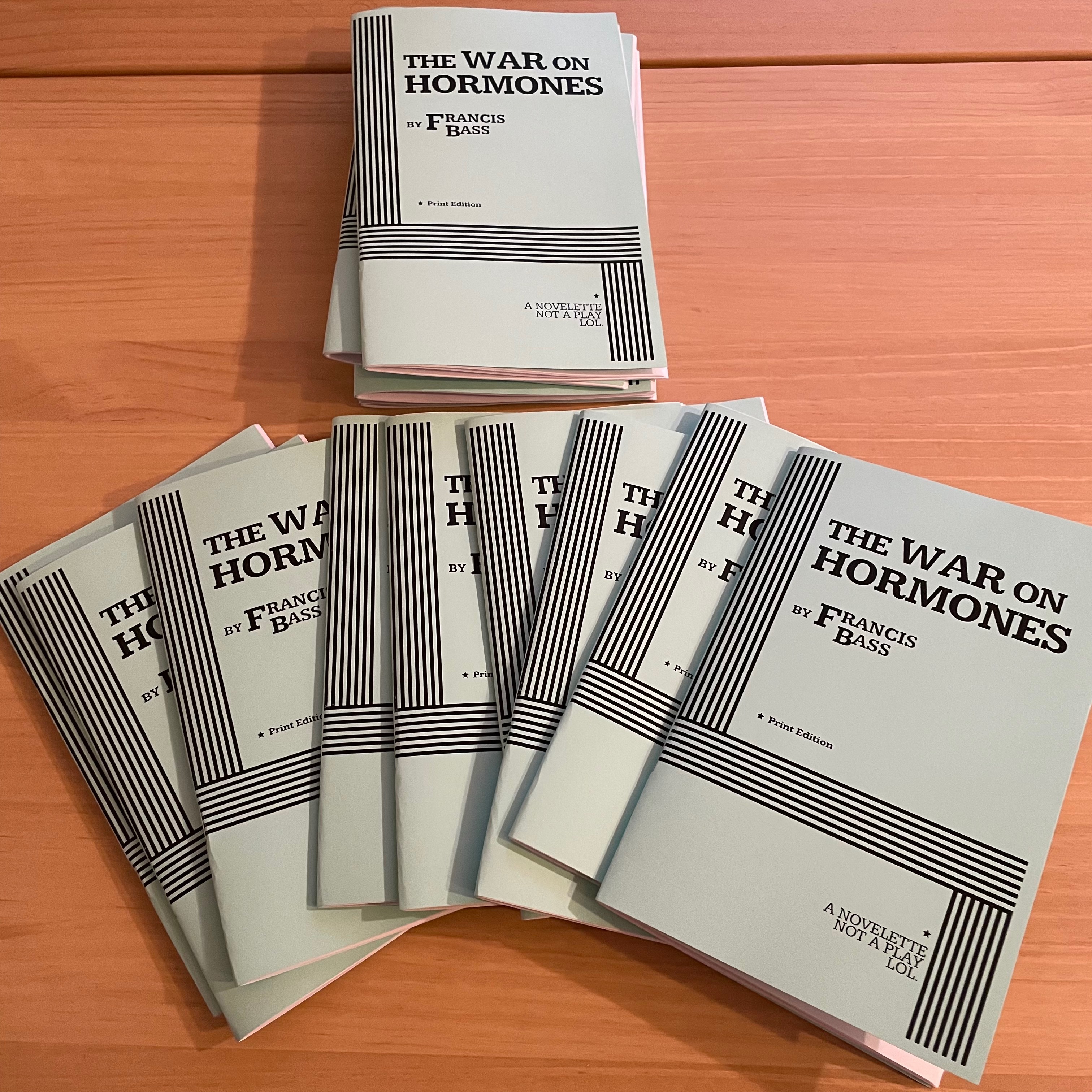
As promised, here is the 4th and final zine of 2023! This one is a re-issue of a novelette I previously published as an ebook, “The War on Hormones.” It’s about pharmaceutically asexual teenagers at a performing arts high school, and I wrote it when I myself was in 12th grade. Despite or because of this, I think it holds up! I had fun rereading it, anyway, and only made a few minor edits for clarity. I also cut the afterword to keep it a more conveniently printable length.

This new zine edition is free! Just email me at Francis.R.Bass [at] gmail [dot] com and I’ll send you a copy. You can also still buy the old ebook version on Smashwords if you want to throw me some money.

Also, if you would like any of the zines I’ve previously released, now is your last chance to get them for free, with free shipping!

To wit, that is:

  • “Cartographer,” a grotesque fantasy about a person lost in the colossal corpse of their god, and the mapmaker they always end up returning to. (LOW STOCK)
  • “Masters of the Wine Printers Guild,” an economic fantasy about a conspiracy of apprentices who decide to defy the masters and print their own wine;
  • “Is Magic School Still Worth It?”, a fantasy short story about trying to put a price tag on our nobler aspirations (i.e., magic.);
  • And “Fires Burn Forever in This World,” a short story about a city where the antiquated practice of leaving firefighting to private insurance companies has persisted right up to the modern era..

If you missed out on one of these before, or if you really liked one and want another copy to share with a friend, let me know! Going forward I will be charging for my zines like the mercenary wretch I am. So get them while you can, orders close Jan 1st.

Year in Review

It’s been a pretty quiet year on the magazine front, but a big year for self-publishing stuff. There are all those zines of course, and also a new collection of short stories which I released as an ebook, Stories About Kids Stealing Things. The book collects seven stories about people with very little ability to control their own lives, and no ability to control the world at large. They are going to try anyway.

It’s also probably the coolest cover I’ve ever made.

I wrote a very long and very negative review of The Parable of the Sower. I mean, I wrote plenty of other reviews this year, but I think this one came out really well, and even if you don’t care about the book, the review gets at some of the things I find lacking in dystopian fiction. If you only read one of my posts from this year, read that one.

No new publications in magazines this year, but I did have one reprint—my story “The Mechanical Turk Has a Panic Attack” appeared on Escape Pod! This is a story I really love, and it was great to have my work appear in such a prominent institution of contemporary short sci-fi.

Not much other than that! I am still writing this fucking novel, the one I mentioned I’d started back in April. It is about 2x the length I expected it to be. I will hopefully have the first draft finished in January, and then can spend the next year writing short stories. I like writing novels, and I honestly think this one is going to come out amazing, but I think I am just too artistically promiscuous to write long projects like this one all the time. Like I cannot imagine committing myself to another novel right after I finish this one. So I’m looking forward to being a narrative slut next year.

Public Domain Day

Public Domain Day approaches! Each year on January 1st, Public Domain Day, I celebrate by releasing one of my works to the public domain. Last year, some friends and fellow artists joined me in this, ceding some of their works as well. If you would like to do the same this year, let me know so I can link to the work you’re ceding in my post! The work can be a song, a photo, a short story—anything you’ve made and would like to release forever to the commons.

For more info on Public Domain Day, you can check out my page on it, or the post from last year.

Happy holidays, see you January 1st!

What I’ve Been Reading, Spooktober 2023

The month of spooktober has passed, but autumn, the season of death, still surrounds us. So today I bring you reviews of the books I read this October. For the past several years this has been a tradition of mine, reading a bunch of spooky books around this time of year, though I’ve only made a post reviewing them all once. Hopefully from this year forward, that can be part of the tradition too.

Boy’s Life by Robert McCammon Boy’s Life is narrated by Cory Mackenson, a middle-aged writer looking back on a pivotal year of his life growing up in the small town of Zephyr, Alabama. The book is divided into four main parts, each corresponding with a season, starting in spring and ending in winter. The year in question is the year Cory turns 12, and the year he and his father stumble upon a murder victim drowned in Saxon’s Lake, an old flooded quarry. That murder, and the mystery of the victim’s identity, let alone the killer’s, is the main throughline of the novel.

However, this book is over 600 pages, and it is not 600 pages of Encyclopedia Brown working one case. Instead, the book is composed of episodic chapters detailing various different adventures in Zephyr. Sometimes these chapters reveal a little more about the murder mystery, but usually they don’t. They often don’t even relate to one another, and they vary greatly in terms of tone and genre. One chapter is about a new kid in town who turns out to be a baseball prodigy; another is a monkey’s paw-esque story about the death of the family dog; another finds Cory abducted by a member of a moonshining clan. These chapters don’t really connect or build up to a larger narrative arc, aside from the arc of Cory growing up. Characters enter and exit like stage actors. They arrive, they play their part to a tee, and then they leave. Even Cory’s main group of friends really only shows up when they’re a central part of the chapter, but otherwise they have no involvement with the murder mystery or any other misadventures.

Because each chapter is so totally committed to its trope or theme or genre, McCammon never holds back. He gets to the good stuff right away, every time. The lake monster isn’t going to come back later, so the first chapter where it appears doesn’t waste time with just a little ripple in the water, or a half-glimpsed fin, no—the lake monster makes a full appearance and attacks Cory! Lots of the chapters feel like B-movies that have been fast-forwarded right to the climax. So instead of a tightly woven story where each thing leads to the next, you get a multigenre smorgasbord of all killer no filler one-off adventures. It’s a trade-off which I was happy to accept.

Read More »

New Publication: Stories About Kids Stealing Things

And a new zine publication! It’s a two for one today!

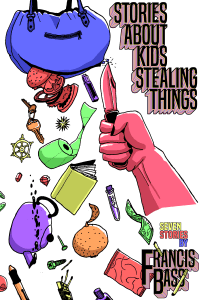
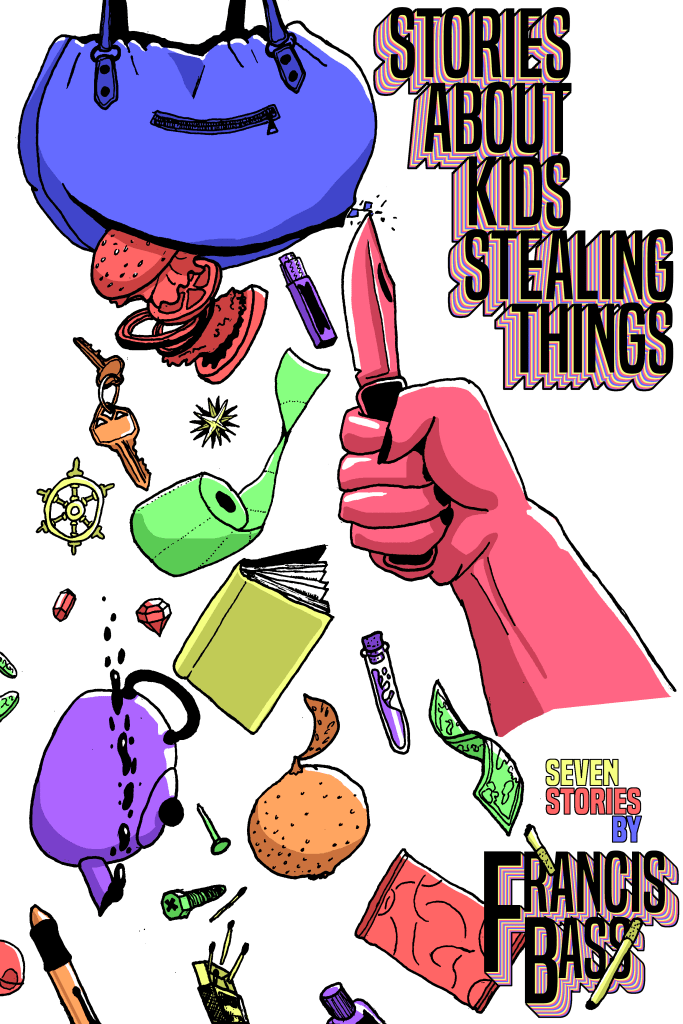
First, Stories About Kids Stealing Things is now out on Smashwords! Wow, cool cover!

Collected in this book are seven short stories, mostly written between 2018-2019. They’re not all about kids stealing things, but most of them are.

Two teens take climate justice into their own hands by stealing from the rich and giving to themselves; AI can’t drive for shit; bearing someone else’s nostalgia for a world long dead; don’t let someone slip a love potion in your cup; your awful ex-boss is running for governor of your failing state, better stop him; privatized firefighting and year-long fires; don’t predict the future, predict the prophecy.

These are stories about people with very little ability to control their own lives, and no ability to control the world at large. They are going to try anyway.

Here’s a full list of the stories collected here, you may see some you’ve read already:

“Fuck You Pay Me,” “Ride of the Blind Sighthound,” “The Hilarious Inside Joke of Our Overwhelming Melancholic Nostalgia,” “Love Poison,” “The Harrowing of Castle Maddox,” “Fires Burn Forever in this World,” and “Red, Her Hand.”

That second to last one, “Fires Burn Forever in this World,” is also now available as a print zine! For free! It’s a short story about a city where the antiquated practice of leaving firefighting to private insurance companies, and letting uninsured buildings burn, has persisted right up to the modern era. And also fires burn for a very, very long time. If you would like a copy, email me at FrancisRBass [at] gmail [dot] com. Check out some interior artwork for it at left!

What’s Next

I am going to make one more short story zine this year. It will be a re-issue of a novelette previously published as an ebook, “The War on Hormones”. A story about pharmaceutically asexual high schoolers, which I wrote while in high school myself. Pretty fun! Expect it in November or December.

And that will conclude this pilot program of zine making! I started making zines last September with “Cartographer.” Since then I’ve made three other zines, and “The War on Hormones” will make five total. I’ve been giving them away for free because I was still figuring things out, experimenting, and I really just wanted to get the things in people’s hands.

So starting next year, they will (mostly) no longer be free. I am also probably not going to release as many new zines next year, maybe just one or two.

Read: I have really enjoyed making these and giving them to y’all, and would like to make this one of the pillars of my career, such as it is. So I am going to spend next year figuring out how to do this sustainably. More thoughts on this probably when I release the next zine.

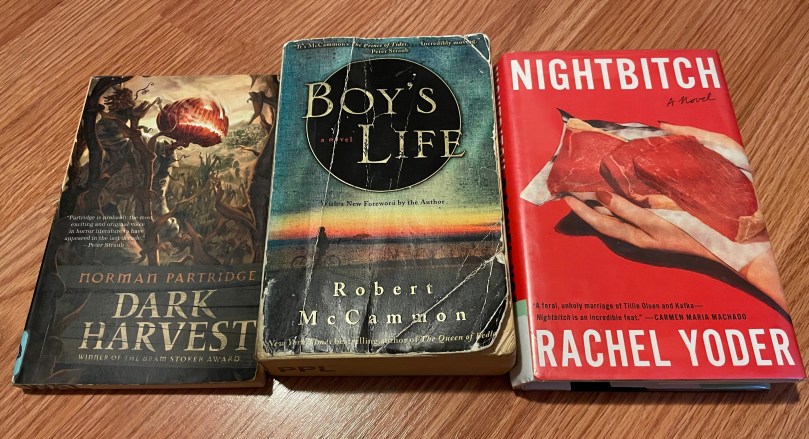
Also, non sequitur, Spooktober is upon us, this year I am reading Boy’s Life by Robert McCammon, Night Bitch by Rachel Yoder, and Dark Harvest by Norman Partridge.

Okay that’s all I’ve got for you now! Is that enough???

What I’ve Been Reading, September 2023

Got a bit of a grab bag this time around. One long review of The Agony and the Ecstasy, a shorter review of A Fine Balance, and a shortest review of The Hard Tomorrow. Also, after all that, some news about two writing projects I’m putting out this month, and an opportunity to place an ad in my zine! Pick your poison.

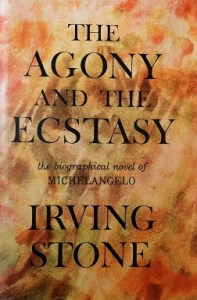
The Agony and the Ecstasy by Irving Stone is a biographical novel about Michelangelo. It starts when he is 13, about to be apprenticed to Domenico Ghirlandaio, and continues throughout his entire life, right up to his death at age 88. The plot is pretty much exhaustive—no part of Michelangelo’s life is omitted, though some is summarized, especially towards the end.

Initially, I concluded that “The Agony and the Ecstasy is a hack job, and it is glorious.” By “hack job” I meant that there’s really no artistry to it. Irving Stone is not making artistic decisions about how to represent things, he is not emphasizing certain moments over others. Every bit of information, every major event, is dutifully transposed into a kind of dramatized biography. This changes slightly towards the end, which I’ll explain more below, but I think my initial impression still applies to 90% of the book. No one should read this who does not want to read a 600-page biography of Michelangelo.

That’s not to say Stone is unskilled, not at all. The drama is compelling, the dialogue and narration are effective. He is rendering well, but he is only rendering. There’s no attitude, no flair, no vision. He is like David, an artist in the studio of Ghirlandaio who Stone describes thus: “David had been well trained in enlarging to scale the individual sections and transferring them to the cartoon itself, which was the dimension of the church panel. This was not creative work, but it took skill.”

The single biggest artistic choice Stone made, and it is a bold one, is writing this book at all. Michelangelo lived a long life, so treating his life with the intense level of researched detail that Stone employs does require commitment, belief, a supreme confidence in the worthiness of the material. This is a hack job in that it lacks any creativity, but it is an uncommon hack job, one which took a tremendous amount of care and effort to complete.

Read More »

Review: Parable of the Sower by Octavia E. Butler

EDIT: This post previously misattributed quotes to the Camden mayor, which were in fact made by the Director of the Camden County Board of Commissioners.

Negative review time! It’s time for a negative review!

I never write negative reviews—I mean fully negative, not just a mixed bag—because I rarely finish books that I really dislike. And then if I do, I don’t want to waste even more energy writing about it. But Parable of the Sower is beloved and lauded, and Octavia Butler is basically canonized by the current crop of SFF writers, so I think a full review is worth my while and yours. Maybe it will shed some light on common failings in dystopian lit, maybe it will make other people who disliked this book feel less insane, maybe it will just be fun!

There will definitely be some spoilers, if you can spoil something that is already rotten.

Introduction

Parable of the Sower is narrated by Lauren Olamina, a young girl living in Orange County, in the year 2024. The United States is collapsing into poverty and lawlessness, and is backsliding into oligarchy, all apparently driven by global warming. Things start bad and get a lot worse. Strike that: things start bad for Lauren’s last-gasp-of-the-middle-class enclave, and get a lot worse. For the poor, the misery is pretty abject from the very beginning.

The book has two major parts, about equal in length. In the first half, when things are only bad, Lauren is preparing for the worst, and trying to get her community to do so as well. This preparation mainly entails making bug out bags and reading books about foraging, first aid, etc. Also she wants to start a religion, “Earthseed,” which recognizes change as the only God, and as a fundamental force which people must accept and work through. She develops this religion, writing its holy verses, in secret.

In the second half, her community has been obliterated, and she travels north with a few survivors, hoping to find somewhere they can resettle. They join a mass migration north, and occasionally add new members to their group. Lauren starts to share Earthseed with them. They are attacked multiple times.

Also Lauren has a psychosomatic hyper-empathy condition triggered by the apparent physical sensations of others. It’s not plot-relevant or theme-relevant, and it’s barely character development-relevant, so I will not mention it again.

That is the basic story-shape of the book. There is a sequel, I haven’t read it.

What’s really strange is that this book is not good any way you turn it. With books I dislike, I can usually see the element that people enjoy in them. I cannot see it here. It fails, or is at most subpar, on all counts.

Let’s start with the loftiest of traditions which this book attempts to engage, which is societal critique. This is generally how this book is framed when people describe or recommend it—a cautionary tale of where we’re heading, or (jerk off motion) a prescient vision of where we are!! Oooo!! Octavia Butler warned us!!! (jerk off motion)

Read More »

New Publication: Is Magic School Still Worth It?

multiple copies of the zine. the covers have the title, a small glove insignia, and the initials FB

“Is Magic School Still Worth It?” is out now! It is available exclusively in print! It is for FREE! Here’s the synopsis:

Ezze recently graduated from magic school, but she hasn’t practiced magic at all since then. She volunteers at a magazine, works at a hotel, and had to sell her silkbud glove to get by. When the magazine assigns her to write an article about whether or not magic school is still worth it, she struggles to find an answer.

The zine itself is staple-bound, with a hand-lettered cover. If you’re curious how I made it, this post about an earlier short story goes into some more detail on the process.

Email me at FrancisRBass (at) gmail (dot) com if you would like a copy! If you live in Philly I can hand-deliver it to you, if you live elsewhere in the US I’ll mail you one. If you live elsewhere outside the US, I may ask you to cover postage, but should still be able to get you a copy.

Upcoming Publications

There will be two more free zines this year. They will be “Fires Burn Forever in This World” (new!) and a re-issue of “The War on Hormones” (old, but newly in print!) I will also release, in ebook form, a collection of short stories from the past few years, which will be titled Stories About Kids Stealing Things. That one will not be free.

Also very soon (maybe later this month?), my story “The Mechanical Turk Has a Panic Attack” will gain a second life at Escape Pod! It was previously published in Uncharted Magazine in 2022, and now it will be published in audio form as well. I’m very excited for that, I hope you are too.

Until then!

What I’ve Been Reading, February 2023

Yes! I am still reading! In fact, there is a section on my homepage where you can see what I am reading right now, which I update every month or so, with little snippets of my current impressions of the books.

These three books I’m reviewing here aren’t all that I have been reading, but they’re what I felt like writing about at greater length in the past few months.

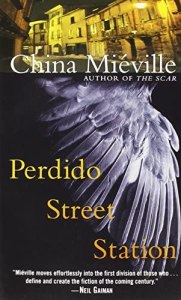
I finally finished Perdido Street Station by China Miéville, read by John Lee, which I’ve been listening to off and on since July. It’s a secondary world fantasy set in the enormous, early industrial metropolis of New Crobuzon. New Crobuzon is full of all kinds of different hominids, including bug people, cactus people, hand parasite people??? The book’s main trio, at least at the beginning, is the scientist Isaac Dan der Grimnebulin, his romantic partner Lin—a bug person artist—and Yagharek. Yagharek is an exiled bird person (these different groups all have actual terms in the book, but I’m just gonna call him a bird person) who has had his wings removed, and he has come to New Crobuzon to see if Isaac can restore to him the power of flight.

The strongest point of the story is the city. It is riotous, expansive, and intensely detailed. Every neighborhood, every little enclave, is a whole world unto itself—just like a real city! There isn’t just The Bug Person Neighborhood, there are actually multiple, which fall into their own hierarchy among each other, with different cultures and different relations to the powerful of the city.

The trouble with the book, and the reason my progress with it slowed down about halfway through, is that the main antagonist basically flattens all this detail. The book switches focus from Isaac’s attempts to help Yagharek fly again, and Lin’s dealings in the sordid art world, and becomes a monster story. A big soul-sucking moth creature from a far away land is loose in the city, and everyone is powerless to stop it. I say it flattens things because this monster has essentially the same relationship with every neighborhood. The differences between the neighborhoods, their cultures, their inhabitants, what type of hominid they are, are all irrelevant. Everyone is equally powerless against this moth. Whereas before, Isaac, a standard human person, has different relationships with all the neighborhoods. Some are totally hostile to him, some he can mingle with easily. In some neighborhoods he doesn’t want to be seen publicly with Lin, in others he is open about his relationship. And likewise, every characters has a different orientation to any given neighborhood.

Like when Lin and Isaac visit a squat of bird people within the city, Isaac unwittingly makes an ass of himself, arrogant and offensive to the locals. Lin, being from an oppressed group herself, can see how abrasive Isaac is being, and tries to get him to leave before he does more damage.

The moth creature flattens this. Our heroes still have to move throughout the city as they try to fight it, and this does occasionally produce some of that sparkling detail and cultural friction which I so enjoyed in the beginning, but its more rare. Two other major characters are introduced, who are also as unique and separate from the city as the moth.

And it’s not that this monster narrative is bad, it’s just such a step down from what was developing before. I mean imagine if in A Song of Ice and Fire, after setting up all these different houses and characters, the second book immediately changed to focus on an invasion of white walkers who sweep across Westeros in indiscriminate carnage. Not bad necessarily, but it’s a waste! This moth story could’ve happened anywhere, it could’ve happened in London or Ankh-Morpork or Gotham.

Nevertheless, it’s a great book overall. Miéville employs a realism that goes beyond some dirt under the fingernails and missing teeth—it’s a realism of attitude, outlook. Most of the characters are subject to powers far beyond their control. The ones that are in power are not evil or righteous—no good kings, no kings at all actually, just an iron-fisted mayor and various apparatuses of violence under his command. Everything’s a little shitty, a little petty, a little casual. You live here. And that realism of attitude, combined with his fantastic, iridescent worldbuilding, is what has me eager to read more of Miéville, and wishing I’d started reading him sooner.

Read More »

New Publication: Cartographer

Hey, it’s a new novelette! It’s actually pretty old, but I’m finally getting around to publishing it, and you can get it now on Smashwords!

Also, if you would like a physical copy of this thing *for free,* I will be posting some details about that on Twitter shortly (edit: Here.) Or you can email me and I’ll let you know about it when I’ve got the details figured out. Essentially: I have been very intrigued by zines and cheap printing lately, and I think sometime in the future I would like to incorporate that into how I sell my stories. Having a little booklet is, I think, so much nicer than staring at a screen. Turning a page rules, and scrolling ceaselessly does not (unless you are using a physical scroll maybe.) For now, I just want to do this as a proof of concept, so I will be charging the low price of *nothing* for a physical copy of this novelette. Though if you want to show your support by also buying a digital copy, I will certainly not stop you.

Here’s the synopsis: Si Muue is lost in the colossal subterranean corpse of their god. Separated from their family, their memory deteriorating, they arrive at the home of a cartographer just in time. The cartographer, Lio P, draws them a map in exchange for a detailed account of their travels through rotting innards and cavernous bones. However, the two disagree on the shape of God: Lio P believes God resembled a godson, like him, while Si Muue believes God was not like any mortal race, but was a mixture of all of them.  

And when Si Muue ventures forth, they soon become just as lost as before, and return to the cartographer. Again they receive a new map, and again they are lost, over and again, until their memories are all a confused mix, and they can’t tell dream from reality, and it seems they will never escape this decaying underworld.

“Cartographer” is a grotesque fantasy, a story of torment, survival, and despair. Lost in bloody darkness, the only way is forward.

CW: Violence

New Publication: “Extrasolar Teas Box” (and some other announcements)

Illustration by Renee Leanne, courtesy of Electric Literature.

I have a new piece of flash fiction out from Electric Literature today, “Extrasolar Teas Box”! The headline they put on it is “No One Was Exploited in the Production of this Space Tea” which I think gives you a good idea of what the story is about. The wonderful illustrations accompanying it are by Leanne Renee. Check it out here!

A few other announcements: First, a month or so ago some writer friends put out an anthology of short stories, which I wrote the foreword to. Each story starts with the same line, “It was a dark and stormy night,” but they all diverge from there. You can get it for free on Smashwords!

Speaking of Smashwords, I am once again participating in their end-of-year sale, so all of my writing on Smashwords is 75% off or free from now until the end of the month!

And finally, there will be more new Francis writing very very soon, because I have a story in the inaugural issue of Solarpunk Magazine! So look forward to that next month, and if you want you can preorder the issue or subscribe to the magazine here.

Review: How to Slowly Kill Yourself and Others in America by Kiese Laymon

Cover courtesy of Simon & Schuster

Kiese Laymon approaches each of his books as a way to celebrate and innovate the form, whether novel, memoir, or, in the case of this book, essay collection. How to Slowly Kill Yourself and Others in America is thematically cohesive and intensely self-referential. It reckons with self-destruction, regret and revision, the worst of white folks, Mississippi, America, writing, truth, and lies. I read the 2021 revised edition, which contains seven essays from the 2013 edition and six new ones, as well as a revised author’s note. Another change is that the essays are sequenced in reverse chronological order, ending with the essay which opened the first edition.

The best way I can describe how these thirteen essays form a whole is to say that it feels like a well composed album. Themes recur and recur. Essays reference each other, and sometimes divulge the origins of each other. Specific phrases like “healthy choices,” “multiple dreamers,” and “the worst of white folks” stitch their way through the whole book. The book moves backwards in time, and meanders north from, then back around to, Mississippi.

That movement provides a structure for the book, a sweeping momentum which leaves you feeling like you’ve really gone somewhere by the end, though it is not the dominating logic of the book. That is, the essays are densely interconnected beyond just geographical or chronological ties. I think that’s what’s so album-like about it—the associative ties between essays, their dense inter- and intra-textuality, combined with the larger arc which gives the thing a simpler form you can hold in your mind. It is singular and plural, which is a hell of an accomplishment.

It’s also like an album because there’s features! Laymon’s mother, his aunt, and several friends lend their voices to a few essays; these sections are well written in their own right, and add depth and energy to the essays they appear in. And the choice to include them is thematically relevant too—in the final essay, “We Will Never Ever Know,” Laymon writes to his uncle, “We talked, but we didn’t reckon with each other.” (152) Bringing other voices into this book, voices in dialogue and disagreement with Laymon’s, is a demonstration of what that reckoning can look like.

This polyphony is most prominent in “Echo,” which features four writers in addition to Laymon: Mychal Denzel Smith, Darnell Moore, Kai M. Green, and Marlon Peterson. Smith starts it off with a letter addressed “Peace Fam,” and then each writer responds, one after the other, like a posse cut. They each write about being black, being a man, and being both; while each essay builds on the last, and they all circle around similar themes, they somehow never repeat each other. The echo shifts pitch and volume each time.

Read More »

The Same Story Told is on sale!

A year ago today I published The Same Story Told, a post-apocalyptic pastoral fantasy novel, retold six times in a row. In celebration of it’s 1-year birthday, you can get it for just $1 from Smashwords this week! You can also read this excerpt I posted to the blog a year ago, if you want a sample of what this book is. Here’s the synopsis:

Whistlers normally draw power for their incantations from the microbial sappers that infect their own bodies, but an incantation to infect others with sappers has been discovered, and the resulting plague has devastated the world. The only immunization against this plague is to be infected by a Whistler with a little more control over the bacterial life they create. Of the survivors gathered at the Academy of Sibilant Arts, Klobs is the youngest Whistler. At 14, she’s been entrusted with infecting just four people—her older brother Binlev, her mentor Daltob, and two friends from another academy, Hakleen and Boos.

These five are sent to reclaim a farming township, but soon a hostile group of Whistlers raids their food stores. Without enough food to make it to the harvest, Klobs uses her sappers to place Daltob and Hakleen in deep sleeps. Working in year-long shifts and year-long sleeps the five can conserve food, but each member of the group experiences a unique fragment of the same struggle, deviating, merging, echoing.

The Same Story Told tells each fragment one after the other, as well as the apocryphal legend that has arisen about the “Lost Expedition,” changing format and style to portray the same post-apocalyptic pastoral fantasy six times in a row.

Review: Bitter in the Mouth by Monique Truong

Cover courtesy of Random House

Bitter in the Mouth by Monique Truong is a coming of age story narrated by Linda Hammerick, looking back on her childhood in Boiling Springs, North Carolina in the 70s and 80s. The main drama of the book is the interactions between different members of Linda’s family, and Linda’s efforts to make her way amid the secrets and dysfunctions around her. One of these secrets is Linda’s, which she only shares with her best friend: Linda has the very rare condition of lexical-gustatory synesthesia. When she hears certain words, she can taste them.

Although her synesthesia is not the whole point of the book, it is a major component, and also the origin of the title, so I’ll start with it. It’s a brilliant device, and such an obvious shortcut to evocative writing that I’m surprised I’ve never seen it used this way before. Lots of writers employ synesthesia in their prose, as a poetic device (e.g. describing a noise as sharp, describing pain as bright), but here it’s built into the character. It allows Truong to frequently assail the reader with the most immediate, vivid sense one can evoke in the written word—taste. Peach cobbler, bread and butter pickles, and sourdough bread register with a reader at an intensity which fuzzy, shrill, or sea foam green do not. At the same time, taste descriptions are normally very difficult to work into a story, because most of the time we aren’t tasting anything. So having a character who experiences vivid, hyper-specific tastes when she hears words feels like a cheat, but an effective one nonetheless. There’s such a pleasure in discovering which words pair with which flavors, in reading dialogue that is peppered with dozens of tastes.

And that is, ultimately, why the synesthesia isn’t just a gimmick, or a way to quickly pull the reader into any scene: Truong commits to it fully in multiple ways which cause complications for the book. The first, most obvious commitment is that the tastes are always rendered in the dialogue, every single time. For instance, here is her teacher calling role:

“HammerickDrPepper, Lindamint.”
“Herehardboiledegg.”
“Harrispecan, Wadeorangesherbet.”
“Herehardboiledegg.” (30)

As I said, this is like jabbing a live wire into the reader’s insular cortex (good 👍), but it effectively throttles the dialogue (bad 👎 or at least a challenge for a writer.) Truong doesn’t just turn it off when it’s inconvenient—it’s always there, just like it’s always there for Linda. And that’s the other major way Truong commits to complication—Linda’s synesthesia is frequently a hindrance to her. In school, she has trouble focusing, and eventually has to start smoking (which dampens the “incomings”) so she can improve her grades. This compelling, juicy literary device has realistic consequences for the character and how she interacts with others; who she does and doesn’t reveal it to is a major plot point.

The other thing that sells it, that makes it rich rather than cheap, is that the pairings of flavors with words are arbitrary. It would be so easy to make a kind of game of this, and communicate Linda’s feelings about certain characters or places through her synesthesia, but that’s not how it works with people who really have it. For Linda, “Dill” is faithful—it tastes like itself—but most food words are not. She enjoys it when her mom calls her selfish, because “selfish” tastes like corn on the cob. This means Linda has a very different relationship with words than everyone around her—an extreme version of the way all of us experience certain tastes, emotions, and even words, in unique, incommunicable ways. As Linda narrates, “But we all haven’t tasted the same unripe fruit. In order to feel not so alone in the world, we blur the lines of our subjective memories, and we say to one another, ‘I know exactly what you mean!'” (15)

Read More »

Review: Long Division by Kiese Laymon

Cover courtesy of Simon & Schuster

Kiese Laymon is a phenomenal writer, and you can tell so the moment you begin any of his three books. I reviewed his memoir Heavy a couple years ago, and have finally read his other two books, starting with Long Division, a novel. I read the 2021 edition, which I’ll talk more about later. The book is split into two halves which read starting from either side of the book, and ending in the middle.

“Book One,” (though Laymon says you can read them in any order, I chose the obvious order) follows a black Mississippian boy named City, in the year 2013. He and his school rival, Lavander Peeler, both make a scene at the national “Can You Use that Word in a Sentence” competition, and City is sent to stay with his grandmother in the rural town of Melahatchie. There, he contends with violent racists, his grandmother’s church, the reaction to his outburst at the competition (which has gone viral in the way things really could go viral back in 2013), and the disappearance of his neighbor, a girl named Baize Shephard. Also, he’s found a strange book titled Long Division, in which he is the main character.

In “Book Two,” a black Mississippian boy named City living in Melahatchie is in love with his friend Shalaya Crump, in the year 1985. Shalaya reveals to him that she’s found a way to travel to the future (2013), and she’s worried that in the future she’s dead. She can also travel to the past, 1964, where her and City’s grandpas are about to be killed by the klan. In 1964, the two meet Evan Altshuler, who wants to help them save their grandpas and his own family. In 2013, they meet Baize Shephard.

Regardless of which half you start with, character is the first thing that jumps out, especially City, the narrator. He has a lot of opinions, a lot that he needs to let you know about Lavander Peeler, about Principle Reeves, about the “Can You Use that Word in a Sentence” competition, about Melahatchie, about Baize Shephard, and about himself. He’s self conscious in a way that stops short of providing a perfect accounting of his inner working at all times, but still goes a lot deeper than most 14-year-old protagonists do. Despite his braggadocio, City is scared and sad about a lot of things. Sometimes he admits this to himself, sometimes he admits only to the way it feels in his body.

It’s not just City though. From Lavander Peeler to Grandma, all these characters leap off the page, and then deepen, reveal richer hues within the bright colors that initially grabbed the reader’s attention. The scenes between City and Baize are dynamite, as she is just as boastful and opinionated as him—and this vibrancy, this vigor of spirit, makes the way the adults treat these young people that much more heartbreaking. The book puts a lot of focus on the cruelty inflicted on children, especially black children, through “education.” The prime example of this is the sentence competition in Book One, which kind of blew my mind and had me, for the first time, thinking about how bizarre and messed up spelling bees are. We meet 2013 City as a smart, verbally dextrous kid locked in a rivalry with the effete Lavander Peeler—and then we see that expansive, energetic persona squashed, curbed, even memified. City’s creative, imaginative, and righteously angry language is denied as not “correct, appropriate, or dynamic”—a dramatic, heightened version of the minute and myriad ways in which adults constantly rebuke children for their creativity, in which white people constantly seek the destruction or neutralization of black imagination.

Read More »

Review: Sex Fantasy by Sophia Foster-Dimino

Cover courtesy of Koyama Press

Sex Fantasy by Sophia-Foster Dimino is a collection of eight zines published between 2013 and 2017, plus two previously unpublished zines at the end. With one exception, the zines are not about sex fantasies, though they are about intimacy, relationships, and the gaps between people. The slight, but not total, mismatch between title and content is indicative of the way a lot of the book operates, in that it invites interpretation. It reaches for something, but doesn’t go all the way toward grasping it—the reader will have to do that on their own.

The book is divided into three sections of three issues each, and a fourth section of one. The first three zines are the most esoteric, consisting entirely of short declarative sentences (usually starting with “I”) paired with illustrations. Although there are a few moments of sequential art, there’s very little scene, and you could scramble the individual panels out of order and not change much. There isn’t even a consistent, recurring character that appears as the “I” or “you” in all the panels. They operate accumulatively—”I made an effort”, “I hit a wall”, “I wasn’t thinking”, “I’m useful” add up to a persona, an emotion. It’s textual-visual poetry, essentially—and like a good poem, you can slow down and appreciate each line, or panel in this case, as it’s own work of art. In fact, the format of the book encourages this, with each panel taking up an entire page, so that you’re only ever looking at two panels at once.

Although these first three zines aren’t my favorite in the collection, I think they hold some of my favorite individual panels. Some are very intricate, while others are imaginative or surprising in how they illustrate the text. “I like your socks” is printed beside a person wearing hamburger socks lightly stepping on someone’s face. “I’m a beverage vendor” appears beside a drink stand; the stand has three large jugs and three containers of ice or tapioca pearls; a bottle for tips; a vase with a flower; eight notes tacked to the stand’s single contiguous wall; a patterned canopy; empty cups held on pegs; a dangling bell; an OPEN sign; a vertical banner displaying a woman drinking from an enormous glass with a straw; and the “I”, sitting on a stool, wearing a spaghetti strap top, flip flops, a hair bow. The text is spare, but the illustrations are rich and suggestive of worlds that extend beyond their snapshot focus. They are not sex fantasies, but fantasy, or fancy, sure.

Read More »