The War of Paraguay: Chapter II, Montevideo

twop-c-10This post remains available for posterity’s sake, but a much revised and much expanded version of this translation is available completely for free! The revised version includes translated footnotes, a translated appendix, an expanded introduction, and a map of disputed territory and important locations. You can download a copy in the following formats: DocxEpubMobiPDF. Or, if you want to throw some money my way, you can set your price for it on Smashwords. And it’s in the public domain!

Note: This chapter deals with an incident which occurred in the aftermath of the Uruguayan Civil War, which I just wrote a whole supplementary post about. I recommend reading it before reading this chapter, if you have not already.

The situation in the Eastern State at the end of 1853 also appeared full of difficulties. In February 1854 the Uruguayan government requested the Empire’s intervention, invoking the 12 October 1851 treaty of alliance (1). Not without much hesitation, our government decided to send to Montevideo a division under the command of General Francisco Félix. No unpleasant event, fortunately, resulted from the presence of that Brazilian force in our neighbor’s capital; but in August 1855 the republic again entered a period of crisis, seeing the president, General Flores, forced to abandon the capital, where immediately a de facto government was formed (2). In this way, the danger of a civil war arose, in which we could see ourselves entangled, along with the Argentine Republic and Buenos Aires. Through all the time of the Paraná ministry the Argentine Republic was divided into two governments: that of the Confederation, whose capital was Paraná, under the presidency of Urquiza, which the thirteen provinces obeyed; and that of Buenos Aires, reduced to the province of Buenos Aires.

Brazil did what was most prudent, given the circumstances: Limpo de Abreu, who shortly before had left the Ministry of Foreign Affairs, was sent to the Plata on a special mission. But before arriving at his destination, the rift—the cause of his departure—was fixed, General Flores having resigned from the presidency, and having been replaced by Bustamente, president of the senate, in accordance with the Constitution.

To this episode Nabuco (3) refers in the following congratulatory message to his colleague from Foreign Affairs: “Y.E., deign to accept my congratulations for the agreeable solution that before your arrival had had the political contention that caused your appointment. Fortune not only accompanies you, but it precedes Y.E.’s steps.”

The following paragraph from an intimate letter to Boa-Vista proves completely the sincerity of the Empire’s politics and the selfless thoughts that animated it. “The policy that we pursued in the Eastern State was not one of balance, but rather one of observation. It was fit, senhor barón, to judge whether the casus fæderis, or cause to comply with our obligation to lend aid to the legitimate government, had arrived; it was fit to know from which part the beginnings of stability would be; it was fit that we would not, beguiled by sympathy, identify ourselves with a foreign party, going along with it—to the detriment of Brazilian relations—in its fortune and adversity, or imposing its will upon the Republic; it was fit to not have the ambitions of the Blancos nor those of the Colorados, a rivalry that was born and appeared after the victory (4); it was fit that Brazil’s intervention was not seen as an imposition, as complicity in the revolutionary movement, as partiality in favor of the Colorados, but rather as a necessity, a desire of all, Blancos and Colorados, as a principle of security for Brazil itself and for the Eastern State. Time, and only time, will show the true character of Brazil’s conduct. Time already vindicates us, and you vindicate us when you say: ‘It is essential that Brazil not be at the mercy of the ambitious of Uruguay.’”

Translator’s Notes

1. Refers to the treaty ending the Uruguayan Civil War, which granted Brazil the right to intervene in future conflicts in the country. In 1854, there was conflict brewing within the Colorado party.
2. This refers to the Rebelión de los Conservadores, a revolt against the Colorado president Venancio Flores by dissidents within his own party.
3. That is, José Tomás Nabuco Jr., the father of Joaquim Nabuco, and a Brazilian politician.
4. The two major political parties that emerged from the Uruguayan Civil War.
The War of Paraguay: Chapter the First, Pedro Ferreira’s Mission

This post remains available for posterity’s sake, but a much revised and much expanded version of this translation is available completely for free! The revised version includes translated footnotes, a translated appendix, an expanded introduction, and a map of disputed territory and important locations. You can download a copy in the following formats: DocxEpubMobiPDF. Or, if you want to throw some money my way, you can set your price for it on Smashwords. And it’s in the public domain!

Strategic_Situation_1865
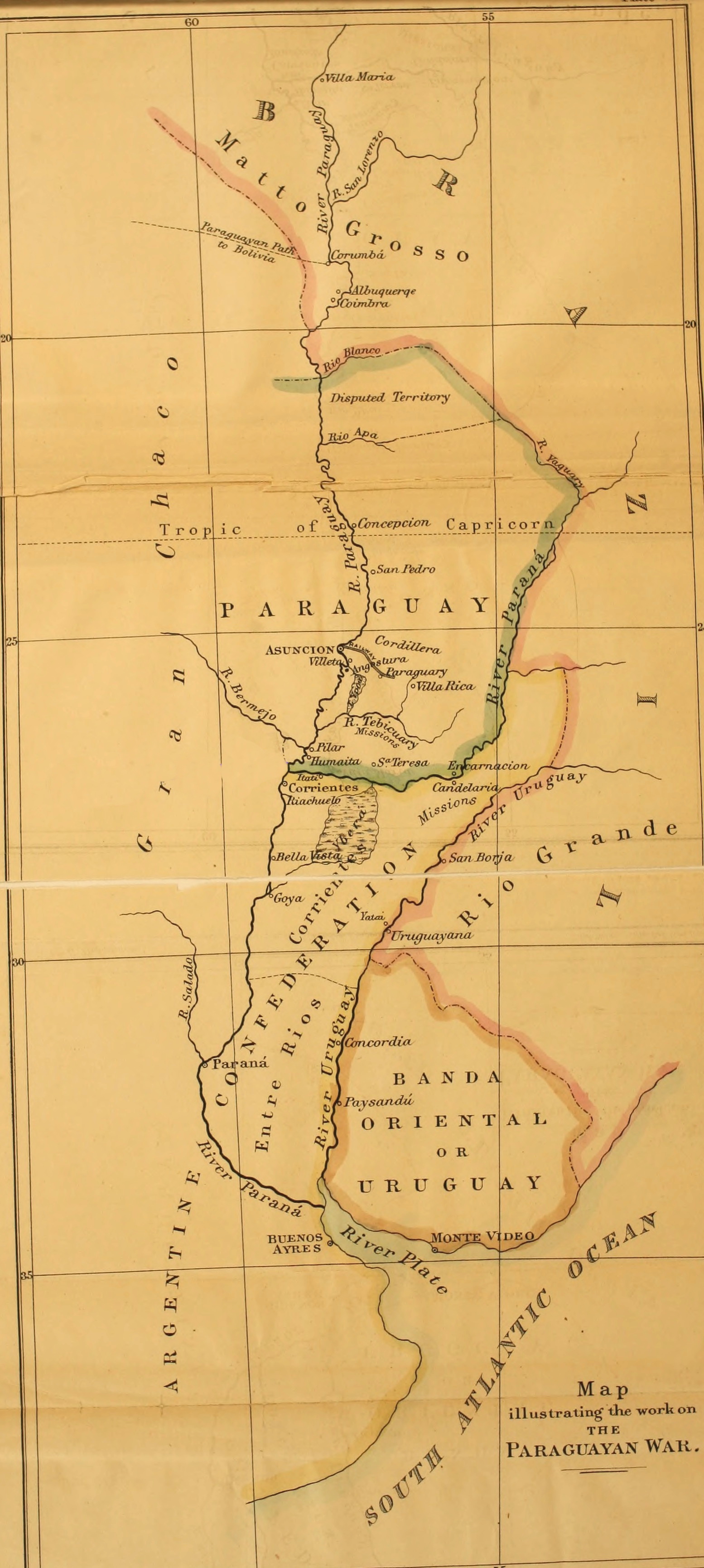
Map of the Río de la Plata region, from George Thompson’s 1869 book The War in Paraguay

A delicate task in the Río de la Plata was fitted to the Paraná ministry (1), the task of guaranteeing the results of the Battle of Caseros (2), and of the ministry of 29 September’s policies (3). Of Uruguay, whose independence we had contributed to saving, of the Argentine Confederation, and of Buenos Aires, whom we had helped liberate from an overwhelming tyranny, we only wanted to be good and loyal neighbors (4); but it was no easy matter, to live in peace with any of them, since the so-called balance of the Plata threatened at every moment to unite them all against us. Peace could only be the fruit of a continuous vigilance and a consummate prudence. And even so, it was in an instant threatened.

López I (5) had given the Brazilian minister Leal his cards (6), accusing him in a note of “being dedicated to scheming and imposture in contempt of the Supreme Government of the State,” and of raising atrocious calumnies against him. With this note arose an issue from which war between both countries could come, and if events had proceeded in another way it is certain that war would have developed.

In demand of reparations for the offense done by the president of Paraguay to the Brazilian minister, the government of Brazil sent to Asunción (7) a fleet lead by Commander Pedro Ferreira, who was made plenipotentiary. At the Paraguayan government’s command, the fleet stopped at the mouth of the Paraguay River (8), Ferreira advancing on the steamer Amazonas, which ran aground before arriving at Asunción. Then began a singular correspondence between the Brazilian envoy and the Paraguayan government, which wound up with Fereira agreeing to board smaller steamers to escape the Amazonas. Such bad beginnings seemed to herald the failure of the mission.

Commander Ferreira’s behavior was quite criticized then, but it seems likely that abstaining from forcing the Paraguay River, at López’s order, was the most prudent and discrete resolution that he could adopt. “Our negotiator and admiral’s instructions,” wrote Paranhos (9) shortly after, “authorized him, in certain cases, to proceed in an energetic and military manner. If this wasn’t so, he would not have shown such determination to justify, with so much deliberation, the conduct that he observed from Tres Bocas … Denied the reparations, and with it the passage of his ships to Mato Grosso, not only was he authorized to force the way, he had orders to do it, and to send two or three of the ships that comprised his expedition to the Brazilian waters of alto Paraguay, and, in this way, await new orders from the imperial government.”

Fragata_a_Vapor_Amazonas
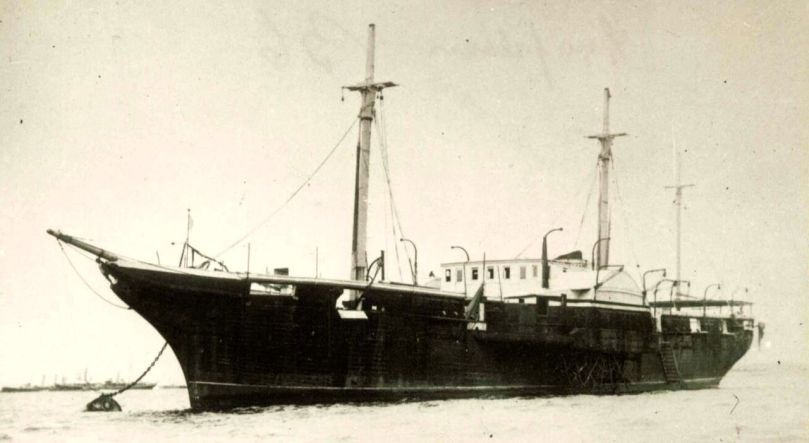
The steamship Amazonas, circa 1880

Read More »

The War of Paraguay: Foreword

twop-c-10This post remains available for posterity’s sake, but a much revised and much expanded version of this translation is available completely for free! The revised version includes translated footnotes, a translated appendix, an expanded introduction, and a map of disputed territory and important locations. You can download a copy in the following formats: DocxEpubMobiPDF. Or, if you want to throw some money my way, you can set your price for it on Smashwords. And it’s in the public domain!

EDIT: A previous version of this post described the Paraguayan War as the deadliest war in Latin American history. That is not the case, as the Mexican revolution almost certainly claimed more lives. The Paraguayan War is, however, the deadliest inter-state war in Latin American history—in the history, in fact, of the entire western hemisphere.

39E.jpg
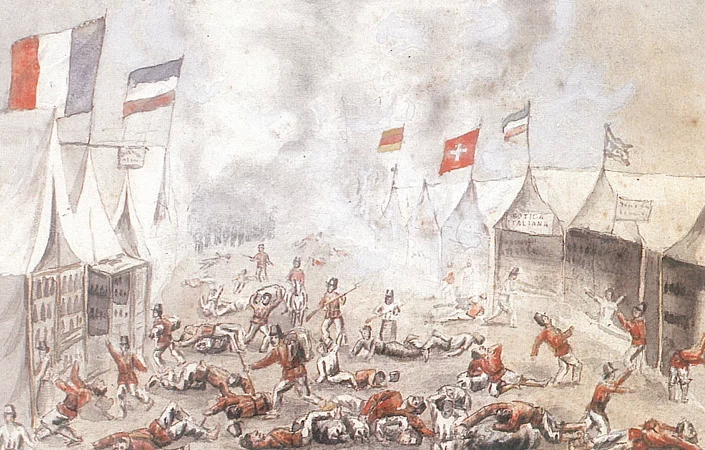
Watercolor by José Ignacio Garmendia, depicting Paraguayan soldiers ambushed while pillaging the allied camp’s commissary in the Second Battle of Tuyutí

I’m very excited to write that tomorrow, I will post the first chapter of The War of Paraguay. Before I do, I want to establish what exactly this thing is, what you should know before reading it, why I think its cool, and what my ultimate plans with it are. But before any of that,

Francis, what’s up with the title?

The title is a near literal translation of the Spanish, La guerra del Paraguay. It should be translated as The Paraguayan War, because that’s the English name for the war—and that’s how I translate it whenever it appears in the text. But for the title, I’m using The War of Paraguay because there is already a book titled The Paraguayan War, and there could well be more books with that title. I don’t think its that important since the title isn’t even the original author’s invention, as I’ll explain right now:

What is this book?

This book is an excerpt from Joaquim Nabuco’s Um estadista do Imperio (A Statesman of the Empire), which is a massive work chronicling the political scene in the Empire of Brazil, from 1813 to 1878 (pretty much the whole life of the Empire), with a special focus on Nabuco’s father, the eponymous estadista, José Nabuco. This excerpt is not a contiguous section of the book—it is pieced together from a few different “books” within Um estadista, which together describe the political, diplomatic, and military events surrounding the Paraguayan War. Each of these books contains multiple chapters, and nothing has been cut from them in the excerpting process, aside from a few footnotes. So each chapter, each book of chapters, is whole, although some of the books have gaps in between them, where Nabuco’s original work had more chapters on matters unrelated to the war.Read More »