Composition with Red, Blue and Yellow by Piet Mondrian, 1930.
Happy Public Domain Day!!! Today, works published in 1930 enter the public domain in the US and many other countries. This year that includes The 42nd Parallel by John Dos Passos (the first book in his U.S.A. trilogy), Olaf Stapledon’s Last and First Men, and the 1930 Watty Piper version of The Little Engine that Could, with illustrations by Lois Lenski. You can read more about what’s entering the public domain over on Duke’s Center for the Study of the Public Domain blog.
As I do every year, I’m celebrating by releasing one of my own works to the public domain. This time it’s a little different—the work I’m ceding to the public domain is a script for an as-yet-unwritten graphic novel, titled BLOOD DINER • FULL SERVICE • BUTCHERED LIVE. It’s set in a future where medical technology allows for the rapid regeneration severed body parts, and the story follows a server on a trial shift at a restaurant which serves human meat.
So you can take this script and read it, print it, adapt it into your own comic, adapt it into a film or a play—whatever you want! I do intend to eventually make it into a graphic novel, and when I do I’ll probably publish that graphic novel as a copyrighted work—but even then, the script will remain in the public domain.
You can download BLOOD DINER as a PDF or Docx. If you end up doing anything with it please let me know! It may be a while before I get around to making my comic.
In further celebration of the public domain, I just reviewed Who Owns this Sentence? A history of copyrights and wrongs by David Bellos and Alexandre Montagu, and you can read that here. And if you want to see previous years’ posts about the public domain, and all the other works I’ve ceded to it, you can find that here.
Mark your calendars, Philadelphians! November 1st, 11am-5pm, in Temple University’s Mitten Hall, I will be tabling at Philly Zine Fest! This will be my first time attending a zine fest as a vendor, and I’m very excited. Some things I’ll be selling:
All my previously published zines, to wit:
“Cartographer”
“Fires Burn Forever in this World”
“Is Magic School Still Worth It?”
“The War on Hormones”
Lonely Friends
A brand new zine about making a map!
Brand new goblin stickers from some of my goblin week drawings!
And a couple free things:
“Masters of the Wine Printers Guild” zine
“Just Dig” 1-sheet
If you are in the Philadelphia area please come by and say hi!
If you’re not able to make it, most of my zines are available on my Etsy, and sometime in November I’ll have the stickers and the new mapmaking zine up there, too.
Some other updates
The main thing I’m working on these days is a comic, One-on-One. I’ve drawn and inked about 20 pages (still need to “color” them in), and I expect the rest of the comic will be another 20 pages. Here’s a fewsneakpeaks. I hope to be finished with it by the end of the year, and have physical and digital editions up for sale.
On the reading front, I’ve finished Battle Hymn of China by Agnes Smedley and can at last move on to the actual sci-fi books on the list, starting with The Dispossessed by Ursula K. Le Guin. I’m over a hundred pages into it now and really enjoying it.
Battle Hymn of China was good, and I’d definitely recommend it to anyone who read and enjoyed Daughter of Earth. It’s not as novelistic as that book, much more episodic. Reading all the chapters together, they don’t combine or build on each other too much, but there are a lot of really fascinating episodes.
That said, I’m going to put my utopia/dystopia reading list on pause in October so that I can engage in my annual tradition of reading horror books for the spooky season. This year I plan to read:
Never Whistle at Night, edited by Shane Hawk and Theodore C. Van Alst Jr.
No Gods, No Monsters by Cadwell Turnbull
A Scout is Brave by Will Ludwigsen
And perhaps, if I have time, Strange Pictures by Uketsu, trans. Jim Rion
Look forward to a post about that 🎃. You can see my previous Spooktober posts here.
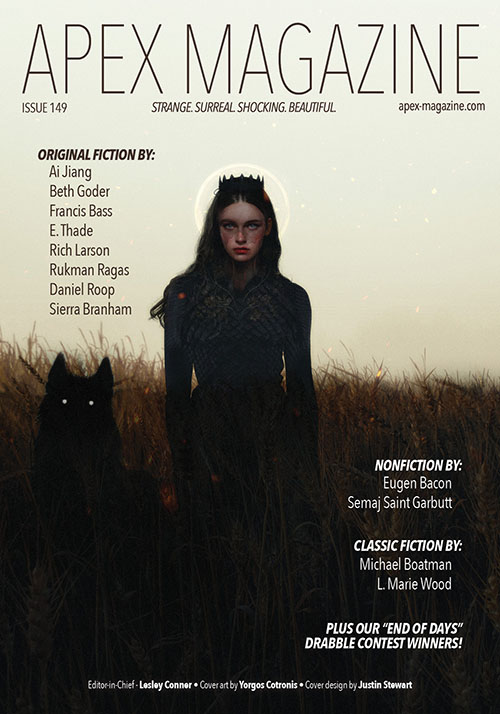
I’m thrilled to announce that I have a short story out in this month’s issue of Apex Magazine! The story, “I Remember a One-Sided Die,” is about an alien species with a strange way of perceiving time and memories, and is narrated by one of those aliens. This is my first story to appear in a magazine in a while, and the longest story I’ve ever had in a magazine, so I’m pretty excited to have it out there! I was also interviewed for this publication by Marissa Van Uden, so after you’ve read the story you can read that interview to see where the idea for this story came from, and how I developed it.
You can read the story and the interview right now if you buy the issue, or you can wait a month and both will be posted on Apex’s website, free to read. I’ll probably share that link in a future blog post as well, when it’s available.
Other news!
I don’t think I’ve actually mentioned it on this blog yet, but back in January I finally finished editing the book I’d been working on for most of the past two years! Currently I’m taking a break from it/waiting to hear back from readers, and later in this year I’ll start querying agents.
I’m also just taking a break from writing in general … although I am editing some short stories I wrote last year … but no new writing! Instead, I’ve been gearing up to making a short comic. I’ve never really intentionally set out to make a comic before, other than LYCC—and that was like a diary comic, so it didn’t require any overarching planning or character development. So this will be a bit of an adventure for me. Right now I’m mostly warming up to drawing again, trying to make it a habit, and I’ve been trying to draw a little 4-panel comic every day. I may clean some of those up and post them here at some point.
That’s the main news from me. Here’s a video of me biking up the SRT to Norristown yesterday.
Wow, it has been a while! Much has happened, but nothing worth posting about by itself, until now: I have an Etsy store! Going forward, this is where I will be selling zines digitally. Up on the store now are copies of “Fires Burn Forever in this World” ($8.50), “The War on Hormones” ($6), and a second printing of “Is Magic School Still Worth It” ($6). I’d like to put out a second printing of “Cartographer” for sale there too, at some point.
If you live in Philly and want to buy something I have listed, I can give it to you in person for $1 cheaper! I’m also going to try to put more zines in shops around Philly, and table at some zinefests—more info on that TK. Right now there may or may not be some copies of “Magic School” at Iffy Books that you can pick up for free :).
That’s the big announcement, now for some other bits and bobs:
I have finished the novel I’ve been writing for the past year! I still need to edit it, but for the moment I’m taking a break from it and working on comics and short stories. Here’s a lil drawing I made a while ago, of one of the characters from the book. 🙂
And yes you read that right, comics! I’ve decided it’s something I want to take a little more seriously, something I want to do more consistently. To that end, I’m working on filling out a collection of comics that I’ll release as a zine later this year, titled Lonely Friends. I’ve posted some of these comics on the website before, and there’s some I’ve never shared at all.
So look forward to me putting out that zine, posting a few more of the comics in it, and putting together a webpage that makes it easy to find all the comics I’ve posted so far. For now, here is a weird one I made during Comix Club at the Free Library of Philadelphia. I left the speech bubbles blank cause I didn’t really know what the characters were saying, I just wanted to put them in these poses. Maybe I’ll leave it like this for the zine, so people can fill it in themselves. What do you think they’re saying?
And finally, here’s a video of me biking along the Schuylkill River Trail on a foggy night in January.
Happy Public Domain Day! Today, works from 1928 enter the public domain in the US and many other countries! Most infamously, this is the year that Steamboat Willie, the ur-Mickey Mouse, enters the public domain. The Duke Center for the Study of the Public Domain has a great write-up on what’s entering PD this year, as well as a detailed post about the Mickey Mouse situation.
As I do every year, I’m celebrating by ceding one of my own works to the public domain: “Just Dig”! This is one of the first stories I self-published, back in 2017. It’s a very short story about asteroid prospectors and luck. Has kind of a western vibe to it. It’s good! I’ll eventually upload it in more formats and update the ebook version on Smashwords, but for now you can read it in this single-sheet, printable version. (UPDATE: I have finally uploaded it in more formats, if anyone cares! PDF — Docx — Epub — Mobi) To read my other posts about the Public Domain, or my other works in the public domain, go here.
I’d also like to take this opportunity to highlight a piece of writing which has been in the public domain for over a century, and which I love—”Life in the Iron Mills” by Rebecca Harding Davis.
“Belmont Iron Works Advertisement,” from “Directory of the City of Wheeling & Ohio County,” 1851. Digitized by the Ohio County Public Library.
This is a short story first published in The Atlantic in 1861, describing a few fateful nights in the life of Hugh Wolfe, a worker in an iron mill. The story was sensational and much acclaimed when it was published, and ahead of its time as far as exposés of the American underclass—this was decades before Jacob Riis and Upton Sinclair. However, the story and Harding Davis fell into obscurity for a while, before being re-introduced to the world in 1972 by writer and literary scholar Tillie Olsen. Olsen, an editor at Feminist Press at the time, published a new edition of the story, along with a lengthy biographical essay about Rebecca Harding Davis, drawing parallels between the thwarted creative efforts of the character Hugh and those of the writer. Olsen then expanded on this idea in Silences, a book about authors whose output was stifled or cut short by their socioeconomic circumstances (e.g. being a woman, being poor.)
I mention all this because 1. reading Silences is how I discovered “Life in the Iron Mills,” 2. I think Silences is required reading for anyone serious about being a writer, and 3. this cultural transmission is a triumph of the public domain. “Life in the Iron Mills” probably entered public domain in 1917, if not earlier. If it had been subject to our current laws, it wouldn’t have entered public domain until 1980, 70 years after Harding Davis’s death. Tillie Olsen would have had to track down the author’s estate and pay for the copyright. If she couldn’t find the estate, or couldn’t reach an agreement with it, she would’ve had to wait eight years for it to enter public domain. Basically my point is that our fucked copyright law is another form of silencing.
If you want to read “Life in the Iron Mills” now you can read it on Project Gutenberg, or you can get the 2020 edition of it from Feminist Press, which includes Olsen’s biographical essay, a few other short stories by Davis, and a new foreword by Kim Kelly. I would not recommend the 2020 edition though. Kelly’s foreword adds nothing, and the story itself contains several typos—right away there’s a typo in the epigraph, and later on an entire paragraph is missing! I would recommend just reading the story, then reading Silences, which does include a version of Olsen’s biographical essay on Harding Davis.
I put this zine together over a year ago, just as a proof of concept for making little booklets like this, and I think I did a pretty good job. Nota bene: I included Olsen’s introductory note, so this zine is not public domain! This zine is illegal! But I think Olsen’s note is so good, one of the best introductions to a literary work I’ve ever read—probably because it’s so brief. So I will take her lead and not waste any more of your time.
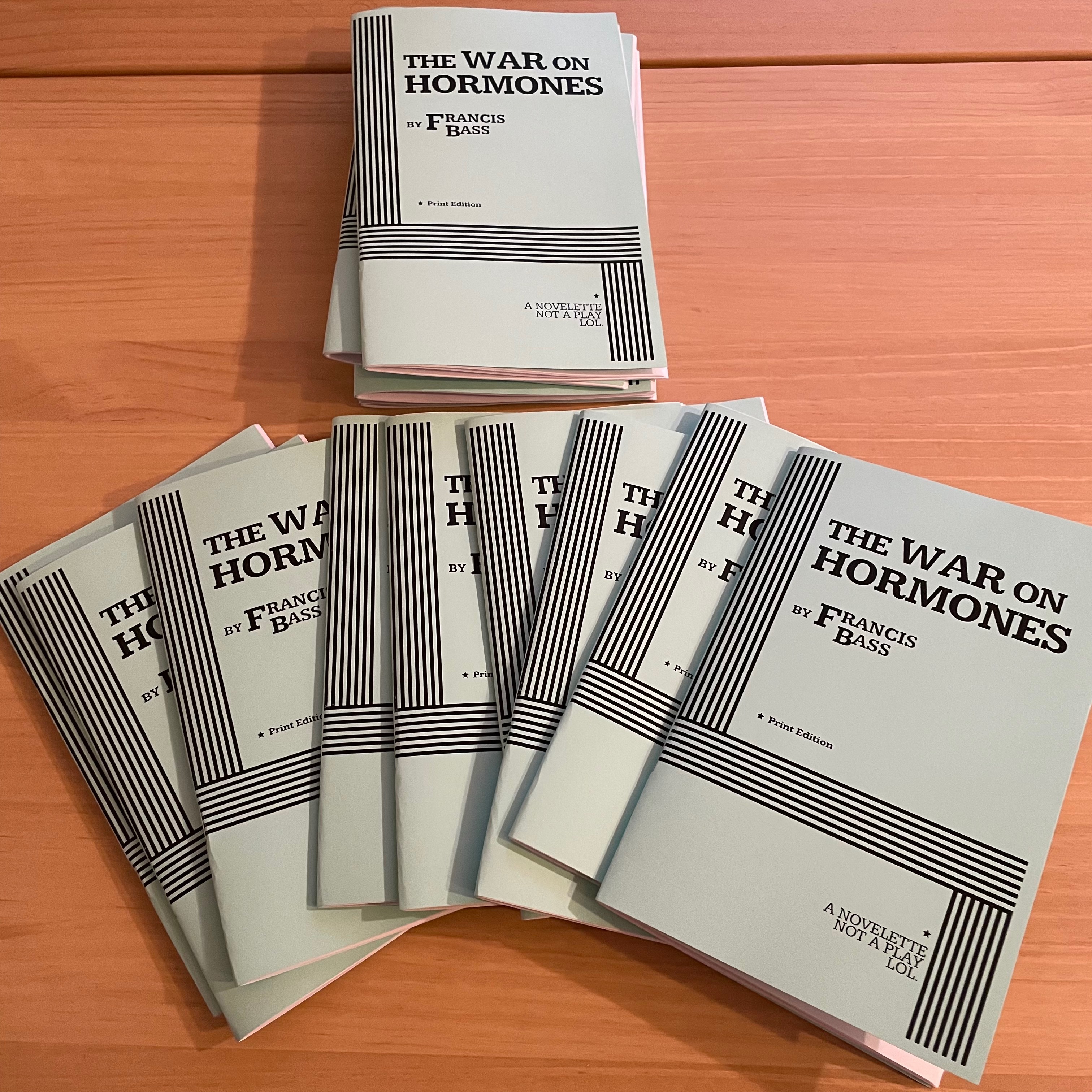
As promised, here is the 4th and final zine of 2023! This one is a re-issue of a novelette I previously published as an ebook, “The War on Hormones.” It’s about pharmaceutically asexual teenagers at a performing arts high school, and I wrote it when I myself was in 12th grade. Despite or because of this, I think it holds up! I had fun rereading it, anyway, and only made a few minor edits for clarity. I also cut the afterword to keep it a more conveniently printable length.
This new zine edition is free! Just email me at Francis.R.Bass [at] gmail [dot] com and I’ll send you a copy. You can also still buy the old ebook version on Smashwords if you want to throw me some money.
Also, if you would like any of the zines I’ve previously released, now is your last chance to get them for free, with free shipping!
To wit, that is:
“Cartographer,” a grotesque fantasy about a person lost in the colossal corpse of their god, and the mapmaker they always end up returning to. (LOW STOCK)
“Masters of the Wine Printers Guild,” an economic fantasy about a conspiracy of apprentices who decide to defy the masters and print their own wine;
“Is Magic School Still Worth It?”, a fantasy short story about trying to put a price tag on our nobler aspirations (i.e., magic.);
And “Fires Burn Forever in This World,” a short story about a city where the antiquated practice of leaving firefighting to private insurance companies has persisted right up to the modern era..
If you missed out on one of these before, or if you really liked one and want another copy to share with a friend, let me know! Going forward I will be charging for my zines like the mercenary wretch I am. So get them while you can, orders close Jan 1st.
Year in Review
It’s been a pretty quiet year on the magazine front, but a big year for self-publishing stuff. There are all those zines of course, and also a new collection of short stories which I released as an ebook, Stories About Kids Stealing Things. The book collects seven stories about people with very little ability to control their own lives, and no ability to control the world at large. They are going to try anyway.
It’s also probably the coolest cover I’ve ever made.
I wrote a very long and very negative review of The Parable of the Sower. I mean, I wrote plenty of other reviews this year, but I think this one came out really well, and even if you don’t care about the book, the review gets at some of the things I find lacking in dystopian fiction. If you only read one of my posts from this year, read that one.
No new publications in magazines this year, but I did have one reprint—my story “The Mechanical Turk Has a Panic Attack” appeared on Escape Pod! This is a story I really love, and it was great to have my work appear in such a prominent institution of contemporary short sci-fi.
Not much other than that! I am still writing this fucking novel, the one I mentioned I’d started back in April. It is about 2x the length I expected it to be. I will hopefully have the first draft finished in January, and then can spend the next year writing short stories. I like writing novels, and I honestly think this one is going to come out amazing, but I think I am just too artistically promiscuous to write long projects like this one all the time. Like I cannot imagine committing myself to another novel right after I finish this one. So I’m looking forward to being a narrative slut next year.
Public Domain Day
Public Domain Day approaches! Each year on January 1st, Public Domain Day, I celebrate by releasing one of my works to the public domain. Last year, some friends and fellow artists joined me in this, ceding some of their works as well. If you would like to do the same this year, let me know so I can link to the work you’re ceding in my post! The work can be a song, a photo, a short story—anything you’ve made and would like to release forever to the commons.
For more info on Public Domain Day, you can check out my page on it, or the post from last year.
And a new zine publication! It’s a two for one today!
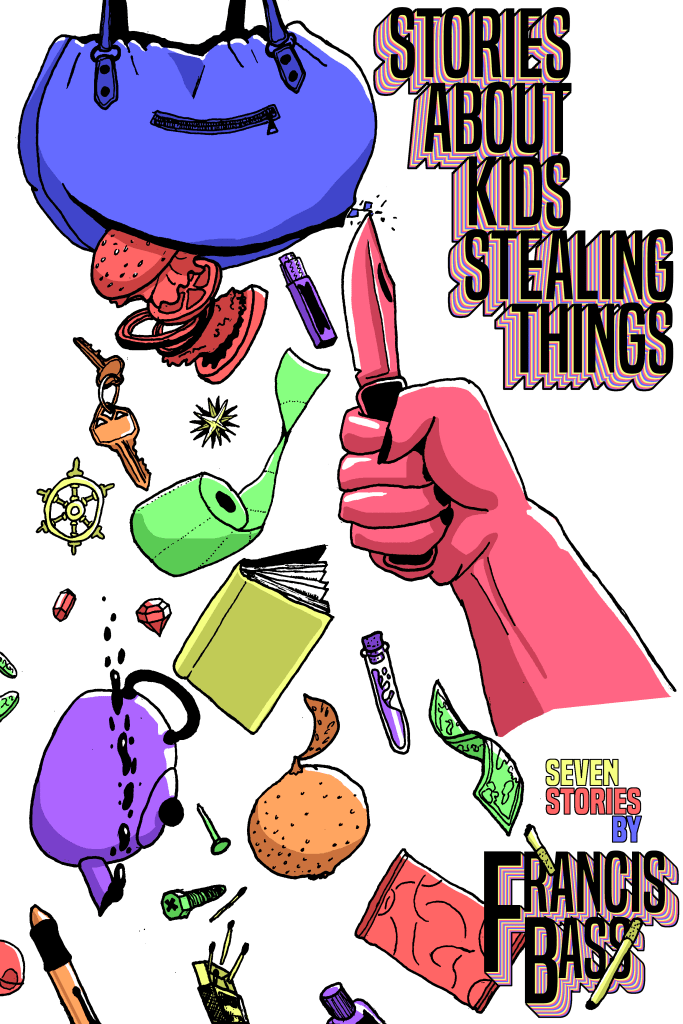
First, Stories About Kids Stealing Things is now out on Smashwords! Wow, cool cover!
Collected in this book are seven short stories, mostly written between 2018-2019. They’re not all about kids stealing things, but most of them are.
Two teens take climate justice into their own hands by stealing from the rich and giving to themselves; AI can’t drive for shit; bearing someone else’s nostalgia for a world long dead; don’t let someone slip a love potion in your cup; your awful ex-boss is running for governor of your failing state, better stop him; privatized firefighting and year-long fires; don’t predict the future, predict the prophecy.
These are stories about people with very little ability to control their own lives, and no ability to control the world at large. They are going to try anyway.
Here’s a full list of the stories collected here, you may see some you’ve read already:
“Fuck You Pay Me,” “Ride of the Blind Sighthound,” “The Hilarious Inside Joke of Our Overwhelming Melancholic Nostalgia,” “Love Poison,” “The Harrowing of Castle Maddox,” “Fires Burn Forever in this World,” and “Red, Her Hand.”
That second to last one, “Fires Burn Forever in this World,” is also now available as a print zine! For free! It’s a short story about a city where the antiquated practice of leaving firefighting to private insurance companies, and letting uninsured buildings burn, has persisted right up to the modern era. And also fires burn for a very, very long time. If you would like a copy, email me at FrancisRBass [at] gmail [dot] com. Check out some interior artwork for it at left!
What’s Next
I am going to make one more short story zine this year. It will be a re-issue of a novelette previously published as an ebook, “The War on Hormones”. A story about pharmaceutically asexual high schoolers, which I wrote while in high school myself. Pretty fun! Expect it in November or December.
And that will conclude this pilot program of zine making! I started making zines last September with “Cartographer.” Since then I’ve made three other zines, and “The War on Hormones” will make five total. I’ve been giving them away for free because I was still figuring things out, experimenting, and I really just wanted to get the things in people’s hands.
So starting next year, they will (mostly) no longer be free. I am also probably not going to release as many new zines next year, maybe just one or two.
Read: I have really enjoyed making these and giving them to y’all, and would like to make this one of the pillars of my career, such as it is. So I am going to spend next year figuring out how to do this sustainably. More thoughts on this probably when I release the next zine.
Also, non sequitur, Spooktober is upon us, this year I am reading Boy’s Life by Robert McCammon, Night Bitch by Rachel Yoder, and Dark Harvest by Norman Partridge.
Okay that’s all I’ve got for you now! Is that enough???
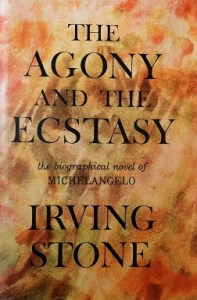
Got a bit of a grab bag this time around. One long review of The Agony and the Ecstasy, a shorter review of A Fine Balance, and a shortest review of The Hard Tomorrow. Also, after all that, some news about two writing projects I’m putting out this month, and an opportunity to place an ad in my zine! Pick your poison.
The Agony and the Ecstasy by Irving Stone is a biographical novel about Michelangelo. It starts when he is 13, about to be apprenticed to Domenico Ghirlandaio, and continues throughout his entire life, right up to his death at age 88. The plot is pretty much exhaustive—no part of Michelangelo’s life is omitted, though some is summarized, especially towards the end.
Initially, I concluded that “The Agony and the Ecstasy is a hack job, and it is glorious.” By “hack job” I meant that there’s really no artistry to it. Irving Stone is not making artistic decisions about how to represent things, he is not emphasizing certain moments over others. Every bit of information, every major event, is dutifully transposed into a kind of dramatized biography. This changes slightly towards the end, which I’ll explain more below, but I think my initial impression still applies to 90% of the book. No one should read this who does not want to read a 600-page biography of Michelangelo.
That’s not to say Stone is unskilled, not at all. The drama is compelling, the dialogue and narration are effective. He is rendering well, but he is only rendering. There’s no attitude, no flair, no vision. He is like David, an artist in the studio of Ghirlandaio who Stone describes thus: “David had been well trained in enlarging to scale the individual sections and transferring them to the cartoon itself, which was the dimension of the church panel. This was not creative work, but it took skill.”
The single biggest artistic choice Stone made, and it is a bold one, is writing this book at all. Michelangelo lived a long life, so treating his life with the intense level of researched detail that Stone employs does require commitment, belief, a supreme confidence in the worthiness of the material. This is a hack job in that it lacks any creativity, but it is an uncommon hack job, one which took a tremendous amount of care and effort to complete.
My story “The Mechanical Turk Has a Panic Attack” is newly available in audio form, at Escape Pod! Wow!! The story was first published a year ago at Uncharted Magazine, and now you can listen to it, narrated by Valerie Valdes, produced by Summer Brooks, and with some host commentary from Tina Connolly. It’s a story about a server in a high-end but not quite high-end-enough restaurant pretending to be an android. The title is the plot, essentially.
I’ve said it many times before, this is one of my favorite pieces from the past few years, and it does a lot of the stuff I really want to do with SFF writing. Check it out! And if you’ve read it already, it’s definitely worth a listen, as Valdes does a wonderful job on the narration.
Some other stuff
I still have copies of “Is Magic School Still Worth It?” available! They are still free! Go here to read more about that.
I recently read “Questioning the Bipedal Default” by friend and fellow SFF person M.E. White, published in the October 2018 issue of Worldbuilding Magazine. It’s an in-depth look at the evolution of bipedalism in humans, with speculations on whether or not it’s a prerequisite to intelligent alien life. Very worthwhile read for SFF writers, or anyone into evolutionary bio!
And to close things out, here’s some videos I took while biking around the Navy Yard, an old semi-disused industrial park at the far south end of Philadelphia. (Although the first clip is from another day, earlier this year, crossing Grays Ferry Bridge.) 🚴♂️🚴♂️🚴♂️
“Is Magic School Still Worth It?” is out now! It is available exclusively in print! It is for FREE! Here’s the synopsis:
Ezze recently graduated from magic school, but she hasn’t practiced magic at all since then. She volunteers at a magazine, works at a hotel, and had to sell her silkbud glove to get by. When the magazine assigns her to write an article about whether or not magic school is still worth it, she struggles to find an answer.
The zine itself is staple-bound, with a hand-lettered cover. If you’re curious how I made it, this post about an earlier short story goes into some more detail on the process.
Email me at FrancisRBass (at) gmail (dot) com if you would like a copy! If you live in Philly I can hand-deliver it to you, if you live elsewhere in the US I’ll mail you one. If you live elsewhere outside the US, I may ask you to cover postage, but should still be able to get you a copy.
Upcoming Publications
There will be two more free zines this year. They will be “Fires Burn Forever in This World” (new!) and a re-issue of “The War on Hormones” (old, but newly in print!) I will also release, in ebook form, a collection of short stories from the past few years, which will be titled Stories About Kids Stealing Things. That one will not be free.
Also very soon (maybe later this month?), my story “The Mechanical Turk Has a Panic Attack” will gain a second life at Escape Pod! It was previously published in Uncharted Magazine in 2022, and now it will be published in audio form as well. I’m very excited for that, I hope you are too.
Happy Public Domain Day! This is my sixth year of celebrating Public Domain Day by releasing one of my works to the public domain, and this year I’ve reached out to get some other people involved. So not only are works from 1927 entering the public domain (you can read more about that here), and not only is something by me entering public domain, but also works from Trevor Neil White and I. Riva are now free for anyone to read, share, copy, and modify!
The short story “Feeding Day” by Trevor Neil White is a series of intersecting vignettes set in a world where the two-party system also happens to have a digestive system.
“Barrow Sentinel” by I. Riva is a short story in the style of an oral folk tale—a warning to would-be adventurers and “heroes.”
EDIT: Two more artists have joined in! “Way Down in the Country Mud” by Rybin is a short science fantasy story about a young man trying to survive and find some meaning in a rapidly collapsing society.
And Miranda White is ceding “The Weeping Statue”, a short, weird Game Boy fable about identity, friendship, and birbs. Playable in browser, Game Boy emulator, or on a Game Boy flash cartridge. Also in the public domain, available as a separate download: original .mod chiptunes, sprite sheets, and pixel art backgrounds from the game, plus a few bonus pieces that didn’t make it in.
Lastly, my novelette “Masters of the Wine Printers Guild” is an economic fantasy about a conspiracy of apprentices who decide to defy the masters and print their own wine. To simplify things, I made a specific page for it which has downloads in a bunch of file formats, including a pre-formatted, easily printable zine! I have jokingly described this as a story about printing a zine with a bunch of your friends (except the zine is magic wine), so it only seemed fitting. You can check it all out here.
Going forward, I would love to keep having other artists join me in celebrating Public Domain Day in this way. It is abundantly clear that lawmakers are not going to make the radical changes to copyright law that we need, so I believe it falls to creators to give back to the commons proactively. Shout out to everyone who joined me this year, and if anyone would like to join me next year, or is doing something similar, please let me know! You can also find my previous posts about the public domain, and my works therein, here.
Hey, it’s a new novelette! It’s actually pretty old, but I’m finally getting around to publishing it, and you can get it now on Smashwords!
Also, if you would like a physical copy of this thing *for free,* I will be posting some details about that on Twitter shortly (edit: Here.) Or you can email me and I’ll let you know about it when I’ve got the details figured out. Essentially: I have been very intrigued by zines and cheap printing lately, and I think sometime in the future I would like to incorporate that into how I sell my stories. Having a little booklet is, I think, so much nicer than staring at a screen. Turning a page rules, and scrolling ceaselessly does not (unless you are using a physical scroll maybe.) For now, I just want to do this as a proof of concept, so I will be charging the low price of *nothing* for a physical copy of this novelette. Though if you want to show your support by also buying a digital copy, I will certainly not stop you.
Here’s the synopsis: Si Muue is lost in the colossal subterranean corpse of their god. Separated from their family, their memory deteriorating, they arrive at the home of a cartographer just in time. The cartographer, Lio P, draws them a map in exchange for a detailed account of their travels through rotting innards and cavernous bones. However, the two disagree on the shape of God: Lio P believes God resembled a godson, like him, while Si Muue believes God was not like any mortal race, but was a mixture of all of them.
And when Si Muue ventures forth, they soon become just as lost as before, and return to the cartographer. Again they receive a new map, and again they are lost, over and again, until their memories are all a confused mix, and they can’t tell dream from reality, and it seems they will never escape this decaying underworld.
“Cartographer” is a grotesque fantasy, a story of torment, survival, and despair. Lost in bloody darkness, the only way is forward.
Plates from Ernest Wittenberg’s 1960 article “Échec!”, about the actual mechanical turk
A bit delayed in announcing this, but I’ve got a new story up on Uncharted Magazine! It’s about a server in a high-end but not quite high-end-enough restaurant pretending to be an android. I mean, the title is the plot, essentially. It’s really good! Seriously, this is probably my favorite thing I’ve written in the past couple years, and I’m so pleased to have it published. You can read it over on Uncharted Magazine.
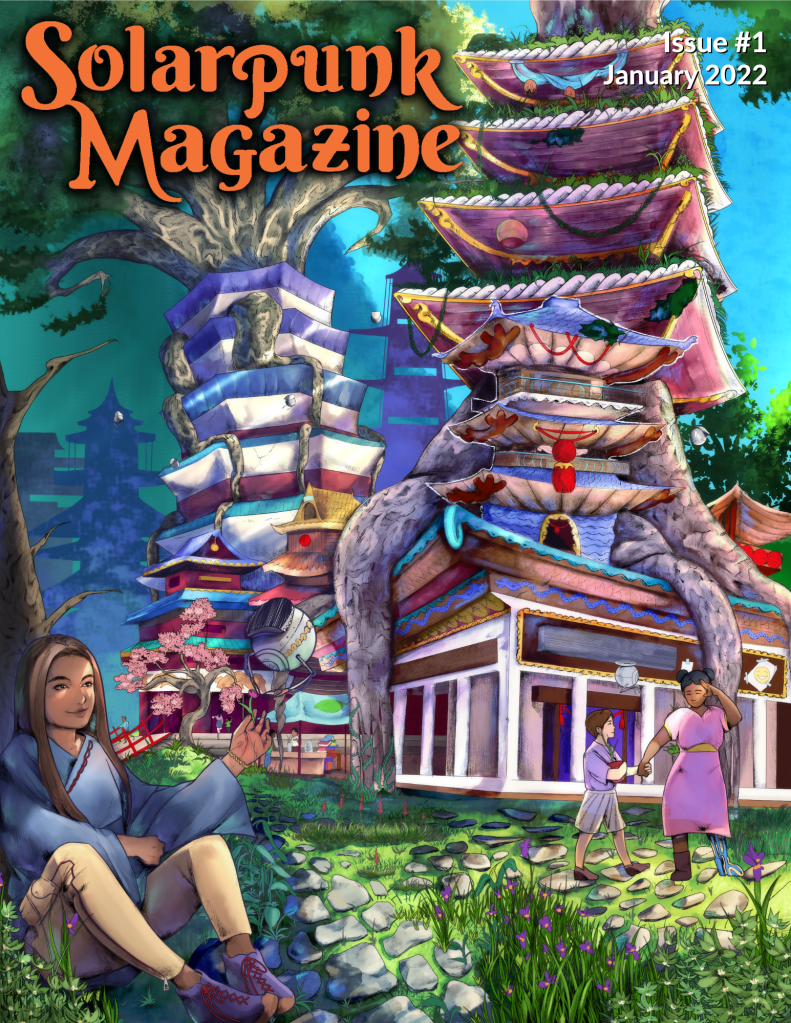
My story “The Hilarious Inside Joke of Our Overwhelming Melancholic Nostalgia” is in the inaugural issue of Solarpunk Magazine, just published today! Solarpunk Magazine is a new magazine publishing writing and artwork that grapples with climate change and “demand[s] utopia.” The first issue is extra-large, with 6 short stories, 3 poems, and 4 nonfiction articles. It even includes an interview with Kim Stanley Robinson! You can purchase it here. EDIT: You can also read or listen to my story online here!
My story is set in a future Florida radically changed by climate change, where “Crimes Against the Future” are punished by implanting memories of the world before, the world lost to rising sea levels and changing ecologies. Kyra, whose older brother has been punished in this way so many times that the implanted memories have become permanent, wants to commit a crime so she can know what the old world was like herself.
In honor of Public Domain Day, I’m ceding my play Classic Cage to the public domain! Classic Cage was produced by Theatre Cedar Rapids as part of the 2019 Underground New Play Festival, and later published in issue 3 of some scripts. And now it’s free for all to read, modify, and perform! Nota bene, this play could very easily, minimally, be adapted to be performed over zoom, since it already takes place entirely through video calls—that’s right, I wrote a zoom play before it was cool!
Here’s the synopsis:
Tara Cage is struggling to sell her next book. Publishers on Mars want another of her cheerful, optimistic Earth travelogues, the ones that made her so popular, but things have been getting bad on Earth. Climate change and economic upheaval have made Tara a lot more cynical, and sick of selling Mars a whitewashed version of her home planet. Her sister and literary agent, Michaela Cage, tries to grease the wheels with a potential publisher by getting a realtime FTL video connection between them on Mars and Tara on Earth. Unfortunately Tara’s internet connection has been screwy, making the video chat’s predictive AI patch over moments of lag with an AI version of Tara, compiled from calls made by Tara the last time she used it—which was twenty years ago. Between the upbeat, cheerful robo-Tara, and the true, jaded, bitter Tara, the publisher is getting mixed messages—though the AI seems to be making a better impression than Tara herself.
Classic Cage is a play about public personas, optimism and pessimism, and the reconciling of youthful dreams with present realities.
Running time is approximately 40 minutes. The cast is 3F, 2M.
You can download the play in the following formats: PDF — Epub — Mobi — Docx. If you really want to pay me for it, you can set your own price for it on Smashwords.
I’ve also written a post for Public Domain Day, about the Public Domain Review, which you can read here.
Two images from Clavis Artis. As always, I’m interspersing this post with some lovely public domain images. I found these all through the Public Domain Review, which is also where I’ve found a lot of the images in previous years’ posts.
Happy Public Domain Day! As of today, works from 1926 have entered the public domain—among them the first Winnie the Pooh book, the first Hercule Poirot book, and the first novel by Ernest Hemingway! This year’s Public Domain Day is special because for the first time literally ever, sound recordings are entering the public domain. You can read more about that and what else is entering PD over on the Duke CSPD.
This year, in celebration of Public Domain Day, I’m reviewing the Public Domain Review. PDR is an online journal which publishes essays concerning art and artifacts in the public domain. They also curate collections of artwork, photographs, and books, some of which they sell prints of. At the start of 2021 they celebrated their tenth anniversary, so they’ve got an extensive backlog—294 essays and 990 collection posts, by their count. Throughout all of 2021, I read every essay they published and perused every collection they showcased, in order to write this review. So I’m going to talk about why Public Domain Review is great, and then recommend some of my favorite posts from the past year.
Firstly, Public Domain Review is great just for being what it is. The public domain is vast. It expands infinitely pastwards. This is exciting, but where do you start? Say, for example, you’re an ES-EN translator, and you want to cut your teeth on a public domain work that hasn’t been translated before. You know plenty of old Spanish books, but they’re the ones that everyone knows, they’re the ones that have already been translated. And you may be familiar with more recent untranslated works, but these are under copyright. (This is why, vast as the public domain is, it is still not vast enough—the stuff that is most recent, most relevant, most likely to be known, is the stuff that is least accessible.)
Illustration by Renee Leanne, courtesy of Electric Literature.
I have a new piece of flash fiction out from Electric Literature today, “Extrasolar Teas Box”! The headline they put on it is “No One Was Exploited in the Production of this Space Tea” which I think gives you a good idea of what the story is about. The wonderful illustrations accompanying it are by Leanne Renee. Check it out here!
A few other announcements: First, a month or so ago some writer friends put out an anthology of short stories, which I wrote the foreword to. Each story starts with the same line, “It was a dark and stormy night,” but they all diverge from there. You can get it for free on Smashwords!
Speaking of Smashwords, I am once again participating in their end-of-year sale, so all of my writing on Smashwords is 75% off or free from now until the end of the month!
And finally, there will be more new Francis writing very very soon, because I have a story in the inaugural issue of Solarpunk Magazine! So look forward to that next month, and if you want you can preorder the issue or subscribe to the magazine here.
A year ago today I published The Same Story Told, a post-apocalyptic pastoral fantasy novel, retold six times in a row. In celebration of it’s 1-year birthday, you can get it for just $1 from Smashwords this week! You can also read this excerpt I posted to the blog a year ago, if you want a sample of what this book is. Here’s the synopsis:
Whistlers normally draw power for their incantations from the microbial sappers that infect their own bodies, but an incantation to infect others with sappers has been discovered, and the resulting plague has devastated the world. The only immunization against this plague is to be infected by a Whistler with a little more control over the bacterial life they create. Of the survivors gathered at the Academy of Sibilant Arts, Klobs is the youngest Whistler. At 14, she’s been entrusted with infecting just four people—her older brother Binlev, her mentor Daltob, and two friends from another academy, Hakleen and Boos.
These five are sent to reclaim a farming township, but soon a hostile group of Whistlers raids their food stores. Without enough food to make it to the harvest, Klobs uses her sappers to place Daltob and Hakleen in deep sleeps. Working in year-long shifts and year-long sleeps the five can conserve food, but each member of the group experiences a unique fragment of the same struggle, deviating, merging, echoing.
The Same Story Told tells each fragment one after the other, as well as the apocryphal legend that has arisen about the “Lost Expedition,” changing format and style to portray the same post-apocalyptic pastoral fantasy six times in a row.
Something a little different this time: I’ve published a Twine story! Twine is a program that lets you write choose-your-own-adventure-type texts, but using hyperlinks instead of page turns.
“Can I Talk to You?” is a short, interactive story about having a conversation with a friend who really needs someone to talk to right now. Your friend has asked you to come over to her place to “talk,” and you are terrified. You don’t know how to talk about serious topics, you’re just a shut-in who spends all your time writing fantasy novels, what could you possibly offer? Then your friend informs you she found a magic sword.
Includes four possible endings, multiple beverage choices, and lots of dialogue! You can download or play it in-browser on itch.io for free, or you can name your price if you want to kick some money my way.
Happy Public Domain Day! This year, works from 1925 enter the public domain in the US and many other countries. Read more about the public domain and what’s entering it this year on the CSPD.
Writing about this kind of stuff raises my blood pressure, so I’ll be showing off some public domain artwork throughout to break it up. Oil painting illustration from The Living Forest by Arthur Heming.
In the past, I’ve said that I think the burden to protect and expand the public domain falls most on creators. This year I’m going to focus specifically on one group, authors, their failure to live up to this responsibility, and the urgent need that they be more copyright literate and considerate of the public domain. Because this year, one case illustrates this problem perfectly—the Internet Archive.
The Internet Archive is a non-profit organization dedicated to digital archival. Its website hosts archived games, movies, music, books, Flash files, and past versions of other websites. Its mission is to preserve these cultural artifacts and provide easy access to them for researchers and the general public. These are works in the public domain, or works that have been uploaded by users. However, the Internet Archive also hosts many scans of copyrighted books through their Open Library, which are available to users through Controlled Digital Lending.
Controlled Digital Lending is a way for libraries to lend books digitally, while still respecting copyright law (that’s the ‘controlled’ part.) Under Controlled Digital Lending, a library can only lend as many copies digitally as it physically owns. I’ll just quote the CDL website itself, because it explains it nicely: “… if a library owns three copies of a title and digitizes one copy, it may use CDL to circulate one digital copy and two print, or three digital copies, or two digital copies and one print; in all cases, it could only circulate the same number of copies that it owned before digitization.” Many of the scans in the Open Library come from local libraries throughout the world. If the library doesn’t have a book the reader wants, the reader can sponsor it, purchasing a physical copy of the book to be digitized and made available in the Open Library forever. This is nothing too strange—this is how libraries work, mostly1. Buy the book once—or receive it as a donation from someone else who bought it—and circulate it forever. CDL is kinda like an instantaneous interlibrary loan that can be accessed online.
The value of this service should be self-evident. If it isn’t, consider this year. Early on in the pandemic most libraries were closed, with only digital resources available. This is great for newer books and popular old books, but the vast majority of books under copyright don’t have ebook versions available on services like Overdrive or Hoopla—readers couldn’t even request that their libraries obtain those ebook versions, because they simply don’t exist. So in early 2020, the only way to access these works without purchasing them (I’ll get to this exception in a bit) was through Controlled Digital Lending. So many educators, students, and readers of all stripes would have to turn away from their local or institutional libraries and utilize the Internet Archive—more patrons than the Internet Archive’s holdings could possibly support. So they suspended all waitlists on their Open Library. Patrons still didn’t have access to DRM-free files, patrons were still only able to borrow for set periods of time, but the Internet Archive was no longer limiting circulation to one copy, one hold. As many people as wanted to could check out a book simultaneously, without having to wait.
Again, the value, the urgency, of this initiative should be self-evident. Even without the pandemic, access to books often poses problems for students with limited money. For example, with an entire class of students needing a book required by the syllabus, unless the local library has multiple copies, students are forced to buy their own or wait to get it through an Interlibrary Loan. The keyword here is waiting—in an academic setting, waiting is often not an option. Assignments, reading discussions, capstone projects, all have deadlines. If you’re just looking for a fun read, sure, you can wait, or pick out a different book that’s available right away. But if you’re hunting down a chapter cited by a book which covers the exact niche angle on the niche topic of your thesis, you can’t just borrow any old book, and you may not have time to wait for other patrons. Students with enough money could buy their required reading, but not everyone has the funds to purchase multiple texts, sometimes quite expensive, every semester. This is the whole point of libraries, after all—if everyone could afford to buy every book they read, we wouldn’t need libraries in the first place. For specific examples of people who benefited from the NEL, see this post on the Internet Archive blog.
The National Emergency Library was to run from March 24 “through June 30, 2020, or the end of the US national emergency, whichever is later.” Ultimately, it only ran until June 16th.











 Francis Bass