It’s summer now—I just finished my sophomore year of college, and high school students around the country are wrapping up their spring semesters—so here’s a novelette about high school, half of which I wrote during my senior year of high school, and half of which I finished after graduating. You can buy it on Smashwords or Amazon. Here’s the synopsis:
In the near future, bioengineering companies create neutralizers—unicellular organisms that can destroy sex hormones in the brain, hopefully improving the academic dedication of students. Silver Path, a new performing arts school, is a pioneer in requiring that its students be neutralized. This kind of environment is perfect for Edward Warwick, a 12th-grader intensely dedicated to acting, and intensely wary of romantic distractions. But over the course of his senior year at Silver Path, it becomes clear that there are many hormones other than testosterone and estrogen, and making it out of high school without any drama may not be as easy as a monthly neutralizer check-up.
The publication also contains an afterword in which I describe how my own final year of secondary education directly lead to, and provided fodder for, this story.
A Series of Unfortunate Events was one of my favorite series when I was a kid, and I’m rereading through all thirteen books, and today I’m talking about the second-to-last one: The Penultimate Peril. This post will contain spoilers for book 12 and all the books preceding it, so if you do not want plot information given away then, to paraphrase Lemony Snicket, “allow me to recommend that you put this next-to-last [review] down first, and find something else to read next at last.”
Cover courtesy of HarperCollins
The Penultimate Peril is the penultimate book in Unfortunate Events, and it finds the Baudelaires at the Hotel Denouement, a hotel organized by the Dewey decimal system (for example, there are teachers staying in room number 371, the number for schools and school activities in Dewey Decimal Classification.) The Hotel Denouement is the last safe place for VFD, and the secret organization will be meeting there in just two days. The Baudelaires, disguised as concierges, spy on the hotel guests, hoping to discover whether or not the safety of the hotel has been compromised, and whether or not they should give a signal to call off the meeting.
I Won’t Tell You When You’re Older
The Penultimate Peril is full of cameos from characters introduced and exited earlier in the series and one of the characters to return is Sir—known as Sir because his actual name is unpronounceable. Other than his callous attitude toward the workers in his lumber mill, Sir’s defining characteristic is the cloud of cigar smoke that is forever swirling around his head, completely obscuring his face. When I first discussed Sir, I wrote about how he’s a model for what’s to come later in the series—these mysteries that are never solved, secrets that only exist as secrets. Since I’ve finished rereading Unfortunate Events, I’ve been poking around looking at reviews of the series. I’ve seen complaints that not all of the big mysteries were resolved, which makes the last few books kind of disappointing. To those people I would say:
You are less discerning readers than an eight-year-old.
I can’t take away anyone’s reading experience—I don’t think anyone is wrong to say that they were disappointed. I would, however, defend Daniel Handler vigorously from anyone who thinks he dropped the ball. Handler does a lot to signal that these big secrets will never be clarified a hundred percent, and rereading Penultimate Peril, I remember that the sequence with Sir was when I, as an eight-year-old, realized that there were certain things that the thirteenth book still would not divulge. The scene is farcical in the way it conceals Sir’s face. Klaus is spying on Sir and his partner Charles, and he escorts the two to a sauna. Sir orders Klaus to hold his cigar while he goes into the sauna. Francis of 2005 was so excited about this—finally, we get to see Sir’s face! What if he’s actually another character under that smoke? What if he’s a relative of another character? But then, “Sir handed Klaus the cigar and strode into the sauna before the cloud of smoke around his head could clear.” (109) And it was at that moment that I realized that we would never find out what the Sugar Bowl is.Read More »
As a kid, A Series of Unfortunate Events was one of my favorite series, and I’ve been rereading all thirteen books. Today I’m discussing my favorite book of the series, book the eleventh, The Grim Grotto.
Cover courtesy of HarperCollins
In The Grim Grotto, the Baudelaire orphans join the crew of the Queequeg, a VFD submarine run by Captain Widdershins and his stepdaughter Fiona. The Baudelaires join the Queequeg in its mission to find the Sugar Bowl before Count Olaf does, eventually identifying its location as the Gorgonian Grotto, an underwater cave that contains a lethal, parasitic species of fungus.
Having at this point reread the whole series, I can say that this book is my favorite. The mood and atmosphere is deeply unsettling, there’s lots of great character revelations and development, and the plot is as good as they come—with the Baudelaires actually being proactive instead of reactive, for the first time in the whole series. So, in this post I’m just going to explain exactly why I love this book so much.
Staring Blindly
First off, the mood. I won’t reiterate everything I said about mood in my post on The Ersatz Elevator, but I will retread some of that ground, because The Grim Grotto is doing the same sort of thing. The mood in book 11 is similar to that in book 6, and both are achieved through similar means—they inspire dread by keeping the reader in the dark on the dangers surrounding the characters. In Ersatz Elevator there’s the darkness of the empty elevator shaft, and in Grim Grotto there’s the darkness of the ocean, and the narrow passage leading into the Gorgonian Grotto. While The Ersatz Elevator still outdoes this book in the omnipresent atmosphere of dread, Grim Grotto is a near second, with the oppressive feeling of a cold, dark, unknown world surrounding the Queequeg at all times. The most prominent example of this is what is referred to in a later book as “The Great Unknown”—a gargantuan serpentine shape, larger than the Queequeg and even Count Olaf’s own enormous submarine, which shows up on the Queequeg’s sonar as a question mark. Whatever it is, it’s something that terrifies volunteers and villains alike, and the best view the Baudelaires ever get of it is after nightfall, and “They could not even tell, just as I will not tell, if it was some horrifying mechanical device, such as a submarine, or some ghastly creature of the sea.” (311)Read More »
A Series of Unfortunate Eventsis one of my favorite book series from when I was a kid, and I’m rereading through all thirteen books. Today I’m writing about The Slippery Slope, the tenth book in the series, as well as meaninglessness and morality.
Photo courtesy of HarperCollins
The Slippery Slope is set in the Mortmain Mountains, a chilly range of odd, squarish mountains, home to snow gnats, bears, and the VFD headquarters. The Baudelaire orphans are separated, with Sunny being kidnapped by Count Olaf and taken to the summit of Mount Fraught, and Violet and Klaus left for dead along the road up the mountains. Sunny is forced to cook for and clean up after Count Olaf and his troupe, who are planning to destroy the headquarters of VFD. At the same time, Violet and Klaus are searching for the headquarters, and hoping to rescue their baby sister.
The Slippery Slope is the first book where the reader starts to get some broad ideas of what VFD is, and why so many villains and heroes alike seem involved in it. It also has some incredibly clumsy grappling with morality and what separates good people from bad people. But, to paraphrase a Fernald’s remarks in The Grim Grotto (which does a much better job of handling these themes), books aren’t either good or bad, “they’re like chef’s salads, with good things and bad things chopped and mixed together” (223). And Slippery Slope is actually mostly good, so while I will get to the fumbled themes, I’m going to highlight some other parts where it sticks the landing wonderfully. First off:
Xylophone
After being attacked by a swarm of snow gnats, Violet and Klaus take refuge in a cave, and find a group of Snow Scouts camping there. The Snow Scouts quickly welcome Violet and Klaus into their troop, and recite the Snow Scout Alphabet Pledge:
“Snow Scouts … are accommodating, basic, calm, darling, emblematic, frisky, grinning, human, innocent, jumping, kept, limited, meek, nap-loving, official, pretty, quarantined, recent, scheduled, tidy, understandable, victorious, wholesome, xylophone, young, and zippered — every morning, every afternoon, every night, and all day long!” (71)
The pledge recurs throughout the book, sometimes as the Snow Scouts recite it and other times just in reference to its absurdity—however the most pertinent commentary on it comes immediately after the scouts first recite it, when Snicket writes that, “Like many pledges, the Snow Scout Alphabet pledge had not made much sense” (71).Read More »
Well, it’s newish. It’s a collection of all the posts I’ve been making about A Series of Unfortunate Events. If you haven’t been reading them, it’s a series of essays in which I examine each book in A Series of Unfortunate Events upon rereading them a decade after I first fell in love with them as a kid. The essays highlight literary techniques, thematic explorations, and the ideas communicated in these books that have resonated with me from when I first read the series to today.
If you have been reading them, consider purchasing the collection to support posts like these, and the blog in general. The collection holds all the posts that have appeared on this site so far, plus the last four posts that will appear on the site over the course of the next month, polished up and consolidated for the book. It also contains “Chapter Fourteen,” an essay that won’t be published on this blog, discussing my relationship with the series through different parts of my life, and The Appalling Appendix—an index of selected notes, quotes, and observations from the file I kept while rereading the series.
Currently it’s available on Amazon, and UPDATE: it is now available on Smashwords!
I’ve just published “Boom Town,” a short story available on Smashwords and Amazon.
The story takes place in a small town on the living planet of Eltru, when a vast reserve of fuel is discovered beneath the town. Katherine, a young girl whose family lives on a spice farm over the fuel reserve, quietly observes her parents as they struggle over whether or not to sell their land to a mining corporation, and move away from their home. She relies on her close relationship with her brother to help her understand the secret conflicts and tensions between the adults, and ends up keeping some dangerous secrets of Julian’s herself.
The publication includes an afterward where I describe how subscribing to Asimov’s influenced the story, and my writing sensibilities as a whole.
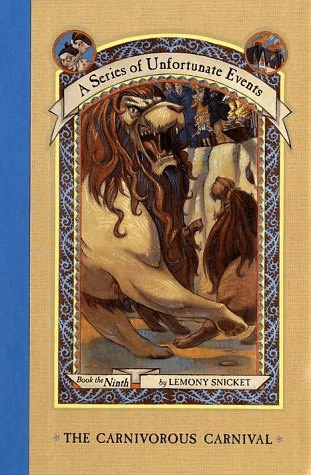
I loved A Series of Unfortunate Events when I read it as a kid, and now I’m rereading and re-loving all thirteen books.Today’s post is about The Carnivorous Carnival, the ninth book of the series. This post will contain spoilers for book 9 and some of the books preceding it, so if you don’t want plot information given away, then in the words of Lemony Snicket, “your time might be better filled with something more palatable, such as eating your vegetables, or feeding them to someone else.”
Cover courtesy of HarperCollins
In The Carnivorous Carnival, the Baudelaires arrive at a rundown carnival in the hinterlands, where Count Olaf is consulting the fortune-teller Madame Lulu to learn the location of the Baudelaires, and whether or not one of their parents survived the fire. Violet, Klaus, and Sunny disguise themselves as carnival freaks, and try to discover how Madame Lulu knows so much about the Baudelaires, and perhaps pre-empt Count Olaf’s next move. Count Olaf also helps Madame Lulu by trying to raise the popularity of the carnival, letting one of his henchmen direct the freak show and make sure the freaks are properly humiliating themselves, and installing a pit of lions.
The book is sparkling with amusing, vibrant characters, from the mysterious Madame Lulu to Kevin, whose big, freakish, shameful quality is that he is ambidextrous (“Is that why you traveled out here to the hinter-lands, so you could stare at somebody who can write his name with either his left hand or his right?”—hilarious. [66]) It’s strikes the perfect tone for a book about a carnival—colorful, eccentric, and with a strong undercurrent of sadness and danger. It also provides a great opportunity for me to talk about:
#FakeNews
In my post about The Vile Village I explained the differences between the books in the first half of the series, and the books in the second. Another difference, which I didn’t mention then, is the nature of the unfortunate events. In the first half, the unfortunate event at the end of every installment is Count Olaf getting away. This is continued into the second half, but also combined with the the Baudelaires repeatedly failing to uncover the mysteries of VFD, and more and more misinformation about them spreading with each book.Read More »
Plays and comics! I’ve been reading a bunch of plays and comics lately. I’m in a playwriting class, and I’m reading a bunch of plays for a project for another class, and the comics I’m reading because they’re light and I really can’t squeeze in too much extra reading given all the Lemony Snicket books I’m reading, not to mention short stories and essays and poems for another class—anyway, here are some of the plays and comics that have really been stand-out terrific, and worth writing about:
The Goat, or Who is Sylvia? by Edward Albee – This is a play about a man who is cheating on his wife with a goat.
Hahaha, lololol, such fun.
Really, the brilliance of this play is that it is both as ridiculous as that description and as real as the chair I’m seated in (I’m seated in a chair of the real variety, by the way.) And the super-brilliance of the play is the fact that it doesn’t just violently switch tracks between isn’t-this-absurd-you’re-in-love-with-a-goat and what-are-the-real-and-tragic-implications-of-doing-such-a-thing, it runs the two modes simultaneously. I was constantly bursting out laughing and constantly taking sharp inhales throughout reading this play. I reacted to it in the same way I react to horribly-absurd/absurdly-horrible real world events. I have to laugh at the absurdity, but I can’t get away from the horrible reality of it because it’s something that actually happened, in the world I live in.
Albee’s great accomplishment here is that he never lets the audience put distance between themselves and the work. The characters continually make choices, adopt lines of conversation, that ring so true that you can’t just think, well it’s just a silly play.
And the play was written by Edward Albee, so it’s crackling with his wit and dynamic character interactions.Read More »
When I was a kid, I adored A Series of Unfortunate Events, and now I’m rereading through all thirteen books.Today I’m discussing book 8, The Hostile Hospital. This post will contain spoilers for book 8 and some of the books preceding it, so if you don’t want plot information given away, in the words of Lemony Snicket, “this [review] is something best left on the ground, where you undoubtedly found it.”
Cover courtesy of HarperCollins
In this eighth installment of Unfortunate Events, the Baudelaire orphans find themselves at Heimlich Hospital, a half-constructed hospital in the middle of nowhere, which inexplicably contains a massive library of records. The Baudelaires manage to get jobs filing paperwork in the library of records, all the while hoping to find some information on the mysterious organization VFD, or the murky circumstances surrounding the destruction of their home and the death of their parents. The treacherous Count Olaf has also arrived at the hospital, though for what purpose the Baudelaires do not know.
Reading to the Rescue!
One of the greatest aspects of Unfortunate Events, which is especially great to find in children’s literature, is the dramatization of reading. Throughout the series, literature and language is used to thwart villains, crack secret codes, and gain an advantage against the Baudelaires’ antagonists. Certainly, plenty of fiction involves characters reading or studying things—Harry Potter and Buffy the Vampire Slayer immediately jump to mind—but in those cases, reading is just a means to deliver knowledge upon which to take some other action (magic, fighting, confronting another character.) In ASOUE, reading is presented in a much more dynamic way, and it often is the action itself. There’s no scene in Harry Potter where the reader feels tension wondering whether or not the characters will fail to read, but there are multiple such scenes in A Series of Unfortunate Events.
The reason I bring this up with this book is that The Hostile Hospital contains more Reading to the Rescue!TM than any other book—it is consistently the way the Baudelaires pursue their goals, and attempt to save themselves from the schemes of others. Not only does the book prominently feature reading and language, it also presents multiple facets of these activities, instead of just the typical studying that every book in the series contains.Read More »
I’ve just published “Grumbles,” a short story available on Smashwords and Amazon.
The story is told by Claudio, who returns to the house of his uncle Terrance, one of his many guardians during his tumultuous childhood, to decide what memorabilia he wants to take with him on his move to the asteroid belt. As he sifts through old scrapbooks and toys, he re-discovers “Grumbles,” a robot companion from his adolescence with an acerbic, sardonic attitude. Space is limited on the shuttle out to the belt, so Claudio and Grumbles argue heatedly about which objects are worth taking, and which items present a distorted recording of the past.
The story was originally published in Kzine, and you can still purchase the issue it appeared in.
So Francis, why should I buy this thing, when I can buy another thing, which has the first thing in it, as well as other things for no additional cost?
Because you love me? Also, because this publication includes an afterword describing the origin of the story, the process of editing it, and some of my own memory-recording habits.
A Series of Unfortunate Events is one of my favorite book series from when I was a kid, and I’m rereading through all thirteen books.Today I’m discussing the seventh book, The Vile Village. This post will contain spoilers for book seven and all the books preceding it, so if you do not want plot information given away then, in the words of Lemony Snicket, “you may prefer to do some other solemn and sacred thing, such as reading another [review] instead.”
Cover courtesy of HarperCollins
The Vile Village is a turning point in A Series of Unfortunate Events. It falls in the exact middle of the thirteen-part series, and narratively speaking, it has one foot in the first half of the series and one foot in the second half. Just like all the previous books, the Baudelaire orphans are sent to live with a new guardian—in this case, an entire village standing in as a guardian, the Village of Fowl Devotees. VFD is governed by the Council of Elders, a group of old townspeople who have generated thousands of rules that must be strictly obeyed. And, the same as the last five books, Count Olaf shows up in disguise to steal the Baudelaires’ inheritance. The book ratchets up the stakes and the tension of all the previous books, in addition to having all the usual dark creativity, verbal gymnastics, and intriguing mysteries.
So, what separates this book from all the books of the first half?
Half and Half
Before I answer that question, I should first explain what I mean by “first half” and “second half.” This is a deeply ingrained framework in my head for understanding A Series of Unfortunate Events. The first half is books 1-6, and kind of book 7. The second half is books 8-13, and kind of book 7. The reason that book 7 doesn’t fall firmly into either category isn’t just because of the imperfect math—it’s because it shares characteristics with both halves. So hopefully I can take this opportunity both to highlight the transitional nature of The Vile Village and delineate the characteristics of the first and second half.Read More »
As of today, it’s Read an Ebook Week, so all my ebooks are on sale for 50% off on Smashwords, and my play We’ll Tell Happy Storiesis available completely free! From March 5-11, you can use coupon code RAE50 to get 50% off any of the ebooks, and coupon code SFree to get 100% off We’ll Tell Happy Stories.
A Series of Unfortunate Events is one of my favorite book series from when I was a kid, and I’m rereading through all thirteen books.In today’s post I review the sixth, The Ersatz Elevator, and talk about mood, darkness, and architecture.
Cover courtesy of HarperCollins
In the sixth installment of Unfortunate Events the Baudelaires return to the city to stay with their new guardians Jerome and Esmé Squalor. The Squalors are obscenely wealthy, and they live in a penthouse on the 66th floor of an apartment building. Esmé is a financial advisor obsessed with fashion, and she constantly discusses which items are “in” and which are “out,” while her husband Jerome is exceedingly kind, but also exceedingly non-confrontational. While the book follows similar plot beats to the previous five, it also alters the formula in a significant way. In this book, not only are the Baudelaires trying to outsmart Count Olaf, who is back to steal their inheritance, they’re also delving into the secret surrounding their parents, the fire that destroyed their home, and Count Olaf himself.
Moody
What this book does better than any other ASOUE book I’ve reread so far (and at this point I’ve reread through book nine) is mood. Of course, all the books have a very distinct style, and Snicket has a distinctly macabre, dry tone—but, at least the way I’m using it here, that’s different than mood. When I say mood, I mean the overall feeling that a book evokes in its reader. Some books evoke wonder, some evoke excitement, and some evoke dread. A Series of Unfortunate Events is the kind of series that has a mood of dread about it, and The Ersatz Elevator has it in spades. In no other book is this feeling that something is terribly wrong so all-encompassing, so pervasive throughout the whole novel. Of course, there are sources of dread in all the books, because the reader knows even before they begin that, whatever the circumstances, this is not going to be the happy home where Violet, Klaus, and Sunny will spend the rest of their childhoods. In The Reptile Room, the narrator mentions early on that Uncle Monty will die later in the book. In The Wide Window, the precarious location of Aunt Josephine’s house on the edge of a cliff instantly inspires anxiety.
The key with dread is to strike a balance between what the reader knows and what they don’t know. If the reader knows too much, then they can anticipate what horrible events are going to happen. If they know too little, then they won’t even realize that there’s any threat of danger. It’s the difference between knowing that your ex is going to come over to get their things at 1:00 pm (some dread), knowing your ex is going to come over some time during the day (maximum dread), and not knowing your ex is going to come over (no dread.) In most of the books, Handler errs on the side of letting the reader know more, displaying the awful machinations which will eventually be set into motion. This has its own benefits (it helps with world-building and character development and is just generally intriguing) but it does cut down on the feeling that something bad could arise from any corner at any time.Read More »
EDIT: As of June 12, 2020, this play has been unpublished. I reread it recently and found it intellectually irresponsible, uncritically insensitive, and just annoying. Not because it’s apologia, but because all the characters are intentionally horrible and the last line is “Who fucking cares.” If I saw this play performed I would think it was wack and be annoyed I’d wasted 15 minutes. Because I’m the author, I can make it so it is never performed or read. So I have.
It has also been removed from the collection 19; a collection of plays.
I’ve just published He Molested Kids, a short play available on Smashwords and Amazon.
In this fifteen-minute play, four college students meet to plan a party, and end up sidetracked by an argument about the savior of the world. Just a few months after he defeated the Himalayan, allegations of sexual abuse have emerged around Dawa the Savior. This issue turns from small talk among a group of friends to an explosive argument with deep implications.
The publication includes an afterword in which I discuss the origins of the idea, and how my intro to political analysis class factored into it’s outlining.
Other announcement: I’m on Twitter now, @FrancisRBass.
It’s been awhile since I did one of these, partly because I’ve been reading more short stories than novels, partly because I’ve been reading A Series of Unfortunate Events. So, other than those books, here’s what I’ve been reading:
The Reeducation of Cherry Truong by Aimee Phan – This novel is a family epic, which surveys the lives of two families of Vietnamese immigrants—the Truongs and the Vos. The families are linked by the marriage of Tuyet Vo and Sanh Truong, but there is plenty of bad blood between them, revealed throughout the book. Cherry Truong is the daughter of Tuyet and Sanh, and the main character of the story—though really, the book is an ensemble work.
Each chapter is told from a different perspective, giving a broad scope of the families, and their lives as immigrants—one family in Paris, the other in Orange County, California. Every character is intriguingly flawed, and watching them interact, and seeing how small conflicts beget bigger conflicts is fascinating. The scope of the book is satisfyingly large, and all the backstories of the characters memorable. The book doesn’t have much of a coherent through-line, and I felt Cherry’s arc was a little rushed, but I still enjoyed it overall.Read More »
A Series of Unfortunate Events is one of my favorite book series from when I was a kid, and I’m rereading through all thirteen books.In today’s post I review the fifth, The Austere Academy.
Cover courtesy of HarperCollins
The Austere Academy is a departure from the first four books. Instead of having a guardian, the Baudelaire orphans are sent to live in Prufrock Preparatory, a boarding school. The closest thing they have to a guardian is Vice Principal Nero, a cruel, pompous man who is a terrible violinist, and who enforces strict rules with harsh punishments in the school. While the book has almost all the trappings of the previous four (Count Olaf in disguise, scheme to steal the Baudelaire fortune, horrible circumstances) it also introduces two new characters that will continue to be important in the following books—Isadora and Duncan Quagmire. Isadora and Duncan are siblings, two of three triplets, whose third sibling and parents have died in a fire. They make a unique addition to the series, first in that they are kids, and second in that they actually befriend and help the Baudelaires.
Soup!
This book gives me a great opportunity to discuss something I’ve been wanting to write about throughout this series—psychological realism. I had trouble posturing what I wanted to say about it, but this book provides a great example of what I mean, and the kind of straightforward simplistic psychology that children’s lit usually engages in. First, what I mean by psychological realism:
Students are forbidden from entering the administrative building, with the punishment being having to eat their next meal without silverware. However, Violet, Klaus, and Sunny Baudelaire have to walk to the administrative building to tell Nero about their suspicions about Count Olaf. On the way there, Klaus starts snickering.
“I just realized something,” Klaus said. “We’re going to the administrative building without an appointment. We’ll have to eat our meals without silverware.”
“There’s nothing funny about that!” Violet said. “What if they serve oatmeal for breakfast? We’ll have to scoop it up with our hands.”
“Oot,” Sunny said, which meant “Trust me, it’s not that difficult,” and at that the Baudelaire sisters joined their brother in laughter. …
“Or fried eggs!” Violet said. “What if they serve runny fried eggs?”
“Or pancakes, covered in syrup!” Klaus said.
“Soup!” Sunny shrieked, and they all broke out in laughter again. (85)
The reason this sequence is great is that, for most of the book, the emotions of the Baudelaires are static. They will react to some change in circumstances or piece of news, positive or negative, and then remain in that emotional track until another such event. So, the most straightforward way to plot this would be as follows: Orphans go to talk to Nero—Orphans are apprehensive—Orphans arrive and begin to talk to Nero—Orphans are determined/frustrated—Orphans are turned away—Orphans are disappointed. There’s nothing wrong with this, and the books move quick so there’s necessarily little time for twists in the tracks. Still, Daniel Handler finds places to put in these little moments where the orphans break from their emotional track, not because of some external development, but because of their own internal psyche. The above sequence gives the reader a window into the minds of Klaus, Violet, and Sunny, to show how they’re coping with these horrible situations by laughing at them.
I’ve watched Netflix’s Lemony Snicket’s A Series of Unfortunate Events in its entirety now, and there’s a lot to talk about. This post will be part review, part analysis, and part comparison between the books and the show. The first third of the post contains no spoilers, but the next two thirds do, for the books and the show, and I’ve put a disclaimer in at that point.
For reference, and so I don’t have to explain it later, this is the basic plot: Three children, Violet, Klaus, and Sunny Baudelaire are orphaned when their parents die in a fire which destroys their home. The parents leave behind an enormous fortune, which cannot be accessed until the eldest Baudelaire comes of age. The children are moved from guardian to guardian, always pursued by the villainous Count Olaf, who schemes to steal their inheritance, and is ruthless in his pursuit of this goal. Violet Klaus and Sunny survive by their inventive thinking, extensive knowledge, and ability bite things (respectively.)
So, here we go:
If You Haven’t Read the Books …
If you’ve never read the books, I highly recommend the show. I don’t know if it’s better or worse to have read the books, but I’m confident that it stands by itself as a terrific work of art. There is nothing like it on TV, and for good reason.
Photo courtesy of Joe Lederer/Netflix
Imagine if a showrunner spent seven years writing hundreds of pages of stories and characters and settings, and wrote all of them in the voice of the show’s narrator. Imagine they worked with a designer who drew hundreds of pieces of concept art detailing the looks of characters, props, and sets. Imagine if the showrunner also composed and performed thirteen songs to go along with different parts of the show (though not to be actually used in the show.) And imagine they had a decade after that time in which they continued thinking about the show, and expanded on the background of the narrator by writing a few hundred more pages about his childhood in this same world.
That, of course, would be absurd, but because of the way this all developed, it’s essentially what happened. And while this could be said of many shows and movies adapted from books, the difference here is that the original creator usually isn’t the one writing the screenplays. Daniel Handler, author of the book series, is also the screenwriter for every episode of the Netflix series (and although he’s not the showrunner, he is an EP.) The result is an uncompromising vision of a world and the characters who inhabit it. The music, set design, and writing are all of a cohesive style—one which is confidently gothic, bizarre, and witty. The show is highly engaging, full of wonderful(ly wry) commentary from the narrator, beautiful(ly ugly) sets, and charming(ly villainous) performances. At times I had doubts about the direction the show was going, the portrayal of a character, or the handling of a particular scene, but never, throughout watching the entire show, did I feel I could look away. I expect that kids will devour it.
If you have read the books, you will also probably love it, unless you love the books for some particular reason which the show has altered. In that case, I’d advise you to pretend that the series has nothing to do with the books, and enjoy it for what it is.Read More »
I’ve just published “Just Dig,” a short story, available on Amazon and Smashwords. Here’s the synopsis:
Two brothers, asteroid prospectors, are awoken when an asteroid lands somewhere along the boundary between their little plot, and the enormous plot owned by their neighbors. They drive out to see on whose plot the rock has fallen, and who can claim it as theirs to sell. As they do, they argue about whether they can depend on luck to end a long dry spell, or if they’ll have to make their own luck to turn a profit.
Also included in the publication is a brief afterword, in which I explain the origins of the story, the edits it went through, and who won the 2014 FSU vs. Notre Dame football game.
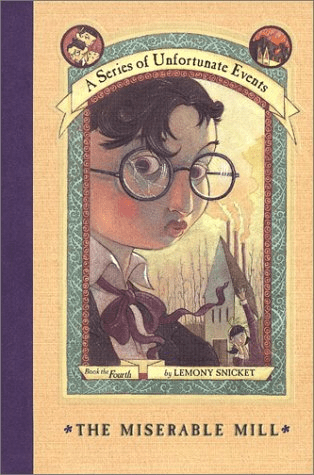
With the TV adaptation released as of this very Friday the thirteenth, I’m rereading one of my favorite book series from when I was a kid—A Series of Unfortunate Events. Today’s post brings us up to fourth book in the series, and the last book adapted in the Netflix show—The Miserable Mill. This post contains spoilers for the first four books of ASOUE, so as Lemony Snicket would say, “if you prefer [reviews] that [don’t give away plot information], please feel free to make another selection.”
Cover courtesy of HarperCollins
The fourth installment of Unfortunate Events tells of the Baudelaire orphans’ stay at the Lucky Smells Lumbermill. Instead of living in a house, the Baudelaires have to live in a bunkhouse for the mill’s employees. Their new guardian offers them a “good deal”—in exchange for his providing them food, housing, and protection from Count Olaf, they will work in his mill. The orphans really have no choice in whether or not to take the deal, and they are forced to work in terrible conditions. While they uphold their end of the deal, their guardian is unable to protect them from Count Olaf, who once again returns in disguise and attempts to steal the Baudelaires’ inheritance.
Some Gripes
The writing of the book is as superbly dark, imaginative, and humorous as the previous three, but there’s less interesting character work, and less intriguing plotting. The new characters introduced in the book are one-note, and the Baudelaires themselves are inactive throughout most of the book. For the majority of the story, things happen to the orphans, rather than them taking initiative and trying to outsmart Olaf, or uncover his plot, the way they usually do. This isn’t actually a problem, as I’ll explain later, but it does make the book a slower read than most of Snicket’s books.Read More »
With the TV adaptation’s release just two days from now, I’m rereading one of my favorite book series from when I was a kid—A Series of Unfortunate Events. Today’s post covers book three, The Wide Window.
Cover courtesy of HarperCollins
“Book the third” of A Series of Unfortunate Events finds the Baudelaire orphans arriving at the house of their new guardian, Aunt Josephine. Aunt Josephine’s house is perched on the edge of a cliff (all but the foyer of the house is held up solely by stilts) above Lake Lachrymose, a lake filled with man-eating leeches. As always, Count Olaf shows up in disguise and concocts a plan to steal the Baudelaires’ inheritance. The book is full of Handler’s dark, gothic creativity, and the plot twists and turns in unpredictable and riveting ways. As I write this, I’ve already reread through book six of Unfortunate Events, and The Wide Window is probably my favorite of the early books.
That Leaves You with a Rattle
In my previous posts I’ve talked about how each of the main characters is somewhat defined by their particular skills—Violet invents, Klaus reads, and Sunny bites—and about how the story can sometimes feel contrived because of the way the orphans end up being presented with situations that require their specific skills. The Wide Window manages to subvert this trend to great effect. When the Baudelaires come to their new home, their Aunt Josephine presents each of them with a present. Violet is given a doll, Klaus a train set, and Sunny a rattle. The fact that the items are so incongruous with the orphans’ skills and interests subverts the reader’s expectations, and this subversion really accentuates the awkwardness of the situation. It’s a smack of reality after the perfect (at least before Count Olaf showed up) life that they had with their previous guardian. But the subversion continues.Read More »

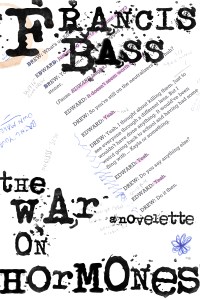 It’s summer now—I just finished my sophomore year of college, and high school students around the country are wrapping up their spring semesters—so here’s a novelette about high school, half of which I wrote during my senior year of high school, and half of which I finished after graduating. You can buy it on Smashwords or Amazon. Here’s the synopsis:






 I’ve just published He Molested Kids, a short play available on



 Francis Bass