Political Analysis: Games

This post we’ll be talking about games—contrary to what people often say in dramas, this is a game.

An extensive-form game is a tree of decisions branching out, with actors forming the nodes in the branches, and the branches representing choices that the actors can make. The assumption is always that each actor is making rational choices, trying to get their best outcome, at every point.

To determine the outcome of an extensive-form game, you work from the ends backward to the beginning, using backwards induction. To demonstrate, here’s this game:

EFG-volunteerRead More »

Political Analysis: Choice

Now we’re talking about choice—why do people choose to do things? Why do they take bribes?

If we suppose an individual faced with a set of actions to choose from, and all of the actions are linked to clear outcomes, there are two principles of rational choice.

Principle One: The individual has a consistent set of preferences for outcomes. There are two types of preference ordering: strict and weak. Strict ordering is like a total dominance hierarchy. No matter what, between two outcomes the individual will always have a preference. Weak ordering is like a partial dominance hierarchy, and an individual can have outcomes that are tied in preference. Unlike a partial dominance hierarchy however, the ordering will never be ambiguous—choices will always be tied or ranked, never unknown (as they were in the black male/white female scenario.)

Principle Two: The individual chooses an action to achieve the most preferred outcomes. Sometimes the choice is easy. Sometimes the link between action and outcome isn’t clear. Sometimes the outcome depends on chance, or someone else’s choice.

Well this seems pretty obvious, so what use is it? It’s useful because by understanding what a person’s preferences are, it’s possible to predict more complex decisions involving the interaction of multiple preferences.Read More »

Political Analysis: Networks

In this continuing series of posts taken from the notes for my Intro to Political Analysis class, we’ll look now at networks and what they tell us about power.

Networks are composed of nodes and ties. Nodes are like points. Each represents an actor. An actor can be any individual, institution, nation-state, or social group with a distinct personality. It can even be a chemical.

Ties are like lines connecting nodes. They can represent any relationship—economic, romantic, religious, chemical. These ties have characteristics, like strength, direction, and elements. Strength can be dichotomous (binary) or cardinal (being represented by a number on a scale.) A tie can be undirected (two-way) or directed (one-way, and assymetric.) The elements of a tie can be univalent (just one relationship), or multivalent (with multiple strands of relationships.)

This is what a total (left) and partial (right) dominance hierarchy look like drawn as networks. The arrows point to the dominators (so A has the most dominance in both networks.)

networks-dominance

Read More »

Political Analysis: Dominance

I just had my midterm for my Intro to Political Analysis class, taught by the eccentric, chalk-wielding, duck-loving Professor Douglas Dion, and in preparation for it I typed up all of my notes. Over the years I’ve found that the best way for me to remember notes, and be able to easily study them afterward, is by writing them down in full sentences and paragraphs. Sometimes they even end up being readable and well organized, and I think this is one of those cases. So, here is the first post in a probably four-part series of my notes on political analysis from the first quarter of the Spring semester, and specifically, power. This post in particular is taken from lectures on dominance theory.

The word “politics” comes from a treatise by Aristotle, deriving from the word “polis.” A practical definition is: the theory or practice of government. It can also mean a person’s ideology (i.e., “what are your politics?”) It could be a term for the acquisition of power or status. From all these definitions, politics might seem a mess, which is why we need analysis—another Greek derivation, from a term that means “to unravel.”

Read More »

Gradecraft

Gradecraft is something I’ve always known about, and done as well, but I didn’t ever have a name for it. And about a week ago, the name popped into my head (maybe inspired by the word statecraft), and I suddenly felt like I could write a post about it.

So what is gradecraft? No, it’s not a Minecraft mod, and while it is “a learning management system dedicated to supporting the gameful classroom,” that’s not what I’m talking about.

When I say gradecraft, I mean the skill or act a student employs in managing or manipulating their grades. I’m guessing it’s increased since schools started posting grades online continuously, rather than only sending them out as report cards a few times a year.

Although cheating would fall under that definition, that’s not really what I’m getting at, and it’s rather a crude form of gradecraft. The form that I’m more interested in, and that I’m really referring to when I say gradecraft (have I said “gradecraft” enough yet?) is the skill a student employs when they consider that they have a 68 in Algebra and a 72 in English, and they can either study for an English test which will count for fifty points of a hundred points (those hundred points weighed at thirty percent of their grade) or finish the algebra homework which will count for sixty points of a thousand (weighed at fifty percent of the grade.) Also taking into consideration the future opportunities to raise grades in each classes, as well as odd quirks of each teacher’s grading system (dropping the lowest scored test, allowing two re-dos per semester, extra credit, whatever.)

This act of gradecraft—deciding when bombing a test or not doing homework is the right choice—has funny results on the other end. Teachers seem to take a student not turning in an assignment as a personal slight, which is a somewhat egocentric view—as if the student does not exist outside that teacher’s own class. The teacher sees it as a lack of caring, whereas  the student sees it as a calculated loss. It’s not personal, it’s economics.

This is clearly not an ideal form of Paideia. Students shouldn’t be worried about grades, they should be worried about mastering a concept, or improving a skill. But grades are the most important factor in education, especially high school. GPA determines the ability to apply for certain scholarships, and to get into certain colleges. And grades are made more relevant because parents are able to see them, and it’s the only glimpse that parents get into how their kid is doing in school. So there’s social pressure to hit these arbitrary marks as well, and less pressure to do things parents can’t see (like participate in class or get tutoring help during lunch.) It’s also a lot easier for a teenager to grasp a specific number on a finite scale than an abstract concept like “fluency” or “mastery.”

The reason this emphasis on grades is bad is because it allows scenarios like the following to happen: A student will place more importance on doing busywork for a subject in which they’re already proficient than on actually learning a subject they know nothing about, if that unknown subject’s teacher is an easy grader.

This is a problem inherent in education. Of course there needs to be some standard that colleges and employers can reference to understand the level of skill of a student, but this places undue importance on grades. Rather than being an indicator of progress toward a goal, grades become the goal itself.

This is why I always got bad grades in English classes (by bad I mean ‘B’s, but that seems bad when you consider that I’m a writer.) I always was comfortable in my mastery of the course, and I didn’t care about pursuing arbitrary grades to prove it. I never engaged in much gradecraft, except in cases where I was pressed for time, and had to choose which assignment would give me the biggest bang for my buck.

I should say, I’ve mostly been talking about high school this whole time, because I find that gradecraft is much less prominent in college. The reason is, you can’t engage in gradecraft if your professor doesn’t put up grades. And, at least at the University of Iowa, professors aren’t required to post grades. Maybe this is completely different at other places, but this is the way it is here. And I think that’s a good thing. Teachers should keep track of grades so they can talk to anyone who’s failing, or so that any student willing to make the effort (not many of them) of visiting a teacher and asking for their grades can see them, but otherwise leave students in the dark. Students can get some idea of how they’re doing based on the assignments that are handed back, and their own intuition. That’s how things are in the real world anyway—no official body is going to tell someone they’re a C- barber, or that they’re an A+ farmer. People just have to figure out their strength and ability on their own, and make decisions from there.

While I have some pride in myself and my cohort for being able to engage in gradecraft, and manipulate a complicated, often broken, sometimes antagonistic system, it’s really a reductive activity. It may be useful for classes that a student has absolutely no interest in ever learning or mastering, but when it’s practiced in every class in a student’s schedule, that’s a problem. Because at that point schools aren’t training students to be scientists, historians, business owners, or doctors, they’re training them to be students—with a masters in gradecraft (and a concentration in test-taking.)

Trump as Described by Dickens

It occurred to me that Donald Trump is such a Dickens character. Incredibly wealthy, incredibly self-centered, incredibly ironic—and, the final flourish, his name. His name is absurd. “Trump,” like a trump card. Also like a blaring trumpet.

So I wrote a little thing.

Donald Trump, as Charles Dickens might describe him

Mr. Trump was a tall man with a tall face and a long mouth, which seemed to have swollen out to accommodate the volume of his voice. Having been successful in the circuits of reality television, Mr. Trump made some small adjustments to his line of work, pinned a flag to his lapel, and transitioned into that other marvelous form of American entertainment, politics.

Just as a trump card, though less qualified in every aspect than a superior card, will beat any ace or king simply because it is a Trump, Mr. Trump battered down his opponents not by his qualification, but by his massive, star-spangled Trumpitude. Though he had no political experience to rival the royalty of the King Bush, or even the Jack Rand, and his business prowess did not match the Queen Carly (Mr. Trump had filed for bankruptcy more often than he’d filed for divorce) he would slap his brand across his opponents as a gambler would slap down a card, and declare, “I’m a winner. I have experience in winning.”

Recommendation Dump, February 2016

Another offloading of recommendations is upon us, or upon the reader, really. A broad selection this time, from articles to TV to a flash game.

Tig Notaro: Live – I found out about this through the Netflix documentary Tig, which I would also recommend. Tig Notaro went through several tragedies at once (multiple illnesses, the death of her mother, and finally a cancer diagnosis) and, being a stand-up comedian, started writing jokes about it all. She did a set at the comedy club Largo, and delivered all that material for the first time, with no idea what to expect from the audience. They loved it. Louie CK, who was backstage during this, convinced her to put the recording of that show out for the world to listen to. You can read his post about it here, it’s pretty interesting.

So six or seven months after I saw the documentary I finally bought the thing. The show is very funny, which is all you can ask for from most comedy. But it’s also terrific to hear someone be so forthright about their experience with death. On another level, it’s fascinating to see both Tig and the audience coping with this tragedy through comedy. And the ending is just perfect. I highly recommend this to anyone who is a human. It’s only five bucks on iTunes, six if you want to get the deluxe edition (comes with a story Tig told at the Moth.)Read More »

Recommendation Dump, December 2015

A much broader range of recommendations this time around, with no recurring theme. That’s why it’s called a dump though, not a cogently curated collection.

The Color Before the Sun Coheed and Cambria is easily my favorite band. They straddle a lot of genres in the rock/punk/metal area, and until this album all of their work has been concept albums, following the story of the lead singer’s comic book series The Amory Wars. The combination of strange song concepts and fantastic music is why I love the band so much. I’ve burned out on a few artists whose music I enjoy, but who keep writing the same songs (conceptually) over and over again. Coheed and Cambria always mixes it up, and in this album they mixed things up by not doing a concept album. At least, the concept isn’t sci-fi, though a lot of the songs focus on the lead singer’s identity crisis. The songs are more rock than metal, with the exception of “The Audience,” but Coheed and Cambria has always danced in and out of genres. Of course, music is incredibly subjective, and this may not be your thing, but for me, this album is my soundtrack right now.

High and Mighty – I started listening to this podcast when it launched along with all the other Headgum podcasts, and it’s slowly become my favorite of the bunch. Each episode, comedian/actor Jon Gabrus has on a guest or two, and they go hard on whatever topic the guest is best suited to. I absolutely love this kind of stuff—not just the basic, wikipedia-level information, but the deep shit. The inside jokes. The behind the behind the scenes. The concepts that don’t come out in theory, but everyone does in practice.

As they discuss in the first episode, Gabrus has his feet in many camps—nerd, meathead, Taco-Bell-fanatic—and these interests all come out in the podcast. That’s another thing I like about it. Neither Gabrus nor the podcast fit into a strict agenda of just geeky or just comedy or just anything, which most podcasts and internet personalities do, and which can be boring (this is part of the reason I do random posts like this and not just writing stuff.)

To get a sense of what I’m talking about, I’d recommend listening to the Long Island episode. It’s the best representation of what I love so much about the podcast.

In the Loop – I first watched this movie when it came out, which was six years ago, when I was twelve or something. Needless to say, I was lukewarm on it then, and chalked my disinterest up to the movie’s parchingly dry Britishness. Six years later, I was actually able to follow the story this time, and understand the distinctions between characters (you know, the basic elements of a movie.) The movie certainly has its dry Britishness, but it has equal parts bombastic Scottishness. The story is a tangling political yarn driven by bureaucrats who are misinformed, incompetent, militaristic, or just constantly dropping F-bombs. It’s an excellent satire, with a great balance of intellect and humor. Fuckity-bye. ‘Nuff said.

Swords and Souls – I normally don’t like Final-Fantasy-style games where you attack by selecting an option. They just feel too grindy, like they’re just about getting stats up and there’s not enough skill or player control involved (Note: I’ve never played Final Fantasy, just some flash games that use that form.) But I loved this game. It was made by SoulGame, who made the Rogue Soul games, and just like those games, it is slick. Instead of being turn-based, attacks are automatic, and special attacks are controlled with hotkeys. The game is constantly moving, and the feeling of control is nice. Each stage is a few enemies and a boss, and after the first time beating a stage there’s a big money and XP reward. And of course, each stage gets a little harder.

This would get boring pretty quickly, but there’s lots of progression milestones to keep reaching for, and to keep the player interested. To level up skills, instead of just grinding through previously beaten stages (although you can also do that), there are mini-games that increase skill in specific traits. They’re mostly based on quick reaction time and precision. Getting good at the mini-games, and being able to fly through them as they speed up (as more apples are flung that must be blocked, or more targets appear that you have to shoot) is really fun. There’s also the little bit of satisfaction from buying new, cool-looking armor, from adding trophies to the museum, or from adding onto your house. The house increases the amount of money you earn, though I didn’t realize this until late on, and had just been buying additions as a show of my awesome status. Swords and Souls is an addictive experience that plays fast, and is incredibly fun.

So, those are four things I really enjoy. Hopefully you do too.

A 30-Hour Bus Ride, Told in 13 Parts

There
My route as generated by Google Maps, with major stops, arrival times, and layovers

I said I’d probably make a post out of it—here it is. My thirty-hour bus ride from Iowa City to Tallahassee. It’s not much of a NaNoWriMo post, really. My goal was to get to twenty thousand words by the time I reached Tallahassee, but my broader objective was to survive—and this post is almost entirely about survival. To find out whether or not I lived, read on.

5:23 pm (Friday)

At the moment, we’re on I-74 heading south through Illinois, next stop I don’t know where. I know my next stop is Indianapolis, but I think there are stops between here and there.

Before I do anything else, I should recount the first part of my journey.

At two ten today I left my dorm and headed out into the thirty-six-degree afternoon. It was cold, windy, and overcast. The sun sets around four forty-five here, so wherever the sun was behind the clouds, it was already low when I made my way to the bus depot, pulling along my suitcase. The station is just beyond the edge of downtown, where all the downtownish brick buildings give way to construction projects and ragged, crumbling parking lots. So walking to the station feels like leaving civilization, and going out into the wilderness.Read More »

The Starbucks Coffee House

In my writing class we had an assignment to write an essay about some place in Iowa City with cultural or historic significance. This is the essay I wrote:

The Starbucks Coffee House

During my first visit to Iowa City, after a day full of walking tours and departmental presentations, my mom and I stumbled across a café at the edge of downtown. At the corner of Clinton and Burlington, where close-knit brick edifices give way to expansive parking lots and construction projects, sat the Starbucks coffee house. Since this is a rather obscure café, I’ll explain that it isn’t owned by a person named Starbuck, but rather the name refers to a character in Moby Dick. We entered the handsome little square building, and were embraced by an aura of inspiration and nurture. Of handcraftedness and innovation. Of intimacy and charm. It was the spirit of the Starbucks coffee house. I ordered a cappuccino and my mom ordered a chai tea latte, and I new I’d found a home away from home.

Half a year later, I return to the café regularly, knowing that there I can find tradition, hospitality, and a good cup of joe. The whole building is permeated with these qualities, from the dark woodgrain countertops (and tabletops and paneling and flooring and bathroom doors), to the news stand with chalked-on prices, to the burlap sacks displaying POP! Gourmet Popcorn—almost as if the Lite Salt popcorn bags had come fresh from the harvest just minutes ago. Sepia-tone photographs on the walls display Iowa’s rich agrarian heritage in various images, such as fields, a man putting wheat into a machine, and other fields.Read More »

Recommendation Dump, October 2015

It happens that I do more than just read, but reading is what I do most, and am best equipped to review. Still, I watch TV and read articles, and feel like sharing such things from time to time. So, here’s a big ol’ offloading of stuff I want to recommend.

Lawrence of Arabia – This was recently added to Netflix, and having nothing better to do one Saturday evening, I watched the whole thing—overture with black screen included. At least, I listened to that part while looking up background on the movie in another tab. From the bit I read, I expected the movie to be more about the things Lawrence did than about the man himself, so when the movie came to an end, I felt a bit lost, wondering, So what? But re-assessing all that had happened, and looking at the movie as a character study, I found it a lot more interesting. The movie raises a lot of questions about fighting wars in foreign lands, and the identity of a nation. Although you could accuse the movie of being Great White Hope of Arabia, that’s one of the issues the movie gets into—can Lawrence really ever be “of Arabia,” no matter how many battles he joins them in or how well he knows the language, so long as he’s a European? Even without all that thinkin’ stuff, the movie is beautiful, and the soundtrack is gorgeous. I’m definitely going to rewatch it at some point with all this in mind … when I get four free hours.

The Outlaw Ocean” by Ian Urbina – A while ago I heard an interview about this topic with the guy who wrote it, and it sounded really interesting. So I bookmarked the article and didn’t get around to reading it for awhile. Now, I’ve finished it. It’s fantastic and fascinating. The series is about the lawlessness of the seas, and blends specific stories with the broader legal and political background that allows such things to happen. The articles go in depth, full of interesting details and great documentation (videos, maps, and photos.)

This Land Is Mine” by Nina Paley – In keeping with the Arabia theme, this is a fantastic animated video set to “The Exodus Song” from the movie Exodus. I actually love the song itself, even though it’s message is dumb. Maybe that’s why I love it, it’s so unapologetically convinced of itself. Like a villain’s song from a musical—just because they’re horrible, the song can still be great. Anyway, the animation is humorous and well-designed, about the various people who have lived and died in the promised land.

Tom Lehrer – After looking at the who’s who from the previous recommendation, in which it mentions Tom Lehrer’s song “Who’s Next?,” I went and watched a bunch of his videos. He’s a musical comedian from the fifties and sixties, who did the song “The Elements.” The music is all pretty simplistic, but the lyrics are hilarious, and interesting in showing the concerns of people in that time. “Who’s Next?” is probably my favorite.

Homestar Runner – If you don’t know who these guys are, well you are in for a treat. If you do, rejoice! They recently put out a new short, “Strong Bad Classics!” I don’t know what to say about it, or about Homestar Runner in general. The joy I get from watching these videos is not something that I want to analyze. It’s just fun.

Frontline: Losing Iraq – This is a PBS documentary about the war in Iraq, from its beginning to it’s finish-ish. I’m not knowledgable enough to be able to call out inaccuracies or lopsided narratives, but it seemed to be unbiased. That is to say, the people they interviewed leveled criticism at almost everybody involved in the thing. It was interesting to see such recent history, history that I’d been alive during (albeit as an ignorant four to fourteen-year-old) documented like the Vietnam War is documented. It brought context to iconic moments I hazily remembered, from the fall of Saddam’s statue to the shoe-throwing incident.

Well, that’s what I’ve been getting into recently. Happy watching/reading/listening!

Chechnya, From Dudayev to Kadyrov

I’ve recently been fiddling with an idea for a short story which would involve a minor war in the future, with ambiguous morality of each side. Separate to that, I attended a presentation by Andrey Sazonov, sponsored by the Iowa City Foreign Relations Council, titled, “Ramzan Kadyrov, Leader of Chechnya: Putin’s Frenemy?” That title interested me, and so did the prospect of free food, but I didn’t even realize how great Chechnya would be for that story I’d been trying to get a grip on. Seeing this seminar (which is available online here), it appeared that Chechnya was perfect. Tiny enough to be ignorable, but  excessively militarized enough to have a robot battalion. At least, to have a robot battalion in the future. So with that lecture as my background, I did some of my own research on Chechnya. Here it is.

Recent History.                                                                                                         

Chechnya was conquered by imperial Russia in the 1800s, though resistance from the conquered peoples continued right up to the declaration of an independent state in 1917, before being taken by the USSR in 1921. Then a bunch of horrible Stalin things and apologetic Kruschev/Gorbachev things happened, and in 1991 Chechen Dzhokar Dudayev lead a nationalist party to overthrow the Chechen-Ingush Autonomous Republic of the Soviet Union. The USSR dissolved in that same year, but Yeltsin wanted to keep all of the Russian Republic—an administrative region of the USSR that is what we now recognize as Russia—together. In 1992 Yeltsin put forth a treaty that granted states of non-Russian ethnic background limited autonomy, which was signed by all but two of the eighty-eight states—Chechnya and Tartarstan. In 1994 Tartarstan signed a treaty to be annexed by Russia, leaving just Chechnya defiant.

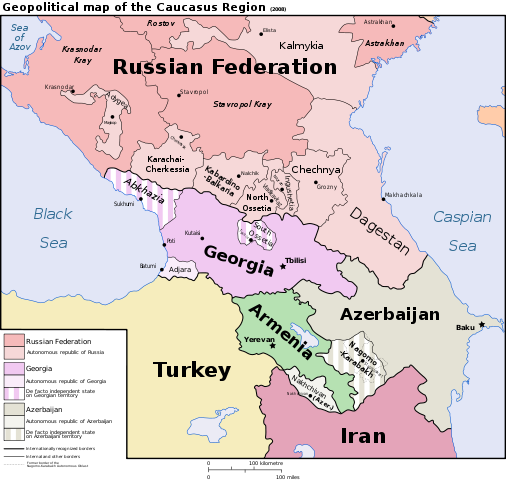
Map courtesy of Jeroenscommons

In 1992 Ingush split from Chechnya and was absorbed into the Russian Republic, and the next year Dudayev declared full independence as the Chechen Republic of Ichkeria. In Dudayev’s Chechnya the minority of ethnic Russians, who had long been the ruling elite, were harshly persecuted. Although most Chechens still wanted independence, not all of them wanted ex-General Dudayev to be in power. Thus, there was some armed resistance to the Republic of Ichkeria, which received support from Russia. In December of 1994, Russia declared a full-on war to retake Chechnya, assuming that a lightning-fast aerial bombardment would bring the republic to it’s knees, and finish the war by that Christmas. But it turns out the fighting wouldn’t end for six more Ramadans.Read More »

1058 Miles from Home; An Epic Journey from Queso

I am roughly a thousand miles from my hometown now, but it doesn’t really feel like that far. I want to figure out why that is—after all, this is an important aspect of books. A large part of what makes an epic “epic” is a large scope. Scope can be rendered in a large cast of characters, or a long stretch of time, or in huge distances, or in all three. But how does an author make two landmarks feel far apart, without just telling the reader that they are?

The answer that jumps out to me is to show the journey. Show the blown out tires and midnight resting stops along the way. The problem is that I had this experience traveling from Tallahassee to Iowa City. My mom and I drove there over the course of two days. We went through the southern end of the Appalachians and a violent thunderstorm at the same time. We stopped in Clarksville Tennessee and spent the night at a hotel there. We carried on through Kentucky into Illinois, and puffy trees disappeared where expansive fields took their place. We passed by the St. Louis arch crossing from Illinois into Missouri, and finally came to our destination in Iowa City, Iowa.

And yet, I can’t conceptualize the distance between Iowa City and Tallahassee the way I can the distance between my house and Moe’s. It’s possible that this is because I’ve walked from my house to Moe’s. Maybe it’s just that I think of cars as slow teleportation—step into a box, wait, step out of the box and you’re where you want to be. Or maybe it has to do with inevitability. The car ride to Iowa City was as much a part of going to college as writing my application had been. The trip was an item in itself, not an expression of distance. When I walked to Moe’s, it wasn’t some inevitable thing.

For a start, I didn’t even have to go there. Not that anyone’s forcing me to go to UI, but it’s something that I’ve been set on for so long, it’s a fact of life. Not so with Moe’s. I made the decision on the bus ride home from school. It was free queso day, and I was going to take advantage of it. I had several moments of doubt when it was not certain that I would go—mainly, when I looked up on google maps the path that I’d have to take. It was long—fifty minutes. And it was hot out. But I went anyway. Every step was intentional. And now I’m beginning to understand what the difference is—the distance became tangible because it was a force that I had to conquer in order to get my free queso. I had to walk down long, unshaded roads with big hills. I had to consult my map when I cut through windy neighborhoods. Worst of all, I had to go through Frenchtown—the “bad” part of town, directly north of the Moe’s—and avoid all of the irrational racist fears that might be inspired there.

So it’s not enough to just show the distance, the distance must be tangible. It must be brought to bear against the adventurer, it must be clear that this distance stands between the quester and the queso. And there was only one moment where I had any struggle on the road, when I was driving through that thunderstorm and could hardly seen ten yards ahead of me. The rest of it was slow teleportation. All I had to do was sit for long enough, and I’d end up in Iowa.

Interesting.

Maybe I should hitchhike home for Thanksgiving, really feel the distance that way.

Or I could save the risk of (insert nightmare hitch-hiking scenario) and just pretend that Iowa City and Tallahassee are linked by a slow teleportation box called the Greyhound.

Beach Nourishment – How

Here’s the second and final installment about beach nourishment, as taken from my research notes for an upcoming story. Last time I talked about what beach nourishment is, and why it is needed. Now I’ll talk about the methods and the costs.

Methods.

So, how to do?

To start with, the sand has to come from somewhere. Although sand can be taken from inland sources, or even from sand trap areas in harbors, it typically comes from offshore deposits. Other sources include inlets, dunes, rivers, and lagoons. The sand grains have to be the same size, or slightly smaller than, the native sand at the beach for the nourishment to be effective. And if taken from an offshore site, it has to be at least two kilometers from the shore. Otherwise the borrow area will just get refilled and cause more erosion.

When sand comes from an inland source, it is brought to the beach via trucks. When it comes from offshore it is brought by pipes. In both cases, as long as the sand is underwater, it is dredged. For offshore dredging there are two methods. Actually there’s a billion, but here are two popular ones—cutter-suction dredging, and trailing-suction hopper dredging.Read More »

Beach Nourishment – What and Why

Well, here’s a post that seems to have nothing to do with anything. Although this is all taken from my research and notes for an upcoming story, it has nothing to do with writing or reading or anything like that. This is just a post about beach nourishment. You’ve been warned.

Introduction.

So, what is beach nourishment?

Photo of a jetty, groin, breakwater, revetment, or something, in the Black Sea, courtesy of PSDS and IO-BAS

No, it is not some form of urban foraging, beach nourishment is the process of replenishing an eroded beach by adding sand. It’s done to protect valuable shoreline property from becoming Venice. Alternatives are building a seawall (very common in Europe) or building a breakwater or groin. I don’t know the difference between those last two, but basically they’re large walls of stone or wood that extend into the ocean and collect sediment on the updrift side, like a dam for sand. They’re kind of problematic though, because if they collect too much sand then downdrift beaches aren’t being replenished as much by the natural current of sand that moves along the coast, and might erode very quickly. Another alternative to beach nourishment is a “managed retreat”—basically giving up to the sea and relocating inland.

There’s another thing which I haven’t seen too much written about, called “living shorelines”—the use of native flora to reduce erosion.

So, why is beach nourishment?

Beach nourishment is nice because it preserves the beach without having to build any structure, or move buildings. Sometimes groins are built in conjunction with it, and can be either a series of tapered groins, or adjustable groins—both for the sake of allowing some sand to pass and continue it’s littoral drift. Beach nourishment isn’t a long-term fix though, because the beach is always eroding.

Before and after photos of beach nourishment in Miami, Florida, courtesy of USGS

Erosion

Erosion can be caused by damn humans damn interfering, but it is also caused by storms. Some beaches can recover from storms if they have enough submerged sand to replenish them. Others can’t. This is why during beach nourishment it’s important not just to focus on what’s above the water, but also the swash zone—the shallow area beneath the water. A lot of that sand will return to the beach as it’s carried in by waves.

Erosion is also caused by longshore drift—and mitigated by it. Longshore drift is the process by which sand is carried along the current of the ocean due to the raking angle of the waves. This causes sand to erode, and be deposited elsewhere—then erode again, and be deposited again. The process of sand returning to a beach is known as “accretion.”

Where’s all this sand coming from? River deltas, mostly. Rivers move a lot of sediment out to the ocean. At least, that’s the natural source for sand. With beach nourishment, there are a multitude of other sources. Which is what I’ll talk about next post—the “How” of beach nourishment. The methods used, the problems posed, and some boring-ass statistics about the costs of things.

If anyone wants to do some more research into this, I found these sources very helpful —

Program for the Study of Developed Shorelines,

Beach Nourishment and Protection by the National Research Council,

and, of course, Wikipedia.

Blog Re-Beginning

So I’m going to pick up this blog thing again.

It’s for me, not for you. Apparently it’s good for a writer to build a platform, so that when you publish new stuff people can buy it, or if readers look you up they can see what your past publications are. And since I actually have something published now, and may have more some time in the sometime, I’m going to give this another shot.

Yes, it’s all about money. And on the topic of money, !!!THE TRIAL OF ADBOT 579!!! is a ¡¡PLAY¡¡ by me about advertising robots and humanity and you can buy it HERE HERE HERE.

In the past I did this blog (three whole posts worth) just because I felt like screaming into the void. I think I gave up on it because I ran out of things to say. Whatever happened, I’ll try to update regularly now. Maybe weekly. Maybe less often.

Although the point of this blog is to attract attention so that people will buy my stuff, the posts will rarely be advertisements.

Speaking of advertisements, I actually wrote a —-> ONE ACT PLAY <—- about an adbot called PLEA$E GIVE ME MONIE$ which you can purchase HHEERREE.

I’m not sure what the posts will be. I don’t even know what this one is. I feel obligated to start this blog with an introduction, even though this isn’t a book. Plus it’s not introducing anything, because I don’t know what this blog is going to be about.

So instead of trying to introduce a never-ending book I haven’t written yet, I’ll elaborate more on why I’m doing this blog. It’s only sort of about money. That is to say, I don’t expect this to do anything for my nearly nonexistent revenue until I have more major publications, ones with bios that point back to this website. I’d like to get into the habit of writing blog posts regularly though, so that when it actually matters I won’t be fumbling around with weird disorganized posts like this one, or slacking off and going through long hiatuses. I’ll have already been keeping up with this for awhile, and will have no problem continuing to post.

Now that I mention it, posting is kind of like…oh screw it.

A Psychopath Starter-Kit

I’ve been doing some research into psychopathy for a story I’m writing.  Not a story about psychopaths really, but psychopath analogs.  In a society where everyone has so much empathy they can not bear to kill, people who are at all capable of the act are sort of analogous to our psychopaths.  The story hinges on genetics, the idea that this society was modified to be unable to murder, and anyone with a mutation in that modification is a born killer.  A bit late in the creative process, I realized it was quite likely I was about to make a complete ass of myself.  So I went and did some research.  Here are a few interesting findings—think of this as a starter-kit for knowledge about psychopathy, with a focus on genetics.

First off, what’s the difference between psychopaths and sociopaths?  Really they’re the same, but ‘sociopath’ refers more to people that are psychopathic because of environmental influences, as opposed to a genetic predisposition.  A sociopath is always a psychopath, but a psychopath is not always a sociopath.

And someone with psychosis is not always psychopathic.  Psychosis essentially means a disconnect with reality.  There are lots of ways to disconnect with reality besides ASPD.  That’s antisocial personality disorder, and it’s synonymous with psychopathy.  Sort of.

Weird semantics aside, what qualifies someone, in cold, clinical detail, as a psychopath?  The Hare Psychopathy Checklist, Revised—or the PCL-R as the cool kids call it.  It’s a set of traits that must be fulfilled to a certain extent for someone to be considered a psychopath.  The traits are organized into two categories, or “factors.”  Factor one is covers lack of empathy, as well as narcissism and a manipulative personality.  Factor two is about antisocial aspects, impulsivity, and irresponsible decision-making.

So, what about the genetics of psychopathy?

Well, there’s a lot of controversy there.  Some believe there are primary and secondary psychopaths—the primaries develop psychopathy because of genetics, and the secondaries because of environmental factors.  Another theory is that the genes for psychopathy are like genes for cancer.  No one is predisposed to growing tumors, just predisposed to a higher susceptibility.  That was an over-simplification, but you get the idea.  Following that line of logic, another theory is that genetics can predispose someone to psychopathy, while environmental influences will determine how the psychopathy manifests itself—or if it manifests at all.

Despite these varying opinions, some things are clear.  For a start, there’s not one psychopathy gene—it’s not that binary.  A study using identical twins with fraternal twins as a control determined that callous-unemotional traits were over sixty percent heritable.  In addition, “conduct problems” such as fighting, stealing, and lying appeared seventy to eighty percent of the time with individuals that tested high for callous-unemotional traits, and a lower thirty to fifty percent of the time with those who tested lower for the traits.  This demonstrated that there is some genetic predisposition involved in psychopathy, or psychopathic factors anyway, and that while this predisposition often leads to conduct problems, it is not a required element for the problems to appear.  So good news, folks—you don’t have to be a psychopath to misbehave!

And although there’s no catch-all psychopath gene, there is one that seems to increase likelihood of aggression and antisocial behavior.  The MAOA gene (often called the ‘warrior gene’) codes for production of the enzyme monoamine oxidase A.  One allele, or version, of the MAOA gene creates an MAO-A deficiency—this deficiency allele is what gives the gene that badass nickname.  A 2007 study found that the functional version of the gene acted as a moderator of “early traumatic life events.”  So if you didn’t have the bad allele, traumatic events in your formative years would be moderated by your MAO-A, and you wouldn’t become a psychopath when you got older.  But if you had the allele that created a deficiency, the traumatic events in childhood would increase likelihood of aggression in adulthood.

That’s about as deep as my research got.  Notice there are no perfect correlations—nothing’s a hundred percent or a definite cause-and-effect relationship.  This makes all these concepts perfect subject matter for a story—gray areas like this are fertile ground for creating deep, intricate characters and fascinating societies.  Plus, it means that this utopia of non-killers is kind of bullshit.  That’s always fun.

Now let me give credit where it’s due.  The majority of my research was done using wikipedia as a hub, and going to their cited sources for more in-depth information.  Mostly I used the article and editorial here as well as the studies linked above.  Of course I’m just some jackass with a blog, I’m sure I’ve made about fifty simplifications, false interpretations, and just plain screw-ups.  This is a starter-kit, meant to clarify a few conceptions about psychopathy and do a bit of analysis on the role of genetics.  More to the point, it’s only the amount of research I felt I needed to do for the story.  I hope you found it interesting anyway.

Speaking of the story, I should probably get to writing it.  Those early traumatic life events aren’t going to exposit themselves…