Riding NaNoWriMo Out

Back Again
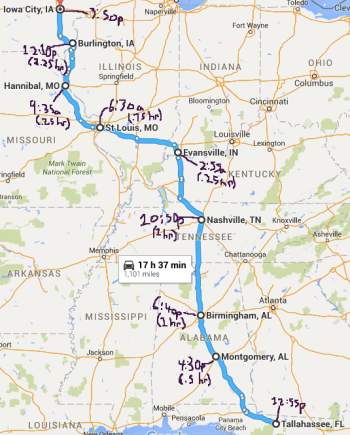
My route as generated by Google Maps, with major stops, arrival times, and layovers

I posted about the bus ride to Tallahassee, now here’s the bus ride back to Iowa City—as well as the final day of NaNoWriMo. This bus ride was only 28 hours, starting at 1:00 pm est on Saturday, and ending at 4:00 pm cst on Sunday. I did a lot more writing this time around, so this post is more focused on NaNoWriMo, and there are no pictures. It was mostly the same cities anyway, nothing new to see.


I started out at around thirty-three thousand words written—seventeen thousand to go.

1:19 pm est

We’re heading out of Tallahassee now. This bus isn’t too crowded, but there is someone next to me. Hopefully they’ll get off in Montgomery. And hopefully more people won’t get on. These are the hopes.

I’m going to write a bunch of Stuffed now.

 2:24 pm cst

We just stopped in Dothan, and I just wrote a shitload of Stuffed. I wasn’t sure whether or not I would, or if I even wanted to. Completing NaNoWriMo isn’t so much something I need to do to prove that I can, because I already know I can. The question really is, do I want to get this book done faster? So I decided that I don’t want to take months and months to finish books (even the shortest novel I’ve ever written took three months to write the first draft of—longer, including false starts and outlining.) I’m not going to do that when I’m a professional writer, so I’m not going to do it now. If I want to finish book one of Stuffed within two months (I do), finishing NaNoWriMo is a great way to reach that goal.

But really, I wrote so much because it was a lot of fun. The above thinking is only what got me to start writing.Read More »

A 30-Hour Bus Ride, Told in 13 Parts

There
My route as generated by Google Maps, with major stops, arrival times, and layovers

I said I’d probably make a post out of it—here it is. My thirty-hour bus ride from Iowa City to Tallahassee. It’s not much of a NaNoWriMo post, really. My goal was to get to twenty thousand words by the time I reached Tallahassee, but my broader objective was to survive—and this post is almost entirely about survival. To find out whether or not I lived, read on.

5:23 pm (Friday)

At the moment, we’re on I-74 heading south through Illinois, next stop I don’t know where. I know my next stop is Indianapolis, but I think there are stops between here and there.

Before I do anything else, I should recount the first part of my journey.

At two ten today I left my dorm and headed out into the thirty-six-degree afternoon. It was cold, windy, and overcast. The sun sets around four forty-five here, so wherever the sun was behind the clouds, it was already low when I made my way to the bus depot, pulling along my suitcase. The station is just beyond the edge of downtown, where all the downtownish brick buildings give way to construction projects and ragged, crumbling parking lots. So walking to the station feels like leaving civilization, and going out into the wilderness.Read More »

What I’ve Been Reading, November 2015 (Dickens Edition!)

Here it is, another post about what I’ve been reading. Mostly Charles Dickens, because I have a lit class on him, and one other book that I mentioned awhile ago.

Little Dorrit by Charles Dickens – This is the second book we read in my Charles Dickens class, and it’s another massive one. It follows the story of the Dorrits—William Dorrit, the father, has spent decades in a debtor’s prison. His youngest daughter (“Little Dorrit”) was born in prison, and his son is constantly in and out of debt and the prison as well. At the same time, the book follows a few families in the aristocracy, among them Arthur Clennam—a middle-aged man without any direction in life, who befriends Little Dorrit. By interweaving the two worlds, Dickens satirizes the aristocracy as well as the British bureaucracy, and notions of gentility and wealth. While I enjoyed the humor of this one as much as I do with any Dickens novel, I was a little bored by the lack of agency these characters had. More often things happen to them rather than any of them doing things, and most of their actions are reactions. It was still an excellent character study, though not a book where I was eager to get to the climax.

Great Expectations by Charles Dickens- This book, on the other hand, develops the main character’s motivations very well. It’s clear that Pip, the poor, orphan protagonist, is striving to be a gentleman—and while this is a rather arbitrary, subjective goal, that’s the point, and it doesn’t make Pip any less compelling. He is by no means a purely good protagonist, and watching his corruption and challenges is fascinating. Really, almost all the characters are like this, and I loved seeing good characters make bad decisions, and bad characters reveal good intentions.

As usual, the book does a wonderful job satirizing gentility, but specifically life in the big city, London. This quote I particularly loved:

“We spent as much money as we could, and got as little for it as people could make up their minds to give us. We were always more or less miserable, and most of our acquaintance were in the same condition. There was a gay fiction among us that we were constantly enjoying ourselves, and a skeleton truth that we never did.”

I’d highly recommend the book. If you don’t have time to sit down and read it, this librivox version of it by Peter John Keeble is excellently performed, and I listened to it for some chapters.

A Tale of Two Cities by Charles Dickens – While this book doesn’t provide such a clear protagonist to latch onto as Great Expectations, the cast of characters and the development of setting is really engaging. The book is a grim look at the French Revolution and the Reign of Terror, showing the madness and bloodlust of the revolutionaries, and thrusting a family into the midst of it—and, of course, paralleling this to mob aggression in London. The family we follow is that of Alexandre Manette, once wrongly imprisoned in the Bastille. Also his daughter Lucie, and her husband, the emigrated French marquis Charles Darnay. A hundred other characters are attached to them as well, each working toward their own motivations.

I was captivated by this book. The fuse is long, but once it’s burnt down, the story really explodes. It’s the way that relationships and characters change and mirror each other throughout the book that makes it so interesting, and so entertaining. Like I said, there isn’t as much of a main character, so I didn’t enjoy it quite as much as Great Expectations, but it’s still an excellent read—and a particularly action-packed one for Dickens.

The Accidental Terrorist by William Shunn – The only non-Dickens book this time around. I mentioned this book earlier, when it was up for pre-order. Now, a few months later, I’ve read it, and it’s available in hardcover and paperback here. And I still recommend it.

The book is about sci-fi writer William Shunn’s experiences in Alberta, Canada, serving his mission for the Mormon Church. What I love is the combination of highly entertaining characters and stories with detailed information about the Mormon Church—its history as well as the its practices at the time Shunn was a missionary. I value any book that can give an up-close look at something most people only vaguely know about, and this book delivers for missionary work. Who knew some missionaries used golf balls to produce a crisper, louder knocking sound when proselytizing? I do, now.

And the other elements, the ones I’d look for in any fictional book, are there too. Shunn describes a wide range of missionaries—brown-nosers, slackers, sinners—showing a full picture of the Mormon church that isn’t just silly magic underwear or straight-laced morality. And, once the story really gets going, it’s incredibly compelling. Less so because I already knew it, but still entertaining, full of twists and tension.

So, that’s what I’ve been reading. I’ll probably talk about Don Quixote next, and the last couple Dickens books we’re reading. See you then.

A Mid-Month NaNoWriMo Update

So far, I’ve been having a nice, lazy, NaNoWriMo. That was my exact plan, and why I decided to write a book about my stuffed animals instead of some horribly complicated time travel thing.

Well, it turns out that when you have a lazy NaNoWriMo, you fall behind! About 10,000 words behind. Who would’ve thought? I kind of did. It’s not so much that I’ve been lazy as it is that I’m prioritizing school work, and not writing much of Stuffed. And I expected that would be the case. The wonderful thing about NaNoWriMo being in November (for Americans, anyway) is that there’s a nice big Thanksgiving break near the end of it. There’s also Veteran’s Day, but UI didn’t give us the day off for it.

The point being, I planned for this. I knew that I would have a long Thanksgiving Break to get a lot of writing done, not to mention two long bus rides to and from Tallahassee. “Long” meaning about thirty hours. I’ll probably spend my time reading, writing, sleeping, drinking coffee, listening to podcasts, and doing various combinations of all those things at once. I may make a post about it, because it seems like it’ll be a fantastic adventure. The most time I’ve ever spent on the road was on the car trip up to Iowa City, and when I did that we stopped for a night in the middle. There’ll be stops on the bus ride, but none of them ten-hours long.

So, that’s where I’m at mid-month. I plan to get up to 20,000 words before my bus ride, but who knows. I have a 10-page paper due this week, so I may not write another word of Stuffed until I’m on the Greyhound. Whatever happens, I’m not worried. Comebacks are more fun anyway.

Did the Author Really Mean That?

Today in my Dickens class, though in a roundabout way, the question was asked.

Did Dickens intentionally use all of the rhetorical devices that we analyze throughout his writing? (The actual question was how long it took Dickens to write his books, assuming that the more time he spent the more likely it was that his subtext was intentional.) This is a question I’ve heard in classes throughout my education—Did the author really mean that? Is it really possible that the author consciously layered in so much meta-textual meaning, or are we looking too hard? The paradox that jumps out at me most is the fact that a person can spend more time analyzing a sentence than the time it took to write the sentence—how do we reckon that?Read More »

Why Do I Keep Writing Science Fiction?

This is a question that nags at me a lot. Why do I almost exclusively write fantasy and science fiction? I normally try to challenge myself, writing in a format or style or length I’ve never written in before—and yet, I continually steer clear of realistic fiction. It seems childish.

One theory is that I’ve hardly lived at all, so I have hardly anything real to write about, and to fill that cavity I have to shove in gods and phasers. That might be part of it.

It’s not as though I’m actively avoiding it. Whenever I come up with ideas for stories, it happens that the ones that excite me are the fantasy ones. I can’t help what excites me, can I?

And then I realized that speculative fiction is just like all fiction, except the world is made up too. Simple, obvious even—I know. It’s the implications of this that got me really thinking.

As far as content goes, there are three elements of a story. Plot, setting, and character. Of course that’s totally simplified BS, but for the purposes of what I’m getting at here, this is how it is. In realistic fiction (or “fiction” as bookstores group it) the plot and characters are invented, but the setting is the same. In science fiction and fantasy books, world, character, and plot are all invented. And this is why I write science fiction and fantasy. I like to make up the world as well as the characters and plot. Why then is this type of fiction labeled differently in bookstores, if it’s just one degree more of made-upness? Totally superficial reasons, which I don’t know enough about to discuss here.

But let’s look at the actual differences. Having a book set in the real world does make for a different book—it’s not completely superficial. It changes the frame of reference, the immediacy, the way a reader processes a book. But the problem is, this is the case for more than just setting.

Why doesn’t a series like Foundation by Isaac Asimov belong to it’s own genre? The characters and world are made up, but the story is roughly modeled on the fall of the Roman empire, which makes for a different reading experience than if it was totally made up.

And what about a book like  Last Night in Twisted River by John Irving, in which his own life and total fiction are mixed together in every element of the story? The way that reality and fiction interact in that story, and in the real world, definitely effected my comprehension and enjoyment of the book.

And what about my own writing? Although it feels like I’m always writing fantasy, when I look at my work this way, I’m really all over the place. In three of my latest stories, one had an invented setting/partially autobiographical character/invented plot, another a partially real-world setting/invented characters/invented plot, and another an invented setting/invented characters/invented plot.

But as far as I can tell, the division in bookstores is this: invented setting/x character/x plot is one genre, real setting/x character/x plot is another genre, and real setting/real character/real plot is a totally different section of the building. There are other books that are divided out based on specific types of plots (like mysteries) or types of settings (like westerns), which is even more obviously superficial than the division between fiction and fantasy. And even with all this division, there may be more variation between two Fantasy books than between a Sci-Fi novel and a Mystery (which, to niche in this whole other can of worms, kind of reminds me of this.)

Like I said, I don’t know the history of these superficial divisions very well. I’m not trying to explain them, or understand them. I’m just rejecting their ideas that I’d unintentionally internalized, and presenting a more dynamic (though still very simple) way of looking at differences in stories. I’m just telling you why I don’t care that I keep writing science fiction.

So About Next Month

We’re coming up on a fun month for writers—November, National Novel Writing Month. I’ll be participating, writing fifty thousand words of StuffedStuffed is a book concept I’ve toyed with but never seriously considered writing. It’s about stuffed animals. My stuffed animals, an ensemble of characters that I’ve held in my head ever since I first played with them. That’s why I never seriously considered writing it. I was afraid it would just be too self-serving, I’d spend too much time wallowing in nostalgia, and that the concept would be completely inaccessible to people who weren’t me. The whole idea also seems wildly unsalable, because the premise sounds like it’s meant for a chapter book, but I’m going to write it like any adult fantasy book.

My not taking it seriously is why I’m actually going through with it though. I have so much writing in the needs-to-be-edited pipeline right now (four books plus, actually), I need something that’ll just be easy. Something that won’t take much outlining. Something I won’t stress about editing. Something where I already know all the characters, and where whimsical discovery writing will fit the mood.

While I no longer fear the book will be too self-serving, I still worry about it being unsalable. But that just means I’ll release it in some alternate way. Maybe indie. Maybe totally free. Maybe a combination. I don’t know, but I’m certain writing it will be a blast.

So I’ll probably make a few NaNo posts throughout November. As a means of procrastinating from writing Stuffed, probably.

The Starbucks Coffee House

In my writing class we had an assignment to write an essay about some place in Iowa City with cultural or historic significance. This is the essay I wrote:

The Starbucks Coffee House

During my first visit to Iowa City, after a day full of walking tours and departmental presentations, my mom and I stumbled across a café at the edge of downtown. At the corner of Clinton and Burlington, where close-knit brick edifices give way to expansive parking lots and construction projects, sat the Starbucks coffee house. Since this is a rather obscure café, I’ll explain that it isn’t owned by a person named Starbuck, but rather the name refers to a character in Moby Dick. We entered the handsome little square building, and were embraced by an aura of inspiration and nurture. Of handcraftedness and innovation. Of intimacy and charm. It was the spirit of the Starbucks coffee house. I ordered a cappuccino and my mom ordered a chai tea latte, and I new I’d found a home away from home.

Half a year later, I return to the café regularly, knowing that there I can find tradition, hospitality, and a good cup of joe. The whole building is permeated with these qualities, from the dark woodgrain countertops (and tabletops and paneling and flooring and bathroom doors), to the news stand with chalked-on prices, to the burlap sacks displaying POP! Gourmet Popcorn—almost as if the Lite Salt popcorn bags had come fresh from the harvest just minutes ago. Sepia-tone photographs on the walls display Iowa’s rich agrarian heritage in various images, such as fields, a man putting wheat into a machine, and other fields.Read More »

Everybody Submits (Except Whiners)

I recently overheard a conversation between two writers (but were they really?) about how much submitting sucked, how much bias there was toward known authors, how brutal rejection was. I wanted to run to the opposite corner of the room and hide from the abundant stupidity of that conversation. I might’ve interjected, but they were too far away from me. So let me break this down.

I don’t know how much bias there really is toward known authors. I have very little experience on the other end of submissions, and I’ve heard editors claim they don’t even know who a submission is from when they get it, and therefore have no bias. And yet, I can’t imagine Asimov’s publishing a novella by someone completely unheard of, without the writing being positively godly. I don’t know if things are any better or worse in the literary community—my knowledge is confined to speculative fiction markets. No matter what though, unknown people do get published, especially in magazines. Names sell issues, of course, but magazines are different from books. They’re subscription based, and they have multiple authors per issue. So it’s not like a book where a reader is deciding whether or not to buy a copy, they’re probably already subscribed. And for the people who aren’t subscribed, they can pick up an issue with a cover story by Aliette de Bodard that also has a short story by Unknown McNeverpublished.

Is it harder for unknowns? Who gives a shit. I’d be more stressed by being a known, and wondering if the market was accepting subpar stories just because I had a recognizable name.

Whatever. Not that important. Second part now.

“Rejection, it’s brutal.” Those were the exact words. I don’t understand this. I love submitting. And, while I’d rather be accepted than rejected, I enjoy getting rejected too. It means I can submit again.

I think what I like about submitting, and receiving rejections, is that it gives me a feeling of legitimacy. I don’t have much in common with professional writers—not in payment, not in success, not in quality of writing—but something I do have in common with them is that we all submit stories, and we all get rejections. At least, those professional writers who write short fiction do. And that connection to professionals is a cool feeling. With each query letter I write, with each story I put into standard manuscript format, with each new list of markets to submit to that I make, I feel like I’m doing professional work. And I also get a little spike of serotonin thinking, Maybe this’ll be the magazine that accepts this story. Maybe this’ll be my first published piece of short fiction.

And it’s the same with getting a rejection. It gives me a sense of camaraderie, like I’m tapping into this universal vein of disappointment and perseverance and writerliness. I’m not insane, some rejections are painful—like form rejections from a market that normally gives feedback, or rejection after a story has been held for further consideration—but mostly they’re just a small, manageable sting. What was worse was getting no rejections. For a while I was working on a 150K-word novel, and had no short fiction to submit, and I missed submitting so much.

So what’s wrong with these chuckleheads complaining about submissions and rejections? I imagine that they don’t realize that professional writers have achieved success because of long hard work. These clowns probably believe that writers are just like them. That professional writers are people with luck, or people with good connections, or people with god-given talents, or anything other than just plain, old, skilled workers. And because they believe that professional writers are so like them, they ironically don’t feel any connection when they submit, and instead suppose their actual writing to be the connection between them and professional writers. This is valid in some ways, but every writer’s process is different, so I’ve always felt that this writing is more of a personal thing. I suppose it’s less personal if you ape the process of a famous writer, which is what many writing books suggest, and can be a trap for aspiring writers. So by supposing themselves and professionals to be equal, these goofballs debase the writers, and devalue that tenuous but very special connection made in submitting.

The worse for them. I love submitting, and I’ll do it relentlessly just like every writer worth a damn has ever done. And they whinge about submitting, and they’ll do it infrequently—and the poor slush readers will have a few less submissions to read. The better for the workers.

Recommendation Dump, October 2015

It happens that I do more than just read, but reading is what I do most, and am best equipped to review. Still, I watch TV and read articles, and feel like sharing such things from time to time. So, here’s a big ol’ offloading of stuff I want to recommend.

Lawrence of Arabia – This was recently added to Netflix, and having nothing better to do one Saturday evening, I watched the whole thing—overture with black screen included. At least, I listened to that part while looking up background on the movie in another tab. From the bit I read, I expected the movie to be more about the things Lawrence did than about the man himself, so when the movie came to an end, I felt a bit lost, wondering, So what? But re-assessing all that had happened, and looking at the movie as a character study, I found it a lot more interesting. The movie raises a lot of questions about fighting wars in foreign lands, and the identity of a nation. Although you could accuse the movie of being Great White Hope of Arabia, that’s one of the issues the movie gets into—can Lawrence really ever be “of Arabia,” no matter how many battles he joins them in or how well he knows the language, so long as he’s a European? Even without all that thinkin’ stuff, the movie is beautiful, and the soundtrack is gorgeous. I’m definitely going to rewatch it at some point with all this in mind … when I get four free hours.

The Outlaw Ocean” by Ian Urbina – A while ago I heard an interview about this topic with the guy who wrote it, and it sounded really interesting. So I bookmarked the article and didn’t get around to reading it for awhile. Now, I’ve finished it. It’s fantastic and fascinating. The series is about the lawlessness of the seas, and blends specific stories with the broader legal and political background that allows such things to happen. The articles go in depth, full of interesting details and great documentation (videos, maps, and photos.)

This Land Is Mine” by Nina Paley – In keeping with the Arabia theme, this is a fantastic animated video set to “The Exodus Song” from the movie Exodus. I actually love the song itself, even though it’s message is dumb. Maybe that’s why I love it, it’s so unapologetically convinced of itself. Like a villain’s song from a musical—just because they’re horrible, the song can still be great. Anyway, the animation is humorous and well-designed, about the various people who have lived and died in the promised land.

Tom Lehrer – After looking at the who’s who from the previous recommendation, in which it mentions Tom Lehrer’s song “Who’s Next?,” I went and watched a bunch of his videos. He’s a musical comedian from the fifties and sixties, who did the song “The Elements.” The music is all pretty simplistic, but the lyrics are hilarious, and interesting in showing the concerns of people in that time. “Who’s Next?” is probably my favorite.

Homestar Runner – If you don’t know who these guys are, well you are in for a treat. If you do, rejoice! They recently put out a new short, “Strong Bad Classics!” I don’t know what to say about it, or about Homestar Runner in general. The joy I get from watching these videos is not something that I want to analyze. It’s just fun.

Frontline: Losing Iraq – This is a PBS documentary about the war in Iraq, from its beginning to it’s finish-ish. I’m not knowledgable enough to be able to call out inaccuracies or lopsided narratives, but it seemed to be unbiased. That is to say, the people they interviewed leveled criticism at almost everybody involved in the thing. It was interesting to see such recent history, history that I’d been alive during (albeit as an ignorant four to fourteen-year-old) documented like the Vietnam War is documented. It brought context to iconic moments I hazily remembered, from the fall of Saddam’s statue to the shoe-throwing incident.

Well, that’s what I’ve been getting into recently. Happy watching/reading/listening!

Chechnya, From Dudayev to Kadyrov

I’ve recently been fiddling with an idea for a short story which would involve a minor war in the future, with ambiguous morality of each side. Separate to that, I attended a presentation by Andrey Sazonov, sponsored by the Iowa City Foreign Relations Council, titled, “Ramzan Kadyrov, Leader of Chechnya: Putin’s Frenemy?” That title interested me, and so did the prospect of free food, but I didn’t even realize how great Chechnya would be for that story I’d been trying to get a grip on. Seeing this seminar (which is available online here), it appeared that Chechnya was perfect. Tiny enough to be ignorable, but  excessively militarized enough to have a robot battalion. At least, to have a robot battalion in the future. So with that lecture as my background, I did some of my own research on Chechnya. Here it is.

Recent History.                                                                                                         

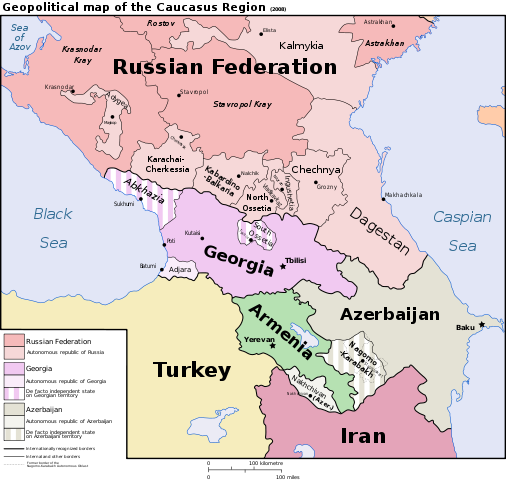
Chechnya was conquered by imperial Russia in the 1800s, though resistance from the conquered peoples continued right up to the declaration of an independent state in 1917, before being taken by the USSR in 1921. Then a bunch of horrible Stalin things and apologetic Kruschev/Gorbachev things happened, and in 1991 Chechen Dzhokar Dudayev lead a nationalist party to overthrow the Chechen-Ingush Autonomous Republic of the Soviet Union. The USSR dissolved in that same year, but Yeltsin wanted to keep all of the Russian Republic—an administrative region of the USSR that is what we now recognize as Russia—together. In 1992 Yeltsin put forth a treaty that granted states of non-Russian ethnic background limited autonomy, which was signed by all but two of the eighty-eight states—Chechnya and Tartarstan. In 1994 Tartarstan signed a treaty to be annexed by Russia, leaving just Chechnya defiant.

Map courtesy of Jeroenscommons

In 1992 Ingush split from Chechnya and was absorbed into the Russian Republic, and the next year Dudayev declared full independence as the Chechen Republic of Ichkeria. In Dudayev’s Chechnya the minority of ethnic Russians, who had long been the ruling elite, were harshly persecuted. Although most Chechens still wanted independence, not all of them wanted ex-General Dudayev to be in power. Thus, there was some armed resistance to the Republic of Ichkeria, which received support from Russia. In December of 1994, Russia declared a full-on war to retake Chechnya, assuming that a lightning-fast aerial bombardment would bring the republic to it’s knees, and finish the war by that Christmas. But it turns out the fighting wouldn’t end for six more Ramadans.Read More »

What I’ve Been Reading, September 2015

Hey look! My first ever review-type post. Maybe I could review these book-by-book, and dedicate entire posts to each, but I don’t feel like it. Here’s what I’ve been reading.

The Restaurant at the End of the Universe by Douglas Adams – I have mixed feelings about this book. I loved Hitchhiker’s Guide to the Galaxy, and I was eager to see how the story would wrap up in this one. I’m not going to recap what these books are about, because you should already know, and it doesn’t matter.

Like the first one, the book is hysterical, full of wonderful pithy gems and subversive creativity. It’s also full of casual nihilism and comic brutality, which I so enjoyed in the first one. The repeated plot device of mortal peril was tiring though, and the randomness became dull. The characters are very reactionary, but don’t take action on any of their own desires (whatever those are, I couldn’t get a firm sense of it for any of them.) It’s definitely worth a read though, and I’m definitely going to read the next one some time—just not as solid as the first book.

Who Fears Death by Nnedi Okorafor – This book excels in every way I’d hoped, and in ways I didn’t even expect. The world is one I haven’t seen, complicated, surprising, and beautiful. Attempting to explain it wouldn’t do it justice, so I’ll just name three items found within it: camel racing, eleventh-year rites, and juju. The protagonist is terrific as well. There’s a tendency in fantasy books to have a Strong Female Character—and no matter how well developed, you can sense that the point of her is to be a Strong Female Character who Breaks Expectations. Onyesonwu, the protagonist of this book, is not that. She’s driven, arrogant, impassioned, and incredibly human. The book is in first-person, and her voice and personality are gripping.

The narrative, driven by that character, keeps a good pace, and twists and turns wonderfully. The book is a hero’s journey, but one that rebukes cliches, and feels fresh. On top of all this, the book is unrestrainedly honest. Even in a section of the book where Onyesonwu comes across a wholly different society, one that’s almost utopic, the sorcerer of the town is still a sexist. I adored this book from start to finish, and can’t wait to pick up more from Okorafor.

Dombey and Son by Charles Dickens – Dombey and Son is a difficult book to review, because it covers so much dramatic ground in its 900 plus pages. The books chiefly follows Paul Dombey, his son, and his daughter—Dombey being the head of the firm Dombey and Son—but there are a lot of other characters and subplots. Rather than tell you what it’s about (I’m not sure I could pin it down precisely), I’ll tell you that the book has both a shakespearean cast of characters and shakespearean plotting, wrought epically across 52 chapters, in which the most minor side-scenes and persons all eventually come to fruition.

Dickens’s style is, as with any classic writer, striking. At times it’s incredibly descriptive, at others dryly hysterical, and most often it’s both. The minor characters had me constantly laughing as well, while the major characters were compelling, and thoroughly examined. The treatment of these characters, their development, and the journeys they go on are as emotionally moving as the best written plays. Have I made enough theatrical references? It’s because this book handles characters as well as theatre does, which is as high a mark as saying a book handles action as well as a graphic novel does. There were certainly chapters that dragged, or twists I found a bit hard to buy, but overall I had a great time reading the book.

So, that’s what I’ve been reading. Since I read a ton of books at once, I’ve actually been reading more than this, but this is what I’ve finished recently. Next I’ll probably talk about Little Dorrit—another Dickens book—Foundation’s Edge by Isaac Asimov, and maybe Don Quixote by this obscure guy you’ve probably never heard of.

1058 Miles from Home; An Epic Journey from Queso

I am roughly a thousand miles from my hometown now, but it doesn’t really feel like that far. I want to figure out why that is—after all, this is an important aspect of books. A large part of what makes an epic “epic” is a large scope. Scope can be rendered in a large cast of characters, or a long stretch of time, or in huge distances, or in all three. But how does an author make two landmarks feel far apart, without just telling the reader that they are?

The answer that jumps out to me is to show the journey. Show the blown out tires and midnight resting stops along the way. The problem is that I had this experience traveling from Tallahassee to Iowa City. My mom and I drove there over the course of two days. We went through the southern end of the Appalachians and a violent thunderstorm at the same time. We stopped in Clarksville Tennessee and spent the night at a hotel there. We carried on through Kentucky into Illinois, and puffy trees disappeared where expansive fields took their place. We passed by the St. Louis arch crossing from Illinois into Missouri, and finally came to our destination in Iowa City, Iowa.

And yet, I can’t conceptualize the distance between Iowa City and Tallahassee the way I can the distance between my house and Moe’s. It’s possible that this is because I’ve walked from my house to Moe’s. Maybe it’s just that I think of cars as slow teleportation—step into a box, wait, step out of the box and you’re where you want to be. Or maybe it has to do with inevitability. The car ride to Iowa City was as much a part of going to college as writing my application had been. The trip was an item in itself, not an expression of distance. When I walked to Moe’s, it wasn’t some inevitable thing.

For a start, I didn’t even have to go there. Not that anyone’s forcing me to go to UI, but it’s something that I’ve been set on for so long, it’s a fact of life. Not so with Moe’s. I made the decision on the bus ride home from school. It was free queso day, and I was going to take advantage of it. I had several moments of doubt when it was not certain that I would go—mainly, when I looked up on google maps the path that I’d have to take. It was long—fifty minutes. And it was hot out. But I went anyway. Every step was intentional. And now I’m beginning to understand what the difference is—the distance became tangible because it was a force that I had to conquer in order to get my free queso. I had to walk down long, unshaded roads with big hills. I had to consult my map when I cut through windy neighborhoods. Worst of all, I had to go through Frenchtown—the “bad” part of town, directly north of the Moe’s—and avoid all of the irrational racist fears that might be inspired there.

So it’s not enough to just show the distance, the distance must be tangible. It must be brought to bear against the adventurer, it must be clear that this distance stands between the quester and the queso. And there was only one moment where I had any struggle on the road, when I was driving through that thunderstorm and could hardly seen ten yards ahead of me. The rest of it was slow teleportation. All I had to do was sit for long enough, and I’d end up in Iowa.

Interesting.

Maybe I should hitchhike home for Thanksgiving, really feel the distance that way.

Or I could save the risk of (insert nightmare hitch-hiking scenario) and just pretend that Iowa City and Tallahassee are linked by a slow teleportation box called the Greyhound.

Beach Nourishment – How

Here’s the second and final installment about beach nourishment, as taken from my research notes for an upcoming story. Last time I talked about what beach nourishment is, and why it is needed. Now I’ll talk about the methods and the costs.

Methods.

So, how to do?

To start with, the sand has to come from somewhere. Although sand can be taken from inland sources, or even from sand trap areas in harbors, it typically comes from offshore deposits. Other sources include inlets, dunes, rivers, and lagoons. The sand grains have to be the same size, or slightly smaller than, the native sand at the beach for the nourishment to be effective. And if taken from an offshore site, it has to be at least two kilometers from the shore. Otherwise the borrow area will just get refilled and cause more erosion.

When sand comes from an inland source, it is brought to the beach via trucks. When it comes from offshore it is brought by pipes. In both cases, as long as the sand is underwater, it is dredged. For offshore dredging there are two methods. Actually there’s a billion, but here are two popular ones—cutter-suction dredging, and trailing-suction hopper dredging.Read More »

Beach Nourishment – What and Why

Well, here’s a post that seems to have nothing to do with anything. Although this is all taken from my research and notes for an upcoming story, it has nothing to do with writing or reading or anything like that. This is just a post about beach nourishment. You’ve been warned.

Introduction.

So, what is beach nourishment?

Photo of a jetty, groin, breakwater, revetment, or something, in the Black Sea, courtesy of PSDS and IO-BAS

No, it is not some form of urban foraging, beach nourishment is the process of replenishing an eroded beach by adding sand. It’s done to protect valuable shoreline property from becoming Venice. Alternatives are building a seawall (very common in Europe) or building a breakwater or groin. I don’t know the difference between those last two, but basically they’re large walls of stone or wood that extend into the ocean and collect sediment on the updrift side, like a dam for sand. They’re kind of problematic though, because if they collect too much sand then downdrift beaches aren’t being replenished as much by the natural current of sand that moves along the coast, and might erode very quickly. Another alternative to beach nourishment is a “managed retreat”—basically giving up to the sea and relocating inland.

There’s another thing which I haven’t seen too much written about, called “living shorelines”—the use of native flora to reduce erosion.

So, why is beach nourishment?

Beach nourishment is nice because it preserves the beach without having to build any structure, or move buildings. Sometimes groins are built in conjunction with it, and can be either a series of tapered groins, or adjustable groins—both for the sake of allowing some sand to pass and continue it’s littoral drift. Beach nourishment isn’t a long-term fix though, because the beach is always eroding.

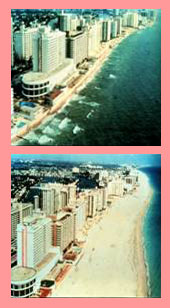
Before and after photos of beach nourishment in Miami, Florida, courtesy of USGS

Erosion

Erosion can be caused by damn humans damn interfering, but it is also caused by storms. Some beaches can recover from storms if they have enough submerged sand to replenish them. Others can’t. This is why during beach nourishment it’s important not just to focus on what’s above the water, but also the swash zone—the shallow area beneath the water. A lot of that sand will return to the beach as it’s carried in by waves.

Erosion is also caused by longshore drift—and mitigated by it. Longshore drift is the process by which sand is carried along the current of the ocean due to the raking angle of the waves. This causes sand to erode, and be deposited elsewhere—then erode again, and be deposited again. The process of sand returning to a beach is known as “accretion.”

Where’s all this sand coming from? River deltas, mostly. Rivers move a lot of sediment out to the ocean. At least, that’s the natural source for sand. With beach nourishment, there are a multitude of other sources. Which is what I’ll talk about next post—the “How” of beach nourishment. The methods used, the problems posed, and some boring-ass statistics about the costs of things.

If anyone wants to do some more research into this, I found these sources very helpful —

Program for the Study of Developed Shorelines,

Beach Nourishment and Protection by the National Research Council,

and, of course, Wikipedia.

Recommendation: The Accidental Terrorist

If you submit to enough short fiction markets and read the guidelines, you’ll see the phrase “Standard Manuscript Format” over and over again, and almost as often you’ll see the name “Shunn.” This is because the science fiction author William Shunn has done an excellent job over at his website, Shunn.net, explaining and giving clear examples of what Standard Manuscript Format looks like, as well as some of the finer details of it. SMF may as well stand for Shunn Manuscript Format, because probably half the submission guidelines I see provide a link to his website as an example.

So when I was first getting the hang of submission, and didn’t have SMF memorized as I do now, I was constantly checking Shunn’s website. I went there so frequently, I eventually started to stray from just the formatting stuff, and I found a podcast with a strange title, The Accidental Terrorist. The title was especially strange because I didn’t know the reference. I gave it a listen, and was instantly hooked. The podcast is an autobiographical account of WIlliam Shunn’s time as a mormon missionary in Canada. It’s completely immersive, giving an inside look at mormon practices and beliefs, the typical lives of missionaries, and rural Canada. That’s what I love most about the podcast, but it also provides a cast of characters who showcase various aspects of the faith and mission work. The fact that it’s about a young sci-fi writer also hooked me—and it does develop to a pretty compelling narrative thread, eventually. The whole “Accidental Terrorist” thing isn’t just a goofy pun.

If this review sounds lacking in details, it’s because it isn’t really a review. I was going to listen to the podcast for a third time, but I decided against it when I saw that William Shunn would be putting out a hardcover, much-revised edition of the memoir this fall. Instead of relistening to it, I’m going to wait until fall to experience the story once again through a completely different medium. I’ve enjoyed the podcast for free so far, so I figure the $27.95 to pre-order and get a signed copy is well worth it. I’d recommend you do the same—though you don’t have to take my word for it. That podcast is still up, completely free. You can see how wonderfully humorous and enthralling the story is for yourself, and then support a terrific writer with a unique and fascinating story.

Blog Re-Beginning

So I’m going to pick up this blog thing again.

It’s for me, not for you. Apparently it’s good for a writer to build a platform, so that when you publish new stuff people can buy it, or if readers look you up they can see what your past publications are. And since I actually have something published now, and may have more some time in the sometime, I’m going to give this another shot.

Yes, it’s all about money. And on the topic of money, !!!THE TRIAL OF ADBOT 579!!! is a ¡¡PLAY¡¡ by me about advertising robots and humanity and you can buy it HERE HERE HERE.

In the past I did this blog (three whole posts worth) just because I felt like screaming into the void. I think I gave up on it because I ran out of things to say. Whatever happened, I’ll try to update regularly now. Maybe weekly. Maybe less often.

Although the point of this blog is to attract attention so that people will buy my stuff, the posts will rarely be advertisements.

Speaking of advertisements, I actually wrote a —-> ONE ACT PLAY <—- about an adbot called PLEA$E GIVE ME MONIE$ which you can purchase HHEERREE.

I’m not sure what the posts will be. I don’t even know what this one is. I feel obligated to start this blog with an introduction, even though this isn’t a book. Plus it’s not introducing anything, because I don’t know what this blog is going to be about.

So instead of trying to introduce a never-ending book I haven’t written yet, I’ll elaborate more on why I’m doing this blog. It’s only sort of about money. That is to say, I don’t expect this to do anything for my nearly nonexistent revenue until I have more major publications, ones with bios that point back to this website. I’d like to get into the habit of writing blog posts regularly though, so that when it actually matters I won’t be fumbling around with weird disorganized posts like this one, or slacking off and going through long hiatuses. I’ll have already been keeping up with this for awhile, and will have no problem continuing to post.

Now that I mention it, posting is kind of like…oh screw it.

The Ins and Outs of Routines

Back in the day, I was up at seven o’ clock every Saturday and Sunday.  I’d head to the kitchen and fix a cup of coffee, sit down at my Macintosh PowerPC, and I’d write until ten or eleven.  Then I’d make breakfast, and print out a chapter if I’d finished one.  I did that from sixth to eighth grade.  It was just the most intuitive way to do things—I had school during the week, so I wrote on the weekends.

Freshman year, I tweaked the routine a bit.  During the week I utilized class time in some of my duller periods to write story notes, while maintaining the weekend writing.

In sophomore year, things finally changed.  With classes I couldn’t just coast through, I had less time to outline stories.  Homework fluctuated from weekend to weekend and left no guarantee of a solid chunk of time to spend writing.  And when homework was on the weekdays, staying up late to finish it didn’t leave me inclined to get up at seven on a Saturday.  I managed NaNoWriMo, but I’ll get to that.  The rest of the year I bobbled in and out of my routine.  By the time it was summer, the system had been broken and I couldn’t get back into it.  I did try, but attempting to maintain the archaic holdover from middle school just meant I didn’t write on the weekdays, and wrote only a couple paragraphs on the weekends before getting distracted.

Trying to force that routine was bad.  But here’s where routines can be good.  When I did NaNoWriMo, I started a routine especially for it, and set out some rules.  Quoting directly from my journal, here they are:

“Every weekday, I will write one thousand words, starting today.  Every weekend or non-school day, I will write four thousand words.  During school I will outline the plots and characters of the episodes.  And school will always take backseat when the choice is between it and writing. ”

That last part was very helpful, and is part of why the NaNoWriMo system worked and my old routine didn’t.  But let me clear two things up.  First off, don’t worry about the math.  I was a bit behind at that point, so it does add up.  Secondly, I’m not advocating ditching school as a routine.  This was just for a month, so it was fine.

Now here’s my point.  Having a system in place, repeating a task day in and day out really helped me.  Each successive time I completed what I needed to do for the day, I could look back and have more and more productive days supporting me.  The routine was self-sustaining—or self-helping at least.  Obviously there were some bumps in the road, but NaNoWriMo’s  more fun like that anyway.

So what’s my opinion of routines?  I think they can be very beneficial.  But they can go obsolete, and if they do I have to step back and reaffirm that writing has nothing to do with circumstance.  I’ve written in houses, planes, buses, on a desk, a ping-pong table, my knees, with water, coffee, orange juice—and how productive I am is always up to me.

To put it as simply as I can, routines are only good when they give you a reason to write, not an excuse not to.

A Psychopath Starter-Kit

I’ve been doing some research into psychopathy for a story I’m writing.  Not a story about psychopaths really, but psychopath analogs.  In a society where everyone has so much empathy they can not bear to kill, people who are at all capable of the act are sort of analogous to our psychopaths.  The story hinges on genetics, the idea that this society was modified to be unable to murder, and anyone with a mutation in that modification is a born killer.  A bit late in the creative process, I realized it was quite likely I was about to make a complete ass of myself.  So I went and did some research.  Here are a few interesting findings—think of this as a starter-kit for knowledge about psychopathy, with a focus on genetics.

First off, what’s the difference between psychopaths and sociopaths?  Really they’re the same, but ‘sociopath’ refers more to people that are psychopathic because of environmental influences, as opposed to a genetic predisposition.  A sociopath is always a psychopath, but a psychopath is not always a sociopath.

And someone with psychosis is not always psychopathic.  Psychosis essentially means a disconnect with reality.  There are lots of ways to disconnect with reality besides ASPD.  That’s antisocial personality disorder, and it’s synonymous with psychopathy.  Sort of.

Weird semantics aside, what qualifies someone, in cold, clinical detail, as a psychopath?  The Hare Psychopathy Checklist, Revised—or the PCL-R as the cool kids call it.  It’s a set of traits that must be fulfilled to a certain extent for someone to be considered a psychopath.  The traits are organized into two categories, or “factors.”  Factor one is covers lack of empathy, as well as narcissism and a manipulative personality.  Factor two is about antisocial aspects, impulsivity, and irresponsible decision-making.

So, what about the genetics of psychopathy?

Well, there’s a lot of controversy there.  Some believe there are primary and secondary psychopaths—the primaries develop psychopathy because of genetics, and the secondaries because of environmental factors.  Another theory is that the genes for psychopathy are like genes for cancer.  No one is predisposed to growing tumors, just predisposed to a higher susceptibility.  That was an over-simplification, but you get the idea.  Following that line of logic, another theory is that genetics can predispose someone to psychopathy, while environmental influences will determine how the psychopathy manifests itself—or if it manifests at all.

Despite these varying opinions, some things are clear.  For a start, there’s not one psychopathy gene—it’s not that binary.  A study using identical twins with fraternal twins as a control determined that callous-unemotional traits were over sixty percent heritable.  In addition, “conduct problems” such as fighting, stealing, and lying appeared seventy to eighty percent of the time with individuals that tested high for callous-unemotional traits, and a lower thirty to fifty percent of the time with those who tested lower for the traits.  This demonstrated that there is some genetic predisposition involved in psychopathy, or psychopathic factors anyway, and that while this predisposition often leads to conduct problems, it is not a required element for the problems to appear.  So good news, folks—you don’t have to be a psychopath to misbehave!

And although there’s no catch-all psychopath gene, there is one that seems to increase likelihood of aggression and antisocial behavior.  The MAOA gene (often called the ‘warrior gene’) codes for production of the enzyme monoamine oxidase A.  One allele, or version, of the MAOA gene creates an MAO-A deficiency—this deficiency allele is what gives the gene that badass nickname.  A 2007 study found that the functional version of the gene acted as a moderator of “early traumatic life events.”  So if you didn’t have the bad allele, traumatic events in your formative years would be moderated by your MAO-A, and you wouldn’t become a psychopath when you got older.  But if you had the allele that created a deficiency, the traumatic events in childhood would increase likelihood of aggression in adulthood.

That’s about as deep as my research got.  Notice there are no perfect correlations—nothing’s a hundred percent or a definite cause-and-effect relationship.  This makes all these concepts perfect subject matter for a story—gray areas like this are fertile ground for creating deep, intricate characters and fascinating societies.  Plus, it means that this utopia of non-killers is kind of bullshit.  That’s always fun.

Now let me give credit where it’s due.  The majority of my research was done using wikipedia as a hub, and going to their cited sources for more in-depth information.  Mostly I used the article and editorial here as well as the studies linked above.  Of course I’m just some jackass with a blog, I’m sure I’ve made about fifty simplifications, false interpretations, and just plain screw-ups.  This is a starter-kit, meant to clarify a few conceptions about psychopathy and do a bit of analysis on the role of genetics.  More to the point, it’s only the amount of research I felt I needed to do for the story.  I hope you found it interesting anyway.

Speaking of the story, I should probably get to writing it.  Those early traumatic life events aren’t going to exposit themselves…

The Thirty-Forty

Ladies and gentlemen, right in this blog post here I hold the answer to writer’s block.  As well, this answer will solve your troubles with the boogie man, and even cure a fatal case of the cooties.

For the nominal fee of continuing to read this post, you too can have the answer.

Alright, here it is—they don’t exist.  Writer’s block was invented by lazy writers who didn’t want to say they were just tired of writing.  It’s as ridiculous as that muse crap the Greeks believed in.

With that out of the way, let’s talk about what’s even crazier than writer’s block—writers who say they never have any story ideas.  Crazy, because I have too many.  I have a word document full of unused ideas I’ve thought up over the years.  In addition, if I really do find myself in a situation where I’m not interested in any of my unused ideas and no new ones are coming to me, I have a fool proof way to generate some fresh, hot premises.

The Thirty-Forty; Thirty story ideas in forty minutes.  The name explains the concept, but there’s a little more to it.

One day in Geometry I was bored, with nothing to do, and about forty minutes left in class.  That part actually happened every day.  This next bit didn’t.  I decided that in those forty minutes I would write out thirty story ideas.  It passed the time pretty well, and it gave me some interesting concepts to work with.  I almost ran out of time, so idea number thirty is simply “A car is alive.”  But the other twenty-nine were more elaborate.  Granted, there were only about five good ideas , with another five that were crummy but had contained one or two intriguing factors.  But that’s really the key to a successful thirty-forty—write everything.  Don’t try to make any of them good, just write the first thing that comes to your mind, expand it a bit, and move on to the next idea.  If you write every the stupid, derivative, or downright bizarre idea you’re bound to put down some pretty interesting ones as well.  And of course, the number of stories and time limit is arbitrary—it’s just what I thought sounded nice, and seems to work pretty well for me.

If a thirty-forty doesn’t leave a writer flooded with ideas, they probably need to read more, get inspired.  Or plagiarize even, just do something.

Now, one last tip for writing a Thirty-Forty—do it in a dull setting with little to stimulate you.  I once did a thirty-forty at my  cluttered writing desk, and just kept wanting to write ideas about scotch tape and staplers.