
Got a bit of a grab bag this time around. One long review of The Agony and the Ecstasy, a shorter review of A Fine Balance, and a shortest review of The Hard Tomorrow. Also, after all that, some news about two writing projects I’m putting out this month, and an opportunity to place an ad in my zine! Pick your poison.
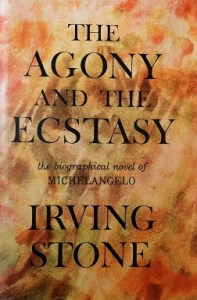
The Agony and the Ecstasy by Irving Stone is a biographical novel about Michelangelo. It starts when he is 13, about to be apprenticed to Domenico Ghirlandaio, and continues throughout his entire life, right up to his death at age 88. The plot is pretty much exhaustive—no part of Michelangelo’s life is omitted, though some is summarized, especially towards the end.
Initially, I concluded that “The Agony and the Ecstasy is a hack job, and it is glorious.” By “hack job” I meant that there’s really no artistry to it. Irving Stone is not making artistic decisions about how to represent things, he is not emphasizing certain moments over others. Every bit of information, every major event, is dutifully transposed into a kind of dramatized biography. This changes slightly towards the end, which I’ll explain more below, but I think my initial impression still applies to 90% of the book. No one should read this who does not want to read a 600-page biography of Michelangelo.
That’s not to say Stone is unskilled, not at all. The drama is compelling, the dialogue and narration are effective. He is rendering well, but he is only rendering. There’s no attitude, no flair, no vision. He is like David, an artist in the studio of Ghirlandaio who Stone describes thus: “David had been well trained in enlarging to scale the individual sections and transferring them to the cartoon itself, which was the dimension of the church panel. This was not creative work, but it took skill.”
The single biggest artistic choice Stone made, and it is a bold one, is writing this book at all. Michelangelo lived a long life, so treating his life with the intense level of researched detail that Stone employs does require commitment, belief, a supreme confidence in the worthiness of the material. This is a hack job in that it lacks any creativity, but it is an uncommon hack job, one which took a tremendous amount of care and effort to complete.
Read More » Francis Bass