Lot’s of books about Vietnam, because I’m in a literature class called “Reimagining Vietnam.” So, here’s what I’ve been reading:
The Quiet American by Graham Greene – The Quiet American is a book narrated by Thomas Fowler, a jaded British journalist working in Vietnam during the violent overthrow of French colonialism. The American of the title is Alden Pyle, a representative with the American economic mission, who seems to have some greater role than he lets on.
The book’s plot is pretty interesting in it’s own right, mainly focusing on the growing relationship between Pyle and Fowler, and Pyle’s attempts to win the heart of Fowler’s Vietnamese mistress—but what I enjoyed most were all the questions it raised about being “engagé.” Fowler firmly believes in remaining neutral as a journalist, while Pyle is full of idealism, convinced that America can do good in bringing democracy to Vietnam—before the US even had a strong military presence there. The book was published shortly after the events described in it—before the “Vietnam War”—but the debates between Fowler and Pyle about the role of western powers in under developed nations have only become more and more relevant. What is the global role of a fading colonial power? What is the role of a rising superpower? At what point does inaction become action?
The book is a quick read, full of dry wit, vivid descriptions of the communist uprising, and terrific dialogue.
The Things They Carried by Tim O’Brien – Vietnam book number two. The book is a collection of short stories revolving around a platoon of American soldiers in the Vietnam War. Most of the stories are narrated by a fictitious version of the author. Some are short vignettes, some are longer, more traditional stories, and some are almost like personal essays, with choppy bits of story and pieces of argument or reflection mixed together.
The more traditional stories are all compelling. O’Brien does a masterful job of characterizing the soldiers and the landscape around them. The opening piece, “The Things They Carried,” is a long meditation on the physical and emotional burden of each of the soldiers, all their memories and personal totems. One of my favorites is “On the Rainy River”, which describes the narrator’s struggle deciding whether or not to dodge the draft. These types of stories, with their intimate depth of character and reflective tone, would be enough for me to highly recommend this book. What makes the collection really special, and something worth re-reading, is the inclusion of those more non-fictional pieces. Pieces like “Spin,” “How to Tell a True War Story,” and “Good Form” add another layer to the book, calling into question the truth of things, and the purpose of writing, and remembering, and telling war stories. And O’Brien did fight in Vietnam, so there’s another layer. The book is rich with experience and questions, an engaging read and one to remember, and keep thinking about, as well.
No Man’s Land by Duong Thu Huong – This book is great. It takes place in (surprise!) Vietnam shortly after the victory of the Communist forces, in a town called Mountain Hamlet. The action kicks off almost immediately when Mien, one of the three main characters, finds that her first husband has returned from the dead. She had married him just before he went off to war, and for over a decade he’s been presumed dead. In that time, Mien married an entrepreneur named Hoan, and had a child with him. But once her first husband, Bon, returns, she feels a social and moral obligation to become his wife again.
The strength of the book is the characters. The main characters are the members of the love triangle, Bon, Hoan, and Mien, but there are plenty of side characters that are just as interesting. Everyone has a backstory, with more depth and hardship hidden beneath the surface. Huong digs deep into all the characters, and all the settings, with descriptions that range from beautiful to horrifying. Everything is so well wrought, the characters and settings and backstories all leave deep emotional impressions on the reader. Of all the books I’ve read so far for my Vietnam class, this one is my favorite.
The Adventures of Huckleberry Finn by Mark Twain – As with many of Mark Twain’s books, this one is all over the place, in terms of tone and subject matter. Most of the time, it works, and the result is a book that is full of many different memorable characters and entertaining situations.
If you don’t know the plot already, Huckleberry Finn follows the Huck and Jim, a runaway slave, as they run away from their abusive father and their owner who plans to sell them down the river, respectively. They set off on a raft down the Mississippi, intending to take a turn around the south end of Illinois and head northeast, to the free states. The book is mostly composed of short episodes which occur as they travel down the river.
This is the strength of the book. These episodes are full of larger-than-life characters, like the Duke and the King—two conmen who board the raft as they’re being chased out of the town they just ran a grift on—or the Grangerfords and the Sphepherdsons—two families on opposite sides of a generations-old feud, whose cause know one can even remember anymore. Below the surface all the colorful characters and funny stories are issues of race, dominance, violence, mob mentality, religion, and, of course, slavery. The balance that Twain strikes between entertainment and substance is terrific and compelling, and it’s why the book is a classic. Unfortunately, the ending is (famously) underwhelming, and abandons the substance in favor of just entertainment, leaving all those issues unresolved and unacknowledged.
Regardless, the book is absolutely worth reading, and there’s a great audiobook of it, performed by John Greenman, on Librivox.


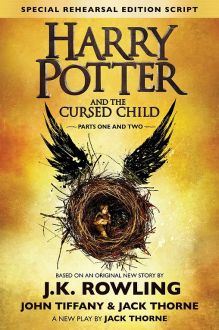 I just finished Harry Potter and the Cursed Child, and I feel like it was one of the most multi-layered reading experiences I’ve ever had with a contemporary work. By multi-layered I mean that I was thinking about, and analyzing meta-textual elements while reading it—which is a common enough experience, when I’m reading old literature for my english classes, but pretty rare with recently published books and plays. So, rather than just reviewing the play as I might review Mr. Burns or Water by the Spoonful, I’m going to review the play in all it’s aspects—the things I noticed as a reader, as a writer, as a theatre person(ish), as a fan of the original books, and as someone interested in the publishing industry. I’ll mention plot elements throughout this post, so if you don’t want the play spoiled, halt now.

