
Happy Public Domain Day! Today, works from 1928 enter the public domain in the US and many other countries! Most infamously, this is the year that Steamboat Willie, the ur-Mickey Mouse, enters the public domain. The Duke Center for the Study of the Public Domain has a great write-up on what’s entering PD this year, as well as a detailed post about the Mickey Mouse situation.
As I do every year, I’m celebrating by ceding one of my own works to the public domain: “Just Dig”! This is one of the first stories I self-published, back in 2017. It’s a very short story about asteroid prospectors and luck. Has kind of a western vibe to it. It’s good! I’ll eventually upload it in more formats and update the ebook version on Smashwords, but for now you can read it in this single-sheet, printable version. (UPDATE: I have finally uploaded it in more formats, if anyone cares! PDF — Docx — Epub — Mobi) To read my other posts about the Public Domain, or my other works in the public domain, go here.
I’d also like to take this opportunity to highlight a piece of writing which has been in the public domain for over a century, and which I love—”Life in the Iron Mills” by Rebecca Harding Davis.

This is a short story first published in The Atlantic in 1861, describing a few fateful nights in the life of Hugh Wolfe, a worker in an iron mill. The story was sensational and much acclaimed when it was published, and ahead of its time as far as exposés of the American underclass—this was decades before Jacob Riis and Upton Sinclair. However, the story and Harding Davis fell into obscurity for a while, before being re-introduced to the world in 1972 by writer and literary scholar Tillie Olsen. Olsen, an editor at Feminist Press at the time, published a new edition of the story, along with a lengthy biographical essay about Rebecca Harding Davis, drawing parallels between the thwarted creative efforts of the character Hugh and those of the writer. Olsen then expanded on this idea in Silences, a book about authors whose output was stifled or cut short by their socioeconomic circumstances (e.g. being a woman, being poor.)
I mention all this because 1. reading Silences is how I discovered “Life in the Iron Mills,” 2. I think Silences is required reading for anyone serious about being a writer, and 3. this cultural transmission is a triumph of the public domain. “Life in the Iron Mills” probably entered public domain in 1917, if not earlier. If it had been subject to our current laws, it wouldn’t have entered public domain until 1980, 70 years after Harding Davis’s death. Tillie Olsen would have had to track down the author’s estate and pay for the copyright. If she couldn’t find the estate, or couldn’t reach an agreement with it, she would’ve had to wait eight years for it to enter public domain. Basically my point is that our fucked copyright law is another form of silencing.
If you want to read “Life in the Iron Mills” now you can read it on Project Gutenberg, or you can get the 2020 edition of it from Feminist Press, which includes Olsen’s biographical essay, a few other short stories by Davis, and a new foreword by Kim Kelly. I would not recommend the 2020 edition though. Kelly’s foreword adds nothing, and the story itself contains several typos—right away there’s a typo in the epigraph, and later on an entire paragraph is missing! I would recommend just reading the story, then reading Silences, which does include a version of Olsen’s biographical essay on Harding Davis.
You can also read it in this little zine edition I made! And here’s a print-imposed version, you can just print this 2-sided, short-edge binding, and it’ll come out perfect.
I put this zine together over a year ago, just as a proof of concept for making little booklets like this, and I think I did a pretty good job. Nota bene: I included Olsen’s introductory note, so this zine is not public domain! This zine is illegal! But I think Olsen’s note is so good, one of the best introductions to a literary work I’ve ever read—probably because it’s so brief. So I will take her lead and not waste any more of your time.
Happy Public Domain Day!

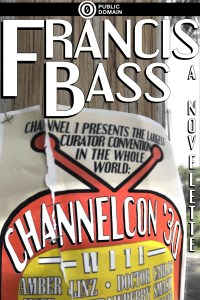 That said, I am still releasing one of my own works to the public domain, as I have in years past. This year, that work is “ChannelCon ’30,” a novelette about “curators” who put together livestreams of public domain movies. Lindsey Xong and Amber Smith, two such curators, form the highly popular channel Amber Linz. Just like any popular curators, they go to ChannelCon, but quickly find the fans there divided into two sides engaged in an intense feud. As the Con falls into chaos, the two factions drive a wedge between Amber and Lindsey, and finding out who is behind the sabotage becomes crucial.

 Francis Bass