
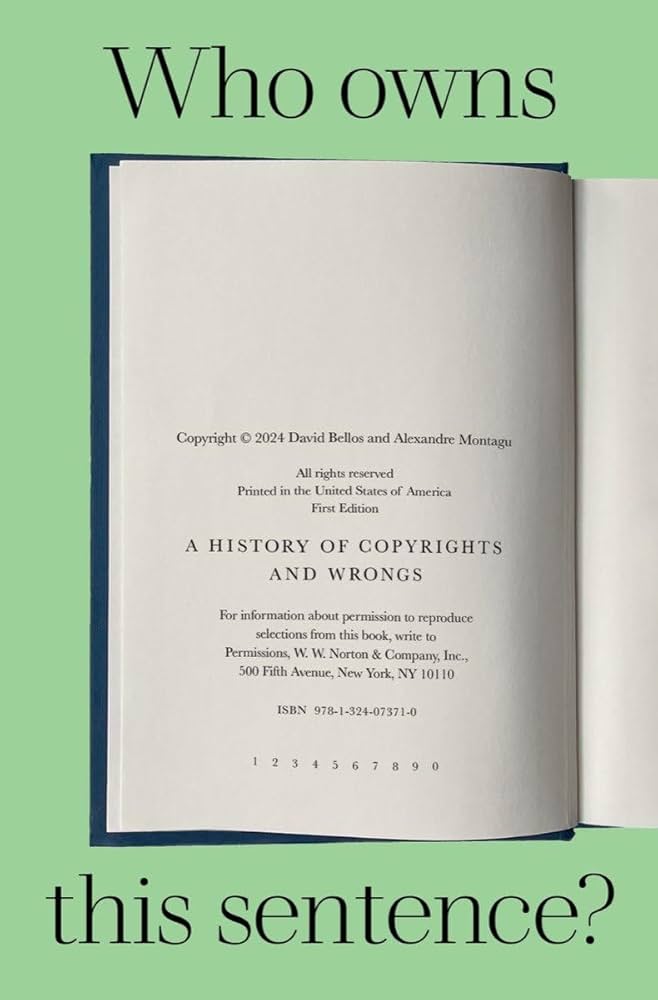
Happy Public Domain Day!!!!! This year, in addition to ceding one of my works to the public domain (read more about that here), I’m reviewing this excellent 2024 book by David Bellos and Alexandre Montagu. Years ago I read Bellos’s book on translation and interpretation, Is That a Fish in Your Ear?, and really loved it (you can read my review of that book here.) So when I saw that he’d co-authored a book about the history of copyright, I was all over it.
Unlike Is That a Fish in Your Ear?, where almost every chapter is like a stand-alone essay, Who Owns This Sentence? is a fairly chronological history of copyright. There are occasional diversions and cul-de-sacs, but you really want to read the book in order. Bellos and Montagu trace copyright’s origins to 15th-century Venice, when the city granted Arabic and Turkish tradesmen monopolies on various products to entice them to come set up shop. From this practice came patents, and from patents, copyright. Copyright has changed a lot over the centuries—from a patchwork of different laws in different countries to a nearly monolithic global regime, from protection of printed words to protection of printed anything, to protection of digital properties, sculptures, even architecture in some countries—and this book takes you through each of those transformations.

Fortunately, it’s not presented like an even-handed, both-sides-have-a-point, isn’t-this-so-darned-interesting?, [insert NPR show here]-style account. The authors are clearly dissatisfied with the current state of copyright law, and they make clear, committed claims about who benefits from it (corporations) and who is hurt by it (artists, the reading/viewing/listening public). They don’t ultimately present an argument for what copyright law should be—that’s not really within the scope of the book—but they are unambiguous in their distaste for its present state, and their dismay at the various turns which brought it there.
Read More » Francis Bass