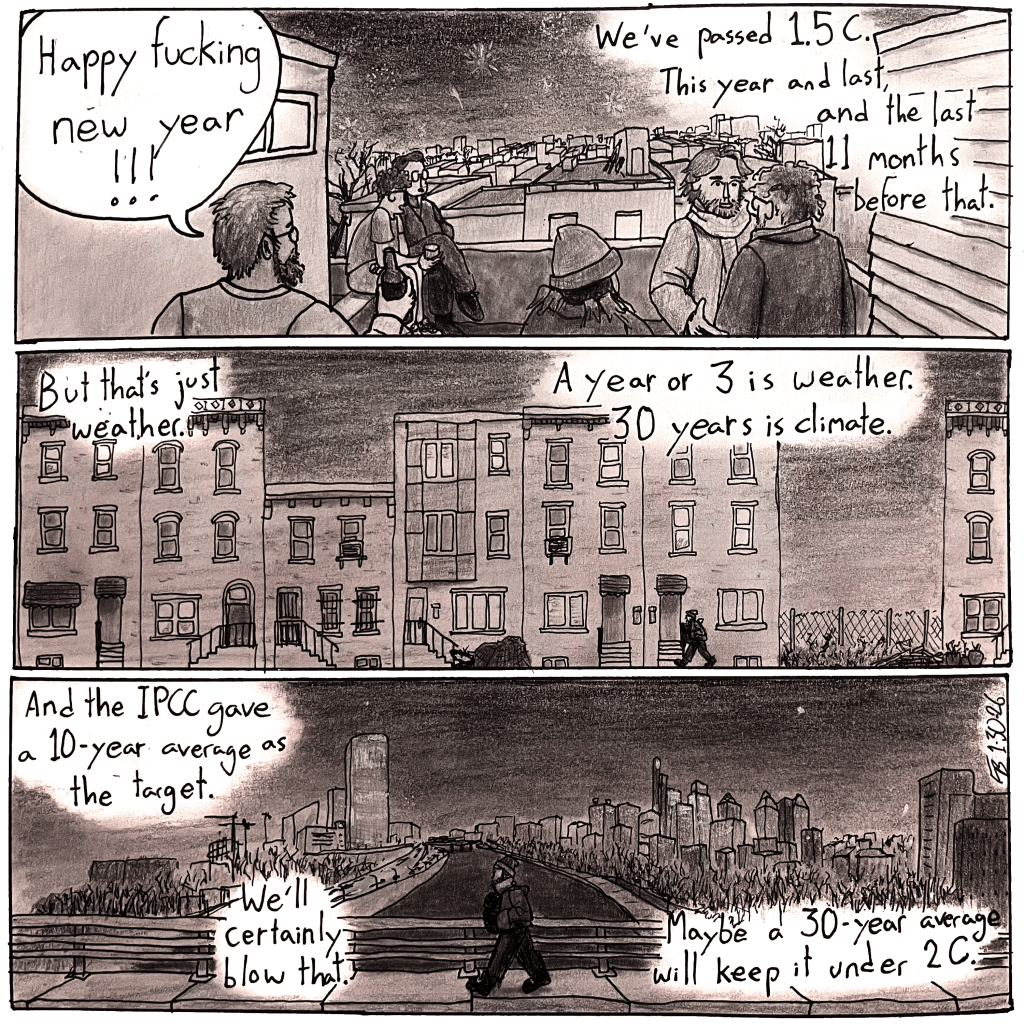
1. FRANCIS: Happy fucking new year!!! TEXT: We’ve passed 1.5 C. This year and last, and the last 11 months before that. 2. TEXT: But that’s just weather. A year of 3 is weather. 30 years is climate. 3. TEXT: And the IPCC gave a 10-year average as the target. We’ll certainly blow that. Maybe a 30-year average will keep it under 2C.
Mark your calendars, Philadelphians! November 1st, 11am-5pm, in Temple University’s Mitten Hall, I will be tabling at Philly Zine Fest! This will be my first time attending a zine fest as a vendor, and I’m very excited. Some things I’ll be selling:
All my previously published zines, to wit:
“Cartographer”
“Fires Burn Forever in this World”
“Is Magic School Still Worth It?”
“The War on Hormones”
Lonely Friends
A brand new zine about making a map!
Brand new goblin stickers from some of my goblin week drawings!
And a couple free things:
“Masters of the Wine Printers Guild” zine
“Just Dig” 1-sheet
If you are in the Philadelphia area please come by and say hi!
If you’re not able to make it, most of my zines are available on my Etsy, and sometime in November I’ll have the stickers and the new mapmaking zine up there, too.
Some other updates
The main thing I’m working on these days is a comic, One-on-One. I’ve drawn and inked about 20 pages (still need to “color” them in), and I expect the rest of the comic will be another 20 pages. Here’s a fewsneakpeaks. I hope to be finished with it by the end of the year, and have physical and digital editions up for sale.
On the reading front, I’ve finished Battle Hymn of China by Agnes Smedley and can at last move on to the actual sci-fi books on the list, starting with The Dispossessed by Ursula K. Le Guin. I’m over a hundred pages into it now and really enjoying it.
Battle Hymn of China was good, and I’d definitely recommend it to anyone who read and enjoyed Daughter of Earth. It’s not as novelistic as that book, much more episodic. Reading all the chapters together, they don’t combine or build on each other too much, but there are a lot of really fascinating episodes.
That said, I’m going to put my utopia/dystopia reading list on pause in October so that I can engage in my annual tradition of reading horror books for the spooky season. This year I plan to read:
Never Whistle at Night, edited by Shane Hawk and Theodore C. Van Alst Jr.
No Gods, No Monsters by Cadwell Turnbull
A Scout is Brave by Will Ludwigsen
And perhaps, if I have time, Strange Pictures by Uketsu, trans. Jim Rion
Look forward to a post about that 🎃. You can see my previous Spooktober posts here.
Every year around October I like to read horror books and you can see all my previous posts about that here and this is this year’s post.
This year I had a couple false starts with some really insipid contemporary horror novels, so I wasted time on those and didn’t finish them, and only ended up reading one prose horror novel—a novella, actually, Low Kill Shelter by Charity Porpentine Heartscape. I also read the graphic novel A Guest in the House by E.M. Carroll, and I watched a bunch of movies, and I went to some graveyards, so I’m just gonna throw all that into this post too. Enjoy! 🎃
Low Kill Shelter by Charity Porpentine Heartscape – A virus has spread across the world which turns its victims rabid, and causes canine-like changes in their jaws. But it hasn’t spread so thoroughly that society has collapsed—in fact, the world is still running along as normal. You still have to work. And everyone has given up on discovering a cure, even the companies supposedly funded to do that. The officially sanctioned cure now is just to execute the infected person.
The novella follows a man who is keeping his infected friend chained up in a closet in his apartment, studying him and trying to find a cure on his own.
This is quintessential Porpentine—a dead-eyed vision of the world which brings the grotesque and the banal smashing together, transgressive in a way that doesn’t feel like just a stunt, transgression as a by-product of probing deep into pain, discomfort, and rabid desires. The book excels in attitude, style, and narrative voice, but the plotting felt a little stilted. At a certain point it just starts going from one archetypal monster movie scene to another, and loses the extreme tension, the claustrophobia, the push-and-pull dynamic of the beginning. Overall I enjoyed it, but it lost its edge about halfway through.
New year, new New Year Comic. I started doing these at the start of the decade and will continue doing them till the end of the decade. You can read the first four here. If they seem oblique that’s cause they are. See you again next year :).
Transcript
1. TEXT: I dunno man. [FRANCIS sitting up in bed.] 2. [FRANCIS pulling on pants over long underwear.] 3. [FRANCIS unlocking bike from the porch railing of a house.] 4. TEXT: I’ve hardly paid attention to climate change these past few years. [FRANCIS biking along the Schuylkill.] 5. [The Ridge Ave trailhead to the Wissahickon. Two figures wave to each other.] 6. [FRANCIS and MAX walking on a hiking trail.] 7. TEXT: Next year we’ll be halfway through the decade. [Two figures walking across Jody Pinto’s Fingerspan Bridge] 8. TEXT: Check back with me then. [FRANCIS walks on a path between two rocks. The path ahead winds.] Signed FB 10 January 2024.
Starting in 2020, I’ve been making a one-page comic at the start of each new year. I’ve only ever posted them on Twitter, but since I’m putting more focus on this website now, you can count on seeing them here every new year. I’m also including the previous 3 comics so you can see those—they do all reference each other.
Also sorry the first one is very scratchy, they do get better.
2020
Transcript
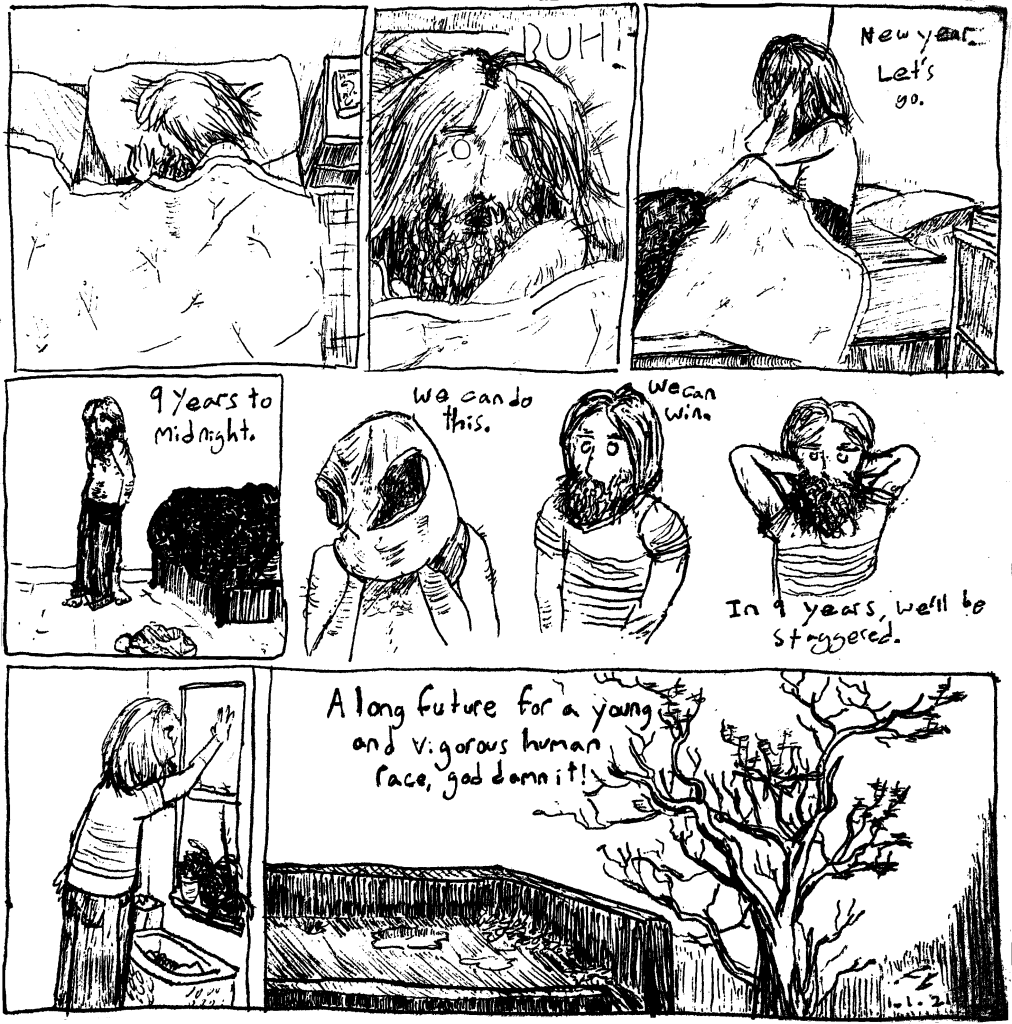
Date: 1 January 2020 1. [Francis asleep in bed.] 2. [Francis wakes up, sitting straight up]. FRANCIS: Ah! 3. FRANCIS [Pointing]: New decade! Let’s go! 4. FRANCIS [Getting out of bed]: The 20’s! We’re gonna halt climate change! 5. FRANCIS [Putting on pants]: 10 years from now we’ll be STAGGERED by the progress made! 6. [FRANCIS, fully dressed, looks out of a window, leaning against it. We view this from outside. Clouds and other buildings reflected on the window.] FRANCIS: A long future for a young and vigorous human race!
Sex Fantasy by Sophia-Foster Dimino is a collection of eight zines published between 2013 and 2017, plus two previously unpublished zines at the end. With one exception, the zines are not about sex fantasies, though they are about intimacy, relationships, and the gaps between people. The slight, but not total, mismatch between title and content is indicative of the way a lot of the book operates, in that it invites interpretation. It reaches for something, but doesn’t go all the way toward grasping it—the reader will have to do that on their own.
The book is divided into three sections of three issues each, and a fourth section of one. The first three zines are the most esoteric, consisting entirely of short declarative sentences (usually starting with “I”) paired with illustrations. Although there are a few moments of sequential art, there’s very little scene, and you could scramble the individual panels out of order and not change much. There isn’t even a consistent, recurring character that appears as the “I” or “you” in all the panels. They operate accumulatively—”I made an effort”, “I hit a wall”, “I wasn’t thinking”, “I’m useful” add up to a persona, an emotion. It’s textual-visual poetry, essentially—and like a good poem, you can slow down and appreciate each line, or panel in this case, as it’s own work of art. In fact, the format of the book encourages this, with each panel taking up an entire page, so that you’re only ever looking at two panels at once.
Although these first three zines aren’t my favorite in the collection, I think they hold some of my favorite individual panels. Some are very intricate, while others are imaginative or surprising in how they illustrate the text. “I like your socks” is printed beside a person wearing hamburger socks lightly stepping on someone’s face. “I’m a beverage vendor” appears beside a drink stand; the stand has three large jugs and three containers of ice or tapioca pearls; a bottle for tips; a vase with a flower; eight notes tacked to the stand’s single contiguous wall; a patterned canopy; empty cups held on pegs; a dangling bell; an OPEN sign; a vertical banner displaying a woman drinking from an enormous glass with a straw; and the “I”, sitting on a stool, wearing a spaghetti strap top, flip flops, a hair bow. The text is spare, but the illustrations are rich and suggestive of worlds that extend beyond their snapshot focus. They are not sex fantasies, but fantasy, or fancy, sure.
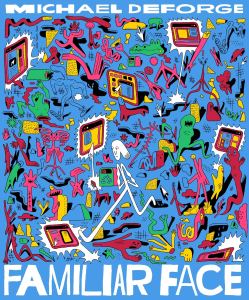
Michael DeForge’s characteristically busy panels full of simple, abstracted forms fit the world of Familiar Face, his latest comic, perfectly. This is a world in unending flux. Every day there are updates, patches, optimizations, altering everything from the subway map of the city to people’s physical bodies. The changes are sometimes drastic and always immediate—no gradualism. One day the narrator character wakes up and finds her body has shrunk, another day the layout of her apartment building has totally shifted, and she’s surrounded by new, unknown neighbors. All these changes are for the benefit of the inhabitants of this world, supposedly, though from the outside they seem totally arbitrary.
As I said, DeForge’s art style is a perfect match. It doesn’t let your eyes sit still, and rarely explains itself. The narrator has a … cat? dog? A very angular spindly little creature which shows up in some panels depicting her apartment, never mentioned in the narrating text which runs over most of the graphic novel. That narrative text keeps the reader on track, helping them identify certain things (e.g. this text description of subway tracks is paired with a drawing of these veiny tubules, so those must be subway tracks), but on other matters the reader is left to strain at comprehension on their own. Is this squiggly blue bit here a car? A person? A dog? You’re as bewildered as the narrator, as anyone in this world, and often the panels are crammed full of this visual information, all in vibrant colors. Now, lots of what I’ve said here could be applied to other works by DeForge, but Familiar Face goes a step further by frequently changing the design of the main character. The one concession to the reader is that characters retain their color scheme, but that’s it—the changes go unremarked by the narrator, forcing the reader to keep pace. I remember at one point reading along and stopping short when I realized that the little four-legged creature I’d been following for a couple pages was, in fact, the narrator!Read More »
EDIT: This post previously said the sale would last through April 20. The sale has now been extended to last through May 31.
As part of Smashwords’ Authors Give Back sale, all my ebooks on Smashwords are free from now through May 31. For catharsis, might I recommend “Beneath Them,” a short story about a devastating alien invasion and an apartment with a roach problem. For pure escapism, “The War on Hormones” is an angsty novelette about pharmaceutically asexual high schoolers at a performing arts school.
If you aren’t already, listen to medical professionals and public health institutions. If you’ve got money to spare, there’s a lot of emergency funds that could use it right now. This is not the first global crisis we’ve faced and it won’t be the last, so let’s do our best and look out for each other!
Ah summer break is here at last, the summer break that will never end because I’ve graduated now, Forever Summer—and I’ve been reading a ton of books!
Kid Gloves by Lucy Knisley — Kid Gloves is the latest graphic novel memoir from Knisley, describing her experience of pregnancy, and everything leading up to it. What’s great is that, in addition to the conception-to-birth pregnancy narrative that we’re all fairly familiar with, Knisley also describes the process of trying to get pregnant, of having miscarriages, and, crucially, her internal state through all of this. Kid Gloves is a very vulnerable, honest book, which spends a great deal of time getting across how Lucy feels about the pregnancy at various stages. Just viewed externally, pregnancy is a pretty dramatic process, but (as Knisley discusses in the book) the experience of the person actually carrying the child is often sidelined in mainstream pregnancy narratives. Not so here.
In addition to her own narrative, Knisley adds in interstitial bits of pregnancy research, trying to debunk some of the misconceptions around pregnancy, and shed light on some lesser known truths. Sometimes this research feels very integral to the personal narrative (the section focusing on miscarriage myths, for instance, spends a lot of time trying to assuage the irrational guilt women who have miscarried often feel), while other sections of research feel kind of inconsequential. Like, pregnancy superstitions or the medicalization of labor might be interesting, but they seem disconnected from the rest of the book in places. Something New had sections like that too, but overall the tone of that book was a lot lighter, so it all felt of a piece.Read More »
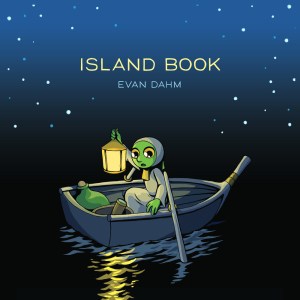
How have I not talked about Evan Dahm before? Evan Dahm is one of those creators I just can’t get enough of. I’ve read all his graphic novels at least twice, and that includes this, his latest completed graphic novel, Island Book.
Island Book tells the story of Sola, a girl living on an island in a vast, unexplored ocean. Many inhabitants of the island believe she is cursed, because of her strange connection to a giant creature simply called “the monster” which lives in the ocean, and which devastated the island when it attacked years ago. So one night Sola steals a boat and sets off into the ocean, hoping to discover the mystery of the monster, and why it seems drawn to her, for herself. She soon learns that there are other islands out there, populated by different peoples, some of whom join her in her quest to find the monster.
By different “peoples,” I mean different fantasy races. If you’re familiar with Evan Dahm’s work, you’ll know what I’m talking about. I believe he refers to them as “kinds” rather than species or races. Basically there’s no humans or elves or dwarves (though Sola’s island’s islanders are fairly close to human.) The character/kind design is an outgrowth of the island they live on—or maybe it’s the other way around. Anyway, this means all the islands are incredibly uh guess what insular, on a design level. Motifs of shape and color are repeated in the look of the land, the island’s ships, and the islanders themselves. For instance, “Fortress Island” is inhabited by these big, hulking turtle people, with ships that look like ironclads. Likewise, the cultures of the islands harmonize with their iconography, and the whole color palette of the book changes from island to island.Read More »
Agggh! This book has sat on the floor of my bedroom since September of last year—basically for my entire senior year thus far—going unread! I made one cursory pass at it sometime during the fall semester, wasn’t really hooked by it, was kind of put off by the art style, and then abandoned it. Well, good thing I didn’t just return it to the library, because now I have read it, and it’s fantastic. (SIDENOTE: I am not a monster. Although my honors student status allows me to check out books for the entire school year without having to renew them, I normally don’t do so unless the book a. is incredibly obscure and clearly not in any demand or b. has multiple copies available. Radtke’s book [probably because she got her MFA here] has multiple copies at the UI library.)
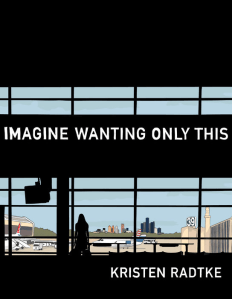
Imagine Wanting Only This is a graphic novel memoir mainly focusing on a period of Kristen’s life starting with her undergrad career and ending shortly after leaving graduate school and moving to Louisville, Kentucky—the “stuck in them 20-somethings” period of life, to borrow a phrase from SZA. As the book moves between major decisions and life events in these years—moves, break-ups, illnesses—Radtke returns again and again to the themes of loss, deterioration, decay, the desire for something more, something new—and the way all these things conflict within her. Is it possible to hold onto the old and gain new relationships, new experiences? Is it possible to hold onto anything at all, when everything is so transitory? What is the value of preserving a ruin versus letting it fall into rot? The strongest through-line of the book is ruins. The urban decay of Gary, Indiana, the devastation of the Peshtigo fire, the volcanic destruction of a town in Iceland, even the mold and water damage in Kristen’s sad college apartment. These images hold the book together, link one event with another, and keep the book feeling cohesive despite the lack of any straight-shot plotline throughout the whole story.
I think one of the things that initially put me off about the book was Kristen and her boyfriend Andrew acting like such creeps (“Really, you can’t say the word ‘yes’ without invoking James Joyce,” Andrew opines at one point), and being unsure whether or not I was supposed to relate to them and feel like their grody behavior was romantic. Because I know these students, anyone getting a liberal arts education knows these students, and they’re the kind of students who I don’t care to be around because I can’t connect with them through their wall of irony and aggressively performed insightfulness. That said, it pretty quickly becomes clear that no, Radtke is not trying to romanticize (for example) the way these two descend on Gary, Indiana in the most exploitative, ruin-pornographer manner. It also becomes clear that a lot of their pretension and surety about the world is covering deep insecurities and internal tensions, which allowed me to relate to them in a way I’m sure I could never, I’m sure they would never let me, if I met them when they were that age at UIowa.Read More »
Been a while since I did one of these, I guess because I’ve been reading lots of short stories. Anyway, here’s what all I’ve been reading the past few months (my god it’s been four months since I read Heavy where did the time go I’m about to graduate aaaaaaaaaaaaaaaa.) Also, I recently read Imagine Wanting Only This by Kristen Radtke, which I had a lot to say about, so that’ll be posted as its own review a few days from now.
Heavy by Kiese Laymon — As the subtitle describes it, Heavy is “an American memoir,” following Kiese Laymon from his childhood up to his early adulthood, returning again and again to themes of abuse, education, body image, racism, and America.
Incredibly, even with these heavy themes, whenever I started listening to this book, I just couldn’t stop. I even listened to it on my airplane ride from Cedar Rapids to Atlanta! Let me tell you, on airplanes I only ever listen to podcasts, or music. Stuff that does not require a lot of cerebral commitment. But when I ran out of saved podcasts, I started listening to Heavy, and the hours just flew by.
Part of the engrossing pull of this book may have to do with how novel-like it is. It’s composed primarily of scenes, scenes that are fully fleshed out with long stretches of vivid dialog, and intriguing, instantly identifiable characters. And the narrative voice shifts to fit the different phases of Kiese’s life. There’s no sense of retrospective distance between the narrator and the events he’s describing, and the result is that as a reader you can be fully immersed in these remembered moments as they play out. That said, Laymon still manages to address more abstract ideas—the book is not just a series of things that happened, it does also pull revelations out of those events, which steadily accumulate and build on one another throughout the book. As I said, it is novel-like, and the novel that it is like is a novel which expertly joins theme with narrative, emotions with ideas, character with critique.Read More »
You ever just have a run of really good books? Like, every book you pick up you just enjoy straight away, and love reading it all the way through? That’s what I’ve had these past few weeks. This is what I’ve been reading:
The Lathe of Heaven by Ursula K. Le Guin — This book follows George Orr, a thoroughly average, inoffensive man living in early 2000s Portland, Oregon (the future at the time Le Guin wrote it.) George Orr is wholly unremarkable, except for the fact that, sometimes, his dreams change the world. When he wakes up from these “effective” dreams, he’s the only who remembers the old world—although he also has new memories from this new world—and otherwise, the new world marches on without missing a beat. When Orr is referred to the psychiatrist William Haber, he tries to get cured of this ability, but soon realizes that Haber is only taking advantage of his effective dreams to try and make a better world as he sees fit—and each attempt only creates a more dystopic reality.
The pacing in the book is terrific, with Haber growing more powerful in each new iteration of the world, and circumstances getting more dire for all of humanity. As well, it lets Le Guin really show off her world-building chops, with all these slightly different futures for Portland and for the whole Earth. The book is largely driven by dialogue, but what prose there is is that clean, cut-glass writing you’d expect from Le Guin. This allows her to establish these new altered worlds quickly, with just a few prominent images to pull the reader in.
What I loved most about this book is the themes it’s dealing with. The idea that the world’s woes can be solved by rational solutions, that these can be applied universally without nuance, is completely dismantled—or rather, Le Guin shows what happens when these rational ideals have to face up against the illogic of humanity, of Orr’s dreams. Nowhere did this theme his harder for me than when Haber tries to solve the war in the near east by telling Orr to dream of a world with no more war. The results are, of course, not perfect, and in fact far more frightening. Haber is the perfect image of the bloodless Rational™ Liberal thinker, who believes there is war in the Middle East because middle easterners are foolish religious zealots, and iF onLy tHey CoUld See tHE lIgHT of ReAsoN TheRe wOulD Be No wAR, and by golly I am the man to fix the Middle East’s problems. Le Guin’s stroke of brilliance is that when this rationality meets Orr’s unconscious mind, the result is not a bunch of humans who suddenly love each other, because in a sense humans were never really the problem—the result is unfathomable monsters.Read More »
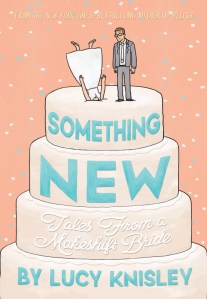
Something New is a graphic novel memoir by graphic novel memoirist Lucy Knisley. Although I’ve read all of Knisley’s travelogues and her terrific culinary memoir Relish (check it out, it’s got recipes!), I put off reading Something New because I knew it was about Knisley’s wedding and weddings in general, and I didn’t think it would hold my interest. I just feel very detached from weddings. I don’t have the kind of money to throw a wedding. I don’t have any attachment to the religious or cultural aspects of it. I don’t have friends who have been married. I don’t foresee myself being married anytime soon (ever?) I’ve been to tons of weddings, but only as an observer, never as part of the groomsmen party (or the bridal party, for that matter.) So even stories of really crazy disaster weddings don’t really connect to me. Like, okay. You did a weird thing with more money than I can ever imagine myself having in accordance with ancient ceremonies, and you put doilies all over it, and then it rained. Like … cool, fun story.
But! I listened to a podcast with Knisley, where she talked about this book as well as her upcoming memoir Kid Gloves, which will detail her pregnancy and fraught-with-difficulties childbirth. I realized that Kid Gloves sounded like a book I would enjoy, as it would present an honest, warts-and-all portrait of pregnancy. And I thought, well, how can I read that book without first reading Something New? Maybe it too will be a different story of marriage than I’m used to seeing. So I checked it out from the ICPL, and dug in. And then I pulled on my socks and shoes and proceed to kick the crap out of myself for not having at least glanced at the first few pages of this book sooner.
The reason I include all this preamble is that, it turns out, many of my feelings toward weddings were exactly Lucy’s feelings, too, before she decided to get married (and even during the process.) And here’s the thing: the wedding itself isn’t all that different from most weddings. It’s not that different from the classical wedding story. However, it’s Lucy’s skepticism and willingness to present the cold, hard facts of marriage that make it such an engaging read. It’s a testament to Knisley’s storytelling that, as she describes her coming to understand why people love weddings, why they are so special, as she sheds some of her skepticism, so did I, to the point that when she finally arrives at the wedding itself, rather than seeing just a bunch of dresses and strings of light bulbs, I was genuinely touched by the emotional sincerity of the moment.
Knisley achieves this in a lot of ways, but mainly by taking her time. The first 70 pages of the book is a love story, detailing the serpentine path that her and her husband took over the course of several years to finally become engaged. Learning who the principal characters (as it were) of this story are in this way is what makes all the wedding planning (which is the majority of the book) engaging, it’s what gives it all depth. And she isn’t messing around with the other 230 pages either, which she uses to address themes that are universal in weddings and marriage, and show how they manifested in her own life. In this way, she’s both informative on weddings in general (with lots of interludes that include facts or statistics about weddings) and insightful in how these things affected her as an individual. One chapter that I found particularly interesting was the one in which she described her experience being bombarded with targeted ads, and how these ads changed her internet experience (and how her fiancé wasn’t targeted at all.)
As for Knisley’s art, she has a very clean, bright style that draws you forward effortlessly, and occasionally provides some great visual gags. She pairs the images and scenes she illustrates perfectly with her narration, underscoring or complimenting the mood, theme, or idea of her words with her drawings. Also, her depictions of food are mouthwatering (another reason to check out Relish.)
Towards the end of the book Knisley writes, “The strangest part I’ve found of being an adult is that I kept waiting for my life to feel the way other people’s lives felt, viewed by me, the outsider.” And although she goes on to explain that we each have to experience our own lives, our own adulthood, for ourselves, I think that with this book she has, in part, granted the reader the ability to look into her life, and the life of a bride-to-be, from the inside—failed DIY projects and all. This book was a terrific, substantial read, and I cannot wait for Kid Gloves.
Plays and comics! I’ve been reading a bunch of plays and comics lately. I’m in a playwriting class, and I’m reading a bunch of plays for a project for another class, and the comics I’m reading because they’re light and I really can’t squeeze in too much extra reading given all the Lemony Snicket books I’m reading, not to mention short stories and essays and poems for another class—anyway, here are some of the plays and comics that have really been stand-out terrific, and worth writing about:
The Goat, or Who is Sylvia? by Edward Albee – This is a play about a man who is cheating on his wife with a goat.
Hahaha, lololol, such fun.
Really, the brilliance of this play is that it is both as ridiculous as that description and as real as the chair I’m seated in (I’m seated in a chair of the real variety, by the way.) And the super-brilliance of the play is the fact that it doesn’t just violently switch tracks between isn’t-this-absurd-you’re-in-love-with-a-goat and what-are-the-real-and-tragic-implications-of-doing-such-a-thing, it runs the two modes simultaneously. I was constantly bursting out laughing and constantly taking sharp inhales throughout reading this play. I reacted to it in the same way I react to horribly-absurd/absurdly-horrible real world events. I have to laugh at the absurdity, but I can’t get away from the horrible reality of it because it’s something that actually happened, in the world I live in.
Albee’s great accomplishment here is that he never lets the audience put distance between themselves and the work. The characters continually make choices, adopt lines of conversation, that ring so true that you can’t just think, well it’s just a silly play.
And the play was written by Edward Albee, so it’s crackling with his wit and dynamic character interactions.Read More »








 Francis Bass