That’d Make a Great Play

I think you can turn any idea into a play, and any idea into a piece of prose. However, there are some ideas that just suit one form or the other better, and since I enjoy writing both, I never try to make an idea that’s best for a short story into a play, or visa versa. I can’t really say what makes an idea excellent material for prose, because there’s so much flexibility in style and scope with prose fiction—however, plays are much more limited. So it really is special when I have an idea for a story, or find inspiration in some piece of news, and think, Man, that’d make a great play. So, when I’m considering how to develop an idea, these are the biggest characteristics that make me think it’d be a good candidate for a work of theatre.

Restricted Setting

This is probably the most obvious one. Because theaters have limited budgets, and limited stage space, most plays take place in one or a few locations. Of course there are exceptions, like every Shakespeare play, but most plays feature just one or two settings. This is something that sets prose and plays apart. There is a clear limitation on the story which is communicated to the audience. The characters can’t get around one another—they can’t solve their problems somewhere else. Everything is going to have to go down on stage, and that creates tension. Even if a prose story is all set in one place, there’s no feeling of suspense over the knowledge that it’s going to be finished in that space—because it isn’t necessarily going to be finished in that space. There are no inherent limits to the form, so the characters can go anywhere they want to, and it takes more work for the author to establish restrictions. With plays, the restrictions are instantly clear.Read More »

Political Analysis: Expectations

Now we come to the final topic from my notes on political analysis—at least from the first half of the class. I’ll probably do another series of posts at the end of this semester, but for now, this is the final word on power.

“How many divisions does the Pope have?”

Thus spake Joseph Stalin in response to Churchill’s concerns about the Vatican’s views.

So far in this discussion of power, we’ve focused on hard power—threats, bargains, consequences—the kind of stuff that Stalin could respect. But what about the Pope? Does he not have power just because his only divisions are brightly dressed swiss pikemen?

It turns out (sorry Stalin) that there is such a thing as soft power, and to talk about soft power we have to talk about expectations, and to talk about expectations, we’re going to talk about John Maynard Keynes and beauty contests.Read More »

Political Analysis: Games

This post we’ll be talking about games—contrary to what people often say in dramas, this is a game.

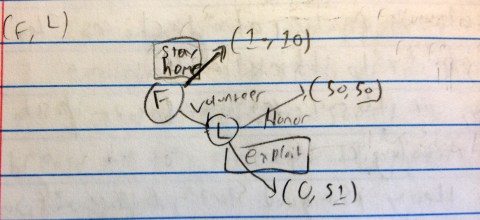
An extensive-form game is a tree of decisions branching out, with actors forming the nodes in the branches, and the branches representing choices that the actors can make. The assumption is always that each actor is making rational choices, trying to get their best outcome, at every point.

To determine the outcome of an extensive-form game, you work from the ends backward to the beginning, using backwards induction. To demonstrate, here’s this game:

EFG-volunteerRead More »

Political Analysis: Choice

Now we’re talking about choice—why do people choose to do things? Why do they take bribes?

If we suppose an individual faced with a set of actions to choose from, and all of the actions are linked to clear outcomes, there are two principles of rational choice.

Principle One: The individual has a consistent set of preferences for outcomes. There are two types of preference ordering: strict and weak. Strict ordering is like a total dominance hierarchy. No matter what, between two outcomes the individual will always have a preference. Weak ordering is like a partial dominance hierarchy, and an individual can have outcomes that are tied in preference. Unlike a partial dominance hierarchy however, the ordering will never be ambiguous—choices will always be tied or ranked, never unknown (as they were in the black male/white female scenario.)

Principle Two: The individual chooses an action to achieve the most preferred outcomes. Sometimes the choice is easy. Sometimes the link between action and outcome isn’t clear. Sometimes the outcome depends on chance, or someone else’s choice.

Well this seems pretty obvious, so what use is it? It’s useful because by understanding what a person’s preferences are, it’s possible to predict more complex decisions involving the interaction of multiple preferences.Read More »

What I’ve Been Reading, March 2016

Some theatre, some sci-fi, some sci-fi theatre. That’s what I’ve been reading.

100 Essays I Don’t Have Time to Write by Sarah Ruhl – The title pretty much explains the book. It’s a collection of one hundred partial essays, almost all of them about theatre. The immediate question that this raises is: why read a book that isn’t complete? And, if you’re looking to learn something, or be informed, or be totally and utterly convinced of something, this is not the book for you. But if you want to be stimulated and provoked, this book is terrific.

First of all, Sarah Ruhl has a fascinating mind. Almost every essay probes into some question or insight that I never would’ve come up with. And, because the essays don’t have to come to some grand point, and very often end with questions, I was left to further explore the topic on my own. The book reads very quickly, and I probably could’ve blown through it in one sitting if I didn’t keep stopping to think, and argue with myself about the ideas she raised in her essays. My only caveat is that I don’t know how interesting the book would be to someone who does not have some experience with theatre—as an audience member, as a performer, or even just as someone who reads plays. My advice for such a person would be: go experience some facet of theatre, and then read Sarah Ruhl’s 100 Essays. It’s fantastic.

If you’re still unconvinced, you can go to her website and read a randomly selected essay (or two, or five.)Read More »

Political Analysis: Networks

In this continuing series of posts taken from the notes for my Intro to Political Analysis class, we’ll look now at networks and what they tell us about power.

Networks are composed of nodes and ties. Nodes are like points. Each represents an actor. An actor can be any individual, institution, nation-state, or social group with a distinct personality. It can even be a chemical.

Ties are like lines connecting nodes. They can represent any relationship—economic, romantic, religious, chemical. These ties have characteristics, like strength, direction, and elements. Strength can be dichotomous (binary) or cardinal (being represented by a number on a scale.) A tie can be undirected (two-way) or directed (one-way, and assymetric.) The elements of a tie can be univalent (just one relationship), or multivalent (with multiple strands of relationships.)

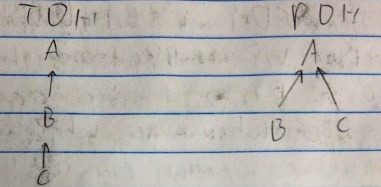
This is what a total (left) and partial (right) dominance hierarchy look like drawn as networks. The arrows point to the dominators (so A has the most dominance in both networks.)

networks-dominance

Read More »

Political Analysis: Dominance

I just had my midterm for my Intro to Political Analysis class, taught by the eccentric, chalk-wielding, duck-loving Professor Douglas Dion, and in preparation for it I typed up all of my notes. Over the years I’ve found that the best way for me to remember notes, and be able to easily study them afterward, is by writing them down in full sentences and paragraphs. Sometimes they even end up being readable and well organized, and I think this is one of those cases. So, here is the first post in a probably four-part series of my notes on political analysis from the first quarter of the Spring semester, and specifically, power. This post in particular is taken from lectures on dominance theory.

The word “politics” comes from a treatise by Aristotle, deriving from the word “polis.” A practical definition is: the theory or practice of government. It can also mean a person’s ideology (i.e., “what are your politics?”) It could be a term for the acquisition of power or status. From all these definitions, politics might seem a mess, which is why we need analysis—another Greek derivation, from a term that means “to unravel.”

Read More »

Gradecraft

Gradecraft is something I’ve always known about, and done as well, but I didn’t ever have a name for it. And about a week ago, the name popped into my head (maybe inspired by the word statecraft), and I suddenly felt like I could write a post about it.

So what is gradecraft? No, it’s not a Minecraft mod, and while it is “a learning management system dedicated to supporting the gameful classroom,” that’s not what I’m talking about.

When I say gradecraft, I mean the skill or act a student employs in managing or manipulating their grades. I’m guessing it’s increased since schools started posting grades online continuously, rather than only sending them out as report cards a few times a year.

Although cheating would fall under that definition, that’s not really what I’m getting at, and it’s rather a crude form of gradecraft. The form that I’m more interested in, and that I’m really referring to when I say gradecraft (have I said “gradecraft” enough yet?) is the skill a student employs when they consider that they have a 68 in Algebra and a 72 in English, and they can either study for an English test which will count for fifty points of a hundred points (those hundred points weighed at thirty percent of their grade) or finish the algebra homework which will count for sixty points of a thousand (weighed at fifty percent of the grade.) Also taking into consideration the future opportunities to raise grades in each classes, as well as odd quirks of each teacher’s grading system (dropping the lowest scored test, allowing two re-dos per semester, extra credit, whatever.)

This act of gradecraft—deciding when bombing a test or not doing homework is the right choice—has funny results on the other end. Teachers seem to take a student not turning in an assignment as a personal slight, which is a somewhat egocentric view—as if the student does not exist outside that teacher’s own class. The teacher sees it as a lack of caring, whereas  the student sees it as a calculated loss. It’s not personal, it’s economics.

This is clearly not an ideal form of Paideia. Students shouldn’t be worried about grades, they should be worried about mastering a concept, or improving a skill. But grades are the most important factor in education, especially high school. GPA determines the ability to apply for certain scholarships, and to get into certain colleges. And grades are made more relevant because parents are able to see them, and it’s the only glimpse that parents get into how their kid is doing in school. So there’s social pressure to hit these arbitrary marks as well, and less pressure to do things parents can’t see (like participate in class or get tutoring help during lunch.) It’s also a lot easier for a teenager to grasp a specific number on a finite scale than an abstract concept like “fluency” or “mastery.”

The reason this emphasis on grades is bad is because it allows scenarios like the following to happen: A student will place more importance on doing busywork for a subject in which they’re already proficient than on actually learning a subject they know nothing about, if that unknown subject’s teacher is an easy grader.

This is a problem inherent in education. Of course there needs to be some standard that colleges and employers can reference to understand the level of skill of a student, but this places undue importance on grades. Rather than being an indicator of progress toward a goal, grades become the goal itself.

This is why I always got bad grades in English classes (by bad I mean ‘B’s, but that seems bad when you consider that I’m a writer.) I always was comfortable in my mastery of the course, and I didn’t care about pursuing arbitrary grades to prove it. I never engaged in much gradecraft, except in cases where I was pressed for time, and had to choose which assignment would give me the biggest bang for my buck.

I should say, I’ve mostly been talking about high school this whole time, because I find that gradecraft is much less prominent in college. The reason is, you can’t engage in gradecraft if your professor doesn’t put up grades. And, at least at the University of Iowa, professors aren’t required to post grades. Maybe this is completely different at other places, but this is the way it is here. And I think that’s a good thing. Teachers should keep track of grades so they can talk to anyone who’s failing, or so that any student willing to make the effort (not many of them) of visiting a teacher and asking for their grades can see them, but otherwise leave students in the dark. Students can get some idea of how they’re doing based on the assignments that are handed back, and their own intuition. That’s how things are in the real world anyway—no official body is going to tell someone they’re a C- barber, or that they’re an A+ farmer. People just have to figure out their strength and ability on their own, and make decisions from there.

While I have some pride in myself and my cohort for being able to engage in gradecraft, and manipulate a complicated, often broken, sometimes antagonistic system, it’s really a reductive activity. It may be useful for classes that a student has absolutely no interest in ever learning or mastering, but when it’s practiced in every class in a student’s schedule, that’s a problem. Because at that point schools aren’t training students to be scientists, historians, business owners, or doctors, they’re training them to be students—with a masters in gradecraft (and a concentration in test-taking.)

Trump as Described by Dickens

It occurred to me that Donald Trump is such a Dickens character. Incredibly wealthy, incredibly self-centered, incredibly ironic—and, the final flourish, his name. His name is absurd. “Trump,” like a trump card. Also like a blaring trumpet.

So I wrote a little thing.

Donald Trump, as Charles Dickens might describe him

Mr. Trump was a tall man with a tall face and a long mouth, which seemed to have swollen out to accommodate the volume of his voice. Having been successful in the circuits of reality television, Mr. Trump made some small adjustments to his line of work, pinned a flag to his lapel, and transitioned into that other marvelous form of American entertainment, politics.

Just as a trump card, though less qualified in every aspect than a superior card, will beat any ace or king simply because it is a Trump, Mr. Trump battered down his opponents not by his qualification, but by his massive, star-spangled Trumpitude. Though he had no political experience to rival the royalty of the King Bush, or even the Jack Rand, and his business prowess did not match the Queen Carly (Mr. Trump had filed for bankruptcy more often than he’d filed for divorce) he would slap his brand across his opponents as a gambler would slap down a card, and declare, “I’m a winner. I have experience in winning.”

Recommendation Dump, February 2016

Another offloading of recommendations is upon us, or upon the reader, really. A broad selection this time, from articles to TV to a flash game.

Tig Notaro: Live – I found out about this through the Netflix documentary Tig, which I would also recommend. Tig Notaro went through several tragedies at once (multiple illnesses, the death of her mother, and finally a cancer diagnosis) and, being a stand-up comedian, started writing jokes about it all. She did a set at the comedy club Largo, and delivered all that material for the first time, with no idea what to expect from the audience. They loved it. Louie CK, who was backstage during this, convinced her to put the recording of that show out for the world to listen to. You can read his post about it here, it’s pretty interesting.

So six or seven months after I saw the documentary I finally bought the thing. The show is very funny, which is all you can ask for from most comedy. But it’s also terrific to hear someone be so forthright about their experience with death. On another level, it’s fascinating to see both Tig and the audience coping with this tragedy through comedy. And the ending is just perfect. I highly recommend this to anyone who is a human. It’s only five bucks on iTunes, six if you want to get the deluxe edition (comes with a story Tig told at the Moth.)Read More »

No One Thinks of Salt

No one thinks of salt.

Of course, people who live in cities close enough to either pole of the Earth do—they see it on sidewalks and roads and doormats for some period of time every year. They couldn’t not think of it, like they couldn’t not think of shoes. But they don’t really think of it in the way I mean. By “think of,” I mean “think up.” And while this could be applied more broadly, I’m mostly focusing on writers when I say “no one.”

More accurately I should say “no one would think of salt,” but that’s not as snappy. Besides, the idea came to me as “no one thinks of salt!” with an implied “if they have no exposure to it.”

So now that everyone’s confused, I’ll try to start making sense. I’ve lived in Tallahassee, Florida almost my whole life. The city, and the entire county it’s in, has just one snow truck, which practically never gets used. In my whole life living there, it only snowed once—and then it was more sleet than snow. So I definitely didn’t think of salt.

I knew that people salted roads in cities where it snowed, but what I didn’t consider is that sidewalks would be salted too. Now that I live in Iowa City, and I’m experiencing my first northern winter, I’ve realized that this is the case. I’ve also realized that salt gets stuck in the treads of your boots, and ends up all over the floor if you don’t kick them off thoroughly. Had I written a story before I lived here, about a city experiencing a typical, snowy winter, I never would have thought to add the detail of a character having salt caked around their boots. But that kind of inventive, extrapolated detail is what makes good writing, especially in science-fiction and fantasy.

Granted, world-building isn’t everything, and a well-told story with the typical fantasy props (castles, dragons, swords, etc.) can still be fun. But there’s no reason a writer can’t tell a good story and develop a well-realized world. Reading science fiction from the fifties, it always nags at me when nuclear power shows up. Many sci-fi writers used it as some catch-all that could power everything from household appliances to helicopters, rather than fully considering other potential energy sources. As a result, the worlds feel simplistic and flat.

Kim Stanley Robinson on the other hand is an excellent world-builder (though not from the fifties.) In his Mars trilogy, he has the typical tented colonies you might find in any martian story, but he also considers the possibility of cities built into mesas, or under the ice caps, or within lava tubes. His rendition of a colonized Mars feels explorable and deep.

Now back to the salt that no one thinks of. Let’s suppose an Earth that is covered by an enormous ocean, with every human being confined to an equatorial island where it never snows. On this tropical island, fantasy writers might spin tales of an incredible world where ice falls in little droplets from the sky. Science fiction writers might speculate about colonizing the polar ice caps. Would these writers consider the problem of snow obstructing paths, and the need to remove it? Probably. But what would their solutions for this problem be? They’d probably be pretty straightforward, and be more impractical than they’d appear on paper. These writers might imagine snow plows, or heated roads, or awnings that could extend to cover pathways when the snow fell. Maybe these writers would lazily speculate that snow could be channeled through gutters just like rain. Salt, although highly practical, would not be the common representation of a solution in these snow stories. But if some writer were inventive and thoughtful enough to envision salt as a solution, their story would be so much richer than the same-old same-old plows and heated roads.

This is what makes some speculative fiction feel not so speculative. What’s fantastic about another retread of Tolkien’s orcs elves and dwarves? What’s innovative about a domed colony on Mars?

It’s the writers that take the time and consideration to extrapolate, and solve problems from the viewpoint of a character in that world rather than an outsider, that create three-dimensional setting. Beyond speculative fiction, it’s the writers that research, or actually visit the setting of their story and fully observe its complexities, that portray a landscape which feels genuine.

It’s the writers who think of salt that craft worlds a reader can live in even after they’ve stopped reading.

Upcoming Publication: “Grumbles”

I’m thrilled to announce that my short story, Kzine15cover“Grumbles,” will appear in the May 2016 issue of Kzine, which will be published sometime around the end of May.

Kzine is a kindle only magazine featuring stories of crime, horror, fantasy, and science fiction. My story falls into the latter category, and once again deals with robots. More than being about sentience or robot souls though, “Grumbles” is about preserving memories, and choosing which memories to hold onto. More literally, it’s about a foul-mouthed robot companion arguing with his owner about what childhood memorabilia the owner should pack for his move out to the asteroid belt.

So … get hype? I think that’s the industry parlance.

My Understanding of Don Quixote

NOTE: I read the Tom Lathrop English translation of this book. The translation is very readable, and full of interesting footnotes to give context. Quotes in this post come from the Ormsby translation, because I don’t have my edition handy.

I’ll start this post by talking about a different  book—The Odyssey.

I was assigned to read this book in a class in middle school and one in high school, and never finished it either time. Every other reading assignment in high school I completed, but not The Odyssey. Part of it was that I was in eighth and ninth grade when it was assigned. Another part was that the book is terrible if read just as a book. The characters are flat, the story is convoluted and repeatedly drags itself out in cheap, illogical ways, and though the writing can be striking at times, it’s translated from a poem written in ancient Greek over two thousand years ago, so I imagine a lot of the poetry is lost. It’s only interesting as it relates to all of western literature following it, which a ninth grader, even one who’s a precocious writer, has no grasp of.

Don Quixote is not as inaccessible as The Odyssey, but it is still a flawed work. The most important thing it contains which The Odyssey doesn’t is relatable characters. Don Quixote and Sancho Panza are realistic, and even have distinct voices. While some of the other characters blur together, and all speak in the same formal style as don Quixote, Sancho Panza and don Quixote are enough to engage a reader on a basic level, with no need for historical context. In addition to this, Don Quixote has the advantage of humor, something that transcends the dry, formal writing style and meandering plot.

If I read this book as just a book, I would say that I enjoyed the episodic style except where the plot completely derailed into repetitive romance stories that had nothing to do with the main characters, and that the book was bloated, but contained an interesting through-line. I’d criticize the almost complete lack of visual descriptions. I would say I adored the main two characters but that there were many secondary characters who seemed redundant, and could’ve been merged into one character. I would say that the handling of Sancho’s character arc was smooth and natural, while don Quixote’s was a bit more jerky and sudden. I’d critique the ending as fitting though too abrupt. Overall I’d like the book, though I wouldn’t recommend it to anyone who wasn’t a big reader.

But I didn’t do that. I read the book knowing it is considered the first modern novel, knowing that everything I’ve read and written has been influenced by this book. I read it knowing that Cervantes wrote the book at the height of the Spanish Empire, and the height of its excess. I read it knowing that it was parody of chivalric romances, the popular genre of the day. I read it knowing it was blazing it’s own path through uncharted literary territory. With that in mind, I loved the book.

Read More »

What I’ve Been Reading, January 2016

Here I go again, with a Victorian novel, a sci-fi novella, and a dramatic play.

Our Mutual Friend by Charles Dickens – The last book I read for my Dickens class, and the last book that Dickens completed. The plot is hard to pin down. The “mutual friend” described in the title is definitely a big part of it, but he’s not the only part, or even the biggest part. There’s the typical Dickens ensemble of characters that ranges from villains to saints and paupers to aristocrats, but they’re not all connected by a common plot. They are connected through themes, the big ones being death and wealth. The mutual friend is the heir to a fortune, and he fakes his own death to live a humbler life—which really ties the two big themes directly together. More than that, it’s difficult to say. I imagine each reader gets a different impression of what the most noteworthy aspect of this book is, and there’s a lot to choose from.

If you like Dickens though, you’ll love this book. The writing is complex and entertaining, and the characters and their relationships are a constant source of fascination. It’s a recombination of many of Dickens’ tried and true motifs, characters, and plots, but a perfection of them that kept me engaged enough to read through the last two hundred pages in a day.

“The Citadel of Weeping Pearls” by Aliette de Bodard – This novella, which I read in the October/November issue of Asimov’s, is set in Bodard’s Xuya universe—a world where China discovered the Americas first, and Southeast Asian cultures goes on to be much more influential. In this novella, it is the space age, and the Dai Viet Empire is facing threats from the Nam Federation. To counter these threats they desperately need to find the Citadel of Weeping Pearls, a space station to which the rebellious princess and heiress fled thirty years ago, and which disappeared without a trace.

The novella is similar to Our Mutual Friend in the way all the characters are tied together by themes, if not plot. That’s not entirely true, because the characters converge much more tightly in “Citadel” than they do in Our Mutual Friend, but that convergence isn’t really crucial or meaningful, it’s just useful for keeping things focused in a short novel. The recurring struggle of these characters is retrieving something that’s lost. The empress wants to reunite with her daughter, who she last saw when she was trying to attack the citadel. An engineer attempts to build a portal into the citadel so she can see her mother again, who was onboard the citadel when it disappeared. The younger princess feels disconnected from her daughter, who was turned into a mindship to be used by the empire.

Though the story opens strong with a fantastically large and interesting world, the characters, and their relationships and struggles, are what ended up engaging me the most. For them, “The Citadel of Weeping Pearls” is worth reading. Currently it’s only available in the issue of Asimov’s in which it was published, but I’m guessing it will be published by itself some time down the line.

Oleanna by David Mamet – Oleanna is a short, two-person play by David Mamet. The characters are a college professor and a student of his. The first act is dominated by the professor spouting long philosophical lines about the failures of higher education, under the pretense of helping his student understand the class. The second act flips things around, as the audience discovers that the student has used sexual harassment claims to threaten the tenure of her teacher.

The play is fascinating. It changed my mind many times throughout reading it, but not because of ambiguity or a withholding of information—just because the characters and the questions raised are so challenging, and so well-explored. It even has a sound, decisive conclusion without crowning a victor, without establishing a right and a wrong. It’s a play that I’m definitely going to re-read, and watch the first chance I get. The only problem is that both the characters seem to be empty, sterile Mamet puppets, mere vehicles for the clashing ideas without much other content (the professor has a house, a wife, and kids, but that’s about all we get. I’m not even sure what the class was really about, or what degree the student wanted to get.) There were times when the lack of personality made me feel distant, and less engaged. I don’t know that the play would be improved with the inclusion of more character development though. Part of why it’s effective is how bare-bones it is. Plus, I didn’t see two flesh and blood actors performing it, so maybe it’s a problem exclusive to the written form of the play.

Regardless of that minor quibble, I highly recommend reading or watching Oleanna.

EDIT: Ennh, or not. At the time I read this I didn’t see it as an attack on political correctness and a denunciation of assault allegations, as one work in a long line of bullshit campus plays and novels. I mainly read it as an exploration of student-teacher power dynamics existing in a vacuum, and I dunno, if you can read it like that maybe you can enjoy it. But I think it pretty clearly was not written in a vacuum, and it’s just another fuckin campus play. As I said in the above review, I actually empathized with the student, which the text is like, not trying to get the audience to do? I’ve never reread or watched Oleanna, and I don’t intend to.

So, that’s what I’ve been reading. I also read Foundation’s Edge and Don Quixote. I thought Foundation’s Edge was alright, but I didn’t talk about it here because I wouldn’t recommend it. The only reason that I’m mentioning it at all is that I mentioned it last post, and I want to clarify that I’m not going to write about it in one of these. You know, in case you’ve just been on god damn tenterhooks since my last What I’ve Been Reading post. Don Quixote I’ll probably write about in a separate review, because there’s a lot to write about.

I have no idea what I’ll review next. Probably it’ll be words.

Chapbook – [Unintelligible] and other works

bottom-borders-smallest

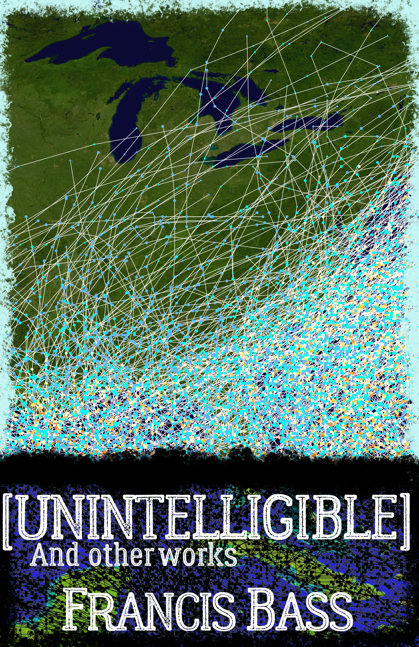
As promised, here’s a PDF of the chapbook, containing two essays and a writing exercise. To be clear, it’s not a published chapbook, it’s a small compilation I made as the final project of a writing class.

The works contained within are “A Faulty Baseline,” “It Was Unbroken,” and of course “[Unintelligible].” And in case you’re wondering, the image on the cover is a portion of a map showing  the paths of every Atlantic hurricane from every hurricane season since 1851.

Recommendation Dump, December 2015

A much broader range of recommendations this time around, with no recurring theme. That’s why it’s called a dump though, not a cogently curated collection.

The Color Before the Sun Coheed and Cambria is easily my favorite band. They straddle a lot of genres in the rock/punk/metal area, and until this album all of their work has been concept albums, following the story of the lead singer’s comic book series The Amory Wars. The combination of strange song concepts and fantastic music is why I love the band so much. I’ve burned out on a few artists whose music I enjoy, but who keep writing the same songs (conceptually) over and over again. Coheed and Cambria always mixes it up, and in this album they mixed things up by not doing a concept album. At least, the concept isn’t sci-fi, though a lot of the songs focus on the lead singer’s identity crisis. The songs are more rock than metal, with the exception of “The Audience,” but Coheed and Cambria has always danced in and out of genres. Of course, music is incredibly subjective, and this may not be your thing, but for me, this album is my soundtrack right now.

High and Mighty – I started listening to this podcast when it launched along with all the other Headgum podcasts, and it’s slowly become my favorite of the bunch. Each episode, comedian/actor Jon Gabrus has on a guest or two, and they go hard on whatever topic the guest is best suited to. I absolutely love this kind of stuff—not just the basic, wikipedia-level information, but the deep shit. The inside jokes. The behind the behind the scenes. The concepts that don’t come out in theory, but everyone does in practice.

As they discuss in the first episode, Gabrus has his feet in many camps—nerd, meathead, Taco-Bell-fanatic—and these interests all come out in the podcast. That’s another thing I like about it. Neither Gabrus nor the podcast fit into a strict agenda of just geeky or just comedy or just anything, which most podcasts and internet personalities do, and which can be boring (this is part of the reason I do random posts like this and not just writing stuff.)

To get a sense of what I’m talking about, I’d recommend listening to the Long Island episode. It’s the best representation of what I love so much about the podcast.

In the Loop – I first watched this movie when it came out, which was six years ago, when I was twelve or something. Needless to say, I was lukewarm on it then, and chalked my disinterest up to the movie’s parchingly dry Britishness. Six years later, I was actually able to follow the story this time, and understand the distinctions between characters (you know, the basic elements of a movie.) The movie certainly has its dry Britishness, but it has equal parts bombastic Scottishness. The story is a tangling political yarn driven by bureaucrats who are misinformed, incompetent, militaristic, or just constantly dropping F-bombs. It’s an excellent satire, with a great balance of intellect and humor. Fuckity-bye. ‘Nuff said.

Swords and Souls – I normally don’t like Final-Fantasy-style games where you attack by selecting an option. They just feel too grindy, like they’re just about getting stats up and there’s not enough skill or player control involved (Note: I’ve never played Final Fantasy, just some flash games that use that form.) But I loved this game. It was made by SoulGame, who made the Rogue Soul games, and just like those games, it is slick. Instead of being turn-based, attacks are automatic, and special attacks are controlled with hotkeys. The game is constantly moving, and the feeling of control is nice. Each stage is a few enemies and a boss, and after the first time beating a stage there’s a big money and XP reward. And of course, each stage gets a little harder.

This would get boring pretty quickly, but there’s lots of progression milestones to keep reaching for, and to keep the player interested. To level up skills, instead of just grinding through previously beaten stages (although you can also do that), there are mini-games that increase skill in specific traits. They’re mostly based on quick reaction time and precision. Getting good at the mini-games, and being able to fly through them as they speed up (as more apples are flung that must be blocked, or more targets appear that you have to shoot) is really fun. There’s also the little bit of satisfaction from buying new, cool-looking armor, from adding trophies to the museum, or from adding onto your house. The house increases the amount of money you earn, though I didn’t realize this until late on, and had just been buying additions as a show of my awesome status. Swords and Souls is an addictive experience that plays fast, and is incredibly fun.

So, those are four things I really enjoy. Hopefully you do too.