
The month of spooktober has passed, but autumn, the season of death, still surrounds us. So today I bring you reviews of the books I read this October. For the past several years this has been a tradition of mine, reading a bunch of spooky books around this time of year, though I’ve only made a post reviewing them all once. Hopefully from this year forward, that can be part of the tradition too.
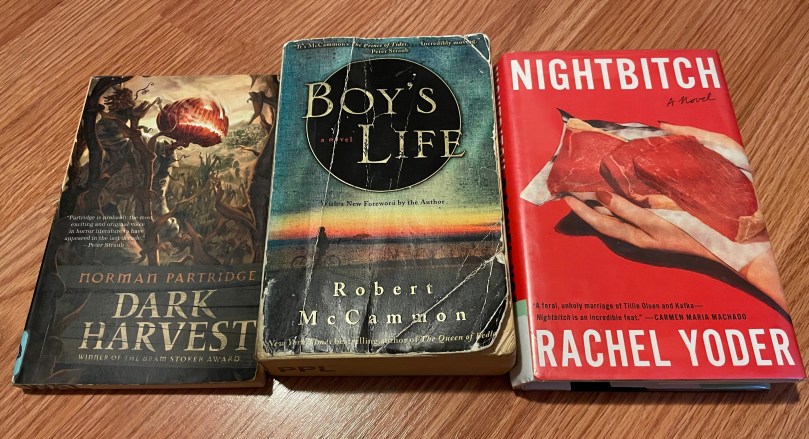
Boy’s Life by Robert McCammon — Boy’s Life is narrated by Cory Mackenson, a middle-aged writer looking back on a pivotal year of his life growing up in the small town of Zephyr, Alabama. The book is divided into four main parts, each corresponding with a season, starting in spring and ending in winter. The year in question is the year Cory turns 12, and the year he and his father stumble upon a murder victim drowned in Saxon’s Lake, an old flooded quarry. That murder, and the mystery of the victim’s identity, let alone the killer’s, is the main throughline of the novel.
However, this book is over 600 pages, and it is not 600 pages of Encyclopedia Brown working one case. Instead, the book is composed of episodic chapters detailing various different adventures in Zephyr. Sometimes these chapters reveal a little more about the murder mystery, but usually they don’t. They often don’t even relate to one another, and they vary greatly in terms of tone and genre. One chapter is about a new kid in town who turns out to be a baseball prodigy; another is a monkey’s paw-esque story about the death of the family dog; another finds Cory abducted by a member of a moonshining clan. These chapters don’t really connect or build up to a larger narrative arc, aside from the arc of Cory growing up. Characters enter and exit like stage actors. They arrive, they play their part to a tee, and then they leave. Even Cory’s main group of friends really only shows up when they’re a central part of the chapter, but otherwise they have no involvement with the murder mystery or any other misadventures.
Because each chapter is so totally committed to its trope or theme or genre, McCammon never holds back. He gets to the good stuff right away, every time. The lake monster isn’t going to come back later, so the first chapter where it appears doesn’t waste time with just a little ripple in the water, or a half-glimpsed fin, no—the lake monster makes a full appearance and attacks Cory! Lots of the chapters feel like B-movies that have been fast-forwarded right to the climax. So instead of a tightly woven story where each thing leads to the next, you get a multigenre smorgasbord of all killer no filler one-off adventures. It’s a trade-off which I was happy to accept.
To accommodate this great variety of genres, McCammon takes several different approaches to the fantastic elements. Some, like the lake monster, are treated as real supernatural phenomena. Others are clearly established as dreams, or the work of Cory’s imagination. Some are left up to the reader to decide. This is a delightful way to handle things because it sidesteps the question of what is “real,” or what is “really” happening—questions which would mean little to 12-year old Cory. Just go along with it, make believe, because this is the stuff a child’s life is made of—the impossible, the imagined, the absurd. It’s like all the things you hoped were true as a kid, all the secrets that you and you alone knew, and all the things that you still can’t believe were real now. I would compare the vibe of the book to Ray Bradbury or Calvin and Hobbes—although decidedly darker.
That was one aspect that quickly hooked me. Though the book is sentimental, McCammon’s vision is not rose-tinted, or even family-friendly. The murder Cory and his father witness is shocking and gruesome, and there are more moments like that throughout the book. That grotesquery, brutality, and plain old banal cruelty underscores the enchantment of Zephyr. It keeps the book from being just nostalgic pap, and gives everything weight and solidity.
In all, the book is an absorbing read. It’s a little shallow for such a long book—because of its episodic style, Cory and his mother and father are the only characters allowed any depth—but as I said, the book makes up for that with sheer narrative firepower.
Dark Harvest by Norman Partridge — Speaking of Ray Bradbury, he and Norman Partridge must’ve drunk from the same jack-o-lantern-shaped goblet of autumnal inspiration, because this book positively radiates Halloween essence in a way I’ve only encountered with Bradbury before.
The premise is this: every Halloween in a small midwestern town, the adolescent boys are set loose with one objective: keep the October Boy from reaching the old church by Midnight. The October Boy is a walking, knife-wielding, pumpkin-headed scarecrow stuffed full of candy. Whoever takes down the October Boy is celebrated as the victor, and allowed to leave the town, while their family is treated like royalty for the next year.
Oh, right—no one is allowed to leave this town. At first it’s unclear if this is just because of circumstances, like economic and cultural forces tying people in place, but later on it becomes certain that these people really are trapped, and the teenage boys running wild on Halloween night are all desperate to make good on their shot at freedom.
The book follows one of these teenage boys, Pete, and the October Boy himself, as their paths steadily converge. The pacing is snappy, with all that exposition I just gave you doled out in tantalizing pieces throughout the first fifty pages, and more reveals later on. It twists and turns with a cinematic speed, leading up to a satisfying blow-out throw-down beat-em-up climax. The book is only 170 pages, so Partridge doesn’t have time to mess around.
The prose is confident and sardonic and thick with imagery. It’s got a kind of detached, cocksure storyteller voice which would get grating if it were longer, but serves the pace and scope of the story well. And as I said, the Halloween vibes are immaculate. E.g.: “The Boy draws another tentative breath, and his exhalation carries the rich scents of scorched cinnamon and gunpowder and melting wax.”
A perfect quick read for October. You could read it all in one night, if you want.
Nightbitch by Rachel Yoder — Boo! It’s litfic!
Nightbitch by Rachel Yoder is about a woman who has to give up her art job and most of her art-making to raise her son. Her husband is a worthless dolt who works out of town four days a week and just goes on his phone on the days he’s back home. As her frustration with this state of affairs grows, the mother starts to turn into a dog, maybe. She also plays “doggy games” with her son, engaging in increasingly feral activities which he gleefully joins in on.
Things escalate. The mother (unnamed, known only as “the mother” or “nightbitch”) is either losing control, or willfully giving in to her canine nature.
The book is a lot of fun. It keeps you off balance, with no way to know what the mother will do next, or when she might go too far. Her acts of wild carnage are simultaneously cathartic and terrifying. It’s also hilarious. As the book progresses, the mother stops trying to hide her transgressions and starts aggressively downplaying them, insisting on their normalcy—even as they get more bizarre. When her son starts sleeping in the kennel, it is still just “doggy games,” a cutesy name which becomes more disturbing and funny in equal measure as things escalate.
Now the book does beg the question of why this woman doesn’t just tell her husband to get his shit together and start picking up the slack—why she lets his inadequacies drive her to rage, and thence to canine adventures. We have to assume that she has already told him, or maybe knows that he won’t listen to her. And then we wonder why she married this bore in the first place, and we have to assume … what? She was so scared of becoming a spinster that she married this man who doesn’t listen to her and likes to go on his phone during family time?
We do get some discussion of the mother’s feeling that she needs to do it all—be the successful career woman and the loving mother—but this is all after she’s had the kid. Why did she feel she had to have the kid in the first place, and why did she marry this loser? We get some reasons that she fell in love with him, but not why she married him. The whole book is driven by the nightbitch’s frustration at not having time to do what she wants, not having energy, at having to give up her identity, at being trapped by her circumstances—but that’s not compelling if she chose these circumstances entirely of her own will. So the reader just has to assume a certain level of coercion for the mother to be compelling, for her rage to be anything other than the rage of the guy shoving a stick into the spokes of his own bike.
If you can get past this, as I said, the book is pretty fun. It’s aesthetically litfic—the style of writing, the treatment of the fantastic—but it doesn’t have more literary depth than, say, Dark Harvest. It’s short, too. And the unnamed midwestern college town it’s set in is 100% Iowa City, you cannot tell me different, you’re not fooling me Yoder, the bougie independent grocer across from the public library, hello? That’s always fun for me.
The final fifty or so pages, though, were a letdown. There’s a moment where nightbitch goes way too far, a horrific act, which I took as an escalation into something even worse, some final rampage—but no, that moment is actually a turning point, and afterward nighbitch’s feral activities become curbed and redeemed, and she comes to an understanding with her husband which is so perfect, it completely deflates the first half of the book. Like if he was this understanding all along, and all it took was her explaining things in a certain way, then why didn’t you just talk to him earlier? In addition to being contrived, it’s just boring.
Put another way, the beginning is very “The tiger
He destroyed his cage
Yes
YES
The tiger is out” (fun, messy)—but then the end is very “You only have to let the soft animal of your body
love what it loves.” (Tedious, twee.)
(First poem is “The Tiger” by Nael, age 6. Second is from “Wild Geese,” Mary Oliver.)
So look, Nightbitch was still a really fun read, I enjoyed it, and I look forward to the film adaptation. I just wouldn’t put it on a shelf beside The Awakening or A Room of One’s Own.
Maybe it can hang out with “The Debutante,” though.
So that is all for Spooktober 2023! Coming up in December, I will be releasing one final zine, a re-issue of a previously self-published novelette, “The War on Hormones.” It’s about pharmaceutically asexual students at a performing arts high school, and was written when I myself was a senior in high school. It will mark the conclusion of this trial period of zinemaking, where I’ve been trying stuff out and giving it away for free—so it will be free, but it’ll be the last one! See you then!
 Francis Bass