Thoughts on A Series of Unfortunate Events, Season One

I’ve watched Netflix’s Lemony Snicket’s A Series of Unfortunate Events in its entirety now, and there’s a lot to talk about. This post will be part review, part analysis, and part comparison between the books and the show. The first third of the post contains no spoilers, but the next two thirds do, for the books and the show, and I’ve put a disclaimer in at that point.

For reference, and so I don’t have to explain it later, this is the basic plot: Three children, Violet, Klaus, and Sunny Baudelaire are orphaned when their parents die in a fire which destroys their home. The parents leave behind an enormous fortune, which cannot be accessed until the eldest Baudelaire comes of age. The children are moved from guardian to guardian, always pursued by the villainous Count Olaf, who schemes to steal their inheritance, and is ruthless in his pursuit of this goal. Violet Klaus and Sunny survive by their inventive thinking, extensive knowledge, and ability bite things (respectively.)

So, here we go:

If You Haven’t Read the Books …

If you’ve never read the books, I highly recommend the show. I don’t know if it’s better or worse to have read the books, but I’m confident that it stands by itself as a terrific work of art. There is nothing like it on TV, and for good reason.

asoueolaf
Photo courtesy of Joe Lederer/Netflix

Imagine if a showrunner spent seven years writing hundreds of pages of stories and characters and settings, and wrote all of them in the voice of the show’s narrator. Imagine they worked with a designer who drew hundreds of pieces of concept art detailing the looks of characters, props, and sets. Imagine if the showrunner also composed and performed thirteen songs to go along with different parts of the show (though not to be actually used in the show.) And imagine they had a decade after that time in which they continued thinking about the show, and expanded on the background of the narrator by writing a few hundred more pages about his childhood in this same world.

That, of course, would be absurd, but because of the way this all developed, it’s essentially what happened. And while this could be said of many shows and movies adapted from books, the difference here is that the original creator usually isn’t the one writing the screenplays. Daniel Handler, author of the book series, is also the screenwriter for every episode of the Netflix series (and although he’s not the showrunner, he is an EP.) The result is an uncompromising vision of a world and the characters who inhabit it. The music, set design, and writing are all of a cohesive style—one which is confidently gothic, bizarre, and witty. The show is highly engaging, full of wonderful(ly wry) commentary from the narrator, beautiful(ly ugly) sets, and charming(ly villainous) performances. At times I had doubts about the direction the show was going, the portrayal of a character, or the handling of a particular scene, but never, throughout watching the entire show, did I feel I could look away. I expect that kids will devour it.

If you have read the books, you will also probably love it, unless you love the books for some particular reason which the show has altered. In that case, I’d advise you to pretend that the series has nothing to do with the books, and enjoy it for what it is.Read More »

New Publication: Just Dig

justdig-4I’ve just published “Just Dig,” a short story, available on Amazon and Smashwords. Here’s the synopsis:

Two brothers, asteroid prospectors, are awoken when an asteroid lands somewhere along the boundary between their little plot, and the enormous plot owned by their neighbors. They drive out to see on whose plot the rock has fallen, and who can claim it as theirs to sell. As they do, they argue about whether they can depend on luck to end a long dry spell, or if they’ll have to make their own luck to turn a profit.

Also included in the publication is a brief afterword, in which I explain the origins of the story, the edits it went through, and who won the 2014 FSU vs. Notre Dame football game.

Rereading A Series of Unfortunate Events: The Miserable Mill

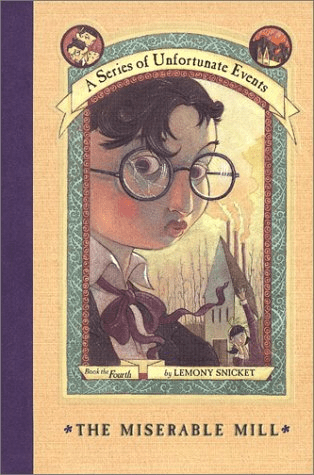
With the TV adaptation released as of this very Friday the thirteenth, I’m rereading one of my favorite book series from when I was a kid—A Series of Unfortunate Events. Today’s post brings us up to fourth book in the series, and the last book adapted in the Netflix show—The Miserable Mill. This post contains spoilers for the first four books of ASOUE, so as Lemony Snicket would say, “if you prefer [reviews] that [don’t give away plot information], please feel free to make another selection.”

the_miserable_mill_usa
Cover courtesy of HarperCollins

The fourth installment of Unfortunate Events tells of the Baudelaire orphans’ stay at the Lucky Smells Lumbermill. Instead of living in a house, the Baudelaires have to live in a bunkhouse for the mill’s employees. Their new guardian offers them a “good deal”—in exchange for his providing them food, housing, and protection from Count Olaf, they will work in his mill. The orphans really have no choice in whether or not to take the deal, and they are forced to work in terrible conditions. While they uphold their end of the deal, their guardian is unable to protect them from Count Olaf, who once again returns in disguise and attempts to steal the Baudelaires’ inheritance.

Some Gripes

The writing of the book is as superbly dark, imaginative, and humorous as the previous three, but there’s less interesting character work, and less intriguing plotting. The new characters introduced in the book are one-note, and the Baudelaires themselves are inactive throughout most of the book. For the majority of the story, things happen to the orphans, rather than them taking initiative and trying to outsmart Olaf, or uncover his plot, the way they usually do. This isn’t actually a problem, as I’ll explain later, but it does make the book a slower read than most of Snicket’s books.Read More »

Rereading A Series of Unfortunate Events: The Wide Window

With the TV adaptation’s release just two days from now, I’m rereading one of my favorite book series from when I was a kid—A Series of Unfortunate Events. Today’s post covers book three, The Wide Window.

the_wide_window_usa
Cover courtesy of HarperCollins

“Book the third” of A Series of Unfortunate Events finds the Baudelaire orphans arriving at the house of their new guardian, Aunt Josephine. Aunt Josephine’s house is perched on the edge of a cliff (all but the foyer of the house is held up solely by stilts) above Lake Lachrymose, a lake filled with man-eating leeches. As always, Count Olaf shows up in disguise and concocts a plan to steal the Baudelaires’ inheritance. The book is full of Handler’s dark, gothic creativity, and the plot twists and turns in unpredictable and riveting ways. As I write this, I’ve already reread through book six of Unfortunate Events, and The Wide Window is probably my favorite of the early books.

That Leaves You with a Rattle

In my previous posts I’ve talked about how each of the main characters is somewhat defined by their particular skills—Violet invents, Klaus reads, and Sunny bites—and about how the story can sometimes feel contrived because of the way the orphans end up being presented with situations that require their specific skills. The Wide Window manages to subvert this trend to great effect. When the Baudelaires come to their new home, their Aunt Josephine presents each of them with a present. Violet is given a doll, Klaus a train set, and Sunny a rattle. The fact that the items are so incongruous with the orphans’ skills and interests subverts the reader’s expectations, and this subversion really accentuates the awkwardness of the situation. It’s a smack of reality after the perfect (at least before Count Olaf showed up) life that they had with their previous guardian. But the subversion continues.Read More »

Rereading A Series of Unfortunate Events: The Reptile Room

With the TV adaptation just around the corner, I’m rereading one of my favorite book series from when I was a kid—A Series of Unfortunate Events. Today’s post regards book two, The Reptile Room, and it does contain spoilers for that book. As Lemony Snicket would say, if you don’t want plot information given away, “you are free to put this [review] back on the shelf and seek something lighter.”

And Speaking of Spoilers …

the_reptile_room_usa
Cover courtesy of HarperCollins

In this book, the Baudelaire orphans go to live with another distant relative, “Uncle” Monty, who studies snakes. Right as the orphans arrive, Uncle Monty is planning a scientific expedition to Peru, and he wants the orphans to come along. Eventually Count Olaf shows up disguised as Monty’s assistant, and schemes to steal their children’s inheritance once again—a scheme made easier by the death of Uncle Monty.

What’s interesting about this book is that it reveals the death of Uncle Monty as early as page 28—and not in some hint or euphemism, the narrator explicitly states, “It is Uncle Monty, unfortunately, who will be dead.” Mentioning this so far up front is important because it lets the readers know that, even though the main characters are having a good time in their new home, misfortune will strike again.

It also softens the blow of Uncle Monty’s death. The death of the caretaker is more disturbing than anything in the first book, because the children actually see his corpse (compare this to Harry Potter, wherein there’re no corpses until book four, more than halfway through the series.) It’s also more shocking to the reader than anything in The Bad Beginning, because unlike the parents who die in the first book, we actually get a chance to see Dr. Montgomery and get to know him before he dies. So knowing that it’s going to happen ahead of time takes some of the edge off the murder. It’s important to do that because this is only the second book of the series, and the first book where the guardian isn’t Count Olaf—the reader can’t have very clear expectations of how “unfortunate” these books will get, so the death of Uncle Monty establishes the tone, and severity of misfortune, for the entire series.Read More »

Rereading A Series of Unfortunate Events: The Bad Beginning

badbeginning
Cover courtesy of HarperCollins

I’ve been wanting to reread A Series of Unfortunate Events for a while, and with the Netflix series premiering in just a week and change, now seems like a good time. So, leading up to Friday the 13th, I’ll be posting reviews of the first four books—the ones covered in the TV series. I could stop there, but as soon as I started reading the first one I was hooked, and I could easier stop drinking coffee than stop reading these books at this point. So I’ll keep posting reviews after that, I don’t know how often, but at least weekly.

The Only Series That Matters

I’ll start by explaining, why this series? Between the ages of six and ten, I read a lot of YA and middle grade books, and a lot of book series—The Underland Chronicles, The Inheritance Cycle, Magic Treehouse, the Alex Rider books, the Alfred Kropp books, GoosebumpsAnimorphsCaptain UnderpantsThe Spiderwick Chronicles, and others. Some of these series I read all the way through, others I didn’t. But as far as I was concerned, A Series of Unfortunate Events and Harry Potter were the only series that mattered. There were no other books that I reread so often as the books in those series. They were the two pillars of children’s literature for me. Looking back on all the books I read as a kid, those are the only series I’m still interested in rereading—and, although Harry Potter was my favorite when I was a kid, Unfortunate Events is the series I now care about rereading most. The books introduced me to so many concepts, phrases, quotes, and words which have stuck with me to this day. Molotov cocktails, Friedrich Nietzsche, mob psychology, waxing and waning—but I’m getting ahead of myself. The point is, the series looms large in my childhood, and hopefully these posts will explain why, as well as illuminate other matters I find interesting along the way.Read More »