Chechnya, From Dudayev to Kadyrov

I’ve recently been fiddling with an idea for a short story which would involve a minor war in the future, with ambiguous morality of each side. Separate to that, I attended a presentation by Andrey Sazonov, sponsored by the Iowa City Foreign Relations Council, titled, “Ramzan Kadyrov, Leader of Chechnya: Putin’s Frenemy?” That title interested me, and so did the prospect of free food, but I didn’t even realize how great Chechnya would be for that story I’d been trying to get a grip on. Seeing this seminar (which is available online here), it appeared that Chechnya was perfect. Tiny enough to be ignorable, but  excessively militarized enough to have a robot battalion. At least, to have a robot battalion in the future. So with that lecture as my background, I did some of my own research on Chechnya. Here it is.

Recent History.                                                                                                         

Chechnya was conquered by imperial Russia in the 1800s, though resistance from the conquered peoples continued right up to the declaration of an independent state in 1917, before being taken by the USSR in 1921. Then a bunch of horrible Stalin things and apologetic Kruschev/Gorbachev things happened, and in 1991 Chechen Dzhokar Dudayev lead a nationalist party to overthrow the Chechen-Ingush Autonomous Republic of the Soviet Union. The USSR dissolved in that same year, but Yeltsin wanted to keep all of the Russian Republic—an administrative region of the USSR that is what we now recognize as Russia—together. In 1992 Yeltsin put forth a treaty that granted states of non-Russian ethnic background limited autonomy, which was signed by all but two of the eighty-eight states—Chechnya and Tartarstan. In 1994 Tartarstan signed a treaty to be annexed by Russia, leaving just Chechnya defiant.
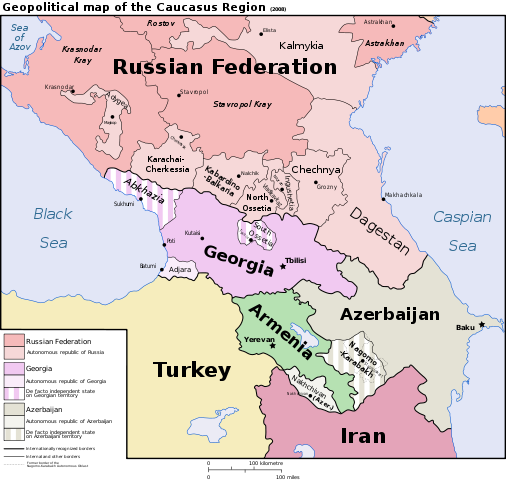
Map courtesy of Jeroenscommons

In 1992 Ingush split from Chechnya and was absorbed into the Russian Republic, and the next year Dudayev declared full independence as the Chechen Republic of Ichkeria. In Dudayev’s Chechnya the minority of ethnic Russians, who had long been the ruling elite, were harshly persecuted. Although most Chechens still wanted independence, not all of them wanted ex-General Dudayev to be in power. Thus, there was some armed resistance to the Republic of Ichkeria, which received support from Russia. In December of 1994, Russia declared a full-on war to retake Chechnya, assuming that a lightning-fast aerial bombardment would bring the republic to it’s knees, and finish the war by that Christmas. But it turns out the fighting wouldn’t end for six more Ramadans.Read More »

What I’ve Been Reading, September 2015

Hey look! My first ever review-type post. Maybe I could review these book-by-book, and dedicate entire posts to each, but I don’t feel like it. Here’s what I’ve been reading.

The Restaurant at the End of the Universe by Douglas Adams – I have mixed feelings about this book. I loved Hitchhiker’s Guide to the Galaxy, and I was eager to see how the story would wrap up in this one. I’m not going to recap what these books are about, because you should already know, and it doesn’t matter.

Like the first one, the book is hysterical, full of wonderful pithy gems and subversive creativity. It’s also full of casual nihilism and comic brutality, which I so enjoyed in the first one. The repeated plot device of mortal peril was tiring though, and the randomness became dull. The characters are very reactionary, but don’t take action on any of their own desires (whatever those are, I couldn’t get a firm sense of it for any of them.) It’s definitely worth a read though, and I’m definitely going to read the next one some time—just not as solid as the first book.

Who Fears Death by Nnedi Okorafor – This book excels in every way I’d hoped, and in ways I didn’t even expect. The world is one I haven’t seen, complicated, surprising, and beautiful. Attempting to explain it wouldn’t do it justice, so I’ll just name three items found within it: camel racing, eleventh-year rites, and juju. The protagonist is terrific as well. There’s a tendency in fantasy books to have a Strong Female Character—and no matter how well developed, you can sense that the point of her is to be a Strong Female Character who Breaks Expectations. Onyesonwu, the protagonist of this book, is not that. She’s driven, arrogant, impassioned, and incredibly human. The book is in first-person, and her voice and personality are gripping.

The narrative, driven by that character, keeps a good pace, and twists and turns wonderfully. The book is a hero’s journey, but one that rebukes cliches, and feels fresh. On top of all this, the book is unrestrainedly honest. Even in a section of the book where Onyesonwu comes across a wholly different society, one that’s almost utopic, the sorcerer of the town is still a sexist. I adored this book from start to finish, and can’t wait to pick up more from Okorafor.

Dombey and Son by Charles Dickens – Dombey and Son is a difficult book to review, because it covers so much dramatic ground in its 900 plus pages. The books chiefly follows Paul Dombey, his son, and his daughter—Dombey being the head of the firm Dombey and Son—but there are a lot of other characters and subplots. Rather than tell you what it’s about (I’m not sure I could pin it down precisely), I’ll tell you that the book has both a shakespearean cast of characters and shakespearean plotting, wrought epically across 52 chapters, in which the most minor side-scenes and persons all eventually come to fruition.

Dickens’s style is, as with any classic writer, striking. At times it’s incredibly descriptive, at others dryly hysterical, and most often it’s both. The minor characters had me constantly laughing as well, while the major characters were compelling, and thoroughly examined. The treatment of these characters, their development, and the journeys they go on are as emotionally moving as the best written plays. Have I made enough theatrical references? It’s because this book handles characters as well as theatre does, which is as high a mark as saying a book handles action as well as a graphic novel does. There were certainly chapters that dragged, or twists I found a bit hard to buy, but overall I had a great time reading the book.

So, that’s what I’ve been reading. Since I read a ton of books at once, I’ve actually been reading more than this, but this is what I’ve finished recently. Next I’ll probably talk about Little Dorrit—another Dickens book—Foundation’s Edge by Isaac Asimov, and maybe Don Quixote by this obscure guy you’ve probably never heard of.

1058 Miles from Home; An Epic Journey from Queso

I am roughly a thousand miles from my hometown now, but it doesn’t really feel like that far. I want to figure out why that is—after all, this is an important aspect of books. A large part of what makes an epic “epic” is a large scope. Scope can be rendered in a large cast of characters, or a long stretch of time, or in huge distances, or in all three. But how does an author make two landmarks feel far apart, without just telling the reader that they are?

The answer that jumps out to me is to show the journey. Show the blown out tires and midnight resting stops along the way. The problem is that I had this experience traveling from Tallahassee to Iowa City. My mom and I drove there over the course of two days. We went through the southern end of the Appalachians and a violent thunderstorm at the same time. We stopped in Clarksville Tennessee and spent the night at a hotel there. We carried on through Kentucky into Illinois, and puffy trees disappeared where expansive fields took their place. We passed by the St. Louis arch crossing from Illinois into Missouri, and finally came to our destination in Iowa City, Iowa.

And yet, I can’t conceptualize the distance between Iowa City and Tallahassee the way I can the distance between my house and Moe’s. It’s possible that this is because I’ve walked from my house to Moe’s. Maybe it’s just that I think of cars as slow teleportation—step into a box, wait, step out of the box and you’re where you want to be. Or maybe it has to do with inevitability. The car ride to Iowa City was as much a part of going to college as writing my application had been. The trip was an item in itself, not an expression of distance. When I walked to Moe’s, it wasn’t some inevitable thing.

For a start, I didn’t even have to go there. Not that anyone’s forcing me to go to UI, but it’s something that I’ve been set on for so long, it’s a fact of life. Not so with Moe’s. I made the decision on the bus ride home from school. It was free queso day, and I was going to take advantage of it. I had several moments of doubt when it was not certain that I would go—mainly, when I looked up on google maps the path that I’d have to take. It was long—fifty minutes. And it was hot out. But I went anyway. Every step was intentional. And now I’m beginning to understand what the difference is—the distance became tangible because it was a force that I had to conquer in order to get my free queso. I had to walk down long, unshaded roads with big hills. I had to consult my map when I cut through windy neighborhoods. Worst of all, I had to go through Frenchtown—the “bad” part of town, directly north of the Moe’s—and avoid all of the irrational racist fears that might be inspired there.

So it’s not enough to just show the distance, the distance must be tangible. It must be brought to bear against the adventurer, it must be clear that this distance stands between the quester and the queso. And there was only one moment where I had any struggle on the road, when I was driving through that thunderstorm and could hardly seen ten yards ahead of me. The rest of it was slow teleportation. All I had to do was sit for long enough, and I’d end up in Iowa.

Interesting.

Maybe I should hitchhike home for Thanksgiving, really feel the distance that way.

Or I could save the risk of (insert nightmare hitch-hiking scenario) and just pretend that Iowa City and Tallahassee are linked by a slow teleportation box called the Greyhound.